Side note, this hypothesis is an interesting perspective as it conflicts with my own personal experience.
One of the reasons I was so sure I wasn’t autistic was because I didn’t have major sensory processing issues.
Instead of avoiding loud sounds, I sought them out.
I loved to go to festivals to just sit by the bass speakers and to figure out ways to play music on my headphones past their DB limit.
https://t.co/cVss7xrqNI
My hypothesis, which I didn’t get to dive deeply into in this article, is that sensory processing sensitivity is driving autism diagnoses in women. I had never heard of it outside the context of autism, but it named something I had dealt with every day. It was an objective sign that made the autism diagnosis feel very real. I just didn’t realize it occurred outside of autism.
Yes, this girl could very well not be autistic.
Nonetheless, she reminds me of myself when I cut all of contact with my psychologist after they diagnosed me with autism when I was 14.
I was convinced I was misdiagnosed and that my psychologist was just Not As Smart As Me ™️
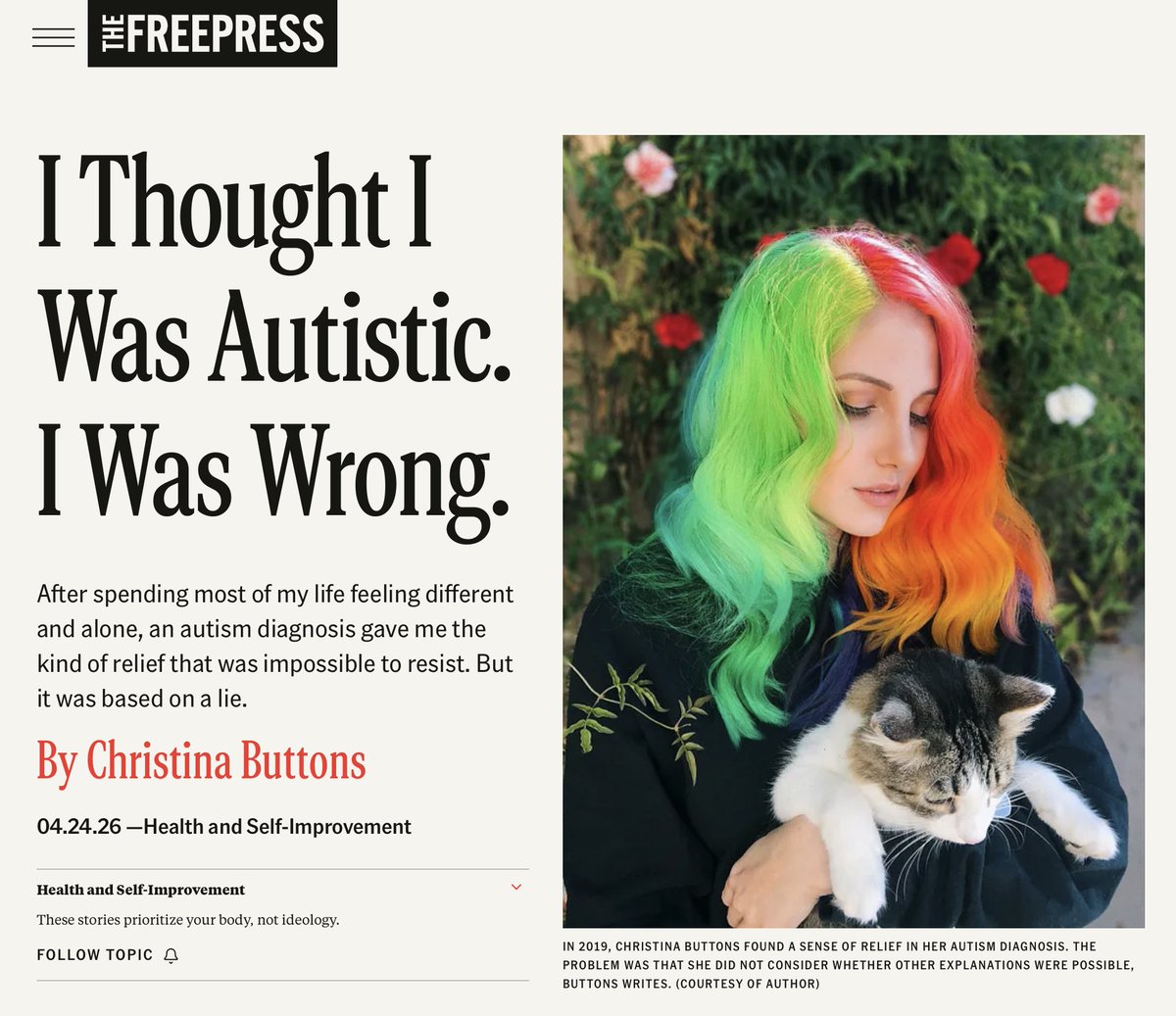
I thought I was autistic. I was wrong.
I was 30 in 2019 when stories of women discovering they were autistic all along began appearing everywhere.
They popularized a newer understanding of autism, with its own “female presentation.” It was framed as a scientific correction to a historical wrong against women, the kind of narrative the press finds irresistible.
Like so many women, I felt immense relief when I was formally diagnosed. It offered an explanation for the mental health crises of my youth and the daily realities of my adult life.
Then I spent a year in the online autism community. What I saw there, especially the way activists treated parents of severely impaired children, turned me into a critic of neurodiversity.
But it was becoming a journalist in 2022, after discovering detransitioners’ stories, that forced me to question narratives about identity and diagnosis, including my own. Journalism also required the social skills autism says I should have lacked.
From there, the rest unraveled: many traits I had come to associate with autism are not uncommon in the general population, but through the “female autism” framework, they looked like a meaningful pattern.
I don’t think my story is unique. The same incentives that kept my diagnosis intact may also help explain why so many women are entering the autism category in adulthood.
Read my first article for @thefp: https://t.co/MBx7VHg8GX
@choco_strawbs@hollowearthterf@p8stie Actually a very common thought
The amount of times I’ve met people at parties and heard “no but where are you really from? Like before you moved here.” when asked where I’m from :’)
Well, if you’re referring to lace front wigs the history of them in Los Angeles comes comes from the many beauty supply stores opened by Korean-Americans in black communities in the 1960s.
The beauty standard in America was very much stacked against black women, and wigs became one of the main forms of assimilation.
Fitting society’s standards = better opportunities in life (not specifically relating to marriage, career and society in general)
And in modern times, wigs evolved to be less about survival and more about fashion and trends being popularized by pop culture and female rappers
It’s not the standard overall for black girls, it’s just the standard for women who are interested in that subset of pop culture
It’s just the same with how there’s women who make getting their nails done a non-negotiable vs. women who don’t care.
Or women who always get their blonde roots touched up vs. women who keep their natural hair color
It’s not necessarily that men prefer it (men do not gaf about nails), it’s just the standard of living a women chooses to engage in
Very untrue.
Black women with white husbands are just less likely to be in social circles with other black women.
Wigs are very intertwined with black girl culture, and so women amidst that subculture are more likely to keep up with those social expectations.
Just like why a girl like Alabama Barker who’s interested in hip hop / black pop culture wears lace fronts regularly.
It’s way more about other black women and performing a specific type of black femininity than it is about black men, who honestly don’t really care what kind of hairstyle a girl has.
I think I’m addicted to Unity Asset Store
Everyday, I check for new releases to buy
Can never have too many asset packs, there’s a shortage of quality cuteness
Day 1 of documenting my game development process 💫
I’ve been working on it for ~7/8 months, and no clue when it’ll be finished so might as well keep track of my progress
Here’s what I did yesterday:
- Designed a few prototypes for the mascot character that will guide users through the app, had fun with Daniel Zeller’s Fluffy Grooming Tool in Unity
- Created a draft of the gacha scene that will let users exchange wish tickets for a random loot present
- Integrated a previously designed level into my new cleaner level completion and progress tracking architecture, reworked the lighting and materials of the scene, integrated with my player spawning setup
- Added level collections vs. just chapter levels to my level database architecture. Previously, I only had chapter levels, which are the main puzzle levels with storyline. These Chapter levels all have unique game mechanics, and it was always my plan to use the game mechanics from these to make mini games. To make the game progression cleaner, I’m putting these mini games into level collections that are unlocked by completing previous chapters
Example flow:
Ch. 1 -> Ch.2 -> Ch.3 -> Levels 1-9 -> Ch.4 -> Levels 10-18
Chapters get their own page and level collections are on the same page in a 3x3 grid.
- Before sleep, I began the process of taking one of the mechanics (a fridge item swap puzzle) from one of my completed chapters and reworking the logic and scripts into a standalone mini game with varying difficulty
Probably will end up making ~9 levels out of that one mini game mechanic
Each of my chapter levels have probably 3-5 different mechanics that can be made into their own minigames
———-
Today, I will start by finishing up the fridge item swap puzzle mechanics I started reworking last night
Stay tuned ⭐️
As a mobile app, I suggest a token cost instead of displaying the exact price per generation.
If you’re going to be on the Apple Store, it’s a lot cleaner to charge $X.99 for 100 generation tokens than to display the individual exact dollar cost of each model, which can’t be billed cleanly
It’s been 19 days and 20 hrs since I last felt Kate’s warm embrace. She landed 47 minutes ago. The 24 hours of travel no doubt has her rushing to shower. She needs to cleanse herself of a dirtied world incompatible with her sensibilities. The wash doubles as a ritual, preparatory for entrance into the symbolic world we’ve constructed.
The time apart has been costly. My body’s electrical signaling betrays the separation. Without her touch, my vagus nerve’s 100,000 myelinated fibers have dropped their high frequency spectral power, squawking distress. An intelligent system broadcasting diminished wave forms, hoping to be heard. There are other signals of distress.
My white blood cells have shifted their gene expression, upregulating pro-inflammatory genes IL-6 and TNF-alpha and downregulating my antiviral genes. A pro-aging biochemical signature of a system suffering hardship.
My environment is a pristine anti-aging laboratory. Air, water, food and light are meticulously measured. Toxins are filtered. Purification systems run autonomously. Biomarkers tracked. Nutrition is calibrated.
Yet outside my control is the affection of another. The 68 trillion cells that constitute Bryan Johnson run non-negotiable code. They demand tenderness, and not of a whimsical type, but deep, all-encompassing love that must be earned and carefully maintained. Otherwise they protest in self-termination.
She’s now only 13 miles away and I can viscerally feel her essence. The transmission pulses in high fidelity. As if there were a fiber optic cable streaming our connection at light speed through the multiplexed cylinders of glass. The time apart created latency, buffering the connection, depriving us of the luminescence and dimming into noise.
In 15 minutes she will be within reach. I can visualize the whites of her eyes and smell her aroma. When she arrives, she will be shy. Whenever we are apart, she returns to zero. Her previous openness will be closed. Her emotional dynamic range will be held in reserve until she feels she is safe and can trust. I’ll need to kindle her again. The rush of the courtship enthralls me.
The anticipation drives a small cluster of my midbrain neurons to flood dopamine. Nerve fibers activate, lighting up my skin’s receptors as it awaits for slow, caressing touch. My hypothalamus begins synthesizing oxytocin, preparing to dump it upon first eye contact to ensure the reestablishment of our pair bond. This biochemical orchestra fills me with delight and sensorial want.
Kate’s been mulling over what she’ll wear for days. She’s considered dozens of possibilities and modeled out my anticipated emotional state, the weather, and our planned activities. The colors will be representative of her psychological state and be positioned to soothe mine. The texture, style, and hues will interplay with our biology. The deliberately chosen accessories will add flair, intrigue and play. This is how she flirts, seduces and bypasses my mind to speak directly to my physiology. She has other tricks too.
She’s arrived. I must wait for her. Her timidness will want to determine the cadence. I hear the door crack open and her bag drop to the floor. She’s nervous. I’m on the couch, neutral and open. She rounds the corner and our eyes meet. The inhibitions wither as the magnetism draws us together. Soft hellos are whispered and our bodies interdigitate.
I feel her finger tips on the back of my neck. Goose bumps light up my body. Skin nerve cells fire signals directly to my brain, bypassing the analytical mind. The hypothalamus dumps the oxytocin, inhibiting fear and lowering cortisol. The body washes itself in this anti-inflammatory chain reaction. Our respiration and heart beats are now synchronizing. The brain piles on with a release of endorphins to soothe the psychological pain of our separation. New powers are now in control. Let them run in glory.
I press my cheek against hers. The skin on skin triggers a wave of desire. I brush her lips with mine, catalyzing a massive activation of neurons in her brain, overwhelming thought and forcing presence.
She relents and wants to dance. She’s home.
I slip my hand under her shirt and brush the small of her back. Goosebumps spread like a wildfire across her body. Her hypothalamus stimulates the release of GnRH which tells the pituitary gland to wake up her reproductive system. Our olfactory systems consume each other with delight, signaling immune system compatibility.
I move both my hands to her jawline, holding her head firmly in place. Our mirror neurons speak to each other. I know what she wants. My lips press against hers and I softly bite her lower lip. Kate’s blood vessels dilate from the acetylcholine and nitric oxide release, flushing her lips, skin and body. The cascade is nearing waterfall.
The executive control of our brains surrenders. No longer concerned with the 68 trillion cells. The prefrontal cortex goes dark. Eliminating future planning and probabilistic modeling. Activity in our parietal lobes diminishes, dissolving the boundary that distinguishes between self and other. No longer is there Kate and Bryan, just a singular biological entity suspended in a state of bliss. The outside world goes quiet. It doesn’t exist. We dissolve into raw existence.