"No le des prioridad a tu apariencia, ya que no durará todo el viaje. Sin embargo, tu sentido del humor sólo mejorará con la edad, tu intuición crecerá y se expandirá como un majestuoso manto de sabiduría. Tu habilidad para elegir tus batallas se ajustará a la perfección, tu capacidad para la quietud y para vivir el momento, florecerá. Tu deseo de vivir todos y cada uno de los momentos superará a todos los demás. Tu instinto para saber qué y quién vale la pena, crecerá como la hiedra en la pared de un castillo.
No le des prioridad a tu apariencia, cambiará para siempre. Prioriza la singularidad que nos convierte en nosotros, y el imán invisible que atrae a otras almas de ideas afines para bailar en su órbita. Estas son las cosas que sólo mejorarán".
Judi Dench 🇬🇧
En novembre 2019, Keanu Reeves est apparu sur le tapis rouge du gala Art + Film du LACMA en tenant la main d’une femme. En quelques heures, Internet s’est enflammé.
Des inconnus sur les réseaux sociaux ont commencé à la juger, la qualifiant de « trop vieille » pour lui et critiquant son apparence à partir de quelques photographies.
Alexandra Grant avait alors quarante-six ans. Keanu en avait cinquante-cinq. Depuis près de dix ans déjà, ils construisaient discrètement une relation loin des caméras et des gros titres. Mais rien de cela ne semblait compter aux yeux du public.
Ce soir-là, le couple n’a fait aucune annonce spectaculaire. Il n’y a eu ni interview exclusive ni révélation soigneusement orchestrée. Ils se sont simplement tenus la main, comme n’importe quel couple. Pourtant, les critiques visant l’apparence d’Alexandra ont immédiatement afflué.
Elle avait les cheveux naturellement gris et avait cessé de les teindre depuis plusieurs années.
Grande, artiste et discrète, elle ne ressemblait en rien au stéréotype hollywoodien lisse et excessivement retouché que beaucoup s’attendaient à voir aux côtés d’une star mondiale.
Les commentaires ont envahi les réseaux sociaux : pourquoi Keanu ne fréquentait-il pas une femme plus jeune, plus jolie ou plus glamour ? Certains l’ont même prise pour sa mère. Cette cruauté paraissait absurde, surtout au regard du double standard qui règne à Hollywood. Dans l’industrie du divertissement, les célébrités masculines vieillissantes sortent régulièrement avec des femmes de plusieurs décennies plus jeunes sans que personne n’y trouve à redire.
Mais Keanu Reeves avait fait un autre choix.
Il avait choisi quelque chose de vrai.
Leur histoire avait en réalité commencé bien avant leur première apparition ensemble sur un tapis rouge. Ils s’étaient rencontrés lors d’un dîner en 2009. Keanu était déjà mondialement célèbre grâce à des films à succès comme Matrix, Speed et Point Break.
Alexandra, de son côté, construisait une carrière respectée dans le monde de l’art à Los Angeles, créant des œuvres originales centrées sur le langage et la narration visuelle.
Leur lien s’est tissé dans la discrétion. En 2011, ils ont collaboré à un petit ouvrage artistique écrit par Keanu, intitulé Ode to Happiness. Alexandra en a réalisé les illustrations, au départ comme un cadeau personnel. Des amis les ont finalement encouragés à le publier.
Ils ont tellement apprécié cette expérience qu’ils ont continué à créer ensemble.
Un second livre a suivi, puis ils ont fondé ensemble une petite maison d’édition en 2017. Il s’agissait de projets réfléchis, profondément personnels, construits patiemment au fil des années, totalement indépendants des cycles de promotion hollywoodiens.
Pendant tout ce temps, ils sont restés très discrets. Ainsi, lorsqu’ils ont finalement été vus main dans la main sur ce tapis rouge en 2019, leur histoire n’était pas une nouvelle romance. C’était simplement une relation qu’ils ne ressentaient plus le besoin de cacher.
La vague de réactions négatives sur Internet a surpris Alexandra, mais elle ne l’a pas changée. Plus tard, lorsqu’on lui a demandé pourquoi ses cheveux gris étaient devenus un sujet d’obsession publique, elle a répondu calmement qu’elle avait cessé de les teindre parce qu’elle ne souhaitait plus utiliser ces produits chimiques.
Pour elle, la beauté doit offrir de la liberté et du choix, non imposer des contraintes.
Elle a rappelé qu’il existe des milliards d’êtres humains sur cette planète et que ce qui comptait le plus pour elle était sa propre liberté de décision, non l’approbation d’inconnus.
Cette philosophie définit leur relation.
Alexandra avait construit son identité et sa carrière bien avant que l’amour n’entre dans sa vie. Keanu, malgré des décennies d’une célébrité écrasante, a choisi une relation fondée sur l’authenticité plutôt que sur l’apparence.
Lorsqu’on lui a demandé quel avait été son moment le plus heureux récemment, il n’a parlé ni de films, ni d’argent, ni de succès.
Il a simplement évoqué le fait d’être allongé dans son lit avec Alexandra, en train de rire avec elle.
La véritable histoire n’a rien à voir avec la célébrité, l’apparence ou l’approbation du public.
Elle parle de deux personnes mûres qui ont trouvé la paix l’une auprès de l’autre et qui refusent de s’excuser pour la manière dont leur amour se présente.
Nous vivons dans une culture obsédée par la jeunesse et la perfection superficielle. Nous applaudissons les hommes qui vieillissent « comme un grand cru », mais nous attendons des femmes qui les accompagnent qu’elles aient éternellement trente ans.
Si la vue d’une belle femme de quarante-six ans, naturelle et épanouie, tenant la main d’une superstar vous met mal à l’aise, le problème n’est pas son visage.
Le problème réside dans votre définition de l’amour.
Pourquoi avons-nous si peur de voir un homme célèbre choisir une femme pour son intelligence, son âme et le partenariat qu’elle lui offre, plutôt que de la considérer comme un simple trophée destiné à flatter son ego ?
Laura Failner, a flight attendant with SkyWest Airlines, witnessed a beautiful act of kindness on July 7th—one she’ll never forget.
"I love seeing the good in the world," she shared. "Today, on my flight to Washington, a sweet 94-year-old woman boarded. She was frail and had trouble making her way to her seat. There was some confusion about where she was supposed to sit."
That’s when a man seated in first class noticed her struggling and called Laura over.
He gently said, “Can you please bring her to my seat? I’ll take hers.”
He got up, walked with Laura to help the woman, and personally guided her to his seat in first class. Touched by his gesture, the elderly woman gave him a warm hug and said,
“In my 94 years, no one has ever done this for me. Thank you, young man.”
Tears welled up in her eyes as she spoke.
That one selfless act changed the entire mood of the flight—it reminded everyone onboard of the power of kindness.
Let’s all strive to do the same. In a world that can feel overwhelming, let’s choose to be the good. ✈️❤️
GOYA PINTÓ A LOS INFLUENCERS MÉDICOS.
Charlatanes. Sacamuelas. Buhoneros.
— ¡Pasen y vean!
Subían a una tarima en la plaza. Un ayudante tocaba el tambor para traer gente.
Vendían Dios sabe qué contra todos los venenos. Aceites milagrosos.
Goya los caricaturizó en los Caprichos. El Protomedicato intentó regularlos (pero fracasó). Porque la plaza siempre pagó mejor.
Pero encima es que se copiaban entre sí.
Si uno acertaba con un brebaje, en días todos vendían el mismo. Si uno inventaba un pregón con rima, todos rimaban. La plaza era un mercado de imitadores.
¿Te suena? Hoy abro el móvil y todos hablan de lo mismo. La semana pasada, la ducha antes de dormir. La anterior, proteína contra creatina. Esta semana toca, no sé dormir del lado derecho. ¿De verdad eso es lo mejor que podemos ofrecer a la población? ¿Eso mejora la salud de alguien?
Cambia el escenario, cambia la tarima. La plaza es un algoritmo. El brebaje viene en bote de plástico con código de descuento.
Pero el sacamuelas es el mismo.
No sé qué es más triste. Si quien juega a ser médico sin serlo, o los médicos que juegan a copiar vídeos de >1 mill.
Pensaré en los Caprichos de Goya. El charlatán está en el centro. Pero al fondo siempre hay alguien mirándolo con cara de pena. ¿Seré yo ese alguien?
#LaTraumatologaGeek
Este sitio tiene 16.000 personas conectadas a la vez haciéndose pasar por ChatGPT para no tener que usarlo.
Toda tecnología nueva tiene su resaca. La de la IA ya arrancó.
La web se llama, traducido, "tu basura de IA me aburre". La armó un programador y explotó a 50 millones de visitas en una semana. Escribís o dibujás lo que necesitás, pero adentro no hay ningún modelo: te contesta otra persona al azar que se hace pasar por la máquina. Tiene 75 segundos para responder pero, si querés una respuesta más trabajada, activás "modo pensamiento" y al humano del otro lado le dan el doble de tiempo.
Es un fenómeno muy particular porque, aprovechando el anonimato, mucha gente hace consultas personales y, del otro lado, un montón de desconocidos con ganas de ayudar gratis. Sin perfil, sin reputación, sin estrellitas, sin ganar nada más que el crédito para preguntar ellos. Por una vez en internet, nadie te está vendiendo nada.
Con la euforia de pedirle absolutamente todo a la IA, lo que falta a veces es tener a alguien del otro lado.
Ese internet viejo, el de los foros y los desconocidos ayudándose porque sí.
-Einstein le dijo a Chaplin: "Lo que más admiro de tu arte es su universalidad. No dices ni una palabra y, sin embargo, ¡el mundo te entiende!".
"Es cierto", respondió Chaplin. "Pero tu fama es aún mayor: el mundo te admira, aunque nadie entienda lo que dices".
—Albert Einstein y Charlie Chaplin, 1931.
One Wednesday afternoon, I was driving west on I-40 when my blood sugar dropped very low and became dangerous. Luckily, there was a Burger King coming up at the next exit.
When I was ordering, I told the person on the speaker that I was diabetic and needed food fast. Low blood sugar makes it hard to think or act clearly.
When I got to the first window to pay, I was surprised to see a Burger King worker named Tina Hardy running toward my car.
She squeezed between the front of my car and the building just to bring me a small cup of ice cream. Tina later said her husband was diabetic too, so she knew I needed help.
After I paid, I went to Tina’s window and she gave me my food. She told me to park across the driveway so she could watch me until I felt better.
After I ate, I waited for a quiet moment and then went back to Tina’s window. I took a picture and told her boss what she had done for me.
If you think Tina Hardy did something special, please share this story. I hope Tina gets the thanks she truly deserves from the public and from Burger King’s managers.
Credit: Rebecca Boening
Credit always goes to the original author!
Estuve viviendo en la calle durante cuatro meses.
Tenía trabajo.
Me duchaba donde podía.
Guardaba mi ropa limpia en una mochila.
Y por la noche dormía en un cajero automático cerrado, en una calle pequeña donde pensaba que nadie me veía.
Una madrugada hizo muchísimo frío.
De ese frío que no te deja dormir.
Tenía las manos dormidas y los dientes me temblaban.
A las cinco, el panadero de enfrente encendió la luz.
Me vio.
Yo bajé la mirada.
Pensé que iba a echarme.
Pero no dijo nada.
Entró en la panadería.
Unos minutos después salió con una bolsa de papel y un café caliente.
Los dejó junto a la puerta y dijo:
“Se me ha hecho pan de más.”
Y volvió dentro.
Al día siguiente hizo lo mismo.
Y al otro.
Y al otro.
Durante todo aquel invierno, cada mañana había una bolsa caliente esperándome.
Nunca me preguntó mi nombre.
Nunca me pidió explicaciones.
Nunca me hizo sentir menos.
Solo ayudó.
Años después recuperé mi vida.
Tengo casa.
Tengo cama.
Tengo calefacción.
Pero cada diciembre vuelvo a esa panadería y dejo pagados varios desayunos para quien los necesite.
En la nota solo escribo:
“Para alguien que tenga frío.”
A veces la bondad más grande no hace preguntas.
Solo deja una puerta abierta.
O una bolsa caliente.
Y permite que alguien conserve su dignidad.
Un amigo del cole me escribe tras 30 años. Le van a operar de gravedad, no sabe si va a salir y lamenta cómo se portó conmigo cuando éramos niños. Pero todo sale bien. Retomamos contacto. La alegría que tengo no la había vivido en mucho tiempo. La vida es esto, dejaos de tontás.
*En clases de español para extranjeros.*
YO: Y díganme, ¿por qué quieren aprender español?
ALUMNA JAPONESA 🇯🇵: Mi empresa requiere que lo aprenda para poder trabajar en las sucursales que tenemos aquí.
YO: Oh, eso suena muy interesante.
ALUMNA ESTADOUNIDENSE 🇺🇸: Porque quiero aprender más de mis raíces. Mis padres son mexicanos que residen en Estados Unidos, pero nunca me enseñaron español para que no sufriera bullying en mi barrio.
YO: Lamento que fuera así, pero al aprender español verás que tus raíces son mucho más interesantes de lo que aparentan.
ALUMNO FRANCÉS 🇫🇷: Porque quiero darle una sorpresa a mi esposa mexicana. No se esperará que un día llegue yo hablándole en español. Creo que sería una bonita sorpresa.
YO: Ow, eso es muy tierno de tu parte.
ALUMNO ALEMÁN 🇩🇪: Porque me encantaría aprender más sobre las culturas latinoamericanas. Desde niño me sentí atraído hacia ellas por su manera tan alegre de vivir la vida. Me gustaría convertirme en parte de ellas.
YO: Y no te arrepentirás.
ALUMNO INGLÉS 🏴: Porque quiero ver "Shrek" en español.
*Todos lo miran confundidos.*
ALUMNO INGLÉS 🏴: Dicen que es mucho más chistosa en español latino, y yo soy muy fan de esa película, así que...
*El alumno inglés se encoge de hombros.*
YO: Pero... Debe haber alguna otra razón, ¿no?
ALUMNO 🏴: No. Sólo Shrek.
*Doy un paso hacia adelante y le tiendo mi mano para que la estreche.*
YO: Ese es el propósito más noble que he escuchado en todos mis años de enseñanza de la lengua española. Me comprometo a que aprendas español perfectamente para que puedas cumplir tan puro objetivo.
In 1997, actor John C. McGinley’s son, Max, was born with Down syndrome. Shortly after, John's talent agent pulled him aside to deliver what was framed as practical advice: Do not talk about this publicly. Keep it quiet. People will stop hiring you.
For some, that might have sounded like reasonable career preservation. Protect the livelihood, avoid the spotlight, and pretend nothing had changed.
John’s response was immediate. He fired the agent.
Then, he did the exact opposite of what he had been told. He brought Max everywhere. Red carpets, talk shows, film sets, and public events. Wherever John went, Max was right beside him. At a time when society still largely preferred to keep individuals with developmental disabilities out of sight, John made a different choice. He made his son visible. Openly, proudly, and entirely without apology.
What began as a father's protective instinct grew into decades of fierce advocacy. John became one of the country's most recognizable voices for Down syndrome awareness. He spoke at global conferences, testified before Congress, and fought hard for employment law reforms that created real opportunities for people with disabilities to work, earn, and live independently.
During this journey, a reporter asked John a question that revealed far more about society's biases than it did about Max. The reporter asked if John ever wished his son were normal.
John didn't hesitate. He replied that Max was normal. The question wasn't. It was a blunt rejection of the idea that a person’s worth is measured by how well they fit into a narrow, conventional box.
Decades have passed since that conversation. Max is now 27 years old. He works, navigates his community, and lives an independent life filled with possibilities that the critics in 1997 never could have imagined for him.
Reflecting on their journey, John often says that Max never limited his life. He expanded it. Through his son, he learned what love, patience, and true commitment require.
The world signaled early on that it would have preferred Max to remain hidden in the shadows. John spent nearly three decades ensuring that the world looked Max right in the eye. Some fathers protect their children by shielding them from the world. Others protect them by refusing to let the world look away.
True inclusion begins when we stop treating differences as deficits. Max didn't need to change to fit into the world.
The world needed to change to make room for Max.
There is an old laptop in your closet.
Gathering dust. Dead battery. Slow processor. You keep it because you feel guilty throwing it away.
That laptop can replace every cloud subscription you pay for.
- Netflix
- Google
- Dropbox
- 1Password
That is $42 a month. $504 a year. To rent things you used to own.
The old laptop in your closet could do all of it.
Now meet CasaOS.
A free and open source system that turns any old laptop, Raspberry Pi, or mini PC into your own personal cloud.
You run one command. In 30 minutes, the laptop becomes a server. You open it from your phone, your TV, your work computer, anywhere in the world.
Then you pick the apps you want from a built-in store. One click each.
- Jellyfin to replace Netflix. Stream every movie and show you own.
- Immich to replace Google Photos. Faces and search included.
- Nextcloud to replace Dropbox. Sync every file across every device.
- Vaultwarden to replace 1Password. All your passwords, your keys.
- Syncthing to keep files in sync across every device, no cloud.
- Home Assistant to control every smart device in your home.
- AdGuard to block ads on every device on your wifi.
Setting up a home server the old way took an entire weekend. Install Linux. Learn Docker. Write config files. Set up storage. Fix errors. Look up every app one by one.
CasaOS does all of that for you. No code. No config files. No Linux skills. You see icons on a screen. You click them.
34,116 stars on GitHub. Apache 2.0. Free forever.
Built by a small team starting September 2021. Runs on Raspberry Pi, Intel NUC, old laptops, and most home servers. Over 100,000 Docker apps can be installed.
A new Raspberry Pi costs $50. The old laptop in your closet costs $0. It already works. It is already in your house.
Netflix charges every month. CasaOS doesn't.
Google charges every month. CasaOS doesn't.
Dropbox charges every month. CasaOS doesn't.
1Password charges every month. CasaOS doesn't.
Here is the wild part.
The laptop you forgot about is more powerful than the web server that ran most websites in 2008.
It is sitting in a drawer. It costs you nothing. It already works.
One command. Thirty minutes. Five hundred dollars a year back in your pocket.
Your files. Your photos. Your movies. Your home.
Your closet just became a data center.
“We have come as far as we have because we are the cleverest creatures to have ever lived on Earth. But if we are to continue to exist, we will require more than intelligence. We will require wisdom.”
— Sir David Attenborough
RULES FOR SONS:
1. Never shake a man’s hand sitting down.
2. Don’t enter a pool by the stairs.
3. The man at the BBQ Grill is the closest thing to a king.
4. In a negotiation, never make the first offer.
5. Request the late check-out.
6. When entrusted with a secret, keep it.
7. Hold your heroes to a higher standard.
8. Return a borrowed car with a full tank of gas.
9. Play with passion or not at all…
10. When shaking hands, grip firmly and look them in the eye.
11. Don’t let a wishbone grow where a backbone should be.
12. If you need music on the beach, you’re missing the point.
13. Carry two handkerchiefs. The one in your back pocket is for you. The one in your breast pocket is for her.
14. You marry the girl, you marry her family.
15. Be like a duck. Remain calm on the surface and paddle like crazy underneath.
16. Experience the serenity of traveling alone.
17. Never be afraid to ask out the best looking girl in the room.
18. Never turn down a breath mint.
19. A sport coat is worth 1000 words.
20. Try writing your own eulogy. Never stop revising.
21. Thank a veteran. Then make it up to him.
22. Eat lunch with the new kid.
23. After writing an angry email, read it carefully. Then delete it.
24. Ask your mom to play. She won’t let you win.
25. Manners maketh the man.
26. Give credit. Take the blame.
27. Stand up to Bullies. Protect those bullied.
28. Write down your dreams.
29. Always protect your siblings (and teammates).
30. Be confident and humble at the same time.
31. Call and visit your parents often. They miss you.
32. The healthiest relationships are those where you’re a team; where you respect, protect, and stand up for each other.
Happy Father’s Day
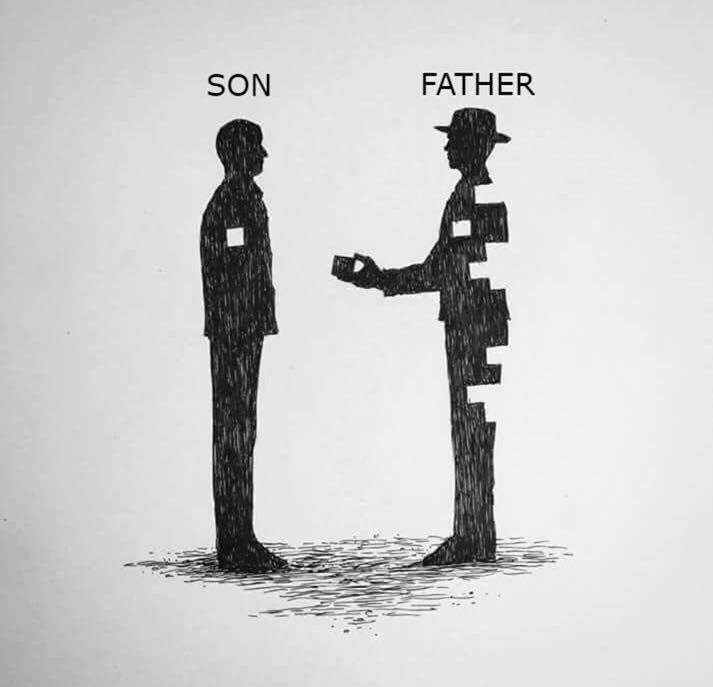
Age 5 – Dad knows everything!
Age 7 – Dad knows a lot.
Age 10 – Maybe Dad doesn’t know everything?
Age 12 – Dad doesn’t know anything.
Age 14 – Dad lost his mind!
Age 16 – I can’t take Dad seriously.
Age 18 – What does Dad even know?
Age 22 – Dad talks nonsense!
Age 24 – I know more than Dad!
Age 26 – Turns out, Dad actually knows a few things.
Age 30 – I should probably ask Dad about this…
Age 40 – How did Dad make it through all of that?!
Age 45 – Dad was always right.
Age 50 – If only Dad were here… I’d have so much to learn.