Excited to show off our NSF-funded Thematic Collections Network to assess the systematics and conservation status of Pacific Island Land Snails. Six institutions across the US are invested and ready to make this happen! https://t.co/0HJBjDQkdC
For the Year of the Kāhuli, we will be posting Hawaiian land snail species profiles, both native and introduced species. These species profile cards are designed by
@andhuangforall! More Kāhuli activities and announcements to come!
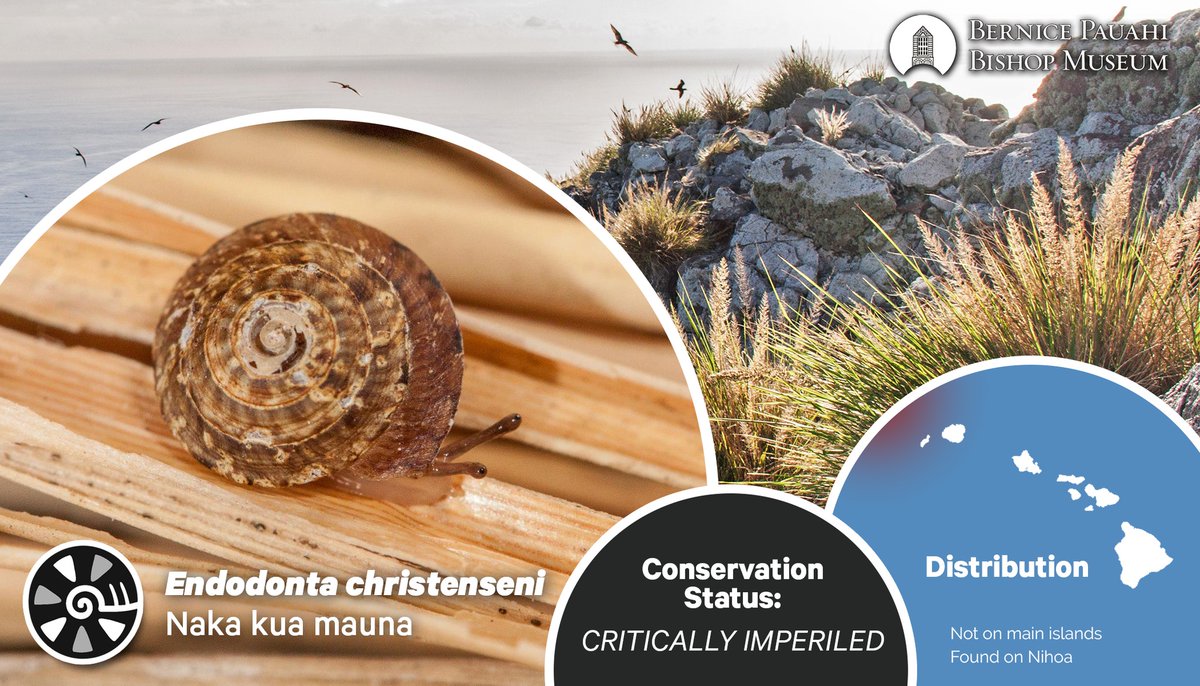
Endodonta christenseni, the last extant species of an endemic Hawaiian genus. Discovered in 1923 by researchers on the island of Nihoa, it remained unnamed for nearly a century.
For the Year of the Kāhuli, we will be posting Hawaiian land snail species profiles, both native and introduced species. These species profile cards are designed by @andhuangforall ! More Kāhuli activities and announcements to come!
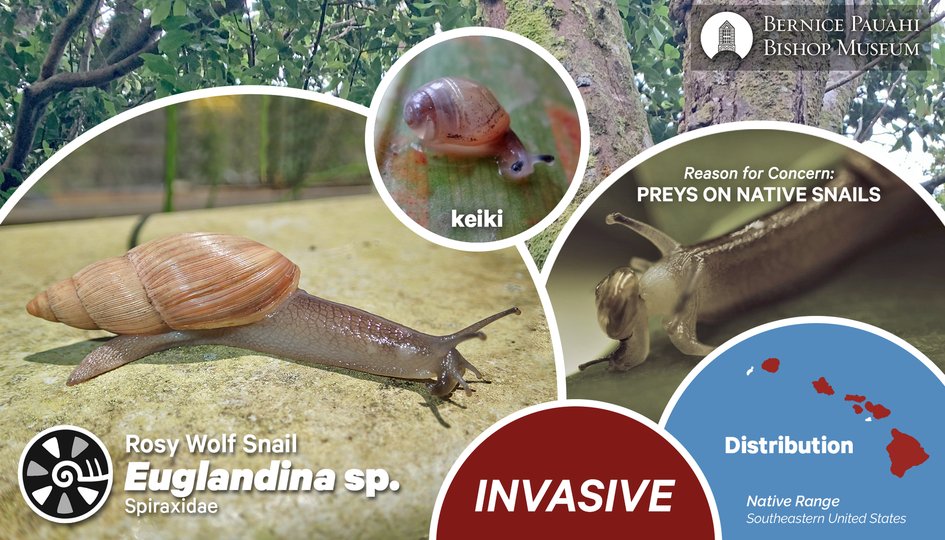
Euglandina rosea, a carnivorous snail, was introduced from Florida as a biocontrol for the giant African snail, Lissachatina fulica. Not only did it fail to reduce L. fulica populations, it has been implicated as a major factor in the extinction of Hawaiʻi's native land snails.
There are currently no control methods for Euglandina rosea or Lissachatina fulica that would not negatively impact the highly threatened Hawaiian land snail fauna.
For the Year of the Kāhuli, we will be posting Hawaiian land snail species profiles, both native and introduced species. These species profile cards are designed by one of our interns, @andhuangforall! More Kāhuli activities and announcements to come!
Succineids have a global distribution primarily in damp areas close to fresh water, but a few inhabit vegetated patches in dry areas. However, Hawaiian succineids (42 endemic species) were once found from xeric coastal dunes to high elevation rainforests.
There are several endearing and affectionate names for succineids like 'chonks', 'chonky boi's or 'snot in a hat' since the snail is not able to fully retract into its shell and usually has parts of its body exposed. Chonks-coined by @ChandraEarl are her favorite Hawaiian snails
For the Year of the Kāhuli, we are posting Hawaiian land snail species profiles, both native and introduced species. These species profile cards are designed by one of our interns, @andhuangforall! More Kāhuli activities and announcements to come!
Kaala subrutila belongs to the family Euconulidae. This species is endemic to the island of Oahu, specifically Mt. Kaala, the highest point on the island. Name after Kaala, this is a monotypic species not recorded for about 50 years and was rediscovered in 2008.
Several additional populations of this ground-dwelling species have been found since then. The beautiful gold speckles you see comes from the body as the shell is translucent.
Endemic to the Waianae Mountains of Oahu, this species was extinct in the wild and only living in Bishop Museum's captive rearing program led by Dr. Daniel Chung. This species was recently re-introduced into predator-proof exclosures in the forests by our colleagues from @dlnr.
To start off the Year of the Kāhuli, we will be posting Hawaiian land snail species profiles, both native and introduced species. These species profile cards are designed by one of our interns, @andhuangforall! More Kāhuli activities and announcements to come!
For our first post, we have Amastra micans. This species belongs to the Amastridae family- the only extant endemic family left in Hawaii that once had 325 described species. Unfortunately, less than 25 species are known to be extant with Amastra micans being one of these species.