@DRM58328434@Trotes936897 They will be automated soon enough and won't need a signal from anywhere.
e.g., fly to this area, find a heat source larger than X and attack.
Swarms will then be used as well. For the price of ONE ten million dollar tank, an awful lot of cheap drones can be made.
@Tatarigami_UA Suppressing the only legal anti-war option says more than any Kremlin press release:
A government confident in public support doesn’t fear letting dissent be counted.
Earthset.
The Artemis II crew captured this view of an Earthset on April 6, 2026, as they flew around the Moon. The image is reminiscent of the iconic Earthrise image taken by astronaut Bill Anders 58 years earlier as the Apollo 8 crew flew around the Moon.
@ruutoo59315971@HLC_actual Fascinating question and answers, I'm definitely bookmarking this.
And yes, that would have been possible, US would have incentive to focus on Europe
But likely would have ultimately only delayed the war and then it would have been even more deadly/tragic
@intermarium24 A bunch of people that love conspiracy theories are suddenly looking at the sky and noticing for the first time how many small planes there are flying around (with lights on at night)... Except they think they are drones/,UFOs.
🇺🇸🇺🇦 "Aid to Ukraine" is really an investment in American manufacturing.
$51.2 billion has gone into the US defense industrial base to date. Once all funds are obligated, it will be over $60 billion.
Top recipient states:
1. Arkansas - $4.25 billion
2. Alabama - $3.31 billion
3. Pennsylvania - $2.83 billion
4. Arizona - $2.72 billion
5. Texas - $2.04 billion
6. West Virginia - $1.98 billion
7. California - $1.96 billion
8. Florida - $1.59 billion
9. Missouri - $968 million
10. New York - $943 million
Note that not all contracts and investments are reflected on the map, so it won't match the total obligations. Only prime contractors and select key subcontractors are mapped. The defense industrial supply chain stretches into all 50 states, and many states are underrepresented due to the nature of the weapon systems provided to Ukraine (e.g. no aircraft =very little for South Carolina & Washington).
If your state isn't highlighted that doesn't mean that there are no funds from the Ukraine Supplementals flowing into your state.
@veaulans@DKThomp@jreich511@redsteeze I think you make some good points and are onto one of the key aspects, namely that each side interprets differently.
They both watch the same thing, but both 'hear' completely different things... For practical purposes they are both living in their own reality.
@Shayan86 The same thing happens on the other side.
It is cognitive dissonance, the brain quickly accepts (without question) information that confirms with their existing beliefs.
Conversely, a person instantly questions or dismisses (fake news) anything that goes against ones beliefs.
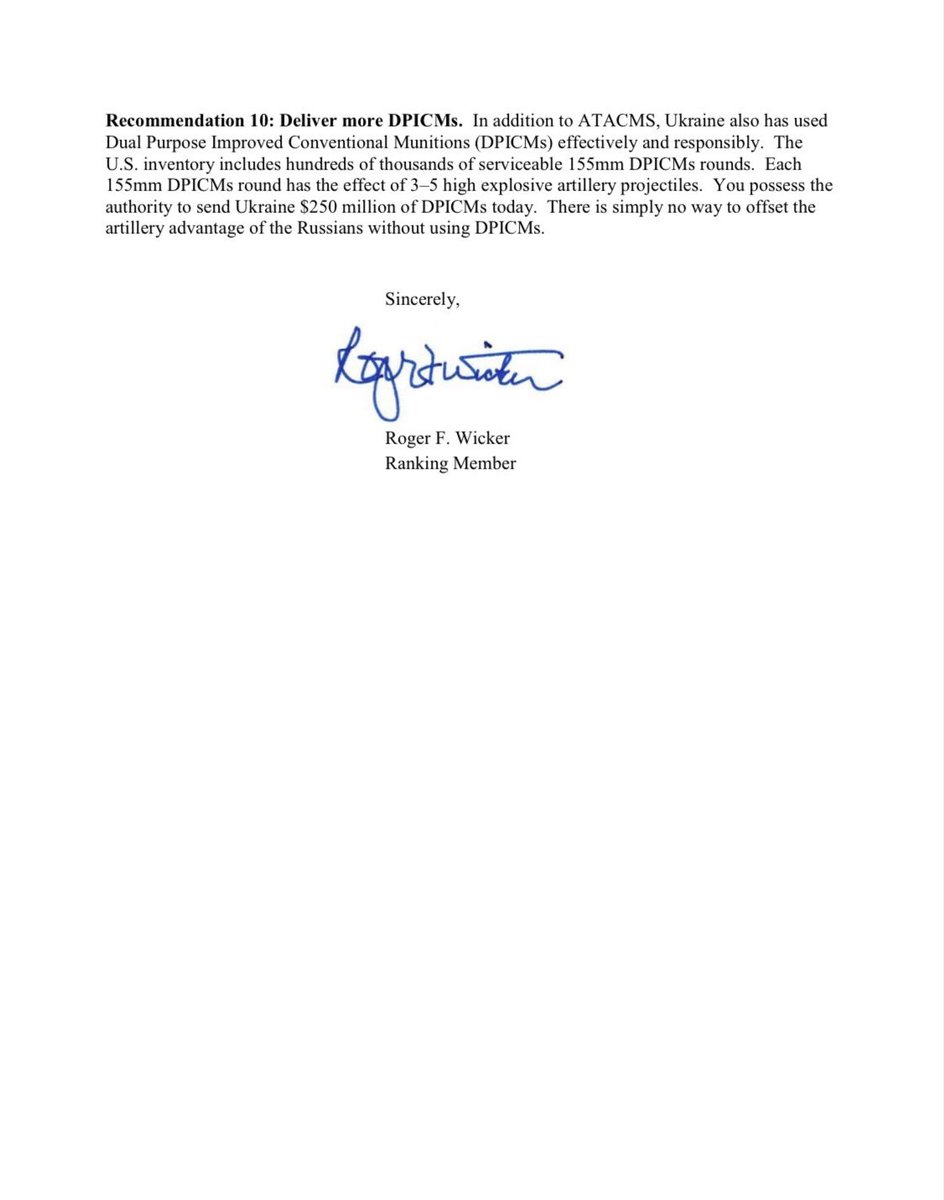
I talked to President Biden.
In the last 90 days of his term, he needs to exercise his responsibilities as commander-in-chief and give Ukraine the weapons it needs to make a “substantial difference” on the battlefield.
I shared my recommendations:
President Zelensky has released his plan for victory, which has been met with varying degrees of acceptance. Regardless of differing opinions, we now have a clearer picture of what the President is aiming for.
I don't intend to criticize his plan - after all, it offers some viable options that could benefit Ukraine if implemented. However, given my own skepticism about the West's willingness to admit Ukraine into NATO, I’ve been considering my own "roadmap," which I’d like to share here. This is not intended as a critique of the current plan by our leader, but rather a personal take offered for entertainment purposes:
The core of the strategy should focus on achieving superiority in several key areas: industrial, technological, command structure, and troop morale. The goal is to make the war increasingly unviable and futile for Russia, thereby forcing an end to the war on terms favorable to Ukraine and its partners. At the very least, this should put Ukraine in a position to negotiate with Russia on equal terms when the time comes.
A key step toward this is the creation of a joint military-industrial complex, integrating Ukraine into the West not as a dependent neighbor seeking aid, but as a critical player in Europe’s military production and technology sectors. Specifically, Ukraine could become a hub for military production, especially in areas like unmanned vehicles, which are becoming increasingly vital in global defense, particularly for Europe, whose military-industrial base remains somewhat dormant.
Let's take a look at it more specifically:
External policies:
1. Defense Production Agreements
Ukraine, alongside European nations, the U.S., and potentially Canada, Japan, South Korea, and Australia, should create a series of bilateral defense production agreements. These agreements would establish joint military production facilities for various arms and munitions, from IFVs (Infantry Fighting Vehicles) to drones, missiles, mortars, and artillery ammunition. The construction of these facilities could be financed on credit, with the expectation that frozen Russian assets or future profits from arms sales would pay off the debt. Placing these facilities in Europe would boost local employment and stimulate regional production, with a percentage of output allocated to the host countries.
2. Missile Production Joint Venture
Ukraine’s Pivdenmash plant was a critical hub in the Soviet missile program, producing everything from tactical to intercontinental ballistic missiles. A joint venture between Ukraine and a country like France or the UK would enable faster development and larger-scale production of Ukrainian missiles. Final assembly could occur within Ukraine, and the missiles’ performance could be tested against common Russian defense systems like the S-300 and S-400, giving them market value.
This would also allow Ukraine to strike targets inside Russia without needing permission from other nations, as the missiles would be domestically produced. If Iran can manufacture hundreds of ballistic missiles, so can Ukraine with the right partnerships.
3. Echeloned Defense Construction
Ukraine should launch a national program to construct high-quality defensive positions, drawing on real battlefield expertise rather than arbitrary lines on a map, which has led to wasteful efforts near areas like Pokrovsk and Kharkiv. This could involve both domestic equipment and machinery leased from the EU, with costs partially covered by Ukraine and the remainder distributed among Western partners.
Japan, which may be hesitant to provide direct military aid but leads in construction machinery, could participate by leasing equipment to Ukraine. A model where Ukraine pays 50% on credit and the rest is covered by Japanese foreign aid could be workable, or at least can be a subject of negotiations between countries.
4. Re-arming Existing Brigades
The Ukrainian General Staff has been horrible in forming new brigades, many of which underperform despite receiving new weapons. Simply handing modern weapons to an inexperienced, uncohesive unit doesn’t work. Aid should be conditional, directed to re-arming existing brigades rather than creating new ones. It’s reached a point where some mechanized brigades only have a handful of functional tanks and IFVs, with the rest even using civilian vehicles due to equipment shortages.
5. Interim Military Aid
While Ukraine builds its defense production capacity with the West, it should receive increased short-term aid in the form of artillery, IFVs, mortars, and air-defense systems. Scaling up local initiatives, such as the drone-based air-defense system, like the one led by Ukrainian activist Sternenko, can help shoot down Russian reconnaissance drones more cost-effectively. This isn’t about liberating Crimea right away but maintaining a solid defense while other strategic objectives are pursued.
Internal policies:
1. De-Sovietization of the Military
Ukraine must overhaul its military’s command and control system, moving away from the Soviet-style top-down hierarchy that stifles initiative. While NATO is also bureaucratic, an external audit could streamline many of Ukraine’s military processes, allowing for more decentralized and responsive decision-making. The practice of high-ranking officials personally directing tactical battlefield operations should end.
2. New Mobilization and Rotation Plan
A new mobilization approach is needed, with planned troop rotations and the ability for soldiers to leave after one year of service. While an immediate mass release isn’t feasible, as it could collapse the frontlines, gradual waves of demobilization can be managed. Those required to serve longer should receive additional compensation. Ukraine should secure deals with Europe and the U.S. to train battalions of these brigades abroad, as was done in 2022-2023 with new brigades. However, training programs must be adjusted to reflect the realities of the war, with Ukrainian instructors providing input alongside NATO standards.
3. Anti-Corruption Measures in Recruitment
The West will not continue its support if Ukraine cannot address the rampant corruption in its military recruitment centers, where those with money and connections can avoid the draft. This has led to an army made up disproportionately of poorer citizens. Ukrainians are increasingly unwilling to serve as cannon fodder in senseless operations, often directed by Soviet-minded commanders who prioritize saving face over soldiers’ lives. Ukraine cannot afford to treat its troops the way Russia does. Ukraine should also focus on refitting existing brigades, rather than filling numerous new units, creating an artificial shortage of manpower on frontlines.
4. Veteran Support Program
While there are efforts to care for wounded veterans, much of this is reliant on private funds, personal connections, and public initiatives. Care quality varies, and some severely injured veterans are left with little government support. Ukraine must implement a much better national program to accommodate the needs of disabled veterans, including making cities more accessible for wheelchair users. The current situation is dire, with some disabled veterans having trouble even leaving their homes. Ukraine can have a joint program with countries that have experience, like the U.S., which has developed extensive systems to support disabled veterans. Proper psychiatric and PTSD care is also crucial. Since this is a humanitarian area, the financing can be located among countries which are willing to help, but are not willing to provide military aid. Just like with previous cases, the cost can be partially covered by Ukraine through frozen Russian funds or even in debt or private funding initiatives. If we want to fix recruitment, we need to show that we care about those who served.
Exit Strategy
If Ukraine can consistently exhaust Russia and strike its facilities with drones and missiles, Russia’s ability to terrorize Ukrainian cities and infrastructure will diminish. Any attack would be met with a counterstrike, making such tactics less appealing for Russia. As Ukraine improves its defense and Russia’s advances become costlier, the economic and military calculus will increasingly favor Ukraine. When negotiations eventually take place, Ukraine must secure security guarantees akin to NATO membership, likely with the U.S. or a coalition of European countries. While NATO membership is preferable, it could face obstacles from countries like Hungary, Slovakia, and even maybe Germany with Turkey, and may not happen in the near future. This approach would allow Russia to claim it stopped NATO’s expansion in Ukraine, while Ukraine secures a protective alliance.
This plan may have its flaws and inaccuracies - after all, it's just a brief roadmap written for entertainment purposes. However, it outlines a potential path for Ukraine to secure a viable exit strategy from the war, while facilitating its integration into the West and the European Union. By doing so, Ukraine could become a valuable and fully integrated member of the Western economic and security framework.
@Teoyaomiquu Isn't it most important to figure out how to survive the next 2 years before worrying about surviving the next 30 years?
Absolutely more aid should be sent. Since it isn't, wouldn't it be a 'all-hands-on-deck' situation? Either that or nobody survives.
Unfollowing toxic social media influencers makes people less hostile!
In 2 large field experiments, unfollowing a few extreme influencers:
-Reduced partisan animosity by 24%
-Increased satisfaction with Twitter/X
-Led people to share higher-quality news
Effects persisting for 6+ months and most people choose not to refollow the influencers after the study was over.
Read the full paper here: https://t.co/3KTtqUjjdi
President Zelensky is seeking security guarantees as part of Ukraine's ongoing effort to join NATO. While few expect this request to result in a positive answer, the reality is that Ukraine urgently needs security assurances to end the war and ensure its survival. This isn’t mere rhetoric to grab your attention - it’s an invitation to an honest discussion about why Zelensky is pushing for a new security framework - and why it must be taken seriously.
Some of these points may echo earlier discussions, but they need to be repeated to understand the full picture. No matter how optimistic some portray the situation, or talk about great Ukraine after the victory, it doesn't resolve the problem. Admitting the problem and discussing it is the first step to a solution.
Let’s take a hard look at the potential consequences if Ukraine freezes the conflict without securing firm guarantees.
First, consider the economic and demographic problems of post-war Ukraine. The country has lost ~18% of its territory, including important agricultural and industrial regions in the south and east. Even in areas under Ukrainian control near the frontline, land remains unsafe due to extensive minefields. Sea ports like Mariupol and Berdyansk are occupied, and large industrial facilities, akin to Azovstal are destroyed.
Demographically, the situation is even worse. Before the war, Ukraine already faced one of the worst population trends in Europe. The Ptoukha Institute for Demography estimates that only around 29 million people lived in government-controlled areas at the start of 2024 - which is down from 45 million before the 2014 Russian invasion and Crimea’s annexation.
The war has accelerated the exodus of younger Ukrainians, particularly women and children, leaving behind an aging population. Adding to this, hundreds of thousands of veterans will return home, many of whom will require physical and psychological support. Managing this social, economic, and political burden without security guarantees would be a monumental task for any state forced to have high military spending, let alone Ukraine, with GDP per capita almost 5 times less than Greece. Additionally, without firm security guarantees and a concrete long-term plan, the likelihood of people returning from abroad remains slim.
Lack of guarantees will multiply the factor of instability, with fears of another Russian invasion driving more citizens to flee once borders fully reopen. The resulting uncertainty would deter post-war investments, as high-security risks and social instability would create an unattractive environment for any serious economic engagement.
Politically, Ukraine will also enter a period of uncertainty and risks. While Zelensky remains a unifying figure in wartime, internal tensions, which are often invisible to the Western audience are mounting, creating an increasingly toxic political atmosphere. A stalled war, millions displaced, lost territories, and a crippled economy hardly set the stage for calm and easy elections. As Ukraine enters a period of intense political competition, accusations of military failures are likely to dominate the discourse. It will be a test of Ukraine’s ability to preserve national unity across political lines.
Some argue that immigration could help address the problem, but what exactly would draw immigrants to Ukraine, where the average monthly salary is between $500 and $700, in a country ravaged by post-war problems and facing the constant threat of another Russian invasion? Especially when far more attractive opportunities are available within the EU.
Many Western partners assure Ukraine that aid will ensure that it won't happen, but how reliable are these statements, given the history of similar statements akin to "Will support Ukraine as long as it takes" in today’s realities? Democracies operate on election cycles, and promises of long-term support can quickly become an object of shifting political winds. As elections approach, Ukraine could find itself a target of political debate, with opposition asking why their nations should prioritize foreign aid over pressing domestic issues like healthcare, education, or economic problems. In such an environment, the commitment to Ukraine is unstable and can't be trusted.
The same applies to military aid for Ukraine. While Russia will keep rebuilding its forces, Ukraine will primarily depend on its own, much smaller domestic production and increasingly uncertain Western support, which will use peace as an excuse to diminish its aid
Russia, despite facing similar challenges, holds a significant advantage by being larger in most metrics, allowing it to better absorb these problems. Its vast resources, particularly oil and gas, offer economic leverage to soften the post-war problems. Moreover, Russia is likely to see some sanctions bypassed thanks to inconsistent enforcement. Under these conditions, it may only be a matter of time before Russia rebuilds a force large enough to deliver a decisive blow to Ukraine. Meanwhile, democratic Ukraine, without solid security guarantees, faces a far bleaker scenario.
Current peace proposals essentially send the same message: no guarantees for Ukraine, but a demand to cede territory and abandon aspirations of joining the Western alliance. In other words, nearly 30 million people are being sacrificed because the West is too weak and unwilling to make bold, risky decisions that could shape a better future.
🇺🇲🇺🇦 Not one Republican who voted for the Ukraine Security Supplemental Appropriations Act, 2024, has been defeated in their primary.
A clear message to those who wanted it to pass but didn't have the courage to vote yes.
Opposing 🇺🇦 aid is a fringe position in US politics.