𝐀𝐍𝐎𝐓𝐇𝐄𝐑 𝐅𝐋𝐈𝐏 𝐓𝐇𝐑𝐎𝐖-𝐈𝐍 𝐀𝐒𝐒𝐈𝐒𝐓 🤯😂🇮🇷
Two weeks ago, Nader Mohammadi went viral after providing an assist with this incredible throw-in technique 😮💨👏
Now, he’s only gone and done it again 😲
Looks like it’s his new signature move 😅
🎥 @rfsruofficial
🚨 Messi retirement reminds me of his honest words about Cristiano Ronaldo 👀
🗣️Reporter: Who’s the best player in the world? Do not include yourself
🇦🇷Messi: “It’s hard to pick because they are so many. Let me think🤔. In my opinion Neymar, Mbappe, Hazard, Suarez, Kun(Aguero). I might have forgotten some. But I’m sure any of these players can be the best”
🗣️Reporter: You mentioned a lot of good players. But you’re forgetting someone. He wears the number 7. Does it come to mind?
🇦🇷Messi: “Cristiano? I excluded him with myself. We’re the same category (GOAT)”
Such an amazing human being ❤️ I will miss you forever 😭
🚨 WHAT A STORY! 😍🇱🇹
Sabah FC have reached the Champions League for the FIRST TIME in their history — but the story of the man who took them there is incredible. 🇦🇿👏
Back in 2000, Valdas Dambrauskas was a student with ZERO experience as a professional footballer when he appeared on “Who Wants to Be a Millionaire?”
He won enough money to travel to England and invest it in his dream: becoming a football coach.
He completed coaching courses and gained experience around Manchester United, Fulham and Brentford before taking charge of ninth-tier Kingsbury London Tigers in 2007, where he achieved some of the best results in the club’s history.
From there, he worked his way through the Baltic leagues, building his reputation step by step.
Fast forward to 2026...
🏆 Azerbaijani league champion.
🏆 Azerbaijani Cup winner.
🔥 Finished ahead of powerhouse Qarabag.
⭐ Guided Sabah into the Champions League league phase for the FIRST TIME EVER.
From using game-show winnings to fund his coaching education... To managing in the Champions League.
Football really is the beautiful game. ❤️👏
🚨En 1986 lo echaron de TODOS los casinos de Las Vegas por contar cartas.
Así que se subió a un avión con 180.000 dólares y aterrizó en Hong Kong. Empezó a apostar a caballos.
Se fue con casi 900 millones.
Se llama Bill Benter.
Descubrió que las carreras de caballos no eran más que otro juego de conteo… solo que con más variables.
Llegó con un socio, 180k y una computadora.
Pasó años entrenándola para una sola cosa: calcular la probabilidad REAL de que cada caballo ganara.
Si su número era mejor que las cuotas del bookie → apostaba.
Si no → pasaba.
Esa es toda la “trampa”:
Valor esperado.
EV = p · b − (1 − p)
Solo apuestas cuando tu probabilidad de ganar (p) a esas cuotas (b) vale más que tu probabilidad de perder.
Esta clase nunca se grabó para hacerse viral.
Nadie pensaba que el profesor Tsitsiklis iba a soltar toda la base en 45 minutos en una pizarra.
Los alumnos de esa sala pagan más de 80.000 dólares al año por escucharlo.
Y aquí está gratis.
Todo quant, todo apostador profesional, todo analista de hedge fund empezó exactamente con esta hora.
Benter solo la vio… y realmente hizo la tarea.
Casi nadie sabe que esta conferencia existe.
Mírala antes de que la bajen.
La respuesta está en el video.
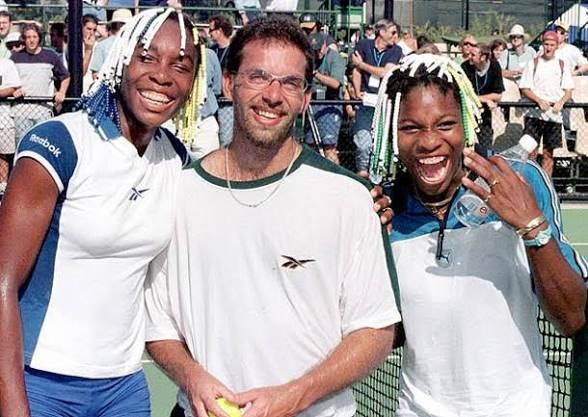
In 1998, Serena and Venus Williams said they could beat any man ranked outside the top 200 in the men's division.
So, little known and 203rd ranked men's player Karsten Braasch took them up on the challenge.
Braasch after a night of drinking and smoking with zero practice, destroyed Serena 6-1 and Venus 6-2 in straight sets.
The Williams sisters are the greatest female athletes of all time. And they barely made Braasch break a sweat.
It wasn't because Braasch was very good. He wasn't.
But, as a male, he possesses biological advantages even the best female athletes can't compete against.
That's the very reason we established women's sports to begin with.
To even the playing field.
That shouldn't be controversial. And you shouldn't need a biology degree to understand it.
There's an entire criminal industry built around removing pollen from honey.
Why?
Because honey is one of the few foods on Earth that never spoils.
Archaeologists have opened sealed jars in Egyptian tombs after more than 3,000 years and found the honey inside still edible. No refrigeration. No preservatives. No packaging technology. Just a substance so hostile to decay that time itself can't break it down.
The reason connects directly to what's happening in that jar when the bubbles and pollen drift upward.
Honey is a supersaturated sugar solution holding only around 17 to 18 percent water. That tiny water content is the whole story. Bacteria and microbes need available water to survive, and honey is so dense with sugar that it physically pulls moisture out of any cell that touches it through osmosis. A bacterium landing in honey doesn't get infected by it. It gets dehydrated to death. On top of that, bees add an enzyme called glucose oxidase that slowly releases tiny amounts of hydrogen peroxide, and the whole substance sits at an acidic pH around 3.9. It's a chemical fortress disguised as breakfast.
Now look at what that density does to the clarification itself.
Honey is roughly 1.4 times heavier than water and absurdly viscous. When wax flecks, air bubbles, and pollen grains rise to the surface, that's not a small thing happening in a thin liquid. Those particles are clawing their way up through a medium so thick it barely flows. They rise because they're lighter than the honey around them, and the honey is so resistant to mixing that once they reach the top, they stay there in a clean layer the beekeeper can simply skim. The same property that makes honey immortal is the property that lets it filter itself. Density does the work that machinery would otherwise have to do.
This is why traditional beekeepers prize settling over forced filtration, and the distinction matters more than most people realize.
When honey clarifies naturally by rising and settling, the pollen comes up gently and can be skimmed without destroying the rest of what's in there. The honey keeps its enzymes, its aromatic compounds, its trace minerals, the living fingerprint of the flowers the bees actually visited. Heat it and force it through industrial micro-filters and you strip all of that out to make it look glassy and uniform on a supermarket shelf.
That stripping has a darker consequence almost nobody talks about.
Pollen is the only way to identify where honey actually came from. Every region's flowers leave a distinct pollen signature, and a trained melissopalynologist can look at the pollen in a jar and tell you the country, sometimes the very valley, it was harvested in. When commercial processors ultra-filter honey to remove every trace of pollen, they're not just changing the texture. They're erasing the honey's birth certificate.
This created an entire shadow industry called honey laundering. Cheap, often adulterated honey from countries facing import tariffs gets ultra-filtered until it's untraceable, then re-labeled as originating somewhere else entirely and sold at a premium. The pollen removal isn't a quality decision. It's an evidence-destroying one. Investigations have found that a startling share of honey on grocery shelves has had its pollen completely removed, which means there is no way to verify it's honey at all, or where it came from.
So the humble act of letting a jar sit while the bubbles rise is quietly the most honest thing that can happen to honey. The slow upward drift of pollen is the honey telling the truth about itself. Filtration, done violently, is how that truth gets deleted.
There's one more layer that makes this almost poetic.
Every gram of that honey represents bees visiting somewhere around 1,500 flowers, and a single worker bee will produce about one twelfth of a teaspoon in her entire lifetime. The pollen rising to the surface is the physical residue of millions of those flower visits. When you skim it gently and keep the honey whole, you're preserving a record of an ecosystem. When you blast it through a filter to make it pretty, you throw that record away.
A spoonful of raw honey isn't just sugar.
It's a sealed, self-preserving, self-clarifying archive of a landscape, written in pollen, built by insects, and capable of outlasting empires.
¡Un experimento mágico que encanta a los niños! 🔮⭐
Ese polvo blanco que ves es sal, y al añadir cúrcuma se crea un efecto increíble cuando la luz atraviesa el vaso. No es magia, es ciencia divertida 💡.
👉 Cómo hacerlo en casa:
1. Llena un vaso de agua.
2. Coloca la linterna de tu celular debajo del vaso.
3. Agrega una cucharadita de sal.
4. Luego espolvorea cúrcuma (o cualquier condimento en polvo con color fuerte).
5. ¡Disfruta el espectáculo de luces y partículas brillando como polvo mágico! ✨
🌱 Beneficios de este experimento
1. Llena un vaso de agua.
2. Coloca la linterna de tu celular debajo del vaso.
3. Agrega una cucharadita de sal.
4. Luego espolvorea cúrcuma (o cualquier condimento en polvo con color fuerte).
5. ¡Disfruta el espectáculo de luces y partículas brillando como polvo mágico! ✨
🌱 Beneficios de este experimento