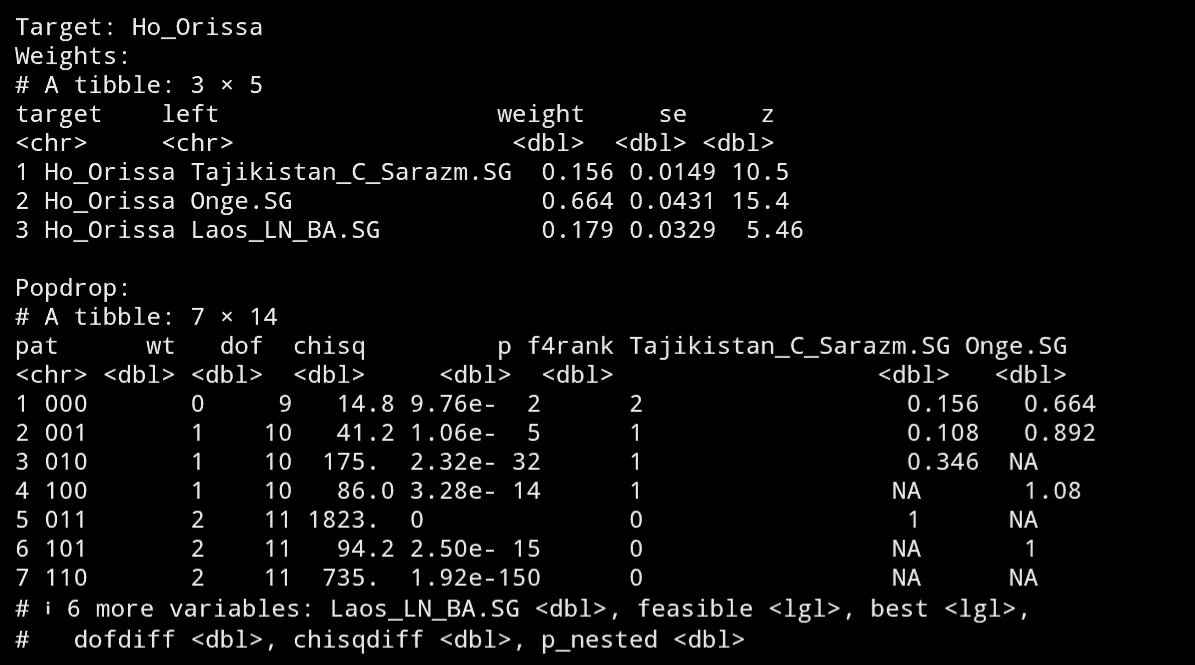
Distal qpadm results for an Awan from Mianwali, Pakistan.
Zagros Neolithic: 30.2%
Anatolia Neolithic: 14.9%
Caucasian HG: 11.2%
South Asian HG: 20.3%
Tutkaul Mesolithic: 10.7%
Eastern European HG: 12.7%
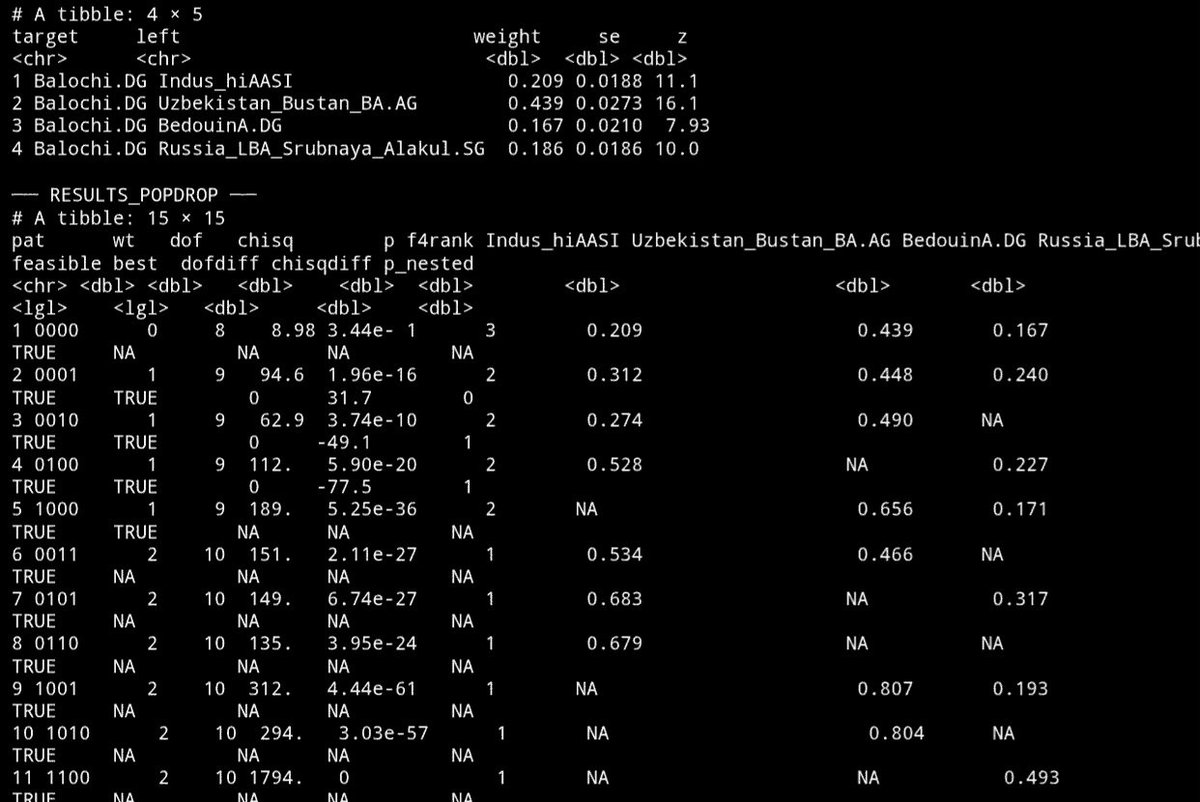
QpAdm results for the eastern-shifted HGDP Balochi.DG samples (n=7).
These samples represent a more eastern shifted Baloch profile.
The total SAHG ancestry is approximately 15% for this cluster.
QpAdm results for the HGDP Balochi.DG samples from Balochistan, Pakistan (n = 14).
These samples represent the core Baloch genetic profile.
Total SAHG ancestry is around 10% in this model.
@ibr83950 BedouinA is more south Levant shifted. Its hard to say where its coming from as of now. Also don't take it as literal ancestral source but as a proxy for Middle Eastern ancestry.
QpAdm results for the HGDP Balochi.DG samples from Balochistan, Pakistan (n = 14).
These samples represent the core Baloch genetic profile.
Total SAHG ancestry is around 10% in this model.
QpAdm results for the eastern-shifted HGDP Balochi.DG samples (n=7).
These samples represent a more eastern shifted Baloch profile.
The total SAHG ancestry is approximately 15% for this cluster.
Big Y-700 results of a Bangash Pashtun from Pakistan, Hangu, Bilyamina.
Y-DNA: T1a3b2a1 - T-FTE3459
FTDNA: https://t.co/3Df2zUc8qR
Yfull: https://t.co/7mpY9GQJWU
This is the first known Big Y-700 result for a T1a Pashtun from Pakistan. Although T1a represents only a small but notable paternal lineage among Pashtuns overall, it is most frequently observed among Karlani tribes, especially the Bangash. Related T1a subclades have also been identified among Yusufzai and Mohmand Pashtuns.
The lineage exhibits a strong Iranic association and may ultimately derive from Persid or other West Iranic populations. At a deeper level, this branch traces back to Chalcolithic populations of the central and eastern Iranian Plateau. The upstream clade T-Y13309, with an estimated TMRCA of approximately 5500 BCE, has been identified in ancient individuals from Tepe Hissar and Shah Tepe, two Late Neolithic sites in north(eastern) Iran.
T-Y13309 was also detected in later Kangju-associated remains from Kazakhstan, indicating that related T1a lineages were present in Central Asia during the Iron Age and historical periods. However, these ancient Central Asian samples do not appear to be directly ancestral to the Pashtun branch.
Most Pashtun, and particularly Karlani, T1a lineages belong to T-Y19167, which has a YFull-estimated TMRCA of approximately 1700 BCE. Outside of Pashtun populations, this clade appears to be most common in southwestern Iran and adjacent Arab regions. The Pashtun T1a lineage shares a common ancestor with an Iranian Arab from the Al-Shaikhly tribe roughly 1,000 years ago, indicating a quite recent connection. While it is possible that the Arab lineage ultimately is Afghan-derived, the broader phylogenetic structure of T-Y19167 and its upstream branches suggests an ultimate origin in either southwestern Iran or Central Asia.
Consequently, this lineage may represent either a legacy of Iranic migrations from Central Asia during the Iron Age or the incorporation of Persid/West Iranian paternal ancestry into Pashtun populations. Additional high-resolution samples from both Pashtun and Iranian populations will be necessary to clarify the precise historical pathway of this lineage.
Facial reconstruction of a 2,500-year-old man from Kalalygyr, Turkmenistan
Kalalygyr was an ancient city in northern Turkmenistan that disappeared in antiquity. It served as the second capital of ancient Khwarezm during the 5th-4th centuries BC. According to the Khwarezm Archaeological Expedition, the fortress of Kalalygyr 1, covering nearly 70 hectares, is the largest known settlement site in Khwarezm.
One of the city's fortresses, Kalalygyr 1, was a rectangular fortified settlement measuring approximately 1,000 × 700 meters. Its walls were reinforced with towers and contained four gates protected by complex entrance labyrinths and bastions. The inhabitants lived primarily within long vaulted corridor-like chambers built into the thickness of the massive defensive walls. Near the western wall, on the inner side of the fortress, stood a monumental palace complex.
Construction of both the fortress walls and the palace was never fully completed, and the site was eventually abandoned. The foundations consisted of large pakhsa (rammed-earth) blocks over one meter high, upon which mud-brick masonry of standard ancient dimensions was erected. The palace was square in plan (80 × 80 meters) and contained two internal courtyards and two external courts. Around these courtyards were approximately thirty rooms of various functions. The palace halls had flat roofs supported by columns, some of whose bases survive.
Researchers believe construction of the colossal fortress of Kalalygyr 1 began in the late 5th or very early 4th century BC, during the period when Khwarezm was under the rule of the Achaemenid dynasty. The project may have been part of broader Achaemenid initiatives connected with irrigation and water management, reminiscent of the policies described by Herodotus.
The male skull series from Kalaly-Gyr I is mesocranic (cranial index 79.9) with average length (182.0 mm), broad width (144.7 mm), and notably high vault (138.6 mm). The forehead is slightly sloping, with a well-developed glabellar region.
Facially, the skulls show medium height (72.9 mm) and medium bizygomatic breadth (132.5 mm), with a moderate facial index (54.9). The face is orthognathic, with moderate profiling at the nasomalar angle and slightly stronger at the zygomaxillary region.
Orbits are moderately high, the nose is medium-width (nasal index 48.7), with moderate nasal projection and a relatively high nasal bridge.
Overall, the series is mainly Eastern Mediterranean in type but shows clear mixture. The increased cranial index may reflect both admixture and brachycephalization. Some facial flattening and reduced nasal projection suggest slight Mongoloid influence. There is also evidence of Andronovo-related Europoid admixture, possibly mixed Srubnaya–Andronovo/Tazabagyab, and one incidence of an equatorial-influenced specimen.
The Iron Age and Early Antiquity inhabitants of Turkmenistan belong to the Tkm_IA/Yaz genetic cluster, which is a mixture of BMAC-related and Indo-Iranic Andronovo-related ancestry. This genetic cluster is pivotal in the spread of the Iranic languages; all modern Iranic languages, with the likely exception of Ossetic, ultimately stem from this genetic cluster.
Reconstruction commissioned by @shoresh03 at the request of @asteraex
@hamza45839252 There's no academic or private Shina sample however I expect them to be similar to Kohistanis with minor variations depending on the region like some Shina live close to Khos and Burusho while others live closer to Kashmiris.