@HelouMaster Chinese AI labs are finding it harder and harder to get the processing power they need. Going forward, who has the compute will ultimately dictate how good these models can get.
Analyst Jim Handy and brokerages in South Korea are warning that the memory market's golden run might be nearing its end. If AI spending slows down, we're looking at a steep drop in DRAM and NAND prices. And once China's new memory capacity hits the market, the industry could find itself swimming in oversupply.
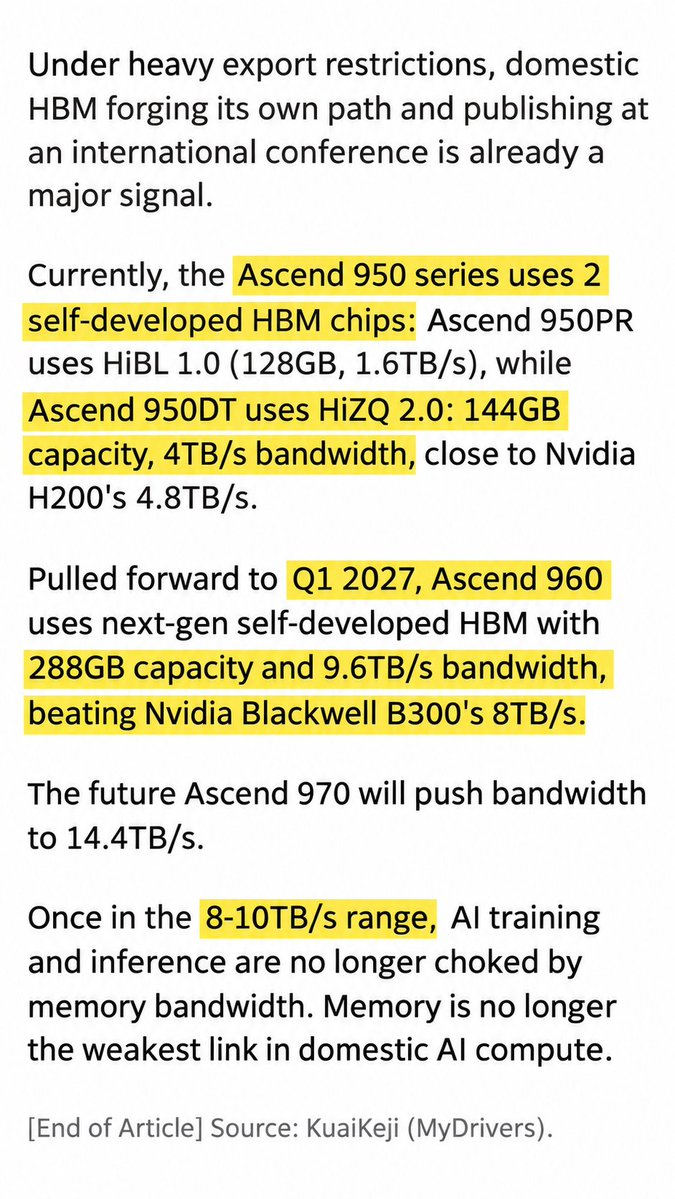
Meanwhile, Huawei's in-house HBM plans are finally seeing the light of day. By leveraging a 4096-bit architecture and wafer hybrid bonding, they're setting the stage for the next Ascend iterations. On paper, the Ascend 960's 9.6TB/s HBM bandwidth actually beats the B300, which could be the breakthrough needed to solve China's domestic compute bandwidth bottleneck.
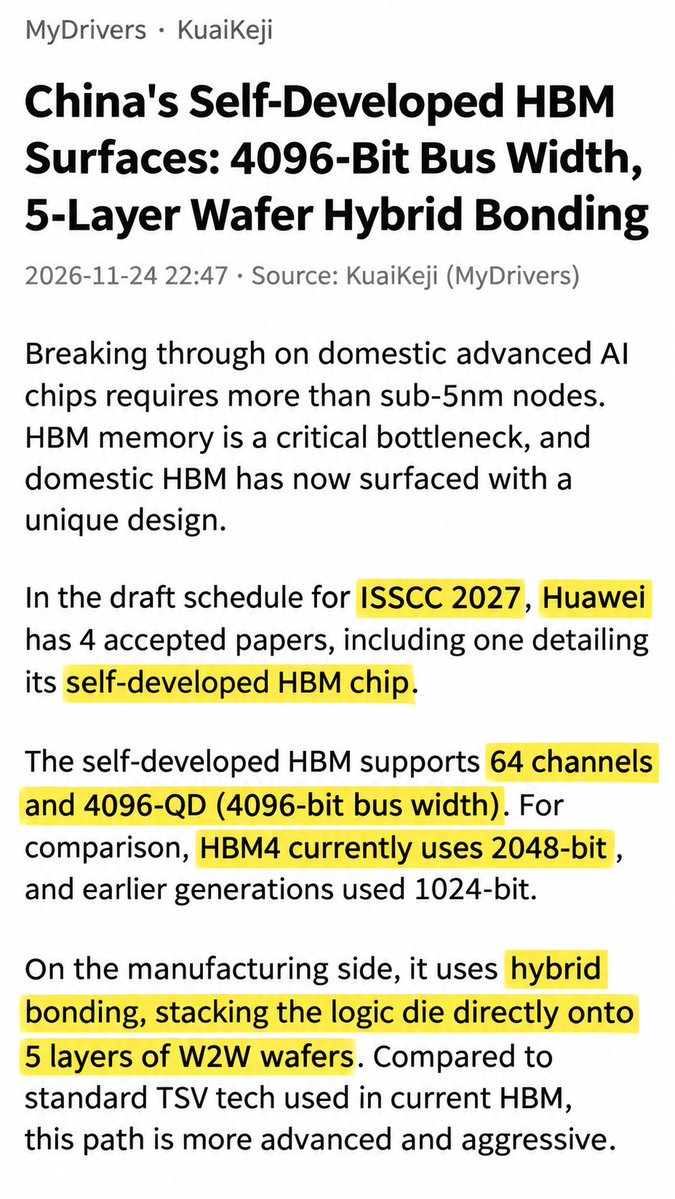
HOLY SHIT. Huawei just blew past HBM4 on paper with a self-developed 4096-bit HBM chip.
2x wider bus than HBM4. 9.6 TB/s on Ascend 960, beating Nvidia Blackwell B300's 8 TB/s. And it drops the exact week analysts warn DRAM prices could crash 70%.
Standard HBM4 uses a 2048-bit interface on TSVs. Huawei's ISSCC 2027 paper skips that completely: 64 channels, a 4096-bit bus, and 5-layer wafer-to-wafer hybrid bonding straight onto logic. No western HBM supply chain required.
Now check their updated roadmap. Ascend 950DT aims for 144 GB at 4 TB/s. Ascend 960 just got pulled forward to Q1 2027, targeting 288 GB and 9.6 TB/s. That beats B300's 8 TB/s headline bandwidth.
And the timing is nasty. Semiconductor veteran Jim Handy (Objective Analysis) just warned that if hyperscalers slow capex, DRAM and NAND prices can collapse up to 70% back to 2024 levels, wiping out Samsung and SK Hynix margins in 2 quarters.
Export controls were supposed to lock China out of AI memory forever. Instead Huawei built a wider bus right before a memory glut hits.
$NVDA - U.S. INTELLIGENCE FINDS NO EVIDENCE CHINA ORCHESTRATED JENSEN HUANG AFFAIR — WSJ
U.S. intelligence officials told congressional staffers that there is no evidence Chinese intelligence directed Alice Huang to spy on Nvidia CEO Jensen Huang, according to The Wall Street Journal.
While Alice Huang reportedly had contact with China's Ministry of State Security, investigators have found no indication she disclosed significant intelligence.
However, national-security concerns remain, and investigations into alleged Nvidia chip smuggling to China are ongoing.
Jensen Huang is scheduled to testify publicly before the Senate Banking Committee on December 3.
The findings could ease concerns surrounding Huang's reinstatement, although the investigations remain unresolved.
Why is Wall Street so nervous right now? Because the “insurance” against corporate defaults over the next five years—the 5-year CDS—has already repriced the risk.And that brings us to the market’s biggest concern right now: can the cash flow generated by the AI industry’s heavily leveraged, capital-intensive compute buildout actually cover the massive debt burden?
Credit risks across AI compute firms are surfacing broadly:
CoreWeave $CRWV shows the highest risk on this chart. It relies almost entirely on borrowing to expand its compute capacity. Its revenue comes mainly from GPU rentals, so it is very vulnerable to rental price swings. Its 5-year CDS at 1145bp implies roughly a 61% chance of default over five years.
Oracle $ORCL is next. It took on huge debt for its compute leasing business and sits right at the edge of investment-grade territory. A year ago, its CDS was only 76bp, implying a 5-year default probability of around 6%. It has now jumped to 316bp, translating to about a 23% five-year default risk. It could fall into junk-bond status quickly if earnings disappoint.
Even leading names including Nvidia $NVDA , Amazon $AMZN and Microsoft $MSFT have seen their 5-year CDS rise, with credit risks picking up across the whole sector.
As AI stocks keep sliding, a worrying question emerges: could this debt-fueled rush to build compute turn into a new AI subprime crisis?
This tariff proposal is hard to block outright. Trump is willing to take market pain to rewrite global trade rules, and the Nasdaq selloff is pricing that risk right now.
BREAKING: The Trump Administration proposes new tariffs on 14 major US trading partners following the conclusion of its trade investigations.
Proposed tariff rates include:
1. China: 20%, potentially rising to 40%
2. Vietnam: Up to 35%
3. India: Up to 25%
4. Taiwan: Up to 25%
5. South Korea: Up to 25%
6. Indonesia: Up to 25%
7. Malaysia: Up to 25%
8. Thailand: Up to 25%
9. Cambodia: Up to 25%
10. European Union: Up to 20%
The Nasdaq 100 extends losses to -2.9% on the day.
@KobeissiLetter This tariff proposal is hard to block outright. Trump is willing to take market pain to rewrite global trade rules, and the Nasdaq selloff is pricing that risk right now.
$QQQ Goldman Sachs strategists are sounding the alarm: it’s not yet the time to buy the dip in the AI rally.
Speaking on Bloomberg TV, Christian Müller-Glismann pointed out that the market’s footing is unstable. There are still no clear signals that AI’s massive spending will turn into actual profits—a condition that must be met before jumping in.

@TruthTrumpPost Falling share prices don’t equal policy success. These constraints accelerate indigenous innovation. Superintelligence will be a global race, not one nation’s monopoly.