Welp, that happened faster than I predicted. Thought it would be end of 2027, then early 2027, but agentic traffic growing so fast that bots have now passed human traffic online for the first time in the Internet's history. https://t.co/2zX5bHdhsa
@paulg It’s important to note how weird this was at the time. We went to college together and he was generally considered a “weird dude”… in retrospect, it was the weirdos that uncovered the future.
@srg444 Sounds promising. But isn’t Tesla and their Megapacks light years ahead of them in terms of cost/MW of installed storage? How does Ford survive in this market long-term without a sustainable cost advantage?
@balajis This is a very silly take. The whole point is that any one member of congress alone does not control any spending at all. Unlike actual billionaires, who do personally control all of their spending. You usually post solid arguments, but I don’t think this is one of them.
@jessegenet Next time, tap on brightest point on the screen before you start recording to lock exposure for that point (highlights). This will make your video less bright. On iPhone, you can then also slide the little yellow level up or down to adjust exposure compensation.
@alexisohanian This is a great message, and one we need to hear more from men who have been successful in business and in life, like you. Thanks for spreading the good word!
Let me explain exactly why every new subdivision in America looks like the top photo, because the math is wild.
A mature tree increases a home's value by 7 to 19 percent. On a $400,000 house, that's $28,000 to $76,000. A single shade tree produces the cooling equivalent of ten room-size air conditioners running 20 hours a day. One tree on the west side of a house cuts energy bills by 12 percent within 15 years. The bottom photo is worth more, costs less to live in, and sells faster. This has been documented by the University of Washington, Clemson, Michigan State, and the USDA. The data is not in dispute.
Removing those trees saves the builder roughly $5,000 per lot. Concrete trucks need twice the dripline radius of every standing tree. Utility trenches need flat ground. A bulldozer flattens 200 lots in an afternoon. Preserving trees adds weeks and thousands per home.
So the developer pockets $5,000 in savings and the buyer eats $50,000 in lost value for the next two decades. The person making the decision and the person paying for it have never been in the same room.
The Woodlands, Texas is the proof of what happens when they are. George Mitchell bought 28,000 acres of Houston timberland in 1974 and preserved 28% as permanent green space. He forced McDonald's to build behind the tree canopy. That McDonald's became one of the highest-volume locations in Texas. The first office building, designed to reflect the surrounding forest so you couldn't see it from the street, leased completely.
The Woodlands median home price today: $615,000. Katy, a comparable Houston suburb that clear-cut: $375,000. Named #1 community to live in America two years running.
Fifty years of data. The trees are worth more than removing them saves. Developers clear-cut anyway because they sell the house once and leave. You live in it for 30 years.
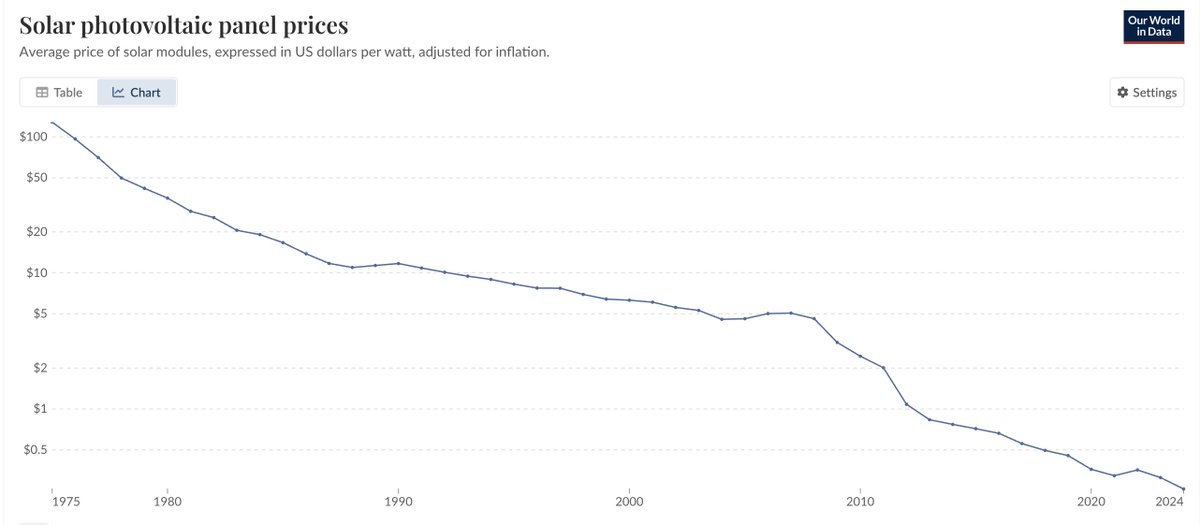
a barrel of oil can provide as much electricity as a 400W solar panel does annually.
a barrel of oil runs $92 and comes with a few minor logistical complications.
this year the solar panel should run less than $90; you can order online, ships in a week.
This is honestly just a terrible development. Part of the unique value of the public markets is liquidity. Making it so companies are required to update their investors less frequent means we are moving towards opaque, confusion, and lack of data.
And there’s nothing “long term” about getting less frequent updates. One of the most long term focused companies ever is Costco, which releases KPIs *monthly*.
Removing the quarterly reporting period will just give investors less data to work with and make it so insiders can sell out of a stock long before the public is aware of the problems.
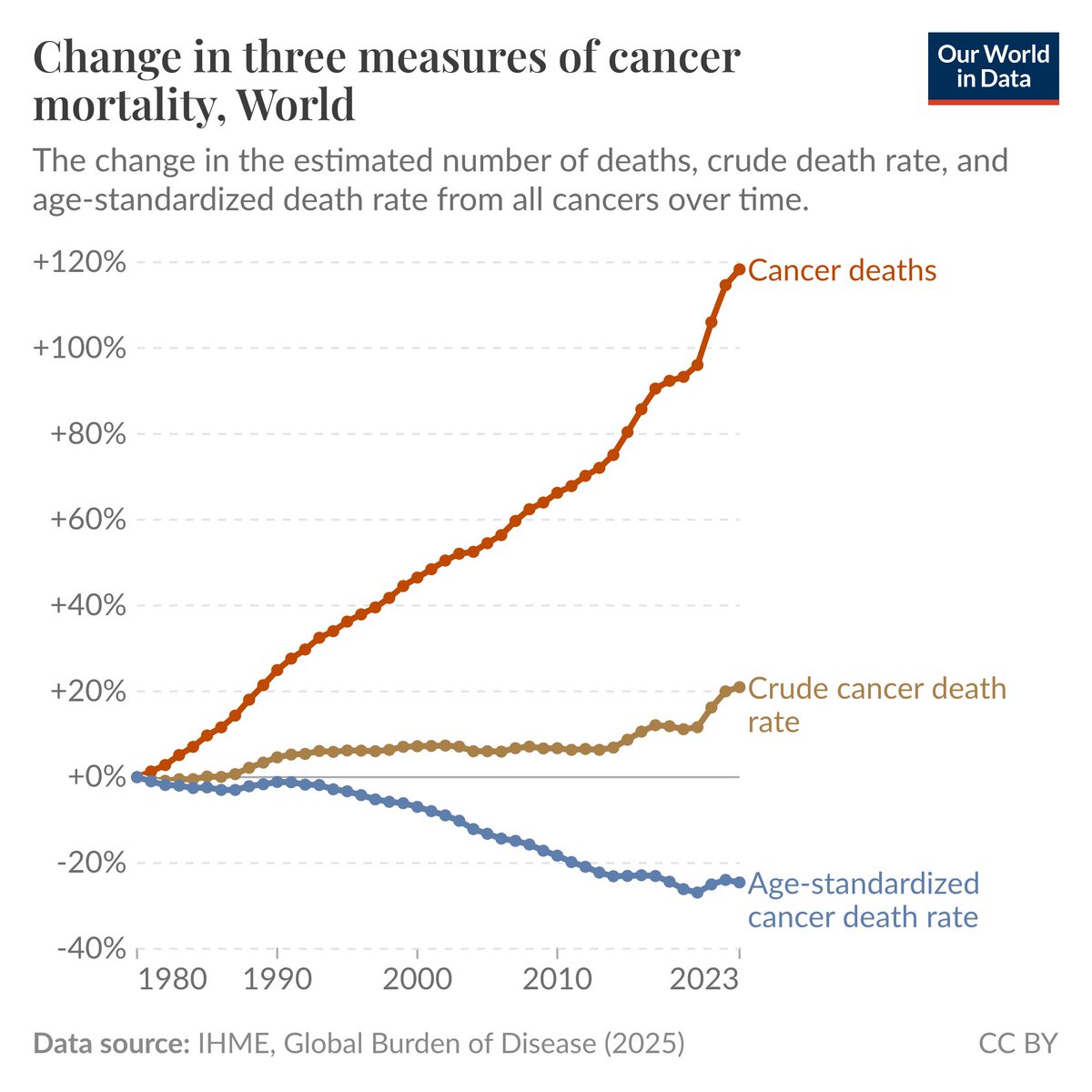
The number of cancer deaths worldwide has more than doubled since the 1980s. Does that mean we're losing the fight against cancer? Not necessarily, because it depends on how you measure it. On this chart, you can see three ways to look at the same data.
The red line shows the total number of cancer deaths. It has increased by about 120%, but this measure doesn't account for the fact that the world's population has also grown enormously over this period.
Another approach is to look at the death rate: the number of cancer deaths divided by the total population. That's the brown line, called the crude cancer death rate. It has increased too, but much less — around 20%.
But there's still a problem: the world's population has been getting older. Cancer is mostly a disease of old age, so even per capita, we'd expect more cancer deaths simply because there are more older people than before.
That's where the method of “age standardization” comes in. It's a way of asking: what would the cancer death rate look like if the age structure of the population hadn't changed?
The blue line shows this age-standardized rate: it's fallen by about 25%. At any given age, people are now less likely to die of cancer than they were in the 1980s.
The same underlying data gives us three different pictures. The absolute number of deaths is up; the crude rate is up slightly; the age-standardized rate is down. None of these are inaccurate, but they answer different questions.
Age standardization is one of the most important statistical methods for making sense of health data. Without it, population aging can hide progress or mask problems.
The world, Europe, and Spain have faced this critical moment before. In 2003, a few irresponsible leaders dragged us into an illegal war in the Middle East that brought nothing but insecurity and pain.
Our response then must be our response now:
NO to violations of international law.
NO to the illusion that we can solve the world’s problems with bombs.
NO to repeating the mistakes of the past.
NO TO WAR.
https://t.co/KpRjBfwY4B