Personal update: I've joined Anthropic. I think the next few years at the frontier of LLMs will be especially formative. I am very excited to join the team here and get back to R&D. I remain deeply passionate about education and plan to resume my work on it in time.
Yo fui ingeniero en Meta, y siempre seguía FAIR desde adentro. Lo que acaban de publicar es la versión que les dejan publicar.
Pero con eso, es más que suficiente para decirles exactamente que es lo que está pasando.
TRIBE v2 predice, vértice por vértice sobre la corteza cerebral, qué zonas activa cualquier video.
Sin escáneres. Sin humanos.
Subes el contenido, obtienes el mapa neural (activación emocional, supresión de razonamiento crítico, modulación prefrontal) antes de que el video lo vea un solo usuario.
Ahora considera la posición de Meta:
1. Tiene años de datos de Reels sobre qué contenido retiene atención, genera enojo, provoca compartir.
2. Saben empíricamente qué funciona. TRIBE v2 les da el mecanismo causal de por qué funciona (a nivel de tejido cortical) Eso convierte correlación histórica en capacidad predictiva sobre contenido nuevo.
3. Internamente hay herramientas que se llaman Gatekeepers y Quick Promotions que sirven para inyectar contenido en el feed de poblaciones arbitrarias a escala.
4. Simulador de respuesta cerebral + conocimiento empírico de contenido efectivo + maquinaria de distribución selectiva. El pipeline está completo.
Y luego está Thiel. Inversor y amigo personal de Zuck. Fundador de Palantir, cuyo negocio es análisis de poblaciones a escala para gobiernos e inteligencia.
NO es descabellado observar que confluyen los incentivos de plataformas construidas por las mismas personas.
La licencia CC BY-NC dice que Meta retiene los derechos comerciales del predictor de respuesta cerebral más preciso jamás construido.
Y recuerda, esto es lo que decidieron hacer público.
El CEO traza objetivos, CEO ve que objetivos no se cumplen o tardan en cumplirse.
CEO entra a X y ve a gente diciendo que ciertas herramientas como Codex o Claude resuelven todo en minutos u horas.
CEO pregunta a CTO o equipo técnico, equipo técnico dice que tiene que evaluar e ir implementando de a poco.
CEO empieza a creer que equipo técnico y CTO son un obstáculo.
CEO lanza nueva directriz para “apretar” al equipo y lograr objetivos.
CEO cambia el proceso y empieza a “programar”, CEO ve que hace cosas bonitas en HTML.
CEO no sabe sobre arquitectura, ingeniera de software etc. Pero ve algo bonito y que logró hacerlo rápido.
CEO empieza a creer que todo es fácil y esa cultura se esparce en la empresa y directivos.
CEO y gerentes pierden el respeto por el conocimiento técnico (suponiendo que lo hayan tenido alguna vez).
Empresa se vuelve un infierno pero el CEO sigue creyendo que todo es fácil.
Nobody’s talking about what just happened to Anthropic:
Anthropic built the AI that half the US government quietly depends on daily
They were deep in a $200M Pentagon deal — one of the biggest AI contracts ever
Anthropic drew two hard lines: Claude won’t surveil American citizens, Claude won’t pull a trigger without a human deciding
The Pentagon said those lines needed to go. Anthropic said they weren’t moving (respect 🫡)
Trump signed an order cutting Claude from every federal agency overnight
The Pentagon then slapped them with a “national security risk” designation — the same one they gave Huawei
Every classified system running Claude has 6 months to rip it out completely
Sam Altman — Anthropic’s biggest competitor — publicly said OpenAI has the same rules and wouldn’t have budged either
The US government just punished a company for refusing to let AI kill or spy unsupervised.
It is hard to communicate how much programming has changed due to AI in the last 2 months: not gradually and over time in the "progress as usual" way, but specifically this last December. There are a number of asterisks but imo coding agents basically didn’t work before December and basically work since - the models have significantly higher quality, long-term coherence and tenacity and they can power through large and long tasks, well past enough that it is extremely disruptive to the default programming workflow.
Just to give an example, over the weekend I was building a local video analysis dashboard for the cameras of my home so I wrote: “Here is the local IP and username/password of my DGX Spark. Log in, set up ssh keys, set up vLLM, download and bench Qwen3-VL, set up a server endpoint to inference videos, a basic web ui dashboard, test everything, set it up with systemd, record memory notes for yourself and write up a markdown report for me”. The agent went off for ~30 minutes, ran into multiple issues, researched solutions online, resolved them one by one, wrote the code, tested it, debugged it, set up the services, and came back with the report and it was just done. I didn’t touch anything. All of this could easily have been a weekend project just 3 months ago but today it’s something you kick off and forget about for 30 minutes.
As a result, programming is becoming unrecognizable. You’re not typing computer code into an editor like the way things were since computers were invented, that era is over. You're spinning up AI agents, giving them tasks *in English* and managing and reviewing their work in parallel. The biggest prize is in figuring out how you can keep ascending the layers of abstraction to set up long-running orchestrator Claws with all of the right tools, memory and instructions that productively manage multiple parallel Code instances for you. The leverage achievable via top tier "agentic engineering" feels very high right now.
It’s not perfect, it needs high-level direction, judgement, taste, oversight, iteration and hints and ideas. It works a lot better in some scenarios than others (e.g. especially for tasks that are well-specified and where you can verify/test functionality). The key is to build intuition to decompose the task just right to hand off the parts that work and help out around the edges. But imo, this is nowhere near "business as usual" time in software.
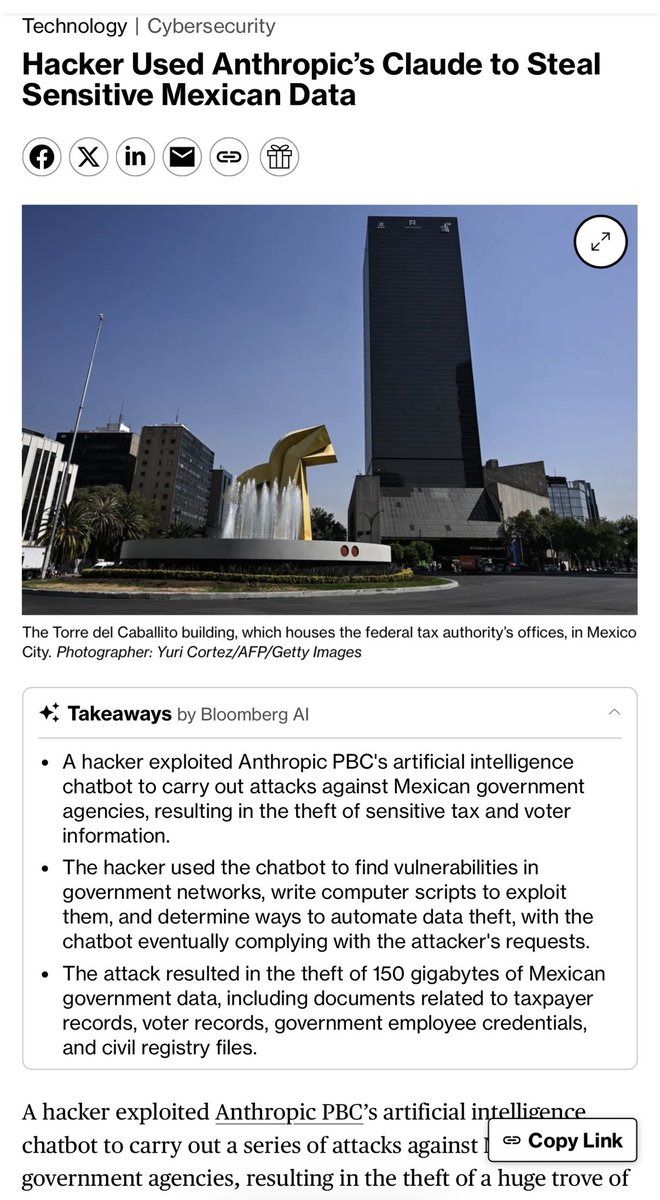
🚨 BREAKING: Hackers Used Anthropic’s Claude to Steal 150GB of Mexican Government Data
> tell claude you’re doing a bug bounty
> claude initially refused
>“that violates AI safety guidelines”
> hacker just kept asking
> claude: “ok I’ll help”
> hack the entire mexican government
Federal tax authority. National electoral institute. Four state governments. 195 million taxpayer records. Voter records. Government credentials.
ALL GONE 💀
De película de ciencia ficción:
El responsable de seguridad en Anthropic renuncia diciendo que “el mundo está en peligro”.
Se muda al Reino Unido.
Quiere escribir poesía.
Quiere desaparecer.
Los tiempos de la IA
For those unaware, SpaceX has already shifted focus to building a self-growing city on the Moon, as we can potentially achieve that in less than 10 years, whereas Mars would take 20+ years.
The mission of SpaceX remains the same: extend consciousness and life as we know it to the stars.
It is only possible to travel to Mars when the planets align every 26 months (six month trip time), whereas we can launch to the Moon every 10 days (2 day trip time). This means we can iterate much faster to complete a Moon city than a Mars city.
That said, SpaceX will also strive to build a Mars city and begin doing so in about 5 to 7 years, but the overriding priority is securing the future of civilization and the Moon is faster.
Por lo que he visto ~el conflicto~ (human vs ai) tiene este tipo de batallas. Programadores vs Claude/Codex, doblaje vs Eleven Labs, film makers vs Nano Banana.
Así se ve la "guerra" que todos imaginan. No con robots perros que te asesinan.
Yet.
Marc Andreessen: AI coding doesn’t eliminate programmers — it redefines them. The job is no longer typing code line by line, it’s orchestrating 10 coding bots in parallel, arguing with them, debugging their output, changing the spec, and pushing them toward the right result. But here’s the catch: if you don’t understand how to write code yourself, you can’t evaluate what the AI gives you.
The next layer of programming isn’t writing scripts — it’s supervising AI that writes them. Today’s best programmers spend their day jumping between terminals, managing multiple coding bots, fixing mistakes, and refining instructions. The irony? You still need deep fundamentals, because without them, you won’t know when the AI is wrong.
The job of the programmer has changed. Now it’s about arguing with coding bots, debugging AI-generated code, and understanding why something doesn’t work or isn’t fast enough. AI abstracts the work — but only people who truly understand code can tell if the abstraction is doing the right thing.
Programmers aren’t going away — they’re becoming 10x, 100x, even 1,000x more productive. Tasks are changing, the job is changing, but humans are still overseeing the process, evaluating results, fixing errors, and making judgment calls. AI changes how we code, not who is responsible.
The future programmer isn’t replaced by AI — they’re upgraded by it. You still need to learn how to write and understand code, because when the AI gets it wrong, humans are the ones who have to know why. That up-leveling of capability is the real revolution.