Did you know you can be a very profitable trader with a less than 40% hit rate? If that doesn't make sense to you, then this is for you 👇
For those who are new here, aside from sharing long-form market updates on my Youtube channel, I have actually made a 25 minute "starter" series (divided into 3 videos) that breaks down the most important concepts that any new/aspiring trader should understand.
If you are just getting into trading, this is where you should start. I cover the proper use of leverage, the concept of "expected value", and the importance of proper position sizing in a "whiteboard" style format using real world examples to make it super clear and easy to digest.
You can watch the series right here: https://t.co/hB6JvhZmof
(Screenshot below is one of the slides from the "expected value" video)
I pay my bills with my @coinbase credit card.
The card pays me 4% back in $btc.
I convert the btc to ethereum:0x4e3fbd56cd56c3e72c1403e103b45db9da5b9d2b.
I send it to a cold storage wallet.
I lock it on @ConvexFinance.
I delegate the voting power for rewards to @StakeDAOHQ.
Every Tuesday, I collect the rewards in crvUSD. The avg APR is 15-30%.
I convert the rewards to $ETH. I send them back to Coinbase.
Coinbase accepts crypto for credit card payments. No bank account is involved.
My credit card balance is now paid for free.
My $cvx position keeps growing and generating more rewards.
Thanks @brian_armstrong for the 4% cashback.
Thanks @CredibleCrypto for the defi lessons.
I’m making more money than ever trading $BTC, and it is painfully easy right now.
It’s because of what I call “dwell blocks”.
I’ve condensed my strategy down into 4 minutes, + my prediction on where $BTC is headed next.
If you plan to make any money in this cycle, I highly suggest you spend 4 minutes on this:
No complexity. No accident.
10/10 was caused by irresponsible marketing campaigns by certain companies.
On October 10, tens of billions of dollars were liquidated. As CEO of OKX, we observed clearly that the crypto market’s microstructure fundamentally changed after that day.
Many industry participants believe the damage was more severe than the FTX collapse. Since then, there has been extensive discussion about why it happened and how to prevent a recurrence. The root causes are not difficult to identify.
⸻
What actually happened
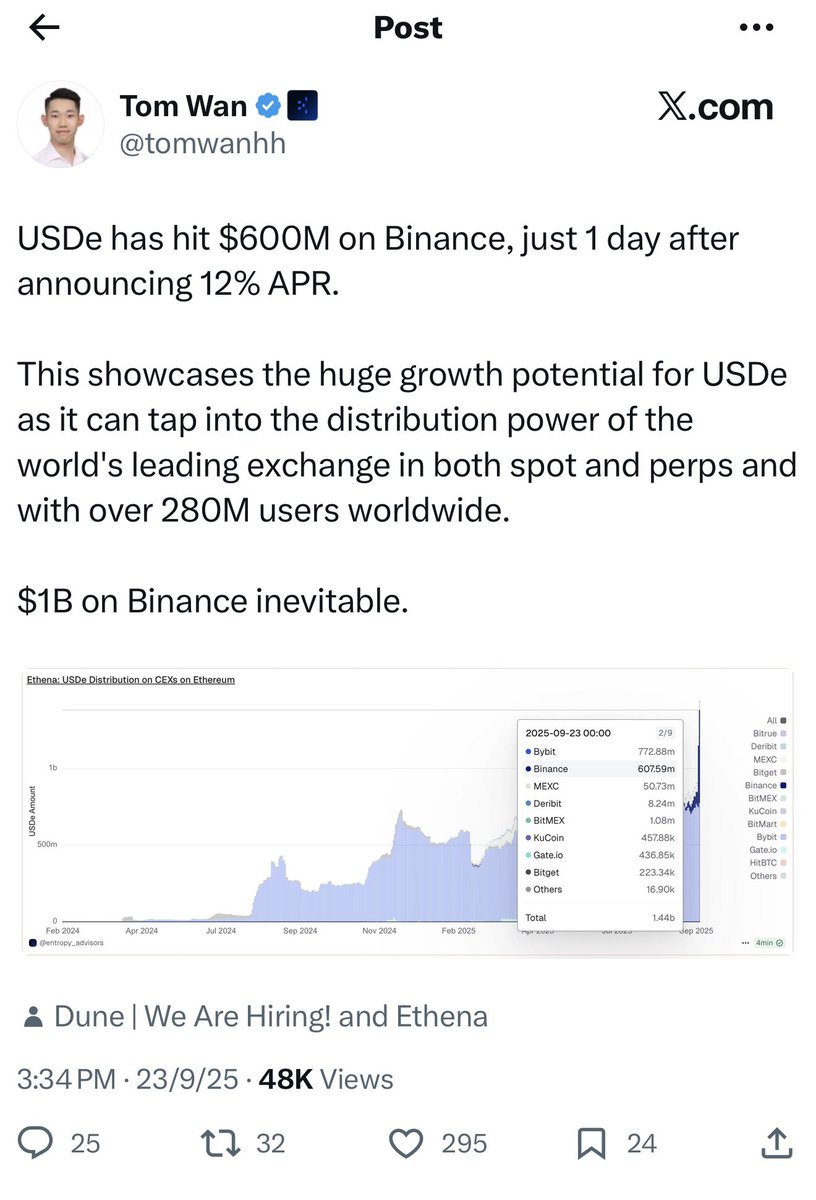
1.Binance launched a temporary user-acquisition campaign offering 12% APY on USDe, while allowing USDe to be used as collateral with the same treatment as USDT and USDC, and without effective limits.
2.USDe is a tokenized hedge fund product.
Ethena raises capital via a so-called “stablecoin,” deploys it into index arbitrage and algorithmic trading strategies, and tokenizes the resulting fund. The token can then be deposited on exchanges to earn yield.
3.USDe is fundamentally different from products such as
BlackRock BUIDL and Franklin Templeton BENJI, which are tokenized money market funds with low-risk profiles.
USDe, by contrast, embeds hedge-fund-level risk. This difference is structural, not cosmetic.
4.Binance users were encouraged to convert USDT and USDC into USDe to earn attractive yields, without sufficient emphasis on the underlying risks. From a user’s perspective, trading with USDe appeared no different from trading with traditional stablecoins—while the actual risk profile was materially higher.
5.Risk escalated further as users:
•converted USDT/USDC into USDe,
•used USDe as collateral to borrow USDT,
•converted the borrowed USDT back into USDe,
•and repeated the cycle.
This leverage loop produced artificial APYs of 24%, 36%, and even 70%+, widely perceived as “low risk” simply because they were offered by a major platform. Systemic risk accumulated rapidly across the global crypto market.
https://t.co/IK2gW4xUOP that point, even a small market shock was sufficient to trigger a collapse.
When volatility hit, USDe depegged quickly. Cascading liquidations followed, and weaknesses in risk management around assets such as WETH and BNSOL further amplified the crash. Some tokens briefly traded near zero.
The damage to global users and companies—including OKX customers—was severe, and recovery will take time.
⸻
Why this matters
I am discussing the root cause, not assigning blame or launching an attack on Binance. Speaking openly about systemic risks is sometimes uncomfortable, but it is necessary if the industry is to mature responsibly.
I expect there may be significant misinformation and coordinated FUD directed at OKX in the near future. Even so, speaking honestly about systemic risk is the right thing to do—and we will continue to do so.
As the largest global platform, Binance has outsized influence—and corresponding responsibility—as an industry leader. Long-term trust in crypto cannot be built on short-term yield games, excessive leverage, or marketing practices that obscure risk.
The industry needs leaders who prioritize market stability, transparency, and responsible innovation—not a winner-take-all mentality where criticism is treated as hostility.
Crypto is still early.
What we choose to normalize today will determine whether this industry earns lasting trust—or repeats the same mistakes again.
Being an optimist this year will make you a lot more money than taking the fear mongering rage bait. The most likely scenario is the dollar doesn't debase, we don't go to war, and the stock market will finish higher up over the next few years even if we get another dip.
One last note on the Fear & Greed Index
When people encounter the Fear and Greed Index in their feeds, they typically operate under a straightforward assumption:
• low index values predict positive future returns
• high index values predict negative future returns
In other words, the index functions as a mean reversion indicator: when markets are overbought (extreme greed) or oversold (extreme fear), people expect that prices will revert toward the mean from these extremes.
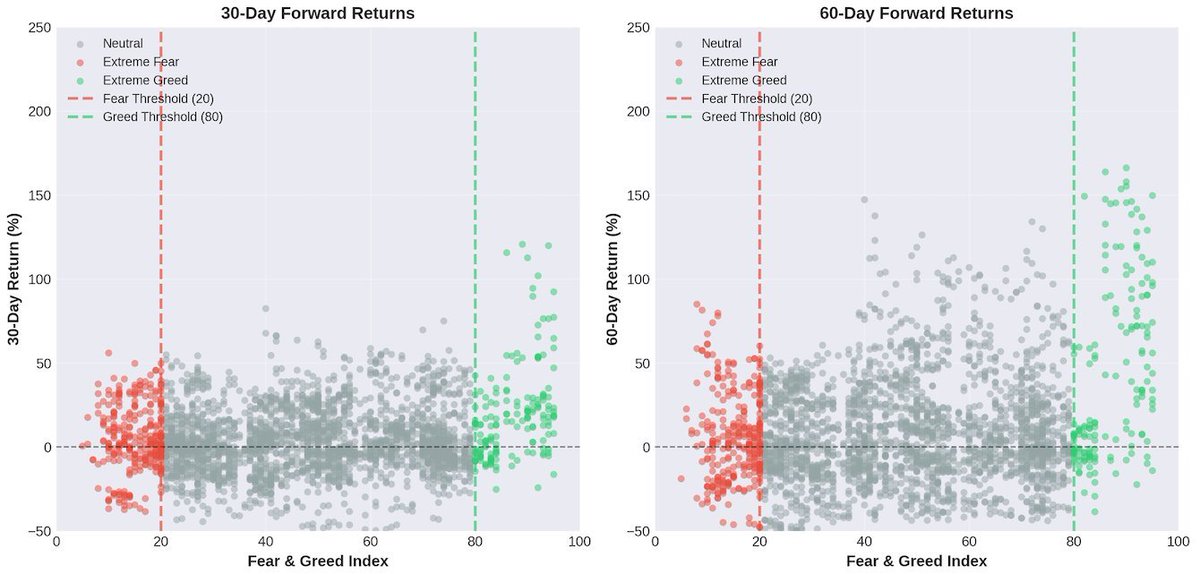
This is a hypothesis we can test. We can examine actual returns following extreme index readings. An easy and fast way to do this is to plot returns against index values and visually inspect the relationship. Under our mean reversion hypothesis, we would expect to see:
• low index values: data points clustering top left
• high index values: data points clustering bottom right
The results reveal a lot of noise, but also a pattern, particularly in extreme greed territory: the indicator frequently fails during trending markets. When you trade based on overbought or oversold signals, you're essentially positioning against the prevailing trend. In practical terms, this means buying too early in downtrends and selling too early in uptrends.
Instead of confirming our hypothesis, we not only find considerable noise but sometimes even the opposite of what we would expect to happen. Obviously, you can discuss how this approach could be slightly tweaked to improve performance. Criticism is welcome, as always.
My point is: this is a metric influencers love to hype, but as the chart shows, it’s mostly just noise :)
Buy Full Moon, exit New Moon
2010 - 2020 SPs-80 trades, 71.25% win rate, raw profit factor 2.59, during this 10-year period, no other day of the month tested out better when looking at exit 10 days later. Have not had time to update stats...but been tracking this for 40+ years.
🇺🇸 BREAKING: President Trump speaks about the pardon for CZ.
"They said, what he did is not even a crime, wasn't a crime... I gave him a pardon at the request of a lot of good people."
I knew Ping was an obvious fade this week because what happened on Binance was going to have repercussions in the following days to weeks.
If you had paid attention, Wintermute was openly stating that Binance fucked them with aggressive ADL at prices that didn’t make sense & WM couldn’t have been the only MM that was screwed over.
Market makers hold spot long & go short perps so no matter what way a coin moves they do not lose or make money. Instead they make money by routing trades, arbitraging across CEXs, & taking a small cut every time you buy or sell, similar to MEV.
If an exchange starts aggressively closing short positions at much higher prices, like what WM claimed, while prices rapidly nuke & they can’t re-short fast enough than they are sitting on huge losses. They then have a tough decision to make…sit on the loss & hope prices go back up or dump your bags ASAP, stop providing liquidity, & gtfo until people figure out what the hell is happening. No matter what decision the MM makes, it’s going to result in thin ass books.
WM said in the interview they did that they were still waiting to find out if they’d be compensated for the losses they took. Likely means other MM’s are waiting too because a client as big as WM would be your priority as a business. And Binance, like any business would have to sort through how much they’d be willing to compensate MM’s, ensure claims are legit, & route things through legal. It’s gonna take a while to sort out the mess, WM isn’t the only MM that operates on Binance. There are a lot of them.
People who thought last week wasn’t a big deal, you’re wrong. It was a huge deal. Some assets went to literal zero. We don’t know how much MM’s lost. MM’s taking on big losses means thinner books & thinner books in a market that already struggles with liquidity while the President of the United States is in a trade war with China is not a recipe for Wonderful Wednesdays. And to that fact that the crypto participants who are left are down and & poor now. Many got liquidated in the chaos. There are less buyers now than there were. The wealth effect is now gone. Crypto natives have been reduced to Haitians.
I agree with WM that what happened impacts shitcoins far worse than it does BTC & majors. Binance has lost a ton of trust and deserves your scorn. I don’t know if it was on purpose or just a big mistake, but the point remains they cannot be trusted.
Sorry Ping. At least you put your nuts on the table.