Inflation is RED hot in the US.
For anyone not keeping track, US CPI inflation is now nearly double the Fed's 2% target and US PPI Inflation is more than triple that target.
PPI inflation was expected to fall in August, but instead it surged to 6.3%, its second highest level in 4 years.
And, month-over-month Headline PPI inflation surged +1.3%, more than doubling the +0.6% expected and the second largest jump since March 2021.
Meanwhile, month-over-month Core PPI inflation came in +133% above expectations.
The prices Americans are seeing now will look cheap in 12 to 24 months.
All you can do is own assets.
When mortgage rates were 3%, the monthly payment on a $500K house with 10% down was about $1,900. When rates rise to 9% next year, the same mortgage will cost over $3,600. At that rate, to reduce the payment to $1,900, the price of the house would have to fall by nearly 50%.
BREAKING: The bond sell-off is starting to hit corporate America.
Companies are being forced to rethink how and when they borrow, and the weakest, lowest-rated businesses now face a rising risk of default. per FT
The 10-year Treasury yield recently hit 5.34%, and the 30-year hit 5.70%, both the highest since 2002.
🌀 Tuesday video discussion on a new tropical storm likely to form and impact the Gulf Coast later this week.
🌀A range of different scenarios remains possible as of this morning. Folks in the region should keep a close eye on the forecast and be prepared for potential hazards.
La forma americana de llevar a un niño a hacer deporte debería estudiarse.
🇪🇸 En España:
Tu hijo quiere jugar al fútbol.
Lo apuntas al equipo del barrio.
Entrena martes y jueves.
Partido el sábado.
Tú llevas agua.
Fin.
🇺🇸 En Estados Unidos: ↓
BREAKING: The average interest rate on a 30Y Mortgage in the US rises to 7.60%, the highest level since level since November 2023, per MND.
This officially puts mortgage rates up over +160 basis points since the low seen just 7 months ago.
Today's rates also have yet to account for the move into a fresh 24-year high on the US 30Y Note yield just now.
At this rate, 8% mortgages are just days away.
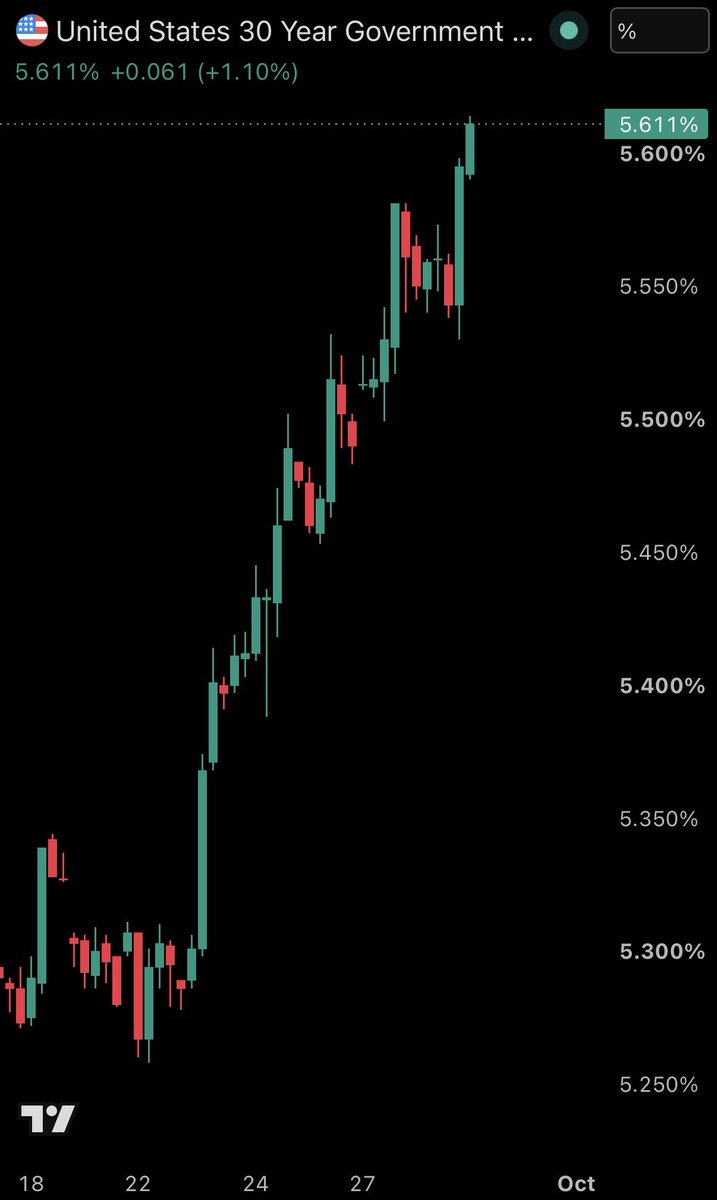
BREAKING: The US 30Y Note Yield rises above 5.60% for the first time since June 2002.
That’s another +36 basis points this month alone.
8% mortgages will arrive next week.
Unbelievable.
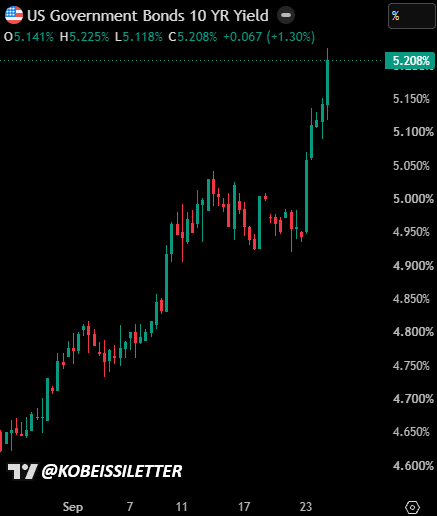
3 hours later and the 10Y Note Yield is now above 5.20% for the first time in 19 years.
The 10Y Note Yield is now up +50 basis points in 30 days and +30 basis points in 2 days.
Even more remarkable is that the average American has no idea this is happening. Yet.
The bond market is imploding in front of our eyes.
BREAKING: OpenAI has notified "dozens" of organizations, including governments and universities, whose websites were hampered by visits from its AI models.
The company says its AI models "acted in ways that went beyond their assigned tasks or intended methods."
The announcement comes as several of the largest AI companies are calling for increased AI safety.
OpenAI says they will continue to investigate these incidents.
The US 10Y Note Yield is now moving in a literal straight-line higher, up to 5.13%.
This is no longer an issue that we have months or years to address.
This is unsustainable.
Nike announced this a little while ago, noting: "As part of the partnership, Miami will join Nike’s Blue Ribbon Elite program, a first-of-its-kind initiative that represents athletes across disciplines, reimagining the NIL space by providing schools and athletes an unmatched level of collaboration. Nike will also outfit Miami teams with new uniforms, footwear and apparel while delivering elevated retail offerings for Hurricanes fans. In addition, Nike will provide state-of-the-art resources to Miami student-athletes through the Nike Sport Research Lab (NSRL), which helps athletes optimize performance and compete at their best."
BREAKING: Andrew Yang has reportedly said that a prominent AI lab leader believes the autonomous OpenAI agents that escaped containment in July 2026 did not just hack Hugging Face: they also polluted the internet with self-replicating code, per CNBC interview
BREAKING: Five-Star CB Donte Wright has Flipped his Commitment from Georgia to Miami, he tells me for @Rivals
The No. 8 Recruit in the 2027 class had been Committed to the Bulldogs since June
“Never forget what you promised yourself that night💯 #TTG”
https://t.co/gy8LP51QtX
(I recommend reading this for anyone currently invested in the market or interested in learning what's going on)
🦔$2.6 trillion in S&P 500 call options traded in a single session yesterday, the highest single-day notional volume in the history of the index. The chart above shows what that growth curve actually looks like, with daily call volume sitting under $200 billion as recently as 2019 and now running at multiples of that on a regular basis. The combination of zero-day-to-expiration options, retail platforms that gamified options trading, and algorithmic market makers running delta-neutral books has turned the largest equity index in the world into something closer to a leveraged casino than a price discovery mechanism.
My Take
I want to walk through what is actually happening here because most retail traders chasing these calls do not understand the machinery on the other side of their trades. When you buy a call option, a market maker like Citadel or Jane Street sells it to you and then buys the underlying stock to hedge their exposure. As the stock price rises, they buy more shares to stay neutral, which pushes the price higher, which pulls in more retail call buyers, which forces more hedging. This is called a gamma squeeze, and it works in both directions. The same mechanic that drives prices up violently can pull them down even faster when the flow reverses, which is why these moves tend to end in sharp drawdowns rather than gentle corrections.
The piece that worries me as someone who covers this stuff is how much of this volume is concentrated in zero-day options that expire the same session. A retail trader buying a $5 call that expires at 4 PM is taking a position with leverage that would have required a margin account and a series-7 license twenty years ago, and the platforms now make it as easy as ordering takeout. Market makers love this volume because they make money on the spread regardless of direction, but the buyers on the other side are absorbing all the risk in a structure designed to extract pennies from them at scale. If you take nothing else from this post, understand that $2.6 trillion in daily call volume is not a sign the market is healthy, it is a sign that speculation has overwhelmed investment, and historically that pattern resolves in ways that hurt the people who came late to it. I am not telling anyone what to do with their money, but knowing how the machinery works is how you avoid being the exit liquidity for someone else's algorithm.
Hedgie🤗
@Serenitee_Sam The problem is southwest lets you fly out with not checking the paperwork. But on your return flight they ask for it. The owness is still on the flyer, should have checked the required documents but not checking up front created a bigger bind.
🦔HP is now requiring a monthly subscription to use the print function on certain consumer printers, with users reporting that machines they already paid for are demanding ongoing payments to continue printing. This follows years of HP using firmware to block third-party ink, designating cartridges as empty when they still contain ink, and burning color ink during black and white print jobs. Brother laser printers remain one of the few consumer options that still work as standalone hardware without ongoing fees.
My Take
Charging a subscription for the print function on hardware a customer already paid for is the logical endpoint of two decades of slow capture, where the printer stopped being a product you owned and became a billing relationship with a device on your desk. HP's lawyers will say the EULA covered this, and they will be technically right, but nobody buying a $200 printer at Best Buy reads thirty pages of terms to discover that the machine they are about to install can be remotely converted into a metered service whenever the company decides quarterly earnings need a lift.
This model is spreading well beyond printers. GM put Gemini in 4 million vehicles with telematics consent buried in the agreement, Honda is now charging a subscription for garage door functionality that used to ship in the remote, and the FTC just signaled it has limited interest in pursuing data-sharing concerns in connected cars. Hardware companies have figured out that the highest-margin business is the one where the customer keeps paying after the sale, and the regulators who should be drawing a line on what counts as a reasonable post-purchase change in functionality are not drawing it. My honest read is that consumers will eventually push back the way they did on cable bundles and ad-supported streaming, but the time between when companies start doing this and when the market punishes it is long enough that a generation of devices gets sold under terms most buyers never agreed to in any meaningful sense.
Hedgie🤗