Rhinosporidiosis
Cause: Infection by Rhinosporidium seeberi (aquatic protist-like organism).
Source of infection: Contaminated stagnant water (ponds, lakes).
Common site: Nasal mucosa (also eye, throat).
Clinical feature: Polypoidal, red, friable mass in nose that bleeds easily.
Symptoms: Nasal obstruction + recurrent epistaxis + “strawberry-like” bleeding mass.
Treatment: Surgical excision with cauterization of base (dapsone may reduce recurrence).
Mamadas nivel:
- no doctor, aunque sea una rabdomiolisis no los puede pasar primero a hemo, en el inss tienen que pasar todos a diálisis peritoneal
Tiene función normal y un chingo de CPK
- no doctor, a diálisis
🤡
Doctor… why are my fingers turning black?
Pain started first.
Then discoloration.
Now parts of the fingers are literally dying.
What could cause this terrifying finding?
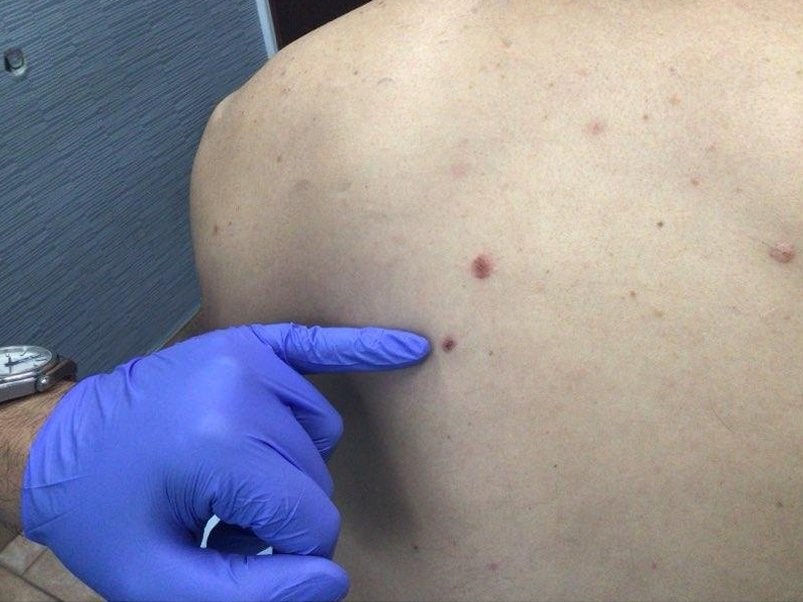
The diagnosis is eruptive halo nevi following melanoma excision.
Halo nevi are benign melanocytic nevi surrounded by a rim of depigmentation caused by a T-cell–mediated immune response against melanocytes. Although most commonly seen in children & young adults, the sudden appearance of multiple halo nevi in adults should prompt evaluation for an underlying malignancy, particularly melanoma.
In this case, a man in his 30s underwent excision of a 0.8-mm, nonulcerated melanoma w/ -ve margins & -ve SLNB. Three months later, multiple preexisting nevi on the back developed halo depigmentation. The melanoma specimen demonstrated a brisk lymphocytic infiltrate, supporting an antitumor immune response that may have cross-reacted with melanocytic antigens in distant nevi, leading to their regression.
Eruptive halo nevi have been reported in association with melanoma, immune checkpoint inhibitors, autoimmune diseases, viral infections, and, rarely, following melanoma excision alone. The mechanism is thought to involve immune recognition of shared melanocyte antigens, resulting in cytotoxic T-cell–mediated destruction of melanocytes in both melanoma cells & benign nevi.
Diagnosis: Lipodermatosclerosis
Overview
Lipodermatosclerosis is a chronic inflammatory condition of the subcutaneous fat, most often affecting the lower legs. It is strongly linked to chronic venous insufficiency. Damaged venous valves lead to venous hypertension, causing leakage of fibrinogen into the dermis, hypoxia, inflammation, and fibrosis.
Acute cases present with painful, erythematous, tender plaques. Subacute disease shows non-tender, hyperpigmented, sclerotic plaques from hemosiderin deposition. Chronic disease produces the classic “inverted champagne bottle” leg: tapered lower leg with proximal edema and distal fibrosis.
Risk factors include obesity, history of DVT, prolonged standing, sedentary lifestyle, older age, smoking, and hypercoagulable states. Diagnosis is clinical and supported by duplex ultrasound assessing venous incompetence or thrombosis, and ABPI to rule out arterial disease.
This condition reflects advanced venous disease where long-standing venous hypertension reshapes the skin and soft tissue, often progressing to venous ulcers if untreated.
Source: https://t.co/tonU0XMH9S
Circinate Syphilitic Lesions.
He had a history of HIV with a CD4+ T-cell count of 374 per cubic millimeter.
PE....
Circinate lesions on the palms, soles, and face and patchy alopecia.
A Venereal Disease Research Laboratory (VDRL) test was positive at a titer of 1:32, which confirmed a diagnosis of syphilis.
The patient was treated with intramuscular benzathine penicillin with resolution of the lesions.
●Atypical Cutaneous Manifestations of Secondary Syphilis and Differential Diagnosis.
https://t.co/cCdu6VOmbK
https://t.co/3wdRYNY8Mj
@docakx It's leprosy (Hansen's disease).The image shows a thickened great auricular nerve (cord-like structure behind the ear), a classic physical sign in tuberculoid leprosy.
@TrackYourHeart Hampton hump sign
The Hampton hump is a radiological sign indicating a pulmonary embolism (PE) with secondary lung infarction. It is characterized by a dome-shaped, wedge-shaped, or rounded opacity in the lung that touches the pleural surface (outer edge of the lung).