Minted my spot for @PepeExplorers by @TrystanNFT , honestly speaking I love the art and I am looking forward to reveal.
Spots were raffled in @The_MSlabs 🥛
One idea is good. Multiple paths are better.
When a single solution feels limiting, exploring alternatives manually gets slow and chaotic. @CodeXero_xyz lets you test multiple approaches side by side, tweak variations, and compare results instantly to see what truly works.
Small differences surface fast. You learn what users notice, what feels smooth, and what actually adds value.
With everything organized in one place, you experiment freely, make bolder decisions, and combine the best parts into a stronger final result.
CodeXero helps ideas evolve faster, cleaner, and with confidence.
Two paths are opening up in front of us, and the deciding factor isn’t how advanced the robots are.
It’s who holds the keys.
In one future, automation scales behind closed doors. Decisions are made by a narrow group, value is extracted upward, and workers feel the impact first. Robots increase efficiency, but the benefits concentrate. Productivity rises while trust erodes. The technology works the system around it doesn’t.
In the other future, the same machines exist, but the outcomes look radically different. Ownership is shared. Governance is visible. Humans don’t compete with machines; they coordinate with them. Automation becomes a multiplier for communities instead of a replacement for them. Progress doesn’t feel threatening because people have a stake in where it’s going.
Same hardware.
Same models.
Different economic design.
This is the conversation robotics actually demands. Not whether automation will arrive that’s already settled, but how it’s integrated into society. Who decides where machines are deployed? Who benefits from the value they generate? Who has a voice when trade-offs appear?
Ownership shapes incentives.
Incentives shape behavior.
Behavior shapes outcomes.
When participation is open and governance is collective, technology stops being something that happens to people and becomes something built with them. Innovation shifts from extraction to alignment. From fear to coordination.
That’s why the future of AI and robotics isn’t just an engineering challenge. It’s an ownership problem. And the systems being designed today will determine whether automation deepens inequality or expands opportunity.
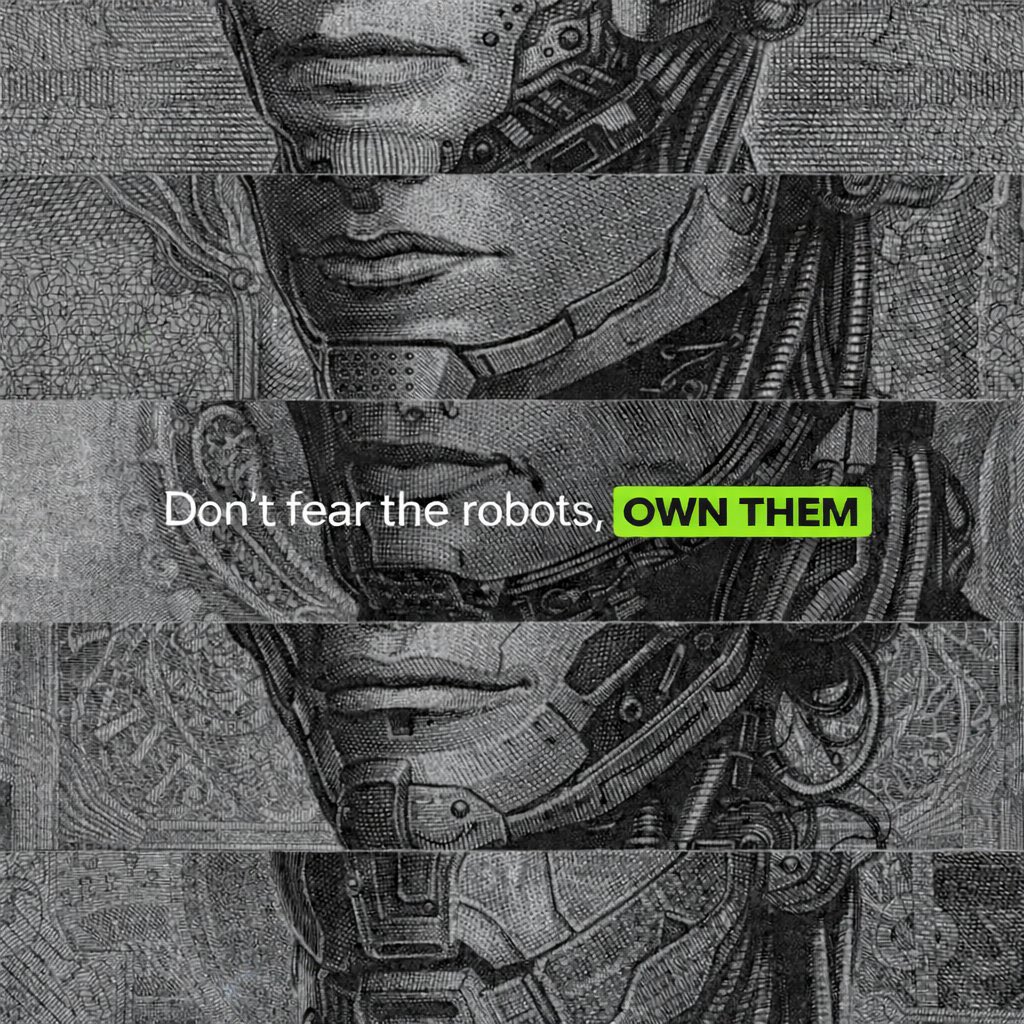
The robots are coming either way.
What’s still undecided is who gets to stand on the same side of the table as them.
Same technology.
Different choices.
Different future.
$DEUS
@xmaquina
Machine systems rarely behave in clean, predictable ways, and @xmaquina doesn’t pretend they do. The architecture is built for uncertainty, where conditions change mid-operation and assumptions break. Instead of locking into rigid plans, the network is designed to adjust on the fly and remain functional under pressure.
Unexpected outcomes aren’t brushed aside or treated as errors to hide. They’re logged, examined, and folded back into the system. Performance shifts, environmental factors, timing differences, all of it becomes usable signal. Over time, this creates a richer operational memory that sharpens future decisions.
Coordination through $DEUS reinforces this adaptive behavior. Alignment emerges from shared outcomes and collective learning rather than centralized commands. The network doesn’t need constant micromanagement to stay coherent; it stays responsive while preserving balance.
What emerges is resilience, not perfection. Machines continue operating, governance continues learning, and strategy evolves alongside reality. Instead of waiting for ideal conditions that never arrive, xmaquina moves forward with context, feedback, and continuous adjustment.
That’s how systems last. Not by eliminating uncertainty, but by learning faster than it changes.
What’s interesting about @xmaquina isn’t just what they’re building, but how they’re approaching it.
Rather than trying to be the loudest voice in the room, the project is quietly assembling the pieces needed for robotics to function as an open economic system. Capital is organized on-chain, decisions are coordinated through governance, and real-world machines are treated as productive assets rather than abstract ideas. Everything points toward sustainability instead of short-term momentum.
There’s also a clear separation from the usual crypto playbook. This isn’t about flipping tokens or chasing narratives. It’s about creating a framework where robotics companies, contributors, and capital can interact without relying on closed networks or privileged access. Anyone willing to participate meaningfully can influence direction and outcomes.
What makes this compelling is the time horizon. Robotics doesn’t move at internet speed, and XMAQUINA seems designed with that reality in mind. The structure favors patience, iteration, and accumulation of real value over time. If humanoids and physical AI become as foundational as many expect, the systems that were built early and thoughtfully will matter the most.
XMAQUINA feels like it’s being shaped for that moment, before it’s obvious to everyone else.
$DUES
In XMAQUINA, progress doesn’t come from bold claims, it comes from repetition. New machines aren’t launched as finished answers, they enter the ecosystem to prove themselves over time.
Once deployed, results matter more than narratives. Output, reliability, and real-world usefulness determine what earns continued backing. The DAO doesn’t guess it responds to evidence.
That evidence shapes capital movement. Projects that demonstrate traction attract more resources, while weaker approaches get reshaped or phased out. It’s a natural selection process applied to robotics.
What makes this powerful is the human layer guiding it. Through $DEUS, the community helps decide which directions deserve focus, using visibility into outcomes rather than speculation. Governance becomes less about opinion and more about pattern recognition.
Over time, this creates a system that learns. Each cycle sharpens decision-making, each deployment improves the playbook. @xmaquina isn’t trying to predict the future of machines it’s building a framework that improves with every real-world result.
GN fam 🌙
What stands out to me about @xmaquina is how participation actually carries weight. Decisions made around $DEUS don’t sit on a forum or disappear into a roadmap doc, they translate into real movement. Funds are deployed, machines get built or backed, and momentum follows wherever the community leans.
That changes the role of a holder completely. Being involved isn’t about agreeing with a vision after the fact, it’s about helping define what gets pursued in the first place. Attention, capital, and effort are all steered by people who show up and take part.
Over time, this creates a natural filter. Ideas are tested in the open, results are visible, and support flows toward what proves itself. Strong projects earn more confidence, weaker ones quietly lose priority. No drama, just signal.
It’s a living cycle: people make choices, those choices produce outcomes, and the outcomes inform what happens next. When ownership and responsibility move together like that, progress stops being theoretical and starts compounding.
One thing that keeps becoming clearer is that influence inside @xmaquina isn’t abstract. When $DEUS holders make decisions, those choices ripple outward into the real world. Capital moves, machines get funded, and projects either gain momentum or stall based on collective direction.
What I find compelling is how this redefines involvement. You’re not passively “aligned” with a roadmap, you’re part of the process that determines it. Being in the DAO means helping decide what deserves resources and attention, and watching those calls turn into tangible progress.
Because everything happens in the open, participation improves over time. The community isn’t guessing in the dark, it’s responding to results. Machines that perform well earn more backing, weaker ideas fall away, and priorities sharpen naturally.
That feedback loop is powerful. Human judgment guides capital, machines turn that capital into output, and the outcomes inform the next round of decisions. It’s a practical model for shared ownership, where responsibility and upside grow together instead of drifting apart.
Many still discuss robots as a distant future concept. In practice @xmaquina is already reshaping how ownership around intelligent machines works. We have spent years getting comfortable with digital capital operating around the clock on our behalf.
What comes next is tangible automation real world machines delivering verifiable output and directing value back into the $DEUS treasury.
Machines do not pause fatigue or lose momentum. Once autonomous systems can generate value continuously exposure is no longer speculative it becomes a calculated strategic requirement.