Lobbying Budget:
PhRMA: $19.6M
AMA: $13.1M
AHA: $10.6M
AHIP: $8.3M
Direct Care: $0.00
Funny how the people actually practicing medicine without the middlemen don’t need a lobbying budget.
https://t.co/Q2EQWS2cTd
I do not believe in accidents.
The system does not need physicians to be wrong.
While physicians argue about vaccines, APPs, RVUs, and IMGs, the architecture dismantling their profession operates without a single opponent in the room.
Section 6001 sits untouched.
CON laws protect incumbent monopolies in 35 states.
Site-neutral payment dies in committee every session.
Professional fees have been cut significantly over the last 20 years.
The Ways and Means contribution tables get filed and forgotten.
Energy and Commerce collected their cash.
Meanwhile the health system have built a captive architecture around commercial insurance. The employed physicians generate commercial revenue that subsidizes the system.
The system tells the physician they are a cost center. The physician believes it.
The physician does not see the facility fee attached to every service they deliver.
The physician does not see the commercial rate differential between the hospital outpatient department and what they would collect in independent practice.
The physician sees only their salary and the number their administrator shows them.
No hospital ownership and now the lobby is moving to ban ASCs entirely in select markets. Of course this is the last structural alternative to hospital employment for proceduralists who still want independence.
Divided physicians are manageable physicians. United physicians are an existential threat to a $275 billion subsidy apparatus.
Every distraction contains a genuine grievance. That is precisely what makes the distraction effective.
You cannot dismiss a legitimate argument. You can only be consumed by it while the architecture calcifies around you.
The hospital and insurance lobby does not need physicians defeated. It needs them occupied.
As far as I can tell, it’s working…
So many people don't want the truth about cholesterol.
They want permission to ignore it.
The social media 'experts' have built a business on providing exactly that.
Society used to reward discipline.
Now it rewards convenience.
- Pills instead of movement.
- Takeout instead of cooking.
- Caffeine instead of rest.
Congrats, we’ve outsourced all
effort to convenience.
Welcome to the age of instant
everything…except fulfillment.
A Reminder for Patients:
The reason you can’t get an appointment…
The reason you don’t have the same physician year after year…
The reason healthcare feels colder, more chaotic, and less personal…
The reason you have less and less choice in your care…
It’s not because your doctor stopped caring.
It’s because insurance companies, large hospital systems, and government policy decided you don’t need choices.
They decided:
•A monopoly makes more money than your autonomy.
•Drugs should cost more—even when they don’t have to.
•Access should be limited—especially if it threatens their margins.
•The physician-patient relationship is secondary to administrative control.
I see this firsthand.
Every Friday, I run a clinic on the Space Coast of Florida.
The most common complaints I hear from my patients there?
– “I can’t get in to see my doctor.”
– “Every time I go, it’s someone new.”
– “It feels like no one really knows me or my history anymore.”
Since Cleveland Clinic of Florida entered the market and bought out most local practices:
– Wait times to see both specialists and primary care have skyrocketed
– Physician turnover is so high, few stay more than a couple years
– Patients are left with less access, fewer options, and a revolving door of providers
They didn’t improve care. They consolidated it.
And you’re the one paying the price.
They’ve redirected resources away from you and your doctor, and into the hands of institutions, executives, and algorithms.
That’s why care feels harder, more frustrating, and less human.
On KETO-CTA by @drjohnm
“…on the authors’ messaging. It’s been egregious and antiscientific... I don’t know what the solution is for this behavior, but I oppose it in the strongest terms.” https://t.co/6pEy0xJHwm
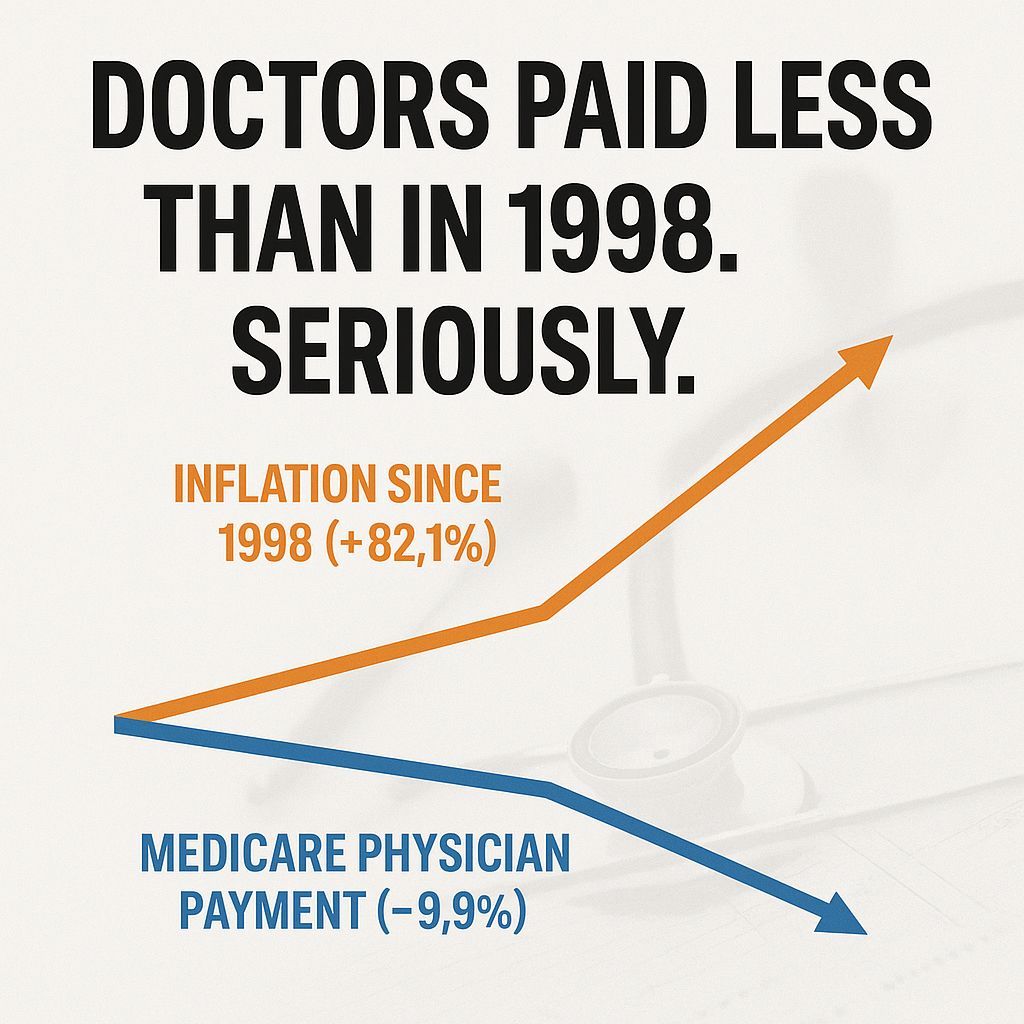
𝐌𝐞𝐝𝐢𝐜𝐚𝐫𝐞 𝐢𝐬 𝐩𝐚𝐲𝐢𝐧𝐠 𝐃𝐨𝐜𝐭𝐨𝐫𝐬 𝟏𝟗𝟗𝟖 𝐰𝐚𝐠𝐞𝐬 𝐭𝐨 𝐩𝐫𝐚𝐜𝐭𝐢𝐜𝐞 𝟐𝟎𝟐𝟓 𝐦𝐞𝐝𝐢𝐜𝐢𝐧𝐞.
𝐒𝐢𝐧𝐜𝐞 𝟏𝟗𝟗𝟖, 𝐢𝐧𝐟𝐥𝐚𝐭𝐢𝐨𝐧 𝐡𝐚𝐬 𝐫𝐢𝐬𝐞𝐧 𝟖𝟐.𝟏%.
Medicare’s physician payment formula (the Conversion Factor)?
Down 9.9%.
That’s not “fiscal responsibility.”
That’s institutional gaslighting.
𝐌𝐞𝐚𝐧𝐰𝐡𝐢𝐥𝐞, 𝐝𝐞𝐟𝐞𝐧𝐬𝐞 𝐜𝐨𝐧𝐭𝐫𝐚𝐜𝐭𝐬, 𝐂𝐄𝐎 𝐬𝐚𝐥𝐚𝐫𝐢𝐞𝐬, 𝐚𝐧𝐝 𝐢𝐧𝐬𝐢𝐝𝐞𝐫 𝐭𝐫𝐚𝐝𝐞𝐬 𝐟𝐥𝐨𝐮𝐫𝐢𝐬𝐡.
But the doctors treating Medicare patients?
They’re being asked to do more with less, year after year, because “𝐡𝐞𝐲, 𝐰𝐞 𝐝𝐨𝐧’𝐭 𝐡𝐚𝐯𝐞 𝐭𝐢𝐦𝐞 𝐭𝐨 𝐛𝐫𝐢𝐛𝐞 𝐂𝐨𝐧𝐠𝐫𝐞𝐬𝐬 𝐥𝐢𝐤𝐞 𝐞𝐯𝐞𝐫𝐲𝐨𝐧𝐞 𝐞𝐥𝐬𝐞”, while the cost of running a practice skyrockets.
If the American people want Congress to preserve access to care for aging Americans, it’s time to speak up and tie Medicare’s payment formula to inflation, just like their own salaries.
𝐔𝐧𝐭𝐢𝐥 𝐭𝐡𝐞𝐧, 𝐠𝐨𝐨𝐝 𝐥𝐮𝐜𝐤 𝐟𝐢𝐧𝐝𝐢𝐧𝐠 𝐚 𝐝𝐨𝐜𝐭𝐨𝐫 𝐰𝐡𝐨’𝐥𝐥 𝐭𝐚𝐤𝐞 𝐌𝐞𝐝𝐢𝐜𝐚𝐫𝐞.
They’re busy trying to survive the 20th century in the 21st.
#HealthcarePolicy #Medicare #PhysicianBurnout #InflationMath #FixTheFormula
@RobSchneider I love you, and I support RFK Jr. for HHS Czar, but all they can legally give are lunches and dinners. All I get is some fast casual here and there. Laws are super strict on it now. Used to be the wild west pre-2009 or so. You can look it up on each doc. "Sunshine laws."
Hospital employment of physicians is the legacy media of healthcare. Safe and generally heading in the wrong direction.
Physicians going out on their own or joining true physician owned practices will be the mavericks, influencers, and will be in control of their destiny.
@jayparkinson Direct [Primary] Care. Hands down. The other "disruptors" are just amplifications of pre-existing trends. The status quo in healthcare is changing like it's changing in the rest of the economy. Widening power gap secured by those with the most power.
New South Park nails it. Health insurance is complete racket: when I was sick (paid into insurance entire life, never used it) at age 33 they tried to deny coverage. MDs at Stanford Oncology had to plead case. Took us weeks. While at my worst. Burn it down
There is no reason that once a journal has completed peer review and accepted a paper that it should not be released on line immediately. Waiting for some conference (often weeks or months away) to present it, so the researcher can get an ovation, delays important knowledge which can be used by real world practitioners immediately.