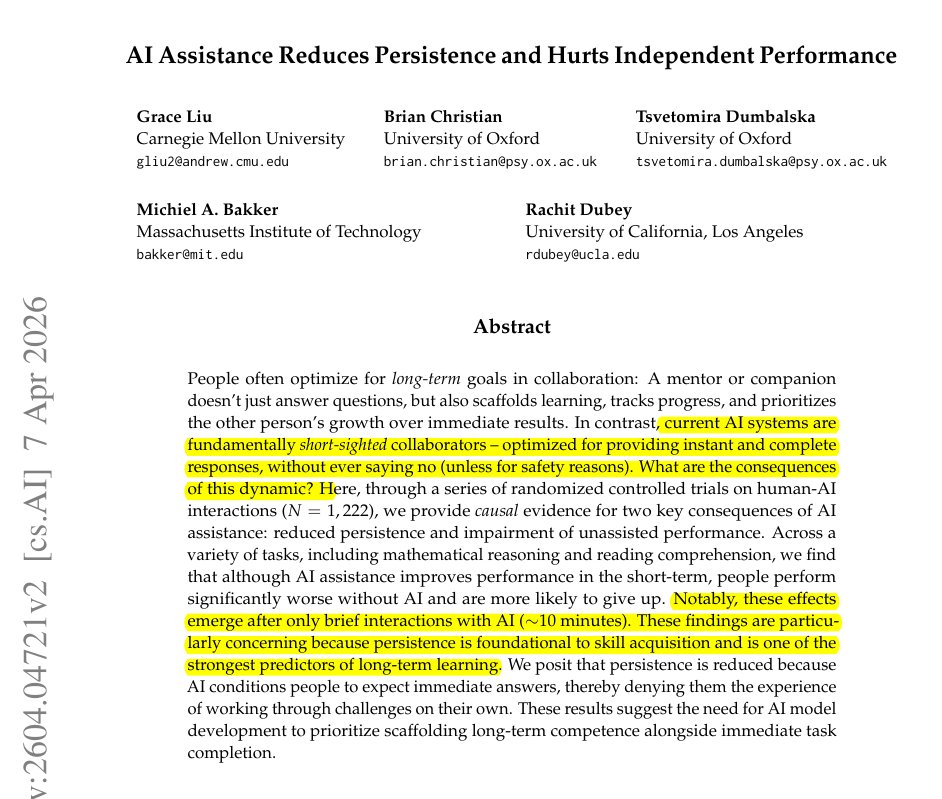
BIG claim from new MIT + Oxford + Carnegie Mellon and other top labs paper:
AI can boost performance at first and then leave people less able to think through problems on their own.
Just minutes of AI help can improve scores now while weakening independent problem-solving right after.
The interesting part is that the damage is not just lower accuracy.
It is lower persistence, which is usually the hidden engine of learning, because skill grows through repeated contact with difficulty, not just exposure to correct answers.
That's why a good teacher sometimes withholds help to preserve struggle as part of the lesson, while today’s chatbots are tuned to erase friction on demand.
Across 3 experiments in math and reading, about 1.2K people either worked alone or used a GPT-5-based assistant for part of the task.
Assisted users finished early questions faster, but after roughly 10 minutes without AI, they solved less, stalled more, and quit sooner.
That happens because hard thinking is not only about getting answers; it is also about building the habit of holding a problem in mind, testing steps, and pushing through confusion.
The sharpest drop came from people who used the model for direct answers, not from those who used it more like a hint system, which suggests the real issue is not AI exposure itself but replacing effort with completion.
The result is not that AI makes people less capable by default, but that answer outsourcing can shrink the mental effort that normally trains skill.
----
Paper Link – arxiv. org/abs/2604.04721
Paper Title: "AI Assistance Reduces Persistence and Hurts Independent Performance"
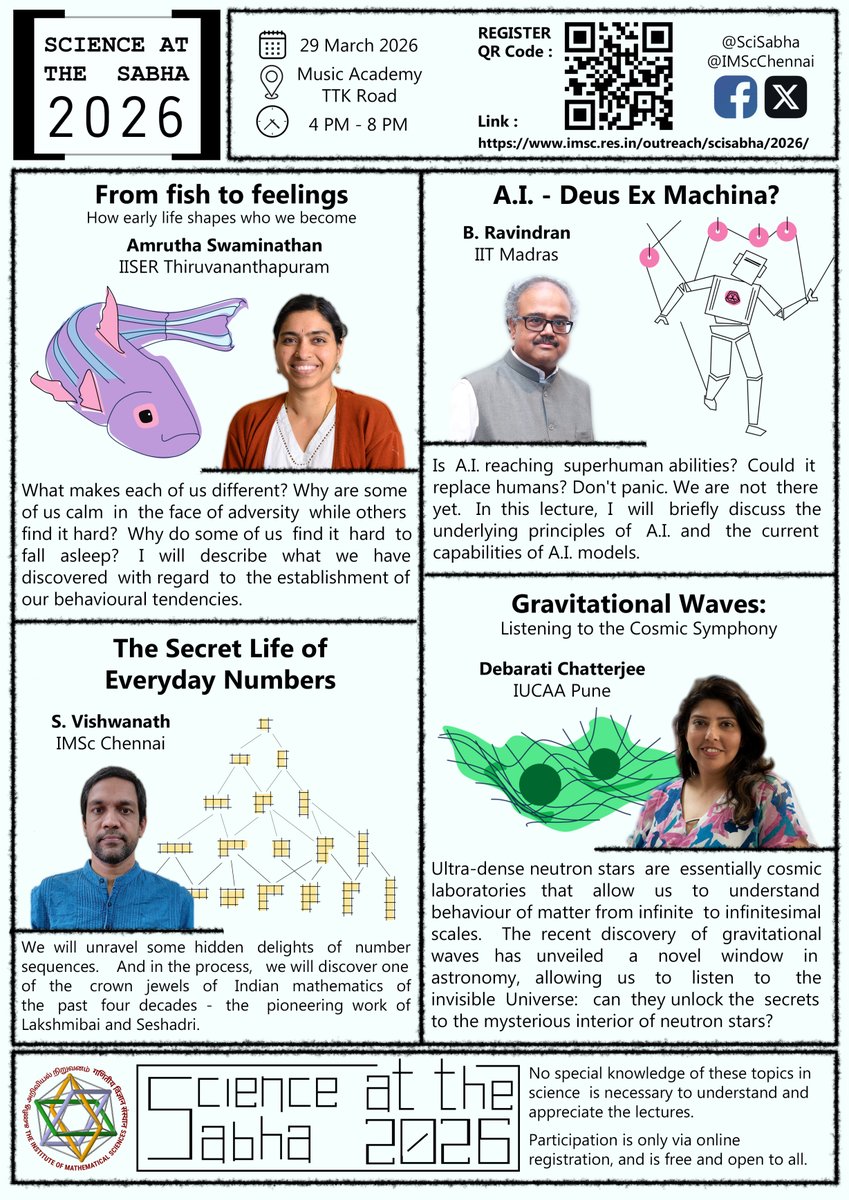
IMSc announces Science at the Sabha 2026 on 29 March, 4-8pm at The Music Academy, Chennai. For details and registration:
https://t.co/crrMCQzg5P
@SciSabha#SatS2026
I think for everyone, there is a pre-you and a post-you, once you’ve experienced what is described herein. But, as stated, you can’t just read about it. You have to do it.
Job seekers in the U.S. and many other nations face a tough environment. At the same time, fears of AI-caused job loss have — so far — been overblown. However, the demand for AI skills is starting to cause shifts in the job market. I’d like to share what I’m seeing on the ground.
First, many tech companies have laid off workers over the past year. While some CEOs cited AI as the reason — that AI is doing the work, so people are no longer needed — the reality is AI just doesn’t work that well yet. Many of the layoffs have been corrections for overhiring during the pandemic or general cost-cutting and reorganization that occasionally happened even before modern AI. Outside of a handful of roles, few layoffs have resulted from jobs being automated by AI.
Granted, this may grow in the future. People who are currently in some professions that are highly exposed to AI automation, such as call-center operators, translators, and voice actors, are likely to struggle to find jobs and/or see declining salaries. But widespread job losses have been overhyped.
Instead, a common refrain applies: AI won’t replace workers, but workers who use AI will replace workers who don’t. For instance, because AI coding tools make developers much more efficient, developers who know how to use them are increasingly in-demand. (If you want to be one of these people, please take our short courses on Claude Code, Gemini CLI, and Agentic Skills!)
So AI is leading to job losses, but in a subtle way. Some businesses are letting go of employees who are not adapting to AI and replacing them with people who are. This trend is already obvious in software development. Further, in many startups’ hiring patterns, I am seeing early signs of this type of personnel replacement in roles that traditionally are considered non-technical. Marketers, recruiters, and analysts who know how to code with AI are more productive than those who don’t, so some businesses are slowly parting ways with employees that aren’t able to adapt. I expect this will accelerate.
At the same time, when companies build new teams that are AI native, sometimes the new teams are smaller than the ones they replace. AI makes individuals more effective, and this makes it possible to shrink team sizes. For example, as AI has made building software easier, the bottleneck is shifting to deciding what to build — this is the Product Management (PM) bottleneck. A project that used to be assigned to 8 engineers and 1 PM might now be assigned to 2 engineers and 1 PM, or perhaps even to a single person with a mix of engineering and product skills.
The good news for employees is that most businesses have a lot of work to do and not enough people to do it. People with the right AI skills are often given opportunities to step up and do more, and maybe tackle the long backlog of ideas that couldn’t be executed before AI made the work go more quickly. I’m seeing many employees in many businesses step up to build new things that help their business. Opportunities abound!
I know these changes are stressful. My heart goes out to every family that has been affected by a layoff, to every job seeker struggling to find the role they want, and to the far larger number of people who are worried about their future job prospects. Fortunately, there’s still time to learn and position yourself well for where the job market is going. When it comes to AI, the vast majority of people, technical or nontechnical, are at the starting line, or they were recently. So this remains a great time to keep learning and keep building, and the opportunities for those who do are numerous!
[Original text; https://t.co/zbIhZHfCC0 ]
We're going through the ABCs of @IBM 🌐 CEO @ArvindKrishna sat down exclusively with our @jonfortt, discussing the company's relationship with China, blockchain initiatives and outlook for enterprise tech in a volatile market.
Join an online Ask Me Anything session on Sat, Jul 23 at 11:00AM IST to talk with Pavan Adhav, #Blockchain Lead at Paramount, about Hyperledger Fabric.
https://t.co/XRnqgcOXuP
Interested in #tokenization? Join for a virtual meetup on Thu, Apr 28 @ 17:00 CET for a discussion about how token classes, like fungible, non-fungible, ERC20, 721 or 1155 tokens can be realized on enterprise ledgers like Hyperledger Fabric & Besu.
https://t.co/3H200Le1pB