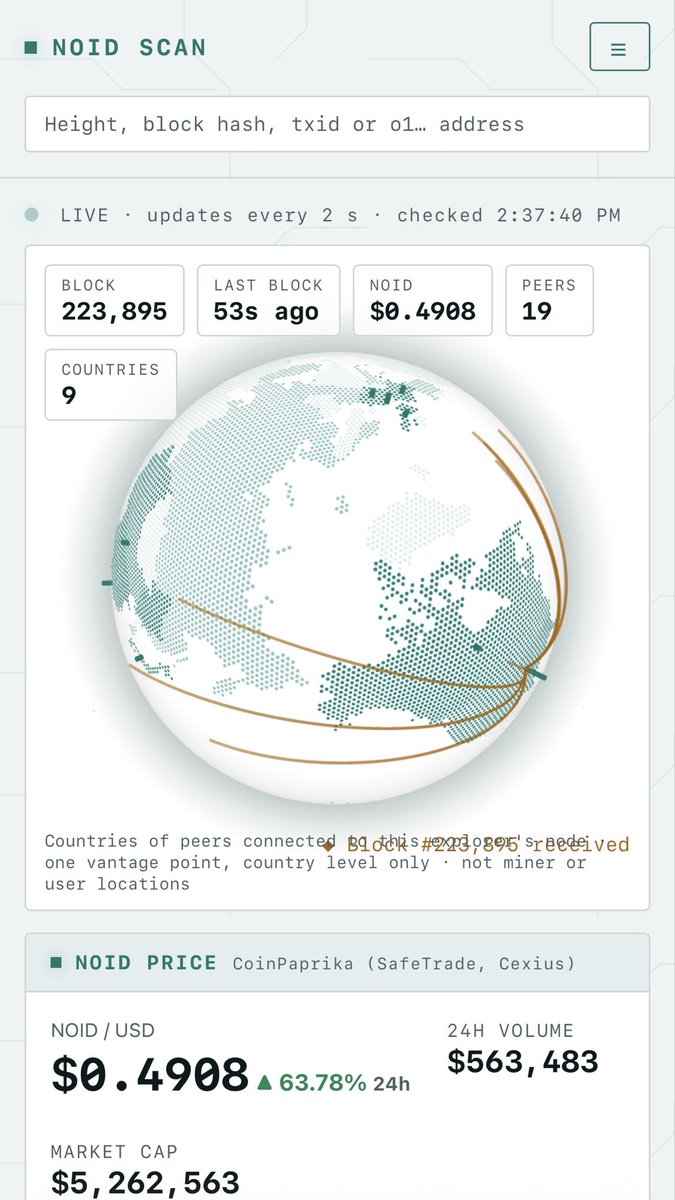
Parano1d prunes old block data to keep nodes light ✂️. That's great for the chain, but it means the history disappears .
Parano1d Scan keeps it 📄. We archive every block, transaction and replaced block, so the full history of $NOID is still there long after nodes drop it.
Need old transactions, address history or chain data? https://t.co/fKpnlKl7re is where it lives. API access is available too.
Transparent proof-carrying state over binary tower fields, running on a live PoW mainnet, with the soundness proofs and code linked.
$NOID is backed by real research.
https://t.co/DeOrwBvApk
Mathematics behind Parano1d's proof-native architecture.
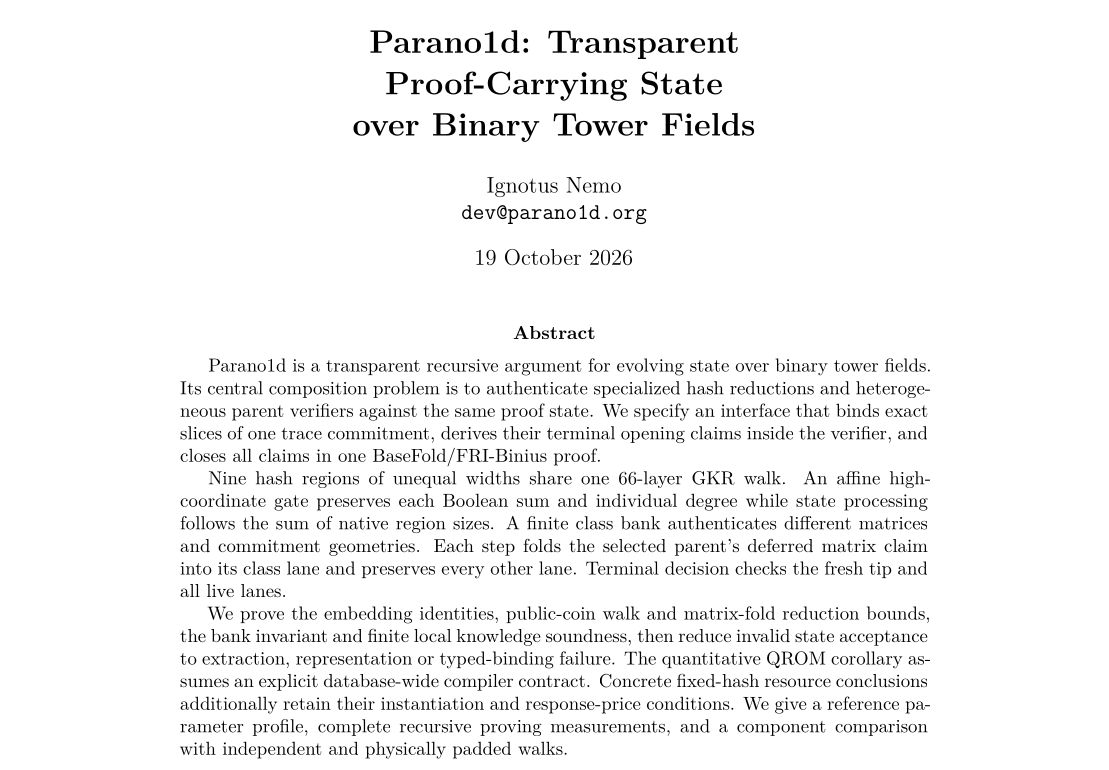
Preprint published: Transparent Proof-Carrying State over Binary Tower Fields
https://t.co/8Sn90UKvLr
Recursive State verification, authenticated GKR reductions, heterogeneous recursion, security bounds and real proving benchmarks. Theorems, proofs, reproducible experiments and open research questions.
Inside Parano1d v2.1...
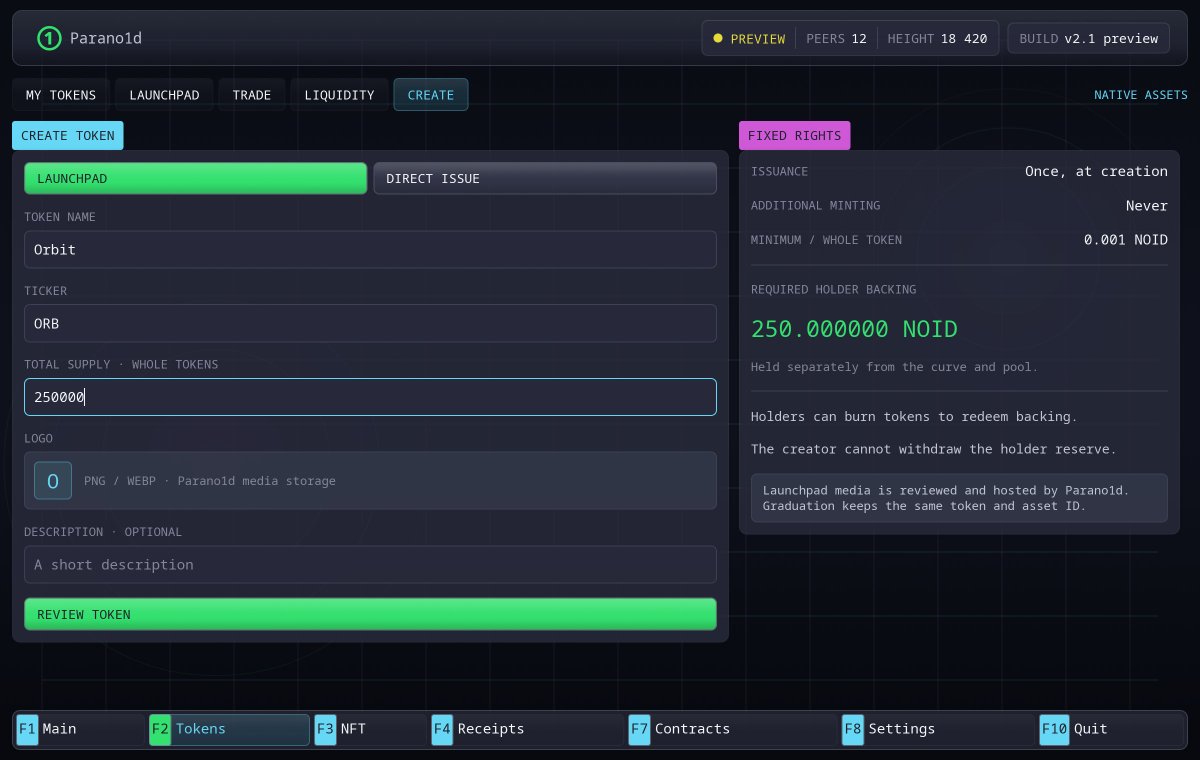
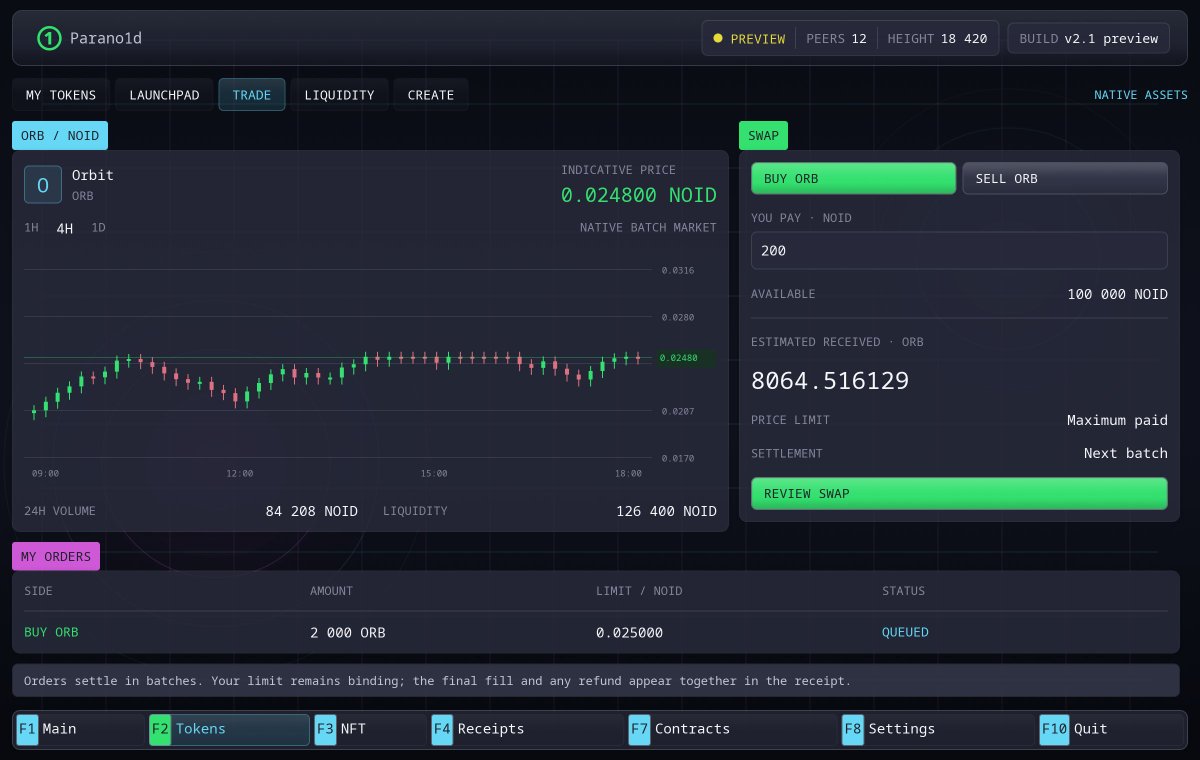
An entire financial ecosystem, built into the existing proof-native L1. Native tokens backed by $NOID. Launchpad, bonding curves, DEX, liquidity pools, atomic swaps and NFTs. All inside the wallet.
No signatures. No EVM. No L2.
Every financial operation becomes part of a proven State transition, recursively verified all the way back to genesis.
One post-quantum proof stack. From ownership to execution to consensus.
We're not changing the architecture to build DeFi.
We're making it capable of DeFi in a post-quantum world.
https://t.co/zIqCUoT0Vu
I think meme launchpads have destroyed a lot of trust in crypto. Centralized stablecoins aren't much better. A handful of people can freeze funds at any address or issue more tokens whenever they want. How is that decentralization?
I don’t want to carry this into a post-quantum future where a few people get rich at the expense of thousands. So I’m considering a different approach for Parano1d.
Every native token would launch with a minimum initial NOID reserve locked by the protocol. Holders could burn their tokens to redeem their proportional share. Creators would have no privileged withdrawal rights, and additional issuance would have to preserve the NOID backing per token.
Tokens could still trade freely at market prices, including through liquidity pools. The right to redeem a proportional share of the NOID reserve would travel with the token.
Enforceable financial rights, built into the protocol and verified by block proofs.
What do you think?
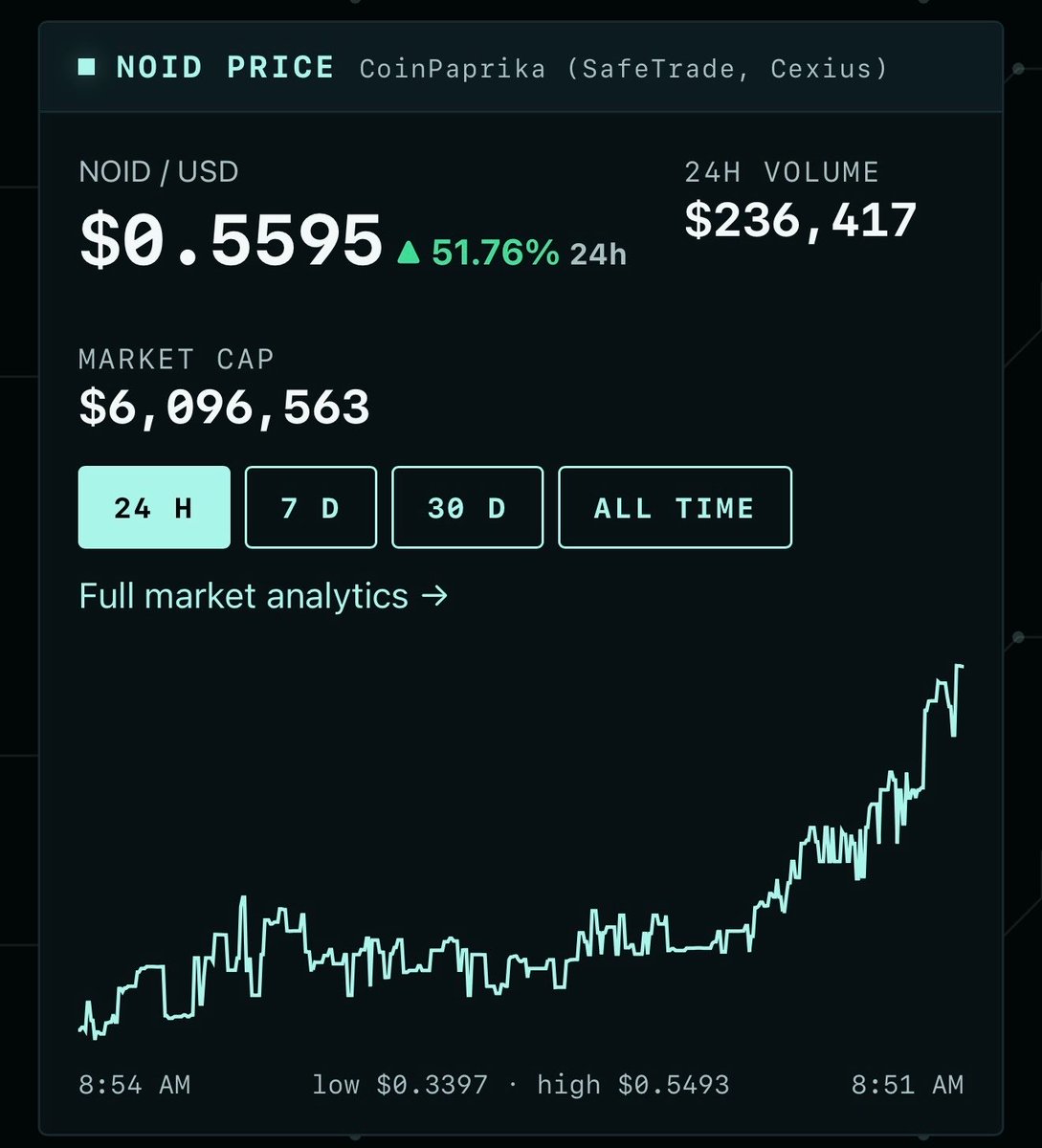
$NOID mainnet was around 0.36 TH/s on October 6th. Now it’s 1.47 TH/s. Four x in 10 days. Poseidon2b is efficient enough that modest hardware punches way above its weight.
The network launched as a fair launch proof of work chain. Issuance declines on a fixed height based schedule that settles into a permanent tail emission. Persistent storage is priced by live state occupancy rather than by elapsed time. The market has not yet priced in a chain built post quantum and proof native from genesis.
The V2 upgrade makes the practical scope clearer. A live output can encode programmable rights over value: who is allowed to claim, under what conditions, in what amounts, and who retains the ability to recover the remainder. The model fits agent payments, delegated budgets, staged releases, and prepaid services that need verifiable conditions without relying on a trusted API.
There are no elliptic curves. There are no traditional signatures published on chain. There is no trusted setup. Recursive proofs keep verification constant time for the life of the chain. Bounded proof native contracts handle concrete financial agreements without requiring new circuits for each application. This is completely different architecture, rather than a patch on an older one.