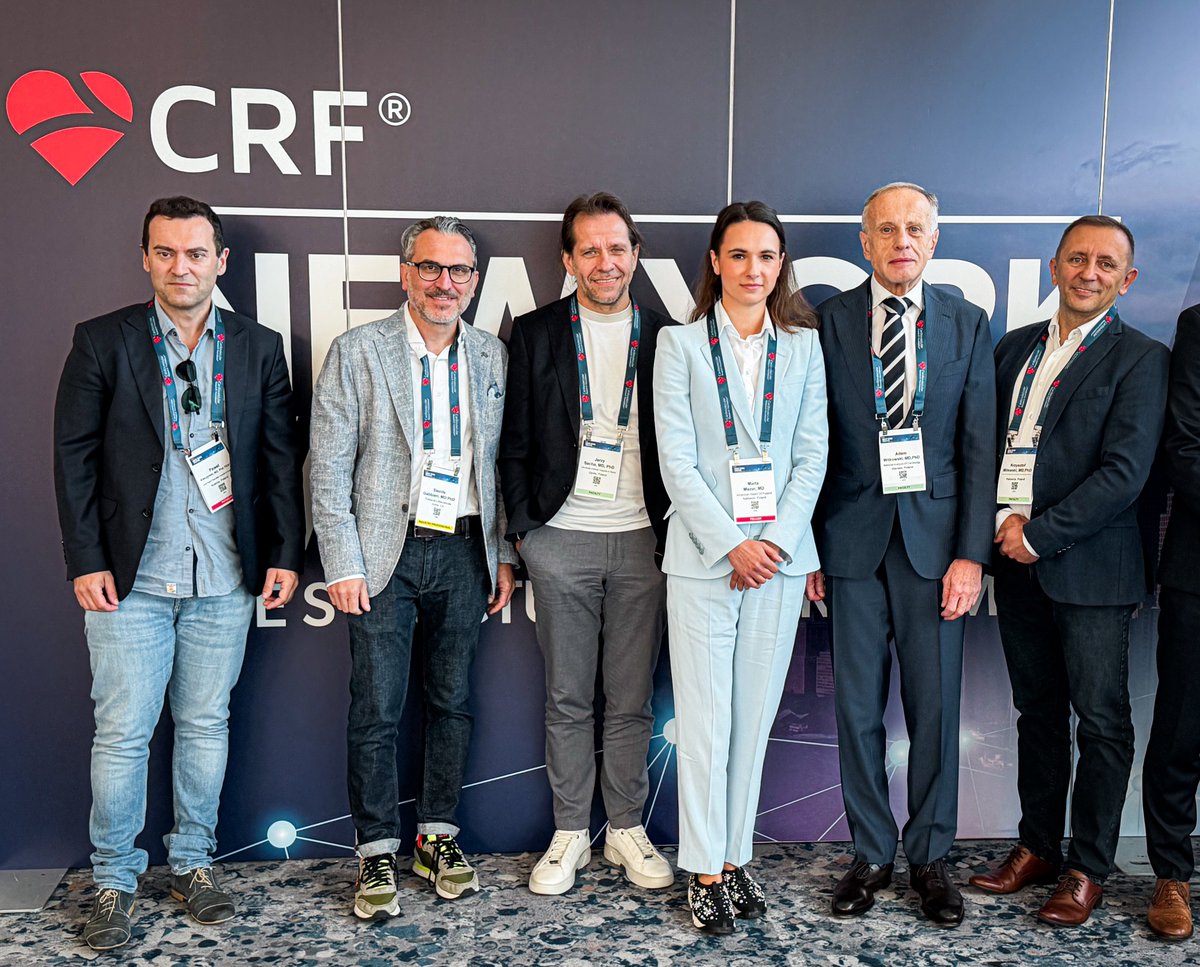
#PCRCIT China Chengdu Valves left a strong impression on me. 🇨🇳
My sincere thanks to Prof. Mao Chen, his team and the #PCRCIT organizers for the warm welcome and the opportunity to see technologies that define the next chapter of structural heart disease. 🚀
An important visit for me, scientifically, professionally and personally. ⭐️
@PCRonline@nicolasdumonte1@EmanueleBarba13@dottormaisano@dmylotte@modine_thomas
The deadline for the the EAPCI 2027 Call for Technology & Innovation is fast approaching 🚨
We are looking for pioneering solutions that will transform cardiovascular interventions including:
⚙️ Novel devices & technologies
🤖 AI, digital health & robotics
🔬 Advanced imaging
📚 Next-gen education & training tools
There is still time to showcase your innovation on the European stage 🫀
⏳ Deadline: 1 October 2026
🔗 Submit your innovation today: https://t.co/0r2HwbdX1J
#EAPCIinnovation #EAPCI27 #EAPCIcommunity
@escardio
Hi all,
The Lp(a) HORIZON trial has released topline data and, quite shockingly, missed its primary endpoint.
In other words, lowering Lp(a) in patients with prior MI, stroke or peripheral arterial disease, who were otherwise very well treated for LDL-C, blood pressure, diabetes and other risk factors, did not reduce the primary cardiovascular endpoint.
We obviously need to see the full data before making firm conclusions, and I don’t want to speculate too much without the details.
But this is a big enough result that it is worth summarizing what we know, what we don’t know, and what this may mean for our patients after 20+ years of trying to test the “Lp(a) hypothesis.”
What we know:
1-There are hundreds if not thousands of genetic, epidemiologic and Mendelian-randomization studies showing that elevated Lp(a) is associated with MI, stroke, peripheral arterial disease and aortic stenosis. That body of evidence is very strong.
2-However, much of those data come from community-based populations, often before the era of intensive LDL-C lowering and modern secondary prevention.
3-There has been much less information about how much residual risk Lp(a) carries in someone who has already had an event and is then treated very aggressively.
4-HORIZON may have had some of the best-treated patients of any recent cardiovascular outcomes trial.
Baseline LDL-C was about 65 mg/dL, a measured LDL-C contains the cholesterol carried on Lp(a), so in reality, 15-20 points lower.
5-In patients with very high Lp(a), if you correct LDL-C for Lp(a)-cholesterol, the actual LDL-C carried by LDL particles may have been closer to 45–50 mg/dL, perhaps even lower in some patients.
6-This raises a very basic question:
Can you still demonstrate a major incremental benefit from lowering another apoB-containing particle when the underlying LDL burden has already been driven this low?
What we don’t know:
1-What was the actual corrected LDL-C in these patients? I think it would be extremely informative to directly measure Lp(a)-C and calculate corrected LDL-C. This may tell us a lot about the biological setting in which pelacarsen was being tested.
2- What was the OxPL status? Our prior work has suggested that much of the pro-inflammatory biology associated with Lp(a) is related to its enrichment in oxidized phospholipids. Did OxPL fall? Did patients with higher OxPL derive more benefit? Was Lp(a) concentration actually identifying the patients with the most pathogenic particles?
3- Did we measure the right component of Lp(a) for trial inclusion? We generally measure molar particle concentration. But is molar concentration itself the main driver of risk, or is it partly a surrogate for what the particle carries? Cholesterol? Triglycerides? Oxidized phospholipids? Other proteins? Could two patients with the same Lp(a) concentration have very different Lp(a)-mediated risk? I think this question deserves much more attention.
3- Were the genetic data telling us exactly what we thought they were telling us? The genetic data are extremely compelling, but genetics reflect lifelong exposure. A clinical trial treats patients late in life, often after decades of arterial injury and after an event has already occurred. Those are not necessarily the same experiment. Could there also be some unrecognized biology linked to the LPA locus that we have not completely accounted for? That possibility should at least be considered.
3- Does very low LDL-C modify the Lp(a) risk relationship? Maybe Lp(a) is particularly important when LDL-C is higher, but its contribution becomes smaller once LDL-C is driven to very low levels. Again, we need the data.
4- Does aspirin or other antiplatelet therapy reduce part of the risk associated with Lp(a)? Lp(a) has potentially important prothrombotic effects. Almost everyone in a trial like HORIZON is receiving contemporary antiplatelet therapy. Could that blunt one component of the risk associated with Lp(a)?
5- Why are these patients still having events? This may be one of the most interesting questions of all. These are patients with LDL-C around 65 mg/dL, and perhaps corrected LDL-C substantially lower, yet cardiovascular events continue to occur. What is driving that residual risk? Inflammation? Thrombosis? Plaque burden that is already too advanced? Other lipoprotein characteristics? Something we are not measuring?
6- Do we need to re-examine some basic assumptions about atherosclerosis? We have spent decades focusing heavily on the quantity of circulating lipoproteins. But perhaps lipoproteins are relatively benign until they undergo biological modification in the artery wall. Oxidation may be one of those key modifications. For some patients, the answer may be to remove more particles from the circulation. For others, perhaps the better approach is to prevent their oxidation or block the downstream biological effects of oxidized lipids. The recent difficulties with anti-inflammatory approaches, including IL-6 inhibition, make these mechanistic questions even more interesting.
7- Was there something specific about pelacarsen, the degree or timing of Lp(a) lowering, advanced disease, trial duration, background therapy or patient selection that mitigated a potential benefit? We simply don’t know yet. That is why the detailed results will be so important.
What does this mean for patients today?
If you have already had an MI, stroke or PAD, the immediate lesson is very clear:
1- Get all of your established risk factors treated aggressively.
2- Get LDL-C/apoB very low.
3- Control blood pressure.
4- Control diabetes.
5- Don’t smoke.
6- Use appropriate antiplatelet and other guideline-directed therapies.
HORIZON shows us what modern secondary prevention should look like.
If you have elevated Lp(a) but have never had an event, the genetic and epidemiologic data still suggest increased lifetime risk.
Until the other 4 outcome trials read out, I would continue to treat every modifiable risk factor aggressively.
We should wait for those trials before drawing broad conclusions about the entire field.
I think the story of Lp(a) therapy is beginning, not ending.
We also need to show tremendous respect and gratitude to the patients who participated in HORIZON and to the investigators and companies that invested enormous resources to actually test the Lp(a) hypothesis, to the ultimate benefit to peole with elevated Lp(a) to best guide how to manage risk.
More to come as we go forward.
The EAPCI 2027 Call for Technology & Innovation is officially OPEN 🫀🚀
We are looking for pioneering solutions that will transform cardiovascular interventions including:
⚙️ Novel devices & technologies
🤖 AI, digital health & robotics
🔬 Advanced imaging
📚 Next-gen education & training tools
Share your breakthroughs with a global network of experts in Milan and help shape the next decade of cardiovascular interventions! 🌍
⏳ Submission Deadline: 1 October 2026
🔗 Discover more and submit: https://t.co/0r2HwbeuRh
@escardio
#EAPCIinnovation #EAPCI27 #EAPCIcommunity
Be a part of EAPCI and apply to become a Committee Member for the 2026-2028 mandate 🧑🧑🧒🧒🫀
🌍 This is your opportunity to actively contribute to our community and collaborate with colleagues across ESC National Societies and Affiliated Countries
📌 Important Details:
👤 Eligibility: You must be an EAPCI Member to apply
⏰ Deadline: 26 July 2026
📢 Results Announcement: September 2026
🔗 Submit your application today: https://t.co/80zebWV0jJ
Not a member yet? Join Today: https://t.co/yw6iY4Xpuv 🚀
#EAPCIfamily #EAPCIcommunity #EAPCIcommittees
@escardio
At #NYValves2026 🇺🇸 I think of a lesson from my Polish mentors that real progress comes from teamwork, effort, and staying together.
Our research and clinical contributions presented here in New York are built on years of work, trust, and collaboration back home in Poland 🇵🇱.
I feel privileged to be part of this team and to keep learning from such people. They are precious.
@CRFHeart@PCRonline@aisnptk@PTKardio@escardio
Full Heart Team Arena today at today’s joint @CRFheart and @PCRonline late-breaking TAVR session at #NYValves2026.
🔹PARTNER 3, EARLY TAVR, VA-CART Evolut, Evolut durability/reintervention, and low-risk bicuspid Evolut data.
An excellent example of 🇺🇸 & 🇪🇺 collaboration! 💎
Excellent best-practice document on redo-TAVR from the Heart & Valve Collaborative, being presented today at #NYValves2026 and now published in JACC Journals.
Congratulations to all co-authors for this achievement!
Prospective data from #ReTAVI (30 day data published!), #ReValve and #RESTORE will now be key to further refine this space. 💡
@G_Tarantini01@DanBlackman7@GuiAttizzaniMD
FINALLY HERE #JACCINT@JACCJournals in time for simultaneous publication at #NYValves2026! Our international group of #TAVR#TAVI experts convened to produce this Heart & Valve Collaboratory (H&VC) 2-part BEST PRACTICE document on REDO-TAVR, from concepts to planning to procedural execution to troubleshooting / complication mitigation. Hope you'll find the KEY PRACTICAL TAKEAWAYS useful in your daily practice encountering the growing volume of failed #TAVR. We look forward to producing an annual update as we publish more data and evidence on this topic, since no doubt the best practices will evolve with time.
Thank you to ALL THE CO-AUTHORS who collaborated on this monumental effort!
Part 1: Short-in-Short, Short-in-Tall
https://t.co/ho9A97XE3i
Full PDF here
https://t.co/bvcBrSGvBD
Supplement:
https://t.co/cLtsFMDbGw
Part 2: Tall-in-Short, Tall-in-Tall
https://t.co/GEWhbrGKmK
Full PDF here
https://t.co/thyAE3AEFD
Supplement:
https://t.co/Lzxwa1d78p
Proud to have helped curate the 2-part landmark special issue on LEAFLET MODIFICATION (LM) in #JACCINT@JACCJournals with Editor-in-Chief David Moliterno and Vasilis Babaliaros to celebrate the 10-anniversary of the 1st leaflet modification done in the world (LAMPOON)! Grateful to be a senior author and co-author of several papers.
https://t.co/BfuHHMYn6B
https://t.co/opVuDDe44D
Congrats to all the authors from around the world who have contributed to this seminal effort!
Key highlights:
Leaflet modification algorithms:
https://t.co/CnBv8MP8js
AORTIC Leaflet Modification
BASILICA step-by-step review:
https://t.co/LTKQA9kLpL
UNICORN step-by-step review:
https://t.co/xvLJhnqVkg
"Split-line" Concept in LM in Redo-TAVR:
https://t.co/jmonmoxsuE
UNICORN benchtop validation in redo-TAVR: works better with failed Sapien, Evolut, Acurate than Navitor:
https://t.co/mLX8u0iEmI
UNICORN registry:
https://t.co/Xz1eWwpiKZ
Bench testing showing UNICORN more effective than (BA)BASILICA in Redo-TAVR:
https://t.co/snsi2oMtPI
Bench testing showing LM in redo-TAVR dependent on TAV type, constraint, 2nd TAV implant. BASILICA no effect on Navitor and BA-BASILICA better with failed Evolut + Acurate
https://t.co/p6LBcvQ6jV
HALT reduction with leaflet modification in VIV #TAVR:
https://t.co/RkqkHRBdv4
Bench testing on LM of calcified native and SAV leaflets showed higher Ca burden increased laceration difficulty, leaflet tears and embolic debris; less spray with shorter leaflet length
https://t.co/2jjGfol5c0
LOFTER-TAVR registry:
https://t.co/nYrXz5NZAa
CT simulation of LM impact on Redo-TAVR Feasibility:
https://t.co/1s4zmf15uv
Fluoro Left-Main Frame Alignment View to Evaluate coronary obstruction in redo-TAVR:
https://t.co/RplVZPEQxY
FIH wire anchoring-assisted BASILICA/UNICORN:
https://t.co/NjzGYtFyuY
FIH tricupsidization of bicuspid native #TAVR
https://t.co/P3HZIDRSFP
Mitral Leaflet Modification
LAMPOON/BATMAN step-by-step:
https://t.co/1gtedQXmP8
BATMAN registry
https://t.co/30rWokpCE2
TRICUSPID Leaflet Modification
ELASTA-T for failed T-TEER to facilitate TTVR step-by-step:
https://t.co/0TIECD3yus
Mechanisms of failed BASILICA/LAMPOON/SEASAME:
https://t.co/oqH9okmTPw
The number of redo-TAVI procedures is expected to rise substantially as indications expand to younger patients with aortic stenosis who are likely to outlive their index transcatheter heart valve. The ReTAVI registry represents the first prospective, multicentre evaluation of redo-TAVI providing systematically collected, core lab-adjudicated data on procedural feasibility and early outcomes. https://t.co/sG8MlMFkbL