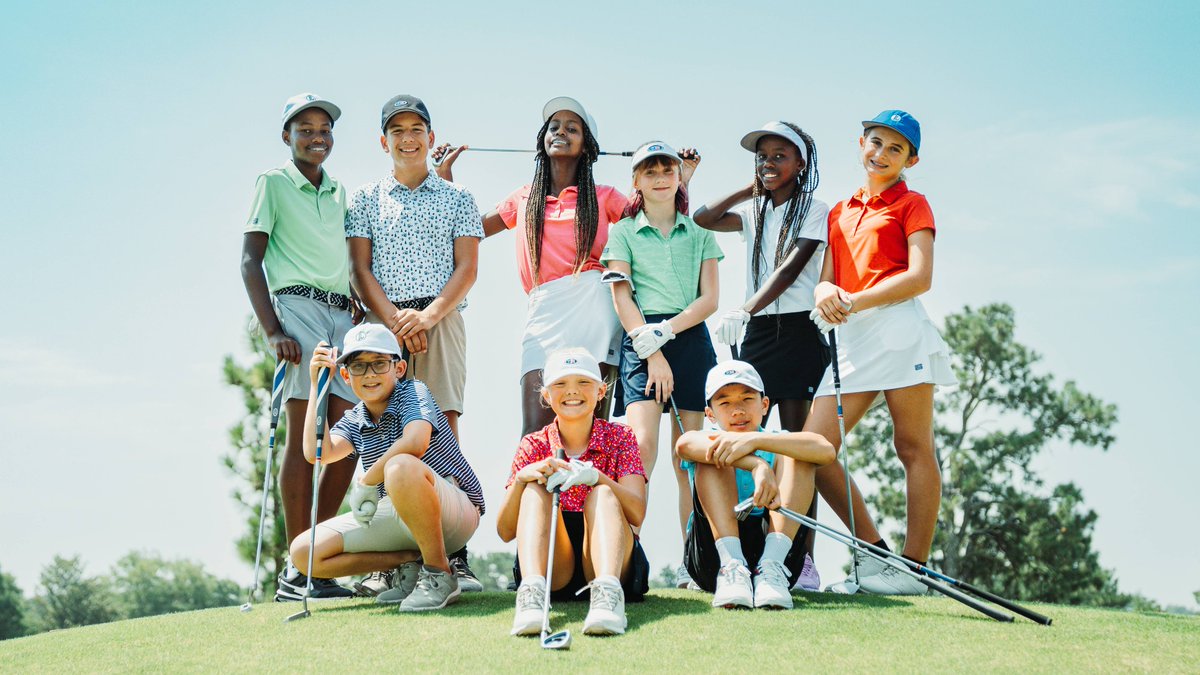
Most families don’t need another movie night.
They need one activity where:
- everyone competes
- everyone talks
- phones disappear
- kids build confidence naturally
Family golf night might quietly be undefeated.
Did I just ace a 373 yard par 4 at 9800 ft elevation?
I think so, BUT... I didn't see the ball go in.
I found my ball short and right of the green which was odd because my tee shot was tracking dead on with the front left pin. After chipping up to the green, I found another ball in the hole - exactly matching the one I hit from the tee AND the ball I chipped up to the green.
What do you think, golf friends?
Too many junior golfers quit because adults accidentally turn every round into a performance review.
Kids don’t need swing thoughts on every tee box.
They need:
• Challenges
• Incentives
• Confidence
• Momentum
• A reason to want the next shot
Junior golf has a branding problem.
Too many kids experience golf as:
- lessons
- pressure
- tournaments
- swing mechanics
Not enough experience:
- games
- creativity
- family competition
- fun
Golf coaches are expected to teach six different skill levels on a single hole using a single scoring system.
That is wild.
A total beginner and a competitive junior should not be playing the same version of the game.
Par Points gives coaches a better way to run practice.
Most junior golf programs make one big mistake.
They teach kids how to play “real golf” before helping them feel that golf is worth playing. A 7-year-old does not need to grind over a double bogey. They need a game they can win today.
That is what Par Points does.
The fastest way to make kids love golf?
Stop making every round feel like a lesson.
Make it feel like a game.
Trash talk.
Challenges.
Ice cream bets.
Team matches.
ParPoints.
Fun first.
Improvement second.
Ironically, that’s usually how improvement happens anyway.
A game built around progress instead of punishment.
That’s the future of junior golf.
Less “play it like the adults.”
More “make the game fit the kid.”
A starter brought his grandkids to the course.
Ages 6, 8, and 9.
The worry was obvious:
Would they slow everyone down?
Would they get frustrated?
Would golf feel too hard too soon?
Then they used Par Point.
Different starting spots.
Simple goals.
Normalize parents and kids talking trash on the golf course again.
Nothing builds family chemistry faster than a $1 putting challenge and someone getting humbled from 3 feet.
Most junior golf programs are accidentally teaching kids to quit. Not because the coaching is bad.
Because the format is brutal.
A 7-year-old should not need to make a double bogey from 180 yards to feel like they “finished” a hole.
Normalize parents and kids talking trash on the golf course again.
Nothing builds family chemistry faster than a $1 putting challenge and someone getting humbled from 3 feet.
Junior golf has a retention problem.
Not because kids hate golf.
Most kids are asked to play a version of golf built for adults.
Long holes.
Big numbers.
Slow rounds.
Constant frustration.