My OpenClaw agent woke me up at 3:47 AM with one message:
"6 markets resolving in the next 90 minutes. Need approval for $12K."
I typed “yes” and went back to sleep.
Woke up to +$43,800.
For the past 9 days I’ve been running an agent that hunts timezone arbitrage on Polymarket.
The setup is simple.
I gave the agent access to global sources:
• Japanese government RSS
• EU parliament streams
• Australian financial wires
• Middle East flight trackers
• Asian central bank announcements
Then I told it:
"Alert me when a market resolving during US sleep hours (2–6 AM EST) shows >30% edge."
At 3:47 AM it detected 6 markets where the outcome
was already clear in local sources — but Polymarket prices hadn’t moved yet.
Copytrade →https://t.co/IPY41UFgnZ
Wallet →
https://t.co/LBKptzhWfV
Examples the agent caught:
• **Japan rate decision — signals showed ~68%, market at 23¢
• **European Parliament vote — livestream showed YES ahead, market 31¢
• **South Korea policy update — RSS confirmed, market 19¢
• **Australia trade deal — minister quote out, market 27¢
• **OPEC notes on **United Arab Emirates production cut — market 15¢
• **Singapore regulation vote — parliament session live, market 22¢
Total capital deployed: $12,000
By 7:30 AM all six markets had resolved.
Entries: 15¢–31¢
Payouts: 95¢–$1
Final result: +$43,800
The edge is simple:
Most Polymarket traders are in the US.
But global events resolve while America sleeps.
By the time the US wakes up - the markets are already closed.
Operation #CyberShakti Phase 1:
A massive cyber attack was launched against the terrorist state Pakistan by the regular every day civilians of India.
This costed Pakistan millions of dollars in damages in the last 24hrs alone.
Our mission is simple: to decimate every last piece of Pakistan’s digital infrastructure with ABSOLUTELY ZERO RESTRAINT.
Here’s a small glimpse of the things we can share with the public as of now:
All media channels, digital platforms and individuals are advised to refrain from live coverage or real-time reporting of defence operations and movement of security forces. Disclosure of such sensitive or source-based information may jeopardize operational effectiveness and endanger lives. Past incidents like the #KargilWar, 26/11 attacks, and the #Kandahar hijacking underscore the risks of premature reporting. As per clause 6(1)(p) of the Cable Television Networks (Amendment) Rules, 2021, only periodic briefings by designated officials are permitted during anti-terror operations. All stakeholders are urged to exercise vigilance, sensitivity, and responsibility in coverage, upholding the highest standards in the service of the nation. 🇮🇳
Read more: https://t.co/bHscgUBMEV
#MediaAdvisory #NationalSecurity #MIBIndia #ResponsibleReporting
@rajnathsingh@DefenceMinIndia@SethSanjayMP@HQ_IDS_India@adgpi@indiannavy@IAF_MCC@PIB_India
TRUTH ABOUT INDIA and PAKISTAN!
Let me break this down before the radical left-wing media spins more lies and the jihadis in America start crying and claiming victimhood, let’s get the facts straight.
India Just Struck Back, Here’s Why:
On May 7, 2025, India launched Operation Sindoor, a decisive strike against terror camps within Pakistan-controlled territory.
These weren’t random targets. India hit known Islamic terrorist hubs used to train and launch attacks against Indian civilians and soldiers.
This wasn’t a drill. This was a calculated response to the Pahalgam Islamic massacre on April 22, 2025, when 27 Hindu tourists were executed in cold blood by terrorists backed by Pakistan.
These innocent civilians....newlyweds, families, honeymooners...were forced to strip, recite Islamic prayers, and prove their religion. When they couldn’t, they were shot on sight. They were slaughtered for not being Muslim.
Who Did India Target?
India hit key terror camps belonging to three of Pakistan’s most notorious jihadist groups. These camps are the core infrastructure of Pakistan’s proxy war strategy against India, housing radical Islamist fighters who routinely infiltrate Kashmir and conduct attacks on Indian civilians and military personnel.
1. Jaish-e-Mohammed (JeM)
A Deobandi jihadist group, JeM is known for carrying out some of the deadliest attacks on Indian soil, including the Pulwama attack (2019). It operates with direct support from Pakistan’s ISI and often functions openly in Pakistan. JeM openly advocates for violent jihad to separate Kashmir from India.
JeM Targets Hit:
Markaz Subhan Allah, Bahawalpur: A major training center for JeM militants, located in Punjab province, Pakistan. Known for recruiting, radicalizing, and arming jihadists.
Sarjal, Tehra Kalan: A strategic base used for combat training and logistics, located in Pakistan-administered territory.
Markaz Abbas, Kotli: A JeM hub involved in indoctrination and weapons training. Key for recruiting local youth for terrorist missions.
Syedna Bilal Camp, Muzaffarabad: An operational base in the Muzaffarabad region, frequently used for launching cross-border attacks into Indian territory.
2. Lashkar-e-Taiba (LeT)
LeT is one of the most dangerous Islamist militant groups globally, responsible for the 2008 Mumbai attacks that killed over 160 people, including foreign nationals. Despite being internationally condemned, LeT continues to operate under the guise of charity organizations and receives significant state support.
LeT Targets Hit:
Markaz Taiba, Muridke: The headquarters of LeT, openly functioning as a “charitable trust” while training militants for suicide missions.
Markaz Ahle Hadith, Barnala: A LeT-affiliated center camouflaged as a religious and educational institution but actively involved in terror training.
Shawai Nalla Camp, Muzaffarabad: A forward operating base for LeT, strategically located for cross-border incursions. Used for arms smuggling and militant training.
3. Hizbul Mujahideen (HM)
HM is the largest Islamist militant group in Kashmir, heavily backed by Pakistan’s ISI. It aims to create separatist insurgency in Kashmir and is responsible for numerous attacks on both civilians and Indian security forces.
HM Targets Hit:
Mehmoona Joya, Sialkot: A logistics center for HM operations, located near the border, facilitating recruitment and weapon distribution.
Maskar Raheel Shahid, Kotli: A training ground for urban warfare and guerrilla tactics. Essential for training new recruits before deployment into Kashmir.
Why Did India Strike?
Because Pakistan has been harboring, training, and equipping jihadists for decades. The Pahalgam massacre was the final straw, India had to respond to protect its citizens from state-sponsored terrorism.
India’s response was not just justified...it was long overdue.
Pakistan’s proxy war using terror groups has cost countless Indian lives.
Pakistan’s Pathetic Propaganda
After getting hit hard, Pakistan did what it does best: lie. Here’s how they tried to cover up their embarrassment:
Claimed to have shot down Indian jets (no proof).
Claimed to have attacked Srinagar Airport (shared a fake video from 2024).
Claimed to have captured Indian soldiers (retracted by their own Defense Minister).
Claimed missile strikes at 15 Indian locations (completely fabricated).
Why Is Pakistan Panicking?
Because they know the world is watching and their terror state status is under the spotlight. If Pakistan wasn’t a terror state, they’d be thanking India for eliminating jihadist breeding grounds. But NO they’re angry because they support terrorism.
(All of the Pakistani Imam's in America like in America are ALSO angry - which our government should be monitoring)
Instead of condemning the Pahalgam massacre, Pakistan is playing victim - spinning tales about nuclear threats and false flag operations. They’re desperate to look strong for their domestic audience, even if it means fabricating stories.
Radical Left-Wing Media - Stop the Lies
While Western journalists and Islamic apologists scramble to portray Pakistan as the victim, the truth is clear:
India didn’t attack randomly - it targeted terror camps responsible for massacres.
India is not the aggressor - it’s defending itself from decades of jihadist violence.
Western media needs to wake up and stop glorifying terrorists just because they’re backed by Pakistan.
To All the Jihadis Crying Victimhood in America:
Enough with the fake victimhood narratives. You support Pakistan’s terrorism, you cry about Indian retaliation, but you never condemn the brutal killings of innocent Hindus.
India is done being silent. The world sees Pakistan for what it is - A TERROR STATE!!!
India’s Message to Pakistan:
You can’t hide behind fake news and propaganda. You can’t cover up your terror state status. The world knows nd no amount of lies and victimhood will save you.
To Everyone Else:
Stay vigilant. Stay informed. Don’t buy the same old narrative that Pakistan is the victim when they are the architects of terrorism. Stand with India’s right to defend itself.
AND GET PAKISTANI RADICALS OUT OF AMERICA!!!
Massive cyber attack could also be attempted by Pakistan.
- Do not open random links
- Turn off auto download media on Whatsapp
- Add extra security to your accounts: Whatsapp, X, Insta, all apps that you use.
#India should also block its social media content from Pakistan, and not allow any content coming from Pakistan.
A while back, I posted a reel on Instagram from Amsterdam and it was blocked in Belarus
#IndiaPakistanWar@neerajmittalias@narendramodi
I love APIs, but as we move towards a more agent-based world, I think we'll see forward-thinking products and platforms offer an interface that's built for agents.
Today, we have robots.txt and sitemap.xml support. They provide instructions to webcrawlers.
Tomorrow, I can imagine us having an agents.json file on websites that provides a description of how to "talk" to the agent interface and what features are supported. Kind of like a discoverable REST API.
So, agents like OpenAI's Operator could then query that file first to see if there's an agentic interface, and if not, revert back to the less-optimal human-oriented one.
What'll be super-interesting is how agents will self-identify who they are and which human they're acting on behalf of -- hopefully, in a verifiable way. Sort of like OAuth for agents.
Fun times ahead!
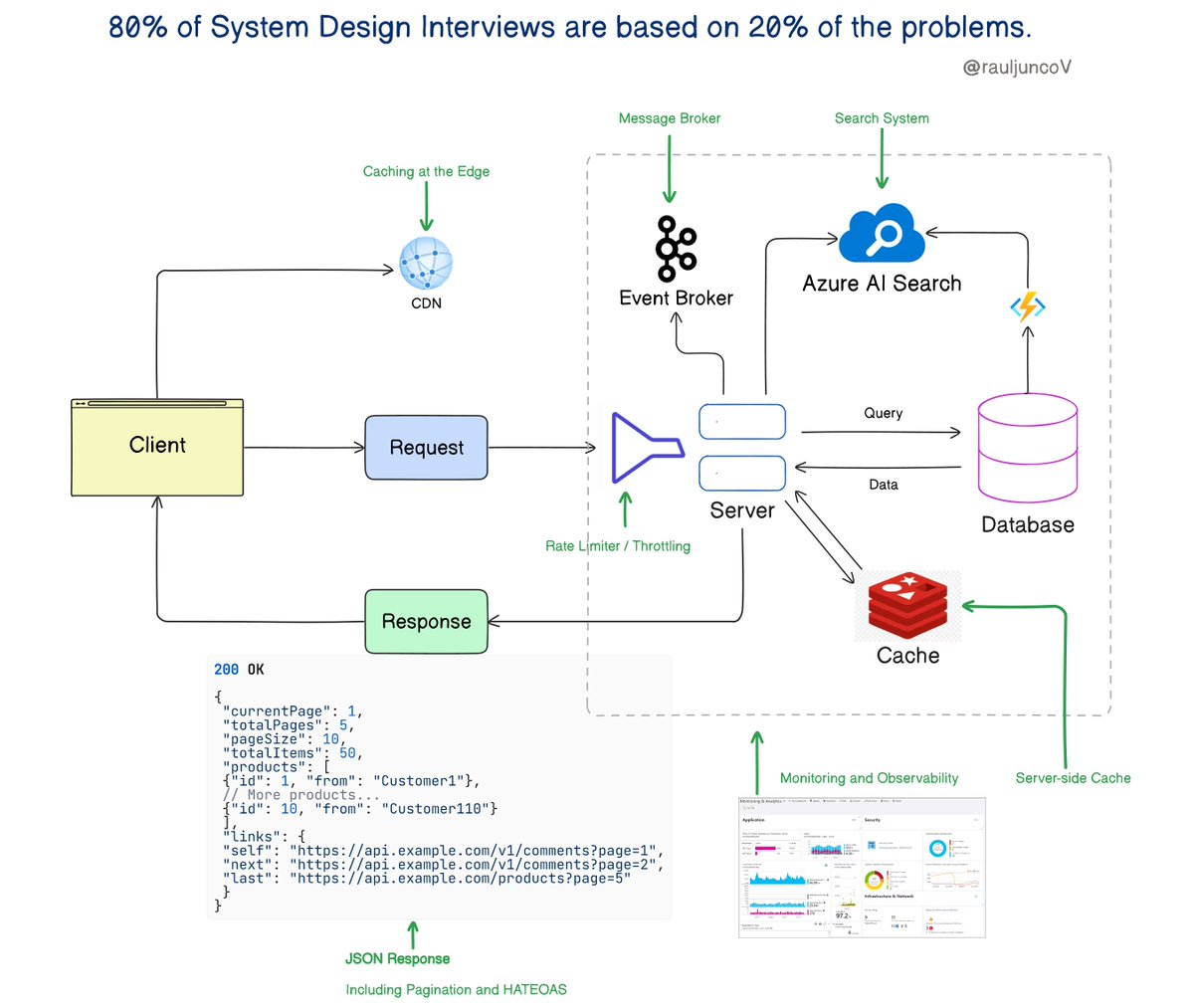
80% of System Design Interviews are based on 20% of the problems.
Here is what you need to master.
1. Scalable Data Storage
• Relational vs. NoSQL: Know when to use SQL vs. NoSQL databases.
• Partitioning: Vertical and horizontal partitioning (sharding). Understand trade-offs.
• Indexing: Covering indexes, primary vs. secondary indexes.
• Consistency Models: Strong, eventual, causal.
2. Caching
• Client-side vs. Server-side Cache: Understand where caching should happen.
• Caching Strategies: Write-through, write-back, write-around.
• Distributed Cache: Redis, Memcached.
• Cache Eviction Policies: LRU, LFU, etc.
3. Load Balancing
• Horizontal Scaling: Why and how to horizontally scale services.
• Load Balancing Techniques: Round-robin, consistent hashing.
• Reverse Proxy: Understand how to use Nginx, HAProxy.
4. Asynchronous Processing
• Message Brokers: Kafka, RabbitMQ. When to use queues vs. streams.
• Event-Driven Architecture: Benefits of decoupling and event sourcing.
• Task Queues: For delayed jobs or retries.
5. Database Read and Write Scaling
• Read Scaling: Master replication, read replicas.
• Write Scaling: Challenges with partitioning for writes, leader-election.
• CAP Theorem: Consistency, Availability, or Partition tolerance may be compromised.
6. Distributed Systems Concepts
• Consensus Algorithms: Paxos, Raft.
• Conflict Resolution: Last Write Wins, CRDTs, vector clocks for data reconciliation.
7. Reliability and Failover
• Redundancy: Active-passive vs. active-active configurations.
• Health Checks.
• Retries and Circuit Breakers: How to protect systems from cascading failures.
8. CDNs (Content Delivery Networks)
• Static Content Delivery: Why use a CDN, how does it work?
• Caching at the Edge: How CDNs improve latency for end users.
9. API Design and Rate Management
• REST vs. GraphQL: Difference and practical use-cases for each.
• Pagination and Filtering: Strategies for efficiently fetching data.
• API Versioning: Best practices for evolving APIs.
• Throttle Requests: Why rate limiting is essential, algorithms like token bucket, leaky bucket.
10. Search Systems
• Indexing: Building and maintaining indexes for fast search.
• Full-Text Search Engines: ElasticSearch, Azure AI Search.
• Ranking and Relevance: Basic understanding of how scoring works.
11. Monitoring, Observability and Security
• Metrics Collection: Prometheus, Grafana.
• Distributed Tracing: OpenTelemetry, Sentry.
• Centralized Logging.
• Authentication and Authorization: OAuth, JWT.
• Encryption: Data in transit vs. data at rest.
If you master these 13 areas, you'll be ready for most system design interviews thrown at you.
Add more if you can 👇