BREAKING: President Trump says that Iran's Supreme Leader has approved a deal between the US and Iran and a signing is "coming soon."
Details of the deal per President Trump:
1. US Naval blockade is lifted once the deal is signed
2. Memorandum of Understanding has been approved by "everyone in Iran"
3. Kharg Island operation by US Military is now "off the table"
4. Formal Strait of Hormuz reopening deal expected by as early as Saturday or Monday
5. Trump declines to set a deadline for the deal, calling Iran "rational and confident" that a deal will be reached
US oil prices extend losses on the news.
Morgan Stanley says SemiAnalysis' report on Nvidia's planned large-scale shipments of 800VDC power architecture being pushed back to 2028 is contrary to their own supply chain checks at Computex.
"Nvidia at GTC Taipei Indicated 800 VDC developments are ongoing with 800 VDC power rack being ready for mass production in 3Q26. +-400 VDC development has been redirected to 800 VDC focus across various hyperscalers."
$NVDA Networking Senior Vice President refuting recent analyst reports on delays:
- “ the most exciting stuff is co-packaged optics.”
- There is no delay in H2 CPO product delivery schedule.
- CPO switch will enter mass production and begin ramping up customer deliveries as planned in the second half of 2026
This was a media article, original interview source credit should have been credited to Tae Kim / Computex.
Something fun to note too was this quote “Gilad was VERY enthusiastic about the CPO ramp from Nvidia.”
Both near term and long term.
Yeah… I’m extremely bullish on CPO alongside Nvidia.
Introducing Claude Fable 5: a Mythos-class model that we’ve made safe for general use.
Its capabilities exceed those of any model we’ve ever made generally available.
$NVTS showcased its 800V-to-6V DC-DC power delivery board at NVIDIA’s AI Factory MGX ecosystem event during Computex.
The board uses 16 GaNFast FETs and targets 97.5% peak efficiency, 1 MHz switching, and 2100 W/in³ power density.
Navitas says the design removes the need for a traditional 48V intermediate bus converter inside compute server trays, helping enable smaller and denser AI server power systems.
Honest take: Being correct doesn’t always pay.
Vicor has spent years being technically right while the market moved around them. At current valuations, you’re betting that gap finally closes.
That’s a faith based trade as much as a fundamentals one.
Some thoughts on $VICR Corp
Seeing it gain a lot of attention recently.
Vicor ($VICR) has one of the most technically interesting ideas in AI power delivery.
Whether that translates into a business is a genuinely open question. 🧵 👇
Here’s the asymmetric angle though:
Vicor doesn’t just sell components.
They sell architecture. If anyone uses Factorized Power principles even through a third party, Vicor can collect IP licensing tolls.
Near-zero incremental cost. Enormous operating leverage.
What's happening in the MLCC market
First off, MLCC as a whole is a $15B market. MLCCs for servers were a $1.3B market in 2025 ($600m for AI servers, $700m for general servers)
The AI server MLCC market is growing at 80%+ CAGR, and the general server MLCC market will also accelerate due to agentic AI increasing CPU demand (around 30%-40% CAGR)
We will see negative growth in the smartphone/mobile MLCC market for at least 2026-27.
Humanoids are another future high-growth market for MLCCs
Book-to-bill ratio for most MLCC suppliers is over 1 now
Reasons for price hikes-
High Nickel & Silver are affecting all segments
There is a supply-demand mismatch in the high-end (high capacitance, high voltage) segment, which is used in autos & servers
High-end MLCC lead time is over 20 weeks
Spot/distributor prices have increased by 20%-40% for low capacitance & consumer device MLCCs due to hoarding and double booking, especially in China
OEM contracts have not seen large price hikes yet
What's happening now:
Rapid capacity expansion happening across the industry
Murata expects blended ASP prices to remain flat (ASP going down in consumer electronics, expansion in AI server market)
Tier 1 players like Murata, Taiyo Yuden, SEMCO building capacity to serve AI server MLCC market
This will create opportunities for Tier 2/3 and Chinese suppliers to expand in the mid to low end market (Macronix effect)
Future:
MLCC production equiment & raw materials suppliers will be the biggest beneficiary of this CAPEX boom
MLCC producer stocks have performed well, and it is finally spilling to raw material/equipment producers
I expect them to outperform MLCC producers now
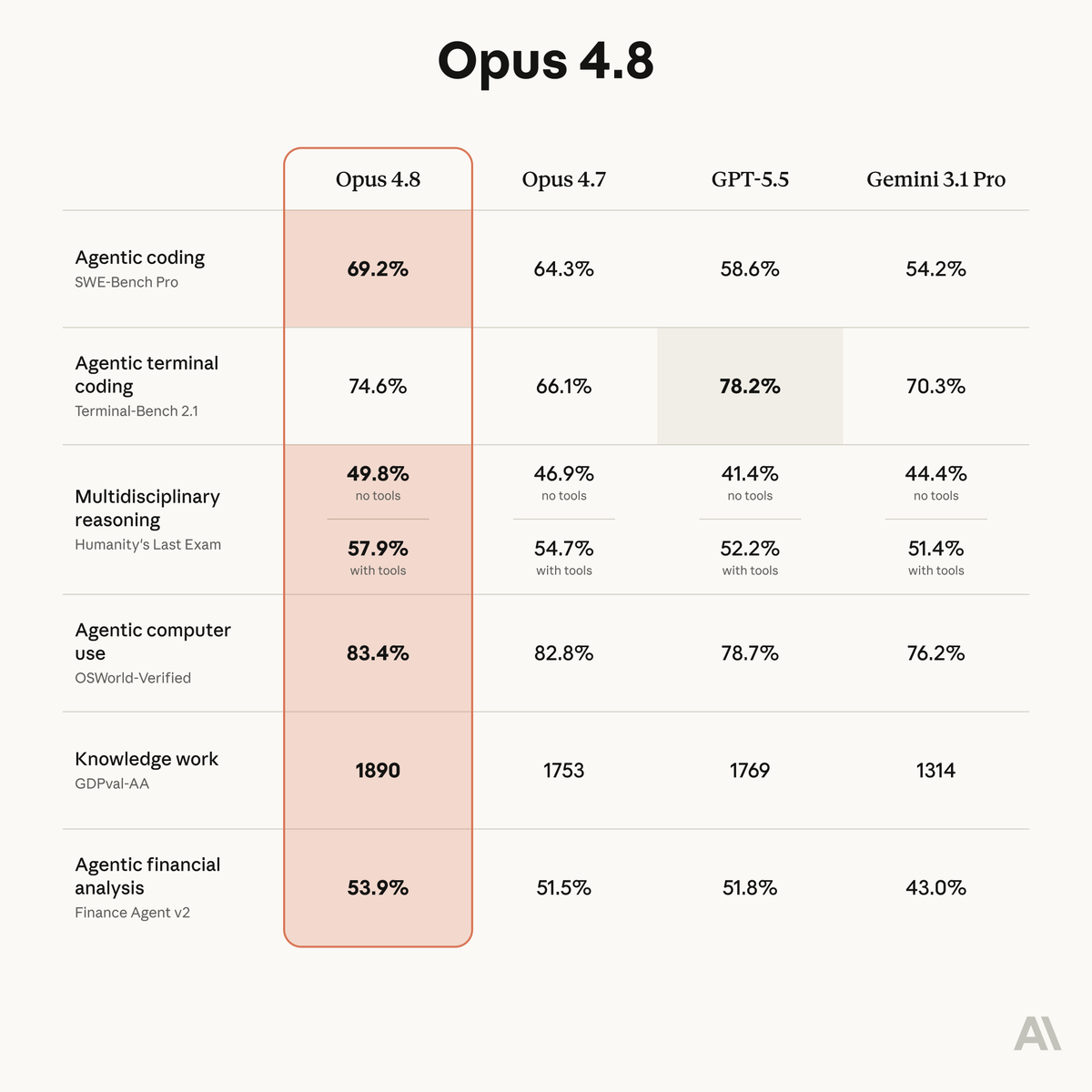
Introducing Claude Opus 4.8: it builds on Opus 4.7 with sharper judgment, more honesty about its own progress, and the ability to work independently for longer than its predecessors.
Available today at the same price.
▶ Yageo signals possible price hikes as Japanese and Korean passive component makers raise prices
• Taiwanese passive component maker Yageo officially noted that Murata and Samsung Electro-Mechanics — the world’s #1 and #2 MLCC makers — recently issued price increase notices to customers.
• Driven by expanding AI demand, the company expects raw material cost increases and tight supply-demand conditions to be gradually met in 2H26, signaling the potential for price hikes.
• Custom high-spec products currently account for 80% of revenue, with demand for high-spec products — including ASICs — continuing to expand on the back of more sophisticated AI server platform design.
• Yageo explained that demand is rising rapidly not only in the GPU market but also in the ASIC market, and that it is strengthening its response to demand within the AI supply chain.
• The current passive component shortage is concentrated in high-spec/custom products, with lead times now extending to 12–18 weeks or more.
• Spillover orders are increasing as competitors’ production lines run at full capacity; the company explained that it has secured the ability to handle urgent orders through long-term capacity planning and proactive inventory build.
• Utilization is expected to run above 80% for standard products and above 90% for high-spec products; despite high utilization, there is room to take on additional orders by clearing bottlenecks.
• AI-related products currently account for roughly 15% of revenue, and the company assesses that the industry is in the “first half of Stage 2 of the AI revolution.”
• The current average book-to-bill (BB) ratio is 1.3, with AI products at 1.4 — higher than the industry average (1.18–1.2) and Murata (1.25) — and order momentum is expected to strengthen further in 2H.
2023-2025: the stocks going up the most can sell into the AI supply chain
2026: the stocks going up the most can sell shares at a higher price to AI supply chain investors