Jensen's back. My take on @ETNOWlive reinstatement removes the leadership overhang. A 31% one-day jump, adding ~$1T in value, shows how much of the AI story the market ties to one leader.
How significant is Jensen Huang's return for global markets?
Counterpoint research senior analyst Parv Sharma says that because NVIDIA serves as the keystone of an interdependent global tech ecosystem, Jensen Huang's return after a brief absence has filled a key leadership gap and restored broader market confidence; even though underlying fundamentals remained unchanged.
This renewed confidence has sparked a rally across NVIDIA's supporting ecosystem, particularly driving momentum in memory, data center infrastructure, and related AI hardware plays - listen in.
@akankshakmtt@Parv_S #NVIDIA #JensenHuang #AITrade #GlobalMarkets #Semiconductors
@wholemars RAM is super expensive, so we reduced AI4.5 from 32GB to 24GB. That will be fine. It’s hard to use 32GB anyway, given memory bandwidth constraints.
1. As far as I know, $AMD 10-K geographic split is by billing location, so a large share of the $7.75B is likely supply chain, not Chinese end demand.
2. In 2025, DC was ~48% of AMD revenue. In 2027, AMD guides DC to >80% of revenue, driven by US hyperscalers and frontier labs (OpenAI, Meta, Anthropic, Microsoft, Oracle).
3. Data center part of AMD’s China exposure, mainly through EPYC.
JUST IN: AMD ($AMD) generates 22.4% of its revenue from customers billed in China and Hong Kong, compared with just 9.1% for Nvidia ($NVDA), raising concerns that AMD could face even greater exposure to tightening U.S. chip export restrictions, Hunterbrook reports.
Until today, the AI cycle could only be traded from the supply side: chips, memory, capex. $ANT puts the demand side on the tape. Every quarter from here, the market gets a public read on compute as a % of revenue the single number that tells you whether the build-out is paying back. @AnthropicAI
$ANT opened at $111.50, up 34%. Within minutes the Nasdaq was down 1.7%. The day the demand side got a ticker, investors took profits on the supply side?
BREAKING: The average Anthropic, $ANT, employee will be worth $44 million after today's IPO, based on current indicated share price:
1. 7 Co-Founders: ~$20+ billion each
2. Several early employees: $1+ billion each
3. 598 employees: $100+ million each
4. 2,800 employees: $1+ million each
5. Total employee equity wealth: $232 billion
6. Employee stock option gains: $119 billion
San Francisco’s median single-family home sale price jumped +29% year over year to $2.39 million in October amid the IPO process.
This marks the largest jump in San Francisco's media home price since February 2018.
Thousands of new millionaires will be minted today.
$NVDA Q3 FY27 earning summary:
Leadership: The board does not intend to reinstate Jensen as CEO and are looking for options internally and externally.
Performance & outlook: Revenue $115.8B, +20% QoQ >2x YoY. DC was $108B (hyperscale $60B, AI cloud/industrial/enterprise $47B). Q4 guide is $130B ±3%, GM bottoms at 71–72% in Q4 as old-price POs ship, then recovers to 72–73% in FY28. FY28 growth was raised to ~75% from 70%.
CPU: New adopters are CoreWeave, Meta, Nscale and OpenAI, joining AWS and OCI. Total CPU revenue is expected to more than double in FY28. Agentic AI is pulling CPU demand ahead of supply. This means FY28 guide >$40B of CPU assuming the ~$20B FY27 base. NVDA may become the biggest DC CPU vendor in 2027 ahead of INTC and AMD.
Vera Rubin: About $20B in its first production quarter, the fastest ramp in NVIDIA history. Hyperscalers brought it into production in ~1 month, half the time Grace Blackwell took. Rubin Ultra in 2027 and Feynman in 2028 are on track.
CPO: Networking revenue was over $21B, and CPO scale-out is in volume production. Lambda is the first production deployment of Photonics switches, connecting more than 10K GB300 GPUs.
Allocation: Everyone pays the same price. Supply goes first to customers whose land, power and shell are ready and whose capital is in place. Non-IG buyers must also show solid offtake.
Neoclouds & financing: Guarantees total $118B, of which $105B is for the OpenAI PORTS-Pike campus, and neocloud commitments are $32B. A guarantee only applies once the neocloud raises its own debt or equity and builds the site; if it slips, the guarantee falls away. Management says the policy is not new, only now spelled out. NVIDIA will now be selective, prioritizing land/power/shell, outside financing partners and IG prepayments. Capital priority is buybacks first, supplier prepayments second, and customer guarantees last.
Chips & Tokens: Token prices are down ~60% since May, and usage is climbing fast: OpenRouter weekly tokens are up 35x YoY and 3.5x in three months, with agentic workloads at ~80% of tokens. Chip prices are moving the other way. Hopper re-contracted at up to 2x its original price, B300 rental rates are up 60%+ since launch, and the fleet is fully utilized across hyperscalers and neoclouds. Cloud backlog rose to $2.5T from $2T in three months, Anthropic’s ARR hit $81B, and frontier labs are ~15% of DC revenue.
Key takeaway: The results showed that demand is still strong. The concerns now weighing on the stock are about governance, policy and financing, and an earnings beat cannot answer those. For now the rally has postponed the next selloff more than it has restored confidence.
Kress kept near term operations steady: customers and suppliers backed the company publicly, TSMC leadership visited this week, memory and packaging are secured, and FY28 guidance went up. On Strategy she deferred long-term pricing against ASICs to “the future,” nobody spoke to the technology roadmap. Jensen would have shut those out. Cautious stance on neocloud financing may reflect the risk appetite for the board.
The next real test is Dec 1–2. If the testimony passes without new revelations, NVDA may begin to recover and the AI trade gets a cleaner run into the Q4 hyperscaler capex guides. Otherwise, demand will not matter, because market is worries about leadership.
Also Nvidia signaled it will no longer absorb that risk, which leaves weaker neoclouds more exposed.
US chip controls now follow who uses the compute.
This is targeted towards the Chinese demand in data centers outside of China.
The compliance is now with chip vendors, server OEMs and colo operators.
Key takeaways:
1. Any training-scale capacity for a Chinese parent needs a license
2. Hardware liability: Vendors and OEMs to push KYC and audit rights
3. SEA demand hit: Shipments into Indonesia, Malaysia, Singapore, Thailand and Brazil now need a license at any performance level. Other countries may benefit.
4. Direct China and Macau applications stay eligible for review. ~H200 performance
5. Foundries and packagers must now verify and license advanced node chips from designers in above five countries. Companies needs approved designer status first, or the foundry needs a US license to deliver the chips.
https://t.co/Y6I5RcenBd
$NVDA Who underwrites the loop now?
1. Jensen was company’s ecosystem financier and dealmaker. Nvidia has put about $51B of disclosed cash into its customers and about $18B into suppliers and platform partners. The money loop everyone talks about.
2. Most of loops were founder-driven. Board’s message is continuity. Board chair Harvey Jones said the company expects its operations, customer commitments and product roadmap to continue without interruption.
3. The market priced exposure by funding model. @nvidia itself recovered most of the shock. The neoclouds fared worse: CoreWeave, IREN and Nebius stocks tanked.
4. The pattern fits the chart. The left side runs on borrowed capital and Nvda backing. The right side is strategic investment.
5. Weak point: A guarantee is only as strong as the lender’s view of the guarantor. Nvidia guarantee may not be seen same now.
What to watch:
1. The pace of new deals. Whether new announcements pause, especially for Nscale, Crusoe and other undisclosed-stake rounds.
2. The OpenAI Ohio guarantee. Whether its terms are revisited.
3. Neocloud debt spreads. CoreWeave and Lambda debt raised against @nvidia contracts.
4. NVLink Fusion partners. Whether MediaTek and Marvell stay a priority, or become the first place a new CEO trims.
This also reinforces my view that buyers will diversify. Our forecast has server AI ASICs overtaking GPU units next year.
More details from @neil_shah@BradyWang10 blog: https://t.co/3Rc8nEOiAo
1. $QCOM supplies the RU (QRU100) and Layer 1 (QDU100); $SPCX reportedly keeps L2/L3 and the core. Owning the scheduler across towers and satellites lets one operator run the same spectrum from the ground and from orbit. No US operator can do that today.
2. For US operators there is a little revenue risk before 2028, real strategic risk now.
3. T-Mobile is most exposed. Its D2D partner is becoming a competitor, and the 800 MHz @SpaceX is buying was T-Mobile's until August.
4. The carriers' D2D JV, and @TMobile and @Verizon both ruling out an MVNO
5. Big win for @Qualcomm RAN for its merchant silicon and a performance-per-watt counter to @nvidia AI-RAN push.
6. Losers: @ericsson@nokia@Samsung miss the US greenfield build, and cable MVNOs face a Starlink broadband + mobile bundle.
SpaceX has selected Qualcomm #Dragonwing Cellular Infrastructure solutions to support @Starlink Mobile’s nationwide terrestrial 5G network in the U.S. https://t.co/Up7LxbQz5o
1. $GOOG is guaranteeing Anthropic’s rent at TeraWulf’s 401 MW Hawesville, Kentucky campus, which carries about $19B of lease commitments.
2. Anthropic has to run TPUs there. Google is locked in for six years, and the guarantee ends once Anthropic is investment grade.
3. Google is using its balance sheet to sell chips, because custom silicon struggles to beat Nvidia on price-performance alone.
4. AWS has already said about selling Trainium externally, $MSFT may follow same route.
5. This is the TPU sales strategy from the Q3 call put into contract form. Kurian said hosting TPUs in third-party facilities “offsets the need for us to pre-build facilities.”
5. Here TeraWulf builds and finances the shell, Anthropic pays the rent, and Google adds only a contingent guarantee that kicks in after construction. In return, it gets six-plus years of guaranteed TPU demand in 401 MW.
6. The cost is that Google now has contingent exposure to Anthropic’s credit. That adds to Anthropic already being a Google investee, a TPU customer and a large part of the Cloud backlog.
https://t.co/WbIr38ritA
𝗔𝗠𝗗 𝗤𝟯 𝟮𝟬𝟮𝟲 𝗘𝗮𝗿𝗻𝗶𝗻𝗴𝘀: 𝗥𝗲𝘃𝗲𝗻𝘂𝗲 𝗝𝘂𝗺𝗽𝘀 𝟰𝟱% 𝗮𝘀 𝗗𝗮𝘁𝗮 𝗖𝗲𝗻𝘁𝗲𝗿 𝗡𝗲𝗮𝗿𝗹𝘆 𝗗𝗼𝘂𝗯𝗹𝗲𝘀 𝗼𝗻 𝗔𝗜 𝗗𝗲𝗺𝗮𝗻𝗱
@AMD reported Q3 2026 revenue of $13.4 billion, up 45% YoY and above the high end of guidance, driven by a record quarter for Data Center. However, a 40% YoY drop in Gaming and rising memory costs weighing on PC demand point to growing pressure on the client side.
𝗞𝗲𝘆 𝗧𝗮𝗸𝗲𝗮𝘄𝗮𝘆𝘀:
• AMD is now a data center company: Data Center revenue grew 97% YoY to a record $8.5 billion, now 64% of total revenue, with operating margin rising to 34% from 25%.
• Helios turns AMD into a system supplier: With MI450 launched and the first Helios racks live, AMD now offers the first credible rack-scale alternative to NVIDIA. AI revenue is expected to overtake server CPU revenue in Q4.
• AMD set to out-earn Intel: Q4 guidance of ~$17 billion (up ~66% YoY) tops the $16.2 billion consensus and Intel’s ~$15.5 billion midpoint. AMD expects 80% revenue growth in 2027, even as PC units may fall by double digits.
𝗦𝘂𝗯𝘀𝗰𝗿𝗶𝗯𝗶𝗻𝗴 𝗰𝗹𝗶𝗲𝗻𝘁𝘀 𝗰𝗮𝗻 𝗮𝗰𝗰𝗲𝘀𝘀 𝗼𝘂𝗿 𝗚𝗹𝗼𝗯𝗮𝗹 𝗗𝗮𝘁𝗮 𝗖𝗲𝗻𝘁𝗲𝗿 𝘅𝟴𝟲 𝗖𝗣𝗨 𝗔𝗻𝗮𝗹𝘆𝘀𝗶𝘀 𝗮𝗻𝗱 𝗜𝗻𝘀𝗶𝗴𝗵𝘁𝘀 𝗿𝗲𝗽𝗼𝗿𝘁 𝗳𝗼𝗿 𝘁𝗵𝗲 𝗹𝗮𝘁𝗲𝘀𝘁 𝗼𝗻 𝘁𝗵𝗲 𝗔𝗠𝗗–𝗜𝗻𝘁𝗲𝗹 𝘀𝗲𝗿𝘃𝗲𝗿 𝗿𝗮𝗰𝗲 𝗮𝗻𝗱 𝘁𝗵𝗲 𝘁𝗿𝗲𝗻𝗱𝘀 𝘀𝗵𝗮𝗽𝗶𝗻𝗴 𝗱𝗮𝘁𝗮 𝗰𝗲𝗻𝘁𝗲𝗿 𝗰𝗼𝗺𝗽𝘂𝘁𝗲:
https://t.co/yxieXMIXgq
#AMD #Semiconductors #DataCenter #AI #AIInfrastructure #Helios #EPYC $AMD
$AMD is guided to out-revenue Intel in Q4: ~$17B vs Intel’s ~$15.5B midpoint. Even AMD’s low end beats Intel’s high end, and the gap is almost entirely data center. https://t.co/IsJYr6zI3O
1. $AMD is guided to out revenue $INTC in Q4. ~$17B vs Intel’s ~$15.5B midpoint. Even AMD’s low end beats Intel’s high end. The gap is almost entirely data center.
2. @AMD DC lead over @intel comes from AI (GPU, racks), not CPUs. AMD DC $8.5B vs Intel DCAI $7.3B in Q3.
3. Take out Instinct and Intel is still bigger in server. In Q4, AMD’s AI business passes its own server business for the first time.
4. Intel’s DCAI grew 78% YoY, very strong. Intel called it the segment’s strongest growth in 15 years, with Granite Rapids on Intel 3 among its fastest-ramping server products and Clearwater Forest on 18A shipping for revenue.
5. 2026 AMD is hold server CPU share (not exploding) but the 2027 will be the key as Intel expects server CPU units to grow more than 30% in both 2026 and 2027. AMD guides server revenue to ~2x in 2027, mostly from units. Meaning share wins for x86 CPU for AMD.
6.DC margin: Intel’s DCAI operating margin (41.5%) beats AMD’s DC margin (34%), but AMD’s is diluted by HBM-heavy Instinct GPUs. AMD’s server CPU margin alone likely tops Intel’s.
7. Company margin: AMD’s 56% gross margin vs Intel’s 44% (38% in Q4) reflects AMD’s fabless model vs Intel’s foundry losses.
8. Both are supply-constrained, but differently. Intel expects shortages through 2027 into 2028, is short on Intel 3 wafers and substrates, and Fab 28 incident. AMD relies on TSMC and has secured supply for 2027’s >80% growth.
1. $AMD Q3 26 revenue $13.4B (+45% YoY) above the $13.0B guide. Driven by the DC which in now 64% of revenue and will be 80% next year. @AMD is now officially a DC company.
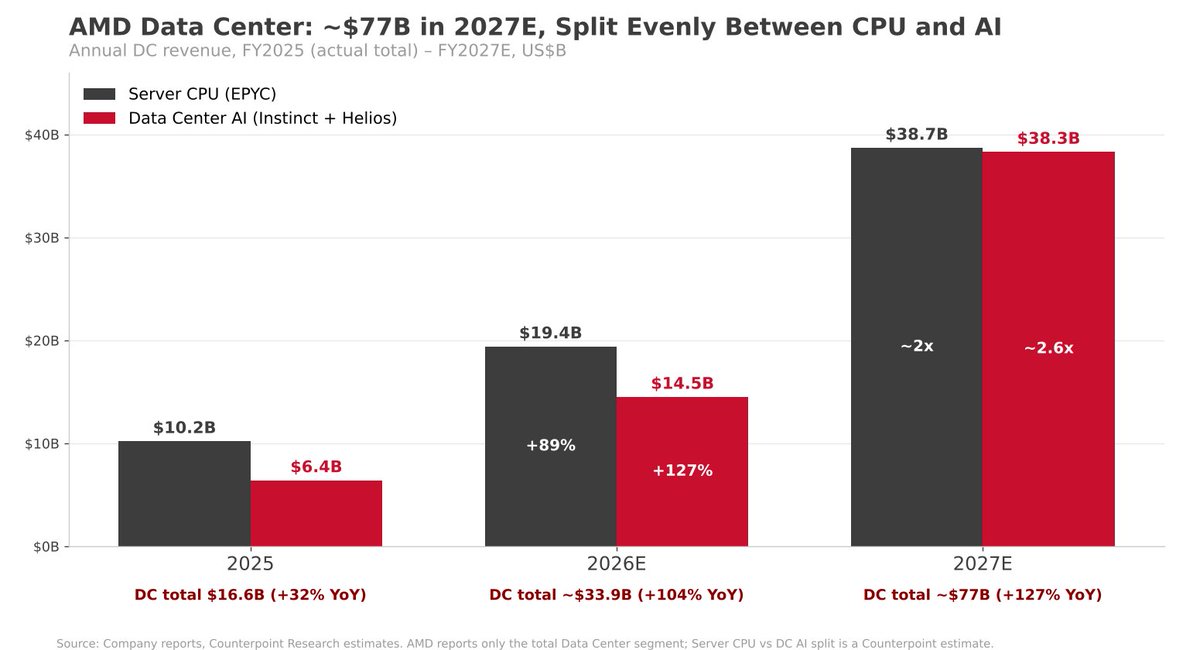
2. Q4 outlook ~$17B (+66% YoY) is ~$800M above consensus. DC AI passes server CPU in dollars for the first time, driven by the Helios ramp.
3. 2027 was raised further: revenue >80%, server ~2x (up from >70%), DC AI significantly more than 2x, DC >80% of revenue, ~$77B DC by our estimate.
4. Agents drive CPU: AMD’s server CPU guide is the harder 2027 target. At its Q4 run-rate, server makes ~$24B a year; the 2x goal needs ~$39B, about 60% more. AI starts closer to its goal and needs only ~40% more.
5. CPU racks: Helion rack: up to 144 Venice CPUs, ~74k threads, the first CPU-only rack built for agents. First systems ship Q4. Venice began revenue shipments, with 240+ OEM platforms, 20% more than Turin.
6. EPYC: Cloud and enterprise server sales each more than doubled YoY. Turin is now the most deployed EPYC gen in public cloud, 540+ instances.
7. Custom ASIC + x86: @OpenAI is using Turin as host CPU for its ASIC. Several model developers and clouds signed head-node deals that ramp over coming quarters.
A deeper dive on the Marvell & Lumentum $115 Billion Deal creating a Vertically Integrated Powerhouse player in Optics & Networking market. https://t.co/pi6FmouFcK
Overall DC story so far Q3 26 earnings
1. Hyperscaler CapEx: In Q3 alone $GOOG spent $51.4B, $MSFT spent $45.2B, and $AMZN confirmed its run-rate toward a $220B annual CapEx. Across the big three, quarterly cloud infrastructure CapEx topped $150 billion.
2. Cloud Revenue is the driver: Google Cloud doubled revenue (+103% to $30.7B), AWS accelerated 39.3% ($46.0B), and Azure jumped 48%, proving customer compute demand is matching the buildout.
3. Hyperscalers have accepted negative quarterly free cash flow (Alphabet -$9B, Amazon -$42B) because cloud AI workloads are growing at 40%–100% YoY.
4. The real winners of this phase aren't the software providers they are the upstream tollbooths (@SKhynix $TSM @ASMLcompany ) that command 65%–80% operating margins to manufacture the physical silicon.