On-Treatment PSA: How Low, How Soon?
🔹 PSA ≤0.2 ng/mL by 6 or 12 weeks predicts long-term overall survival as well as achieving it by 24 weeks.
🔹 An elevated PSA at 6–12 weeks is not an early treatment failure—many patients continue to decline to PSA ≤0.2 by 24 weeks.
🔹 The same PSA nadir does not mean the same prognosis. Disease volume and nodal status significantly influence survival.
🔹 Patients with low-volume disease consistently outperformed those with high-volume disease, even when both achieved PSA ≤0.2.
🔹 Abiraterone-based therapy was associated with the most favorable outcomes across PSA response groups.
🔹 Clinical takeaway: Interpret on-treatment PSA alongside disease burden rather than in isolation.
📖 Kayani, Murphy et al. Lancet Oncology. 2026.
Colorectal cancer is packed with practice-changing science at #ESMOGI26.
Here are the Top 10 Colon & Rectal Cancer abstracts I’m watching most closely 👇
1️⃣ LBA1 | KRYSTAL-10
Can adagrasib + cetuximab become the new second-line standard for KRAS G12C-mutant metastatic CRC?
2️⃣ 1O | ATOMIC
Could this redefine adjuvant treatment duration in dMMR stage III colon cancer?
3️⃣ 8O | GALAXY
Can postoperative ctDNA guide adjuvant chemotherapy after colorectal liver metastasis resection?
4️⃣ 7RO | BREAKWATER
Which patients derive the greatest benefit from encorafenib + cetuximab ± mFOLFOX6 in BRAF V600E mCRC?
5️⃣ 6RO | KANDLELIT-001
The first major efficacy update of calderasib (MK-1084) in KRAS G12C-mutant CRC.
6️⃣ 2RO | CAPRI-2 GOIM
Can cetuximab be successfully integrated across the continuum of care in molecularly selected mCRC?
7️⃣ 4RO | Anti-EGFR Retreatment IPD Analysis
Should anti-EGFR retreatment replace switching to anti-VEGF after progression in RAS/BRAF wild-type mCRC?
8️⃣ 295RO | TORCH-iTNT
Updated results of immunotherapy-based total neoadjuvant therapy with or without short-course radiotherapy in locally advanced rectal cancer.
9️⃣ 3RO | AGEO-NEO-MSI
How do treatment strategy and immune-related toxicities influence response to neoadjuvant immunotherapy in dMMR/MSI-H colorectal cancer?
🔟 5RO | LAVA-CRLM
Microwave ablation vs stereotactic body radiotherapy for oligometastatic colorectal liver metastases.
Which colorectal abstract are you most excited about?
#ESMOGI26 #ColorectalCancer #RectalCancer #GIOncology @myESMO@OncoAlert
CIRCULATE is an important step forward for ctDNA-guided adjuvant therapy—but it is not the final word.
Key takeaways:
• Postoperative ctDNA strongly identified patients at higher risk of recurrence.
• The trial provided the first randomized signal that treating ctDNA-positive Stage II colon cancer may improve outcomes.
• However, the study was substantially underpowered, and the primary ITT analysis was not statistically significant.
• Clinical decisions should continue to integrate ctDNA results with established clinicopathological risk factors—not rely on either alone.
The message from the accompanying editorial is clear: ctDNA should refine clinical judgment, not replace it.
📖 Reference: Tarazona N, Parikh AR. Annals of Oncology. 2026 Editorial on the CIRCULATE-AIO/ABCSG trial.
#MVOnco #ColonCancer #ctDNA #ColorectalCancer #PrecisionOncology #MedicalOncology #Oncology #AdjuvantTherapy #MRD #ESMO #ASCO
HER2+ THERAPY IS BECOMING RESPONSE-ADAPTED
A simple algorithm proposed by Tarantino et al. (JCO 2026):
▪️ Stage IIA → THP → Surgery → HP
▪️ Stage IIB → THP → Response assessment → Continue THP or escalate to T-DXd
▪️ Stage III → TCHP or THP → T-DXd → Surgery
▪️ pCR → Complete planned HER2-directed therapy
▪️ Residual disease → T-DXd or T-DM1
The concept is simple:
✓ Stage
✓ Biology
✓ Treatment response
Together determine treatment intensity.
We are moving beyond a one-size-fits-all approach toward more personalized HER2-directed therapy.
Adapted from Tarantino et al., JCO 2026.
#BreastCancer #HER2 #HER2Positive #Oncology #JCO #ASCO #TDXd
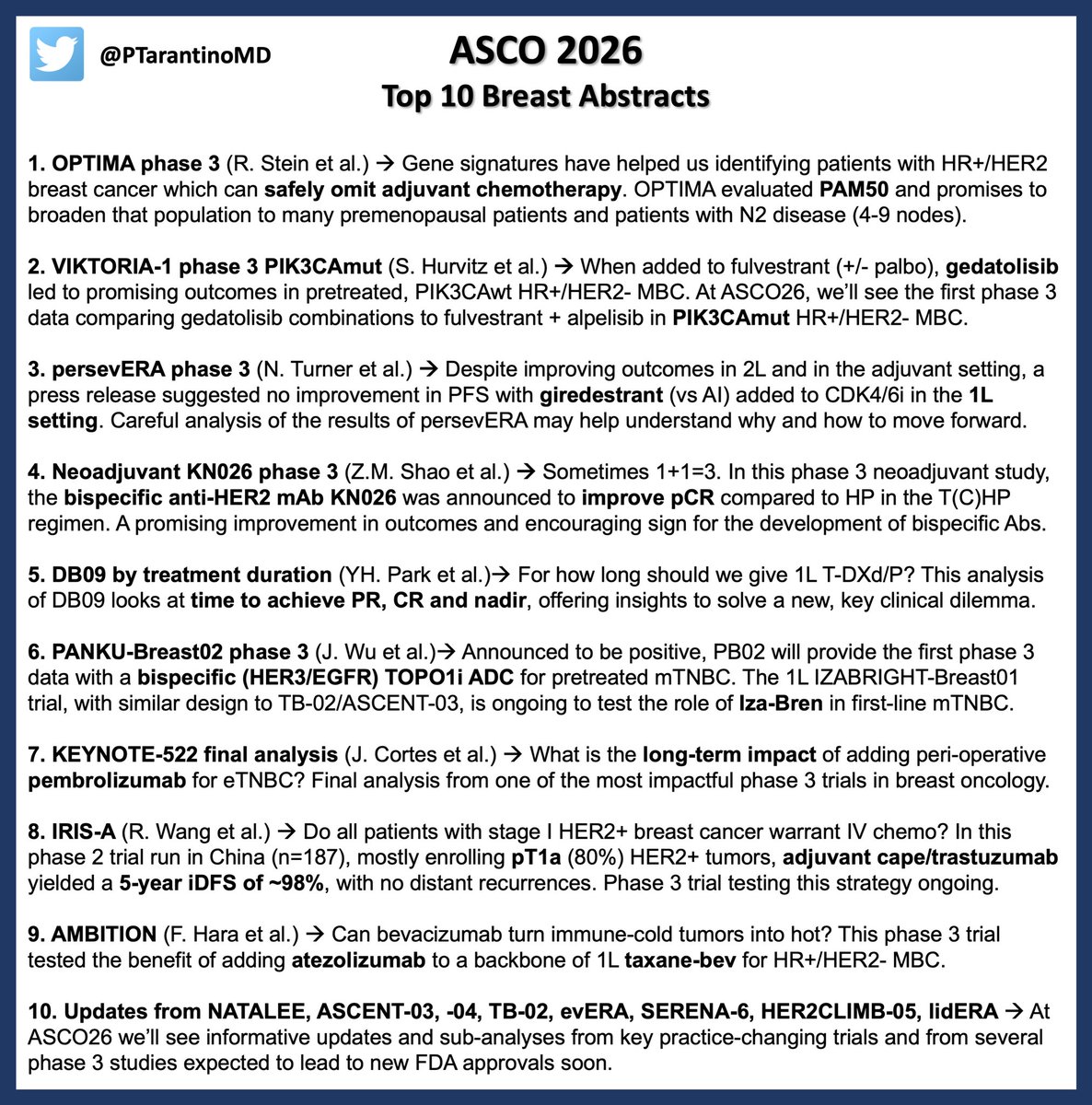
OPTIMA Trial #ASCO2026
One of the most important lessons from ASCO 2026:
Clinical high risk ≠ Genomic high risk.
Among patients with clinically high-risk ER+/HER2− early breast cancer, 68% had low genomic risk (ROR ≤60).
A PAM50-guided treatment strategy substantially reduced chemotherapy use while preserving outcomes:
📊 5-year IBCFS: 90.4% vs 91.5%
📊 HR 0.99 (Non-inferior)
Key takeaway:
🧬 Biology and clinical risk are not the same.
💉 Less chemotherapy is possible for many patients.
✅ Outcomes remained preserved.
Stein et al. #ASCO2026
#BreastCancer #Oncology #PrecisionOncology #MedTwitter #MVOnco
Updated Results of the POSITIVE (Pregnancy Outcome and Safety of Interrupting Therapy for Women with Endocrine Responsive Breast Cancer) Trial
https://t.co/x4vT9HZXOf
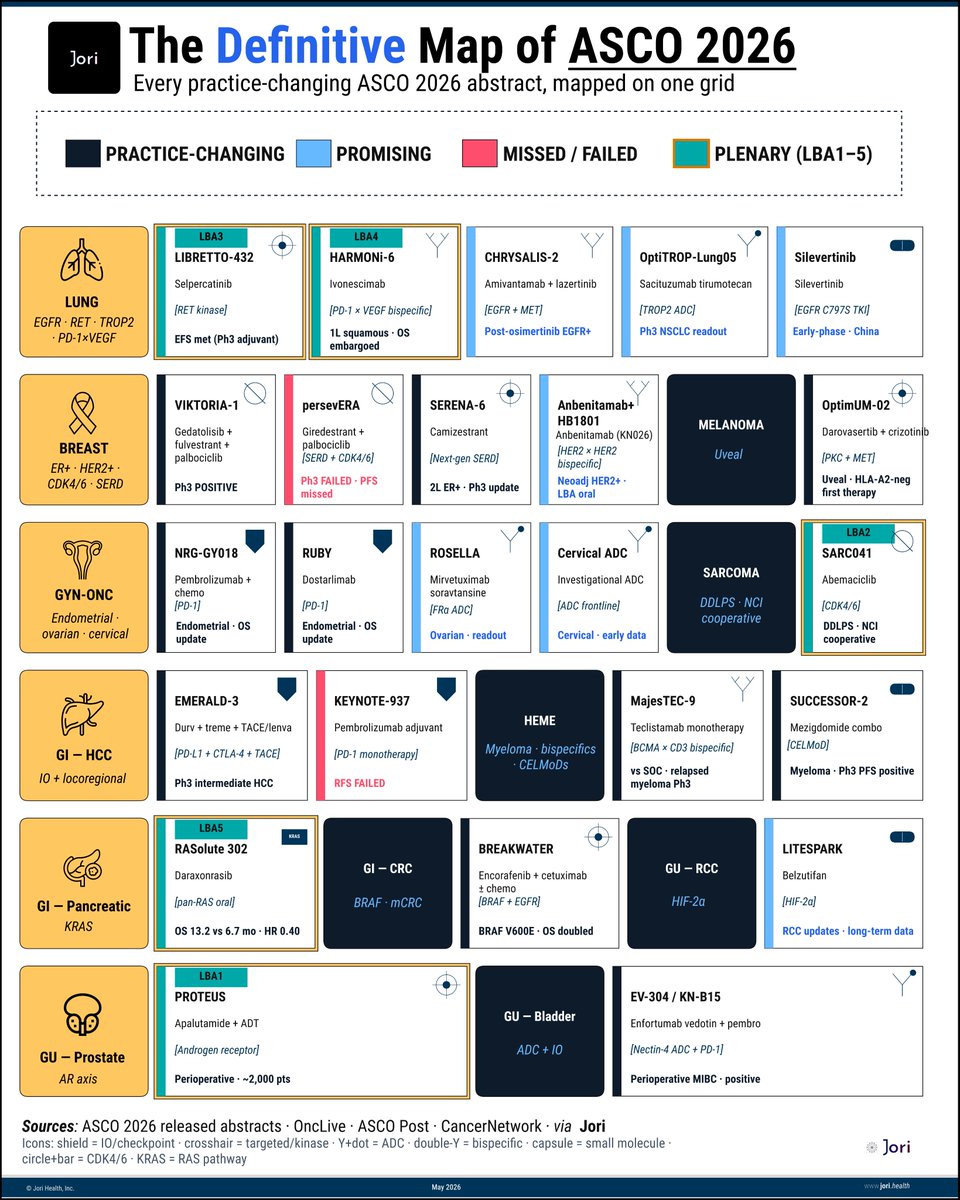
ASCO this year has 5,000+ abstracts.
But maybe 24 will actually change practice. This is that map.
(ERRATA: this plot fixes an error on VICTORIA which reflected incorrect data, thnx @Dr_RShatsky)
Map spans 12 disease areas, 24 critical readouts, 5 plenaries & 2 confirmed misses already on the board.
Few things jump out immediately:
▫️Pancreatic cancer gets the headline.
Daraxonrasib: 13.2 vs 6.7 months.
▫️Sarcoma gets a plenary because public science funded what pharma would not.
▫️Lung cancer remains the most crowded battlefield in oncology:
RET adjuvant, bispecific OS, post-osimertinib, next-gen EGFR.
By next week, some of these cells will become new standards of care.
This is your cheat sheet to keep score in real time.
- - - - -
Sources: @asco@OncLive@CancerNetwrk via @Jori_health
- - - - -
Clinical high risk does not always mean genomic high risk.
In the OPTIMA trial, many ER+/HER2− early breast cancer patients with node-positive disease — including premenopausal women — maintained excellent outcomes without routine chemotherapy when Prosigna/PAM50 ROR scores were low.
A major step toward biology-guided chemotherapy de-escalation.
Study: Stein et al, #ASCO2026
#BreastCancer #Oncology #MedEd #MVOnco
Only few days to #ASCO26. For breast oncologists, this edition will deliver a new promising biomarker to spare unnecessary chemo, informative updates from practice-changing trials across subtypes, and major innovations coming from China. See you in Chicago next week! #bcsm
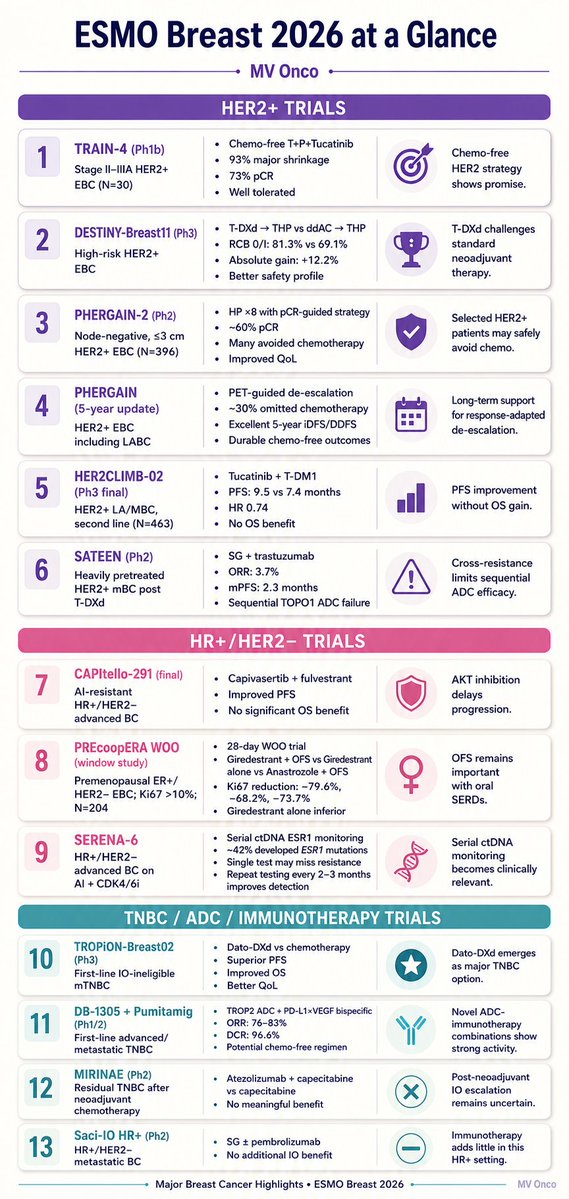
ESMO Breast 2026 — key trials at a glance
• HER2+ trials
• HR+/HER2− trials
• TNBC / ADC / Immunotherapy trials
Major studies, key results, and clinical take-home messages — all in one quick visual summary.
#ESMOBreast2026#BreastCancer#Oncology#MVOnco
A wonderful experience in Berlin.
Behind every trial is the persistent work of researchers striving to change the future of patients with cancer.
Deep respect to all who continue to move breast cancer care forward.
This is my overview #ESMOBreast26@myESMO. @OncoAlert
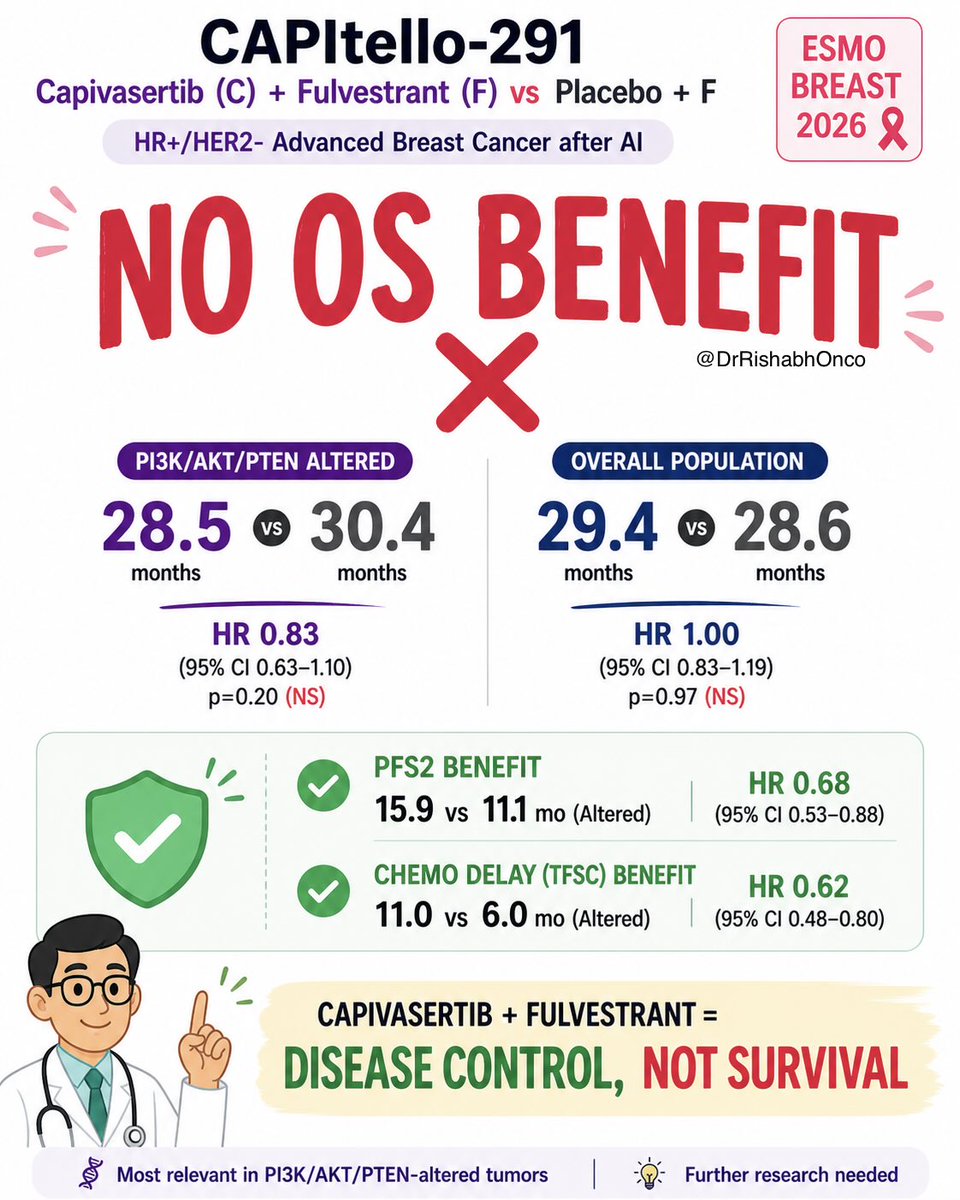
🔥 Does capivasertib actually improve survival?
CAPItello-291 final OS just answered this 👇
Trial: Capivasertib + fulvestrant vs placebo + fulvestrant
Setting: HR+/HER2- ABC post-AI
👥 Study population
708 pts
Biomarker cohort: PI3K/AKT/PTEN altered
💊 Arms
Capivasertib + fulvestrant
vs
Placebo + fulvestrant
🎯 Key results
🔹 OS (final analysis)
Altered: 28.5 vs 30.4 mo
HR 0.83 (NS)
Overall: 29.4 vs 28.6 mo
HR 1.00 ❌
👉 No survival benefit
🔹 PFS2
Altered: 15.9 vs 11.1 mo
HR 0.68 ✅
🔹 Time to chemo (TFSC)
Altered: 11.0 vs 6.0 mo
HR 0.62 ✅
🔹 Safety
No new signals
🧠 Takeaway
Capivasertib = disease control drug
✔ Delays progression
✔ Delays chemotherapy
❌ Does NOT improve OS
📌 Most relevant in PI3K/AKT/PTEN-altered tumors
💬 Would you still use capivasertib without OS benefit?
🔖 Save for clinic decisions
📖 Full data in presentation
#ESMOBreast26 #BreastCancer #OncoTwitter @OncoAlert@myesmo@esmo_open@ASCO
TRAIN-4 Study: Chemo-Free Triple HER2 Therapy
The TRAIN-4 study tested a chemotherapy-free combination of Trastuzumab + Pertuzumab + Tucatinib in early HER2+ breast cancer and delivered impressive results:
• 93% of patients had major tumor shrinkage after just 3 cycles
• 73% achieved pathological complete response (no cancer at surgery)
• Benefit seen irrespective of hormone receptor status
Treatment was well tolerated. Promising step towards less toxic targeted therapy
#ESMOBreast2026 #MVOnco #HER2BreastCancer #BreastCancerResearch #Oncology
Highlights options with ESR1 mutations in HR+ HER2 - BC after progression on CDK 4/6 inhibitions.
https://t.co/Snr2DeUOJJ
#oncology#medtwitter#breastcancer
PI3Kα inhibition is coming to the FRONTLINE?
A new all-oral triplet may reshape HR+/HER2- MBC 👇
Trial signal: ReDiscover (dose-finding)
PIK3CA-mutant | Prior CDK4/6: 100% | Median 3L
🧪 Triplet
💊 Zovegalisib (mutant-selective PI3Kα inhibitor)
💊 Atirmociclib (CDK4 inhibitor)
💊 Fulvestrant / AI
📊 Key results
• ORR: 44%
• Tumor shrinkage: 85%
• Grade 3 hyperglycemia: 0%
• Febrile neutropenia: 0%
• Median PFS: Not mature
⚡ Why this matters
👉 PI3K inhibitors = efficacy but toxicity issues historically
👉 Here: clean metabolic profile + manageable safety
👉 ORR approaching 1L doublets (~53–55%) despite 3L setting
🧠 Phase 3 (planned)
🆚 Triplet vs CDK4/6 + AI
🎯 Population: endocrine-sensitive, PIK3CA-mutant
📌 Primary: PFS | Secondary: OS
💡 Clinical take
If tolerability holds, this could be the first viable PI3K-based frontline strategy.
Still early. Small N. Immature PFS.
But signal = hard to ignore.
#OncoTwitter #MedTwitter #BreastCancer #bcsm
@OncoAlert@myesmo@esmo_open@asco @RelayTx
First-line CDK4/6 inhibitor use did not improve overall survival vs second-line use in advanced hormone receptor–positive, ERBB2-negative #BreastCancer and increased grade ≥3 adverse events.
https://t.co/HFpuBhUexu
This is the treatment algorithm we’ve used during our discussion with @smitha42 for Colon/Colorectal Cancer!
✅ Early disease
✅ Biomarker & NGS driven approach
✅ Metastatic disease
#OncTwitter#MedX@OncUpdates#gism