🇧🇪 Consul General of Belgium in Shanghai. Previously in NY UN, NDelhi, BSB, Mscw, BRU (EU Trade Pol.), NY UN (Dpr), TLV, BRU (dir. ECOFIN, EPSCO, Cohesion)
CONCLUSION 🧵(1/2): Putin would have the world, and especially the United States, believe that he is somehow holding back from crushing Ukraine, but that he could do so at any moment of his choosing. The opposite is the case.
If Putin had had a way of ending the war quickly, he surely would have used it. The effort to field an army large enough to make virtually no gains is costing Putin a fortune, driving up inflation in Russia, and generating increasing social discontent. Fielding a larger army would cost more with no guarantee of materially changing the situation on the front. That is why Putin is holding back at least for now. ⬇️
Putin has likely recognized the folly of trying to drown Ukraine in Russian blood and has instead opted to try to hammer Ukraine into submission with a strategic bombing campaign. The Russians have secured a temporary advantage in the skies over Ukraine through their jet-powered drones and the shortage of Patriot missiles that can intercept their ballistic missiles. But Ukraine is fielding solutions to defend against the jet-powered drones, and it is hardening and decentralizing its infrastructure to survive the ballistic missile strikes (as well as developing its own ballistic missile interceptors, although that effort will take time).
The Russian strikes are currently devastating Ukrainian energy and other infrastructure and imposing a brutal cost on Ukrainian civilians—as Putin intends. But there is no reason to think that this strategic bombing campaign will be any more successful than every other strategic bombing campaign in history—all of which have failed to compel a country holding its own on the battlefield to surrender.
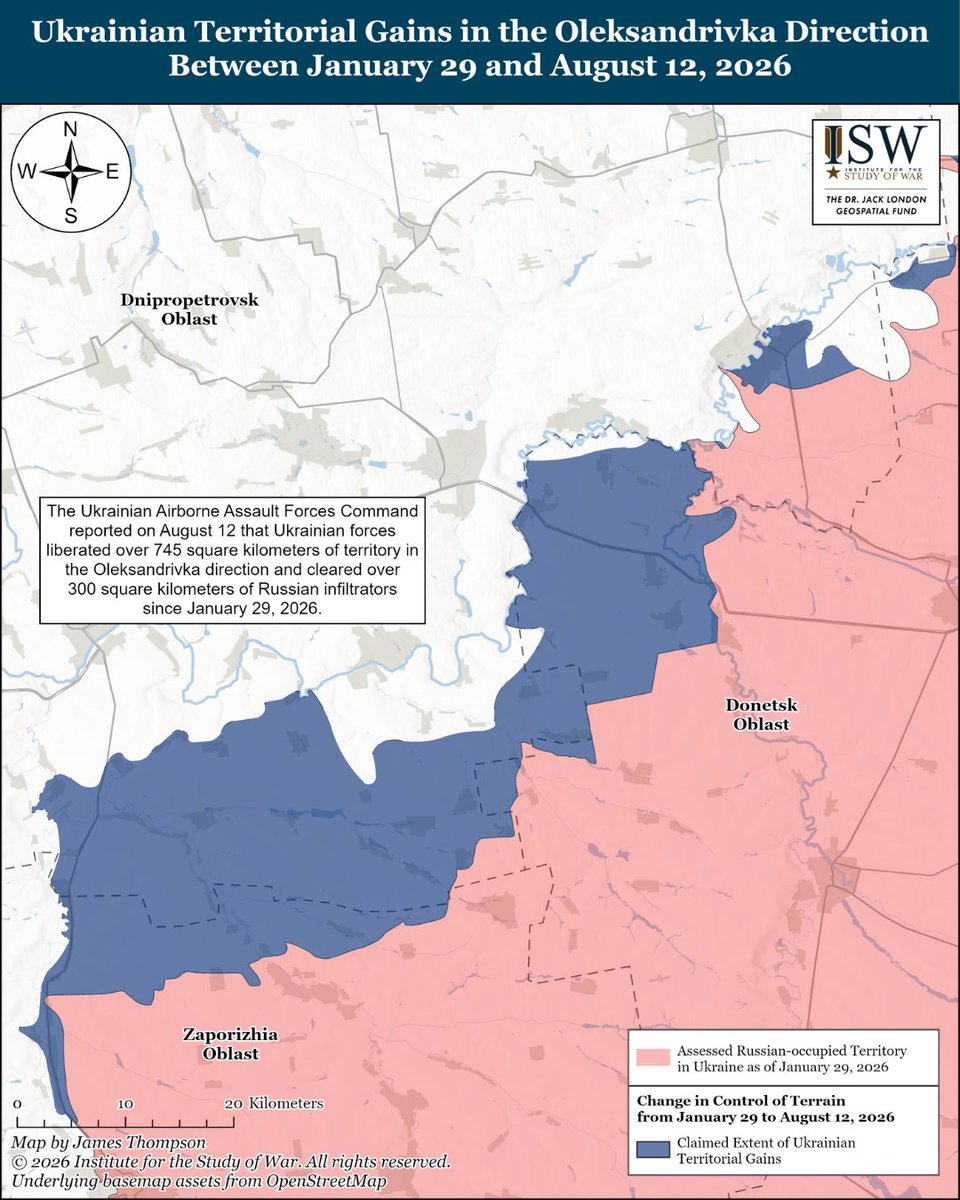
NEW: Ukrainian forces are making slow but tactically significant gains in the Oleksandrivka direction that may later threaten Russian logistics and efforts in the Oleksandrivka and Hulyaipole directions over the long term.
Other Key Takeaways:
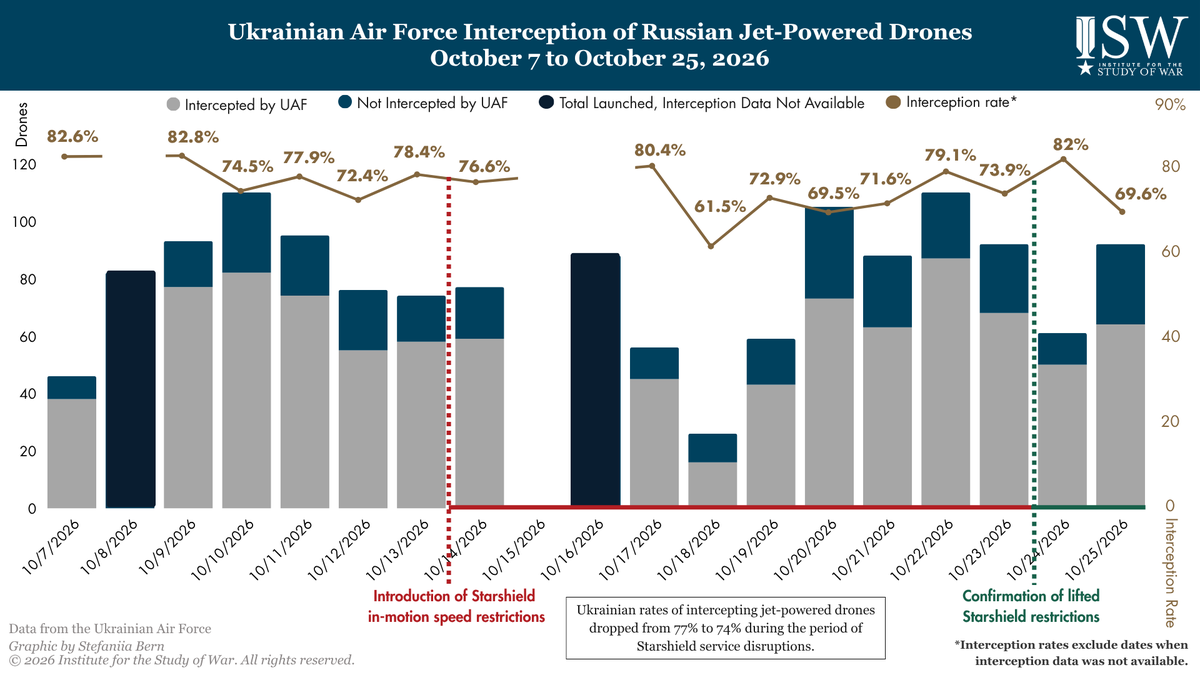
Ukraine had a slightly lower but still relatively high interception rate of Russian jet-powered drones during the Starshield restrictions in mid-October 2026, but will need innovative jet-powered interceptors to work to sustain and improve these interception rates over the long term.
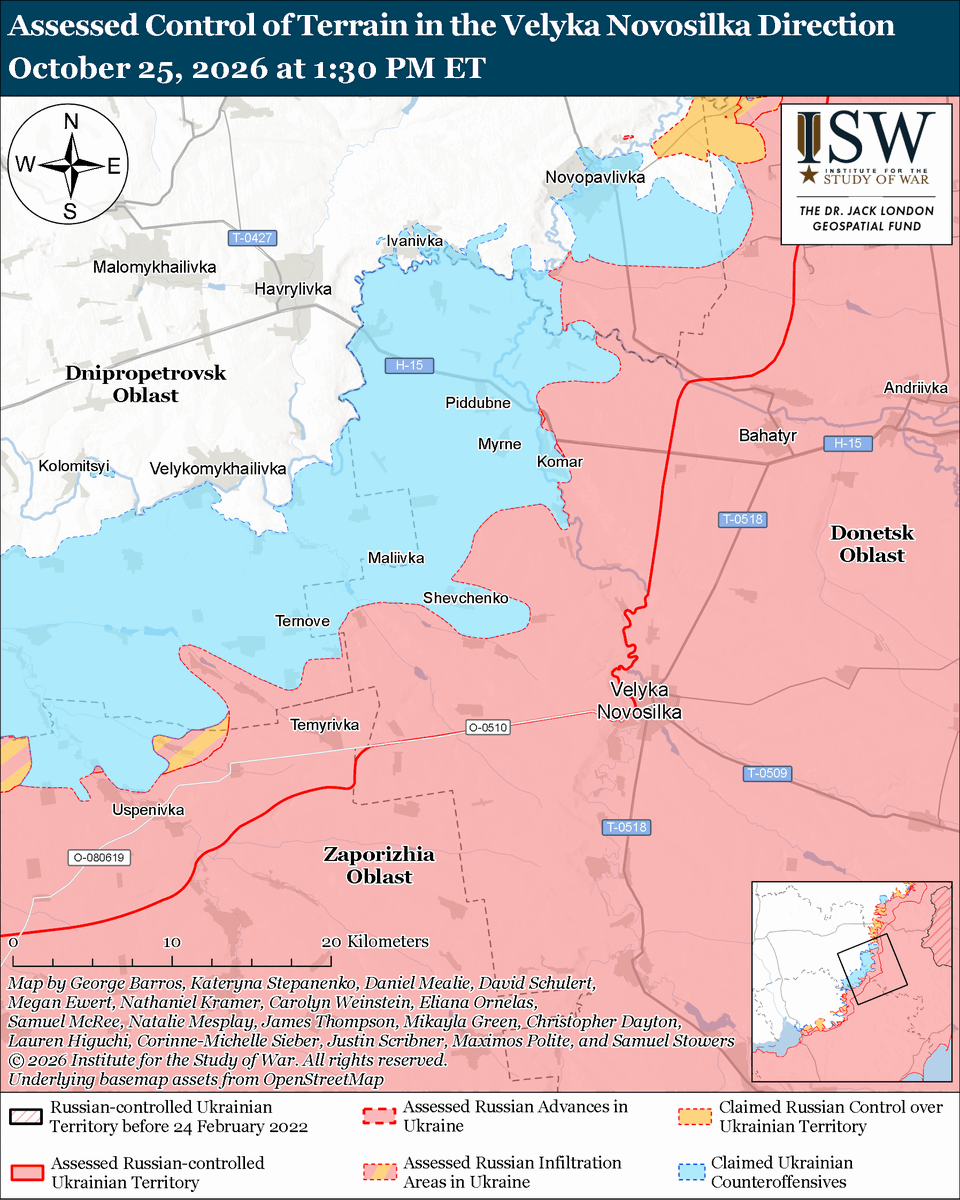
Russian forces recently advanced in the Novopavlivka direction.
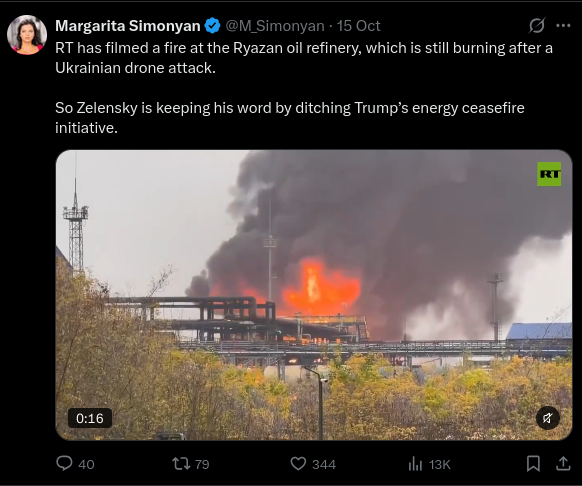
Ukrainian forces conducted a series of long-range strikes against industrial facilities in Russia. Russian forces conducted several high-casualty strikes on October 24 and 25, including in western Ukraine.
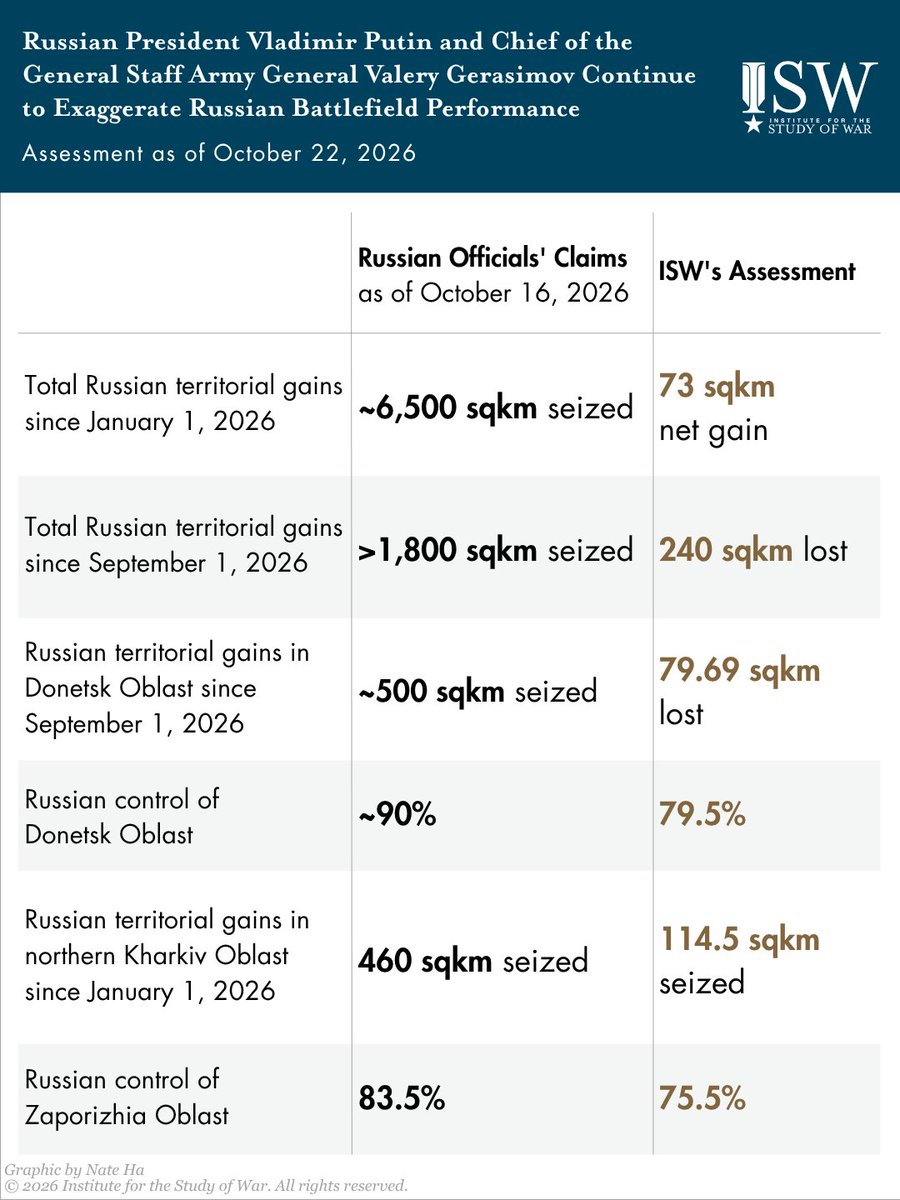
It is unclear whether Putin is lying about Russian gains or being lied to by his own military—or both. Russian military correspondents constantly complain of what they call “beautiful reports” that Russian military units send to higher headquarters, claiming gains they have not made. Ukrainian forces say that they have been able to use the Russian military’s own internal culture of lying to their advantage, luring Russian troops into traps because the Russians think that they are moving through territory they control. Leaked Russian military maps show phantom gains, often matching Putin’s claims. The pervasive lying within the Russian military is a problem for Russian soldiers, but likely an advantage for Putin, as it supports his own efforts to present Russian forces as advancing and winning when, in fact, they are doing neither.
I would not want us to approach a meeting of the three leaders – Ukraine, the United States, and Russia – having lifted all sanctions on the Russian Federation. This is an important point. Sanctions were imposed for aggression, not for an opportunity to have a chat. So if we say that this is the end of the war, there is a certain order for lifting sanctions. I told the American delegation this because I have had this feeling for quite a long time: when we talk about Russia’s loyalty, we should not buy it at such a price. Because without sanctions, we could find ourselves in a trilateral dialogue where we still do not know what will happen next, but the sanctions have already been lifted. And who will have the strength we had at the beginning of the war to impose all those sanctions again? To bring people together in such a way that we could secure more than 20 sanctions packages around the world. That is why I am very cautious about this.
I do not want us to find ourselves at a meeting with Putin without tools – without sanctions, without money, or without frozen assets. Because then, as Mr. Trump said, we really would not have too many cards in our deck.
From an interview with Alla Mazur for TSN Week on 1+1, as part of the United News telethon. (3/5)
I highly recommend reading this article by Michael @McFaul.
The former U.S. Ambassador to Russia makes a point I fully agree with:
"Helping Ukraine as it fights for its independence and against Russian occupation is not just the right thing to do; it’s also the pragmatic thing to do.
Let’s be realistic. Putin is not going to abandon his autocratic partners in China, Iran, and North Korea just because Trump offers him concessions. That is a naïve reading of Putin. He sees the United States as his enemy, no matter how many gifts he gets from Trump.
By trying to appease Putin, Trump is also weakening America’s relationships with our democratic allies and partners in Europe. In this new era of great power competition with China and Russia, our democratic allies are America’s greatest comparative advantage. Together, the free world has far greater economic power and military strength than autocracies, and our democratic values and ideals have significantly more global appeal than those of autocracies. But Trump’s embrace of Putin and his abandonment of Ukraine are weakening these ties."
“Dear Italian students, who today take to the streets carrying flags with the hammer and sickle and wearing T-shirts emblazoned with ‘CCCP’,” began an open letter in Italian by Lithuanian expat Neringa Budryt.
“I would like to ask you a question: do you truly know what the symbols you carry represent? And do you know what would have happened to many of you had you openly demonstrated in countries living under the oppression of communist regimes?
Let me tell you something. It is easy to display a red flag when, for you, communism is merely an abstract idea of equality, social justice, and rebellion against the system. It is easy to wear a T-shirt with "CCCP" on it when you have never experienced the reality of a communist regime.
We come from that part of Europe where communism was not a T-shirt, a symbol of rebellion, or a romanticized notion of equality. It was the system in which we lived—a system we never chose.
We know the history of Soviet repression, Stalinist purges, the Gulags, and mass deportations. Above all, we know the word "Siberia"—a place to which thousands of innocent people were forcibly deported, simply for thinking differently.
In Siberia—amidst freezing cold, starvation, and forced labor—many lost their lives; those who survived carried the scars of that experience forever. Entire families were torn apart, and generations were denied the chance to live freely in their own homeland.
In the countries of the Soviet bloc, censorship, political police, surveillance, and the suppression of dissent drastically curtailed individual freedoms.
We grew up in a system where state control permeated even our daily lives. At school, we were required to wear the red necktie of the "Pioneers." We were monitored; they tracked where we went and even whether we attended church. Even faith—a choice that should belong to an individual’s own conscience—could become a cause for suspicion.
We used to celebrate Christmas with our windows blacked out, to ensure no one would see us and report us. Because it was forbidden—just like so many other things: jeans, rock music, and all the symbols of a Western lifestyle. My mother returned from a Soviet labor camp. And do you know what happened to her? She was barred from continuing her education because she had been labeled an enemy of communism.
Under a communist regime, you could not protest. You risked arrest, imprisonment, interrogation, persecution—and, in certain historical contexts, even death. In the Soviet Union and other communist regimes, political dissent could cost you your freedom and your life.
Demonstrations independent of the authorities were not a guaranteed right; they were often suppressed by force.
That is why it strikes me to see young Italians proudly displaying the hammer and sickle—symbols associated with regimes that persecuted and imprisoned millions of people.
Today, you are free to take to the streets, shout against the government, criticize institutions, and wave your flags precisely because you live in a democracy that grants you these freedoms. Under an authoritarian regime of that kind, protesting against those in power could have landed you in prison.
This is not about denying the existence of social injustices, inequalities, or the right to fight for a better world. You are free to take to the streets to demand a more just society—but you should not idealize a system that denied so many people the very things you are free to exercise today: the right to choose, to believe, to speak, and to dissent. Before wearing a T-shirt with "CCCP" on it, listen to those who experienced that world. Talk to the deportees and their descendants; read the accounts of those who endured the gulags and forced exile to Siberia. Learn what it meant to be stripped of your freedom, your home, your loved ones—and even any prospect of a normal life—simply because of your background or your beliefs.
Before waving the hammer and sickle, please, study history thoroughly.”
As long as Russia believes it can achieve the goals of its invasion — goals it cannot achieve on the battlefield — by having anyone pressure Ukraine into capitulation, it will not enter serious negotiations.
That is why maintaining and increasing pressure on Russia remains critical to ending this war.
Peace through strength is the only strategy that works. But that strength must be applied to the aggressor, not to the country defending itself.
This war cannot be ended by stopping Ukraine's resistance. It can only be ended by stopping the aggressor's attacks.
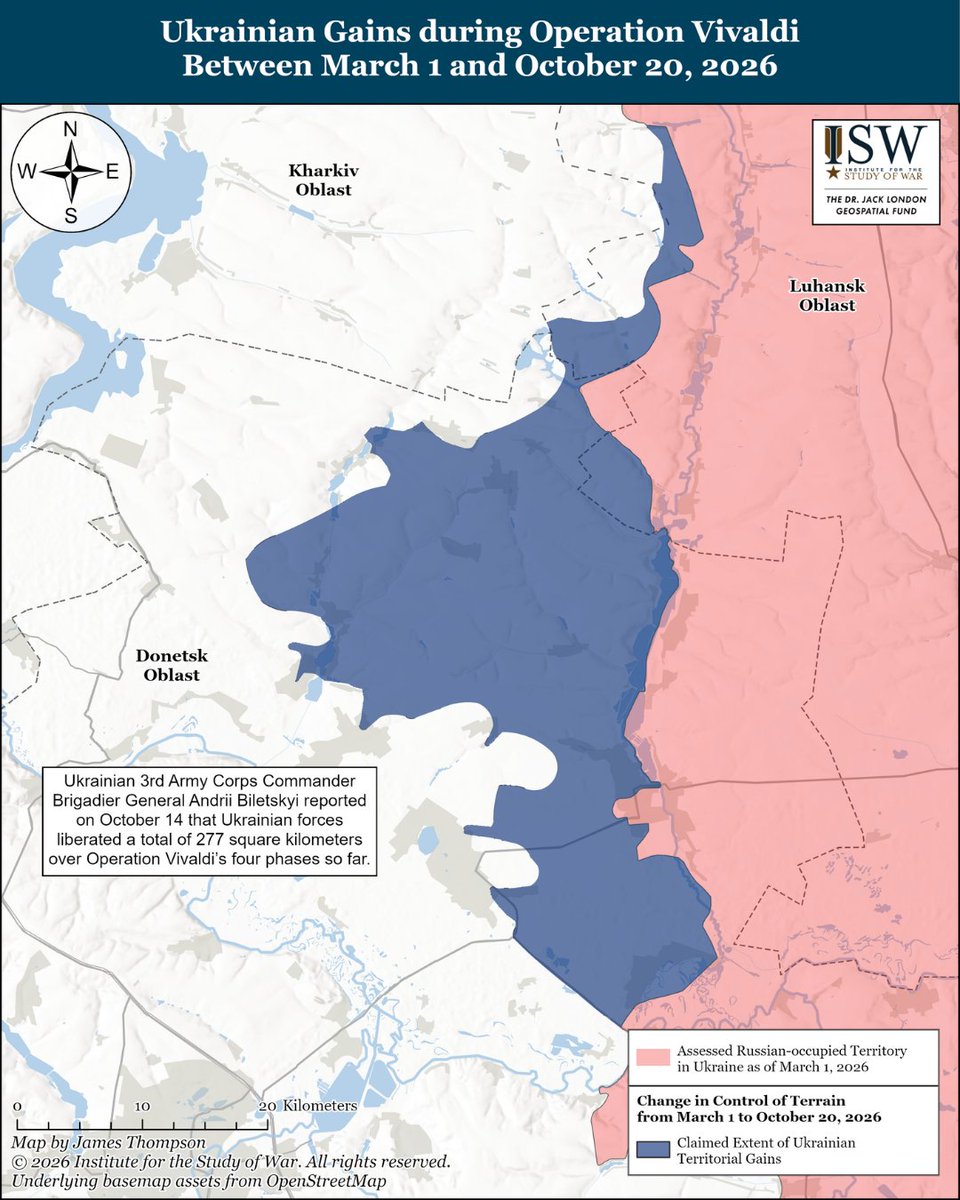
Ukraine, not Russia, has held the initiative in key sectors of the frontline for much of the year. Ukrainian forces have decisively defeated the main Russian offensive intended to complete the seizure of Donetsk Oblast in 2026. Ukrainian forces operationally defeated the Russian northern pincer in the Lyman direction and defeated the Russian military command’s plan to conduct a wide encirclement of Ukraine’s Fortress Belt.
Ukraine’s Operation Vivaldi resulted in the liberation of around 277 square kilometers and 16 settlements north and northeast of Lyman over four phases that Ukrainian 3rd Army Corps Commander Brigadier General Andrii Biletskyi began announcing in September 2026, although the operation likely began around March 2026.
MORE: Russian occupation authorities are fully responsible for the humanitarian crisis in Oleshky and have repeatedly and deliberately blocked evacuation and humanitarian routes into the settlement since the beginning of Russia’s occupation.
Russian occupation authorities stopped the delivery of food and other critical supplies into Oleshky in late December 2025 and have failed to deliver any food or medicine to Oleshky since May 2026.
The Kremlin rejected three local humanitarian ceasefire proposals from Ukrainian Ombudsman Dmytro Lubinets in May, July, and September 2026, after which Ukrainian forces conducted an operation to provide food to Oleshky residents via drone drops in September 2026.
Russian authorities have long refused to address the humanitarian crisis in Oleshky, and Gerasimov’s October 23 statement is the first instance of a Russian attempt to facilitate humanitarian aid deliveries.
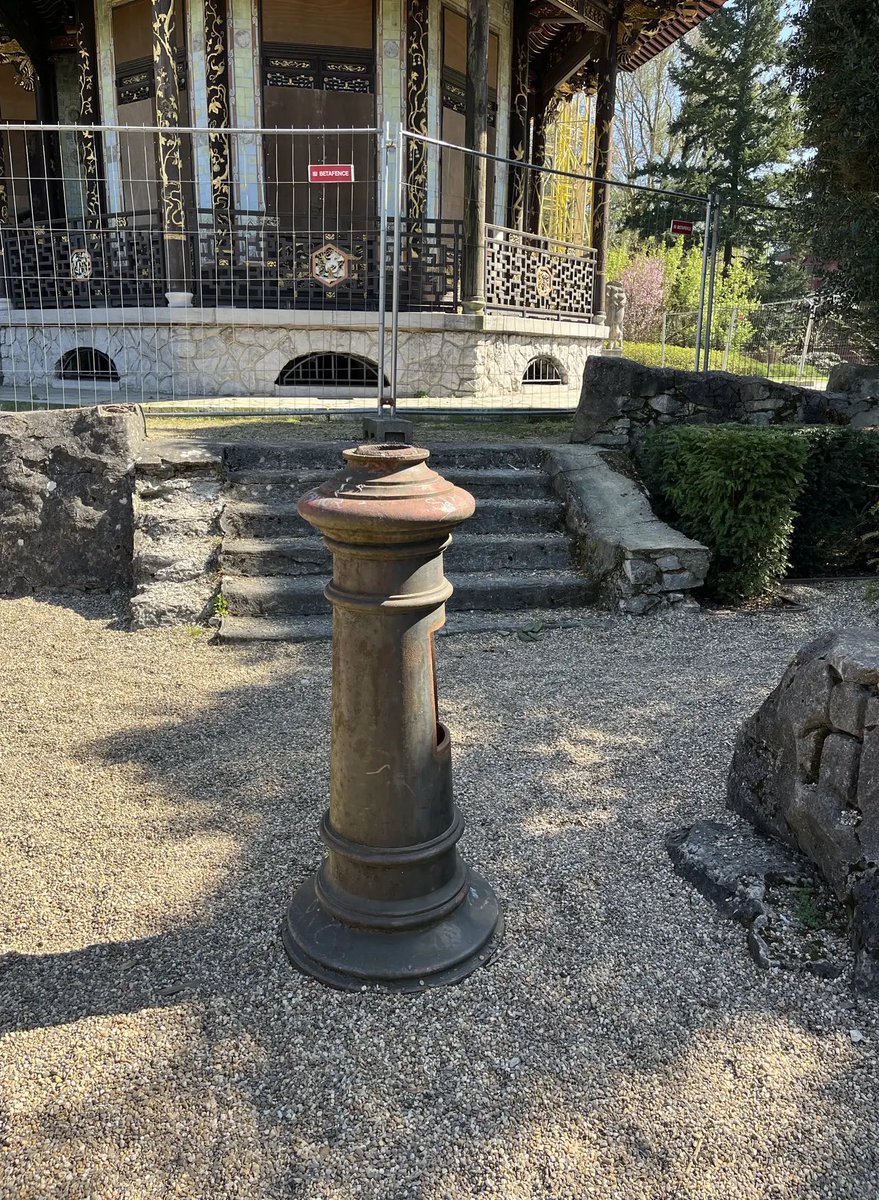
📣 Non- profit organisation Chinese Pavilion & Silk Road Countries has launched a public subscription campaign to restore 6 standing lamps of the pavilion in 🇧🇪 Brussels, starting @ 100 EUR
Help them restore them & switch them back on in spring 2027.
👉 https://t.co/n2sP7ZmAFF
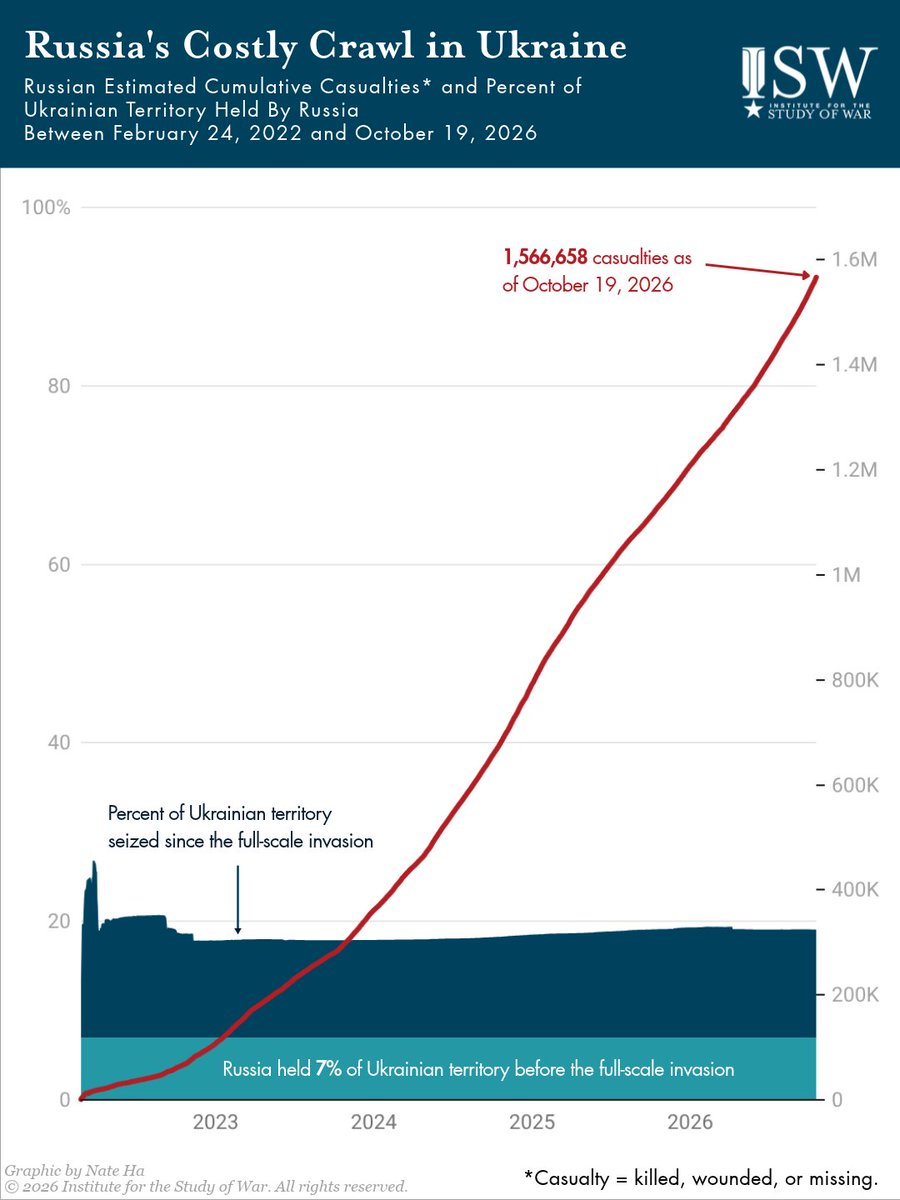
Russian forces are not winning on the battlefield, however, particularly as Ukrainian forces have stymied the planned Russian offensive to seize Donetsk Oblast. ISW has observed evidence that Russian forces suffered a net loss of 241 square kilometers of territory in Ukraine since September 1, 2026. The average rate of daily Russian advances has significantly declined since 2025, with an average of 0.25 square kilometers per day so far in 2026.
Ukrainian forces have, comparatively, been contesting and seizing the operational initiative across several sectors of the frontline throughout 2026, including most recently in the Lyman direction with Ukraine’s Operation Vivaldi which liberated over 270 square kilometers of territory and thwarted the Russian military command’s plan to encircle the Fortress Belt.
Russian forces are also facing mounting monthly casualties while the Russian recruitment rate continues to fall short of its loss rate. Russian forces have suffered almost 37,000 casualties thus far in October 2026 — much higher than the 31,270 casualties for all of October 2025.
The Kremlin may face mounting challenges in the coming months, should Ukraine continue to contest the operational initiative and disrupt Russian offensive plans, potentially further pushing Russian commanders to urge Putin to conduct a mobilization in some form.
VIDEO: The Kremlin is conducting an escalating series of kinetic campaigns against Europe. In this video, ISW Director of the Defense of Europe Project @Mason_R_Clark explains the Kremlin's objectives behind its activity in Europe and why naming it "hybrid attacks" and "provocations" might undermine an effective response.
The Kremlin is highly unlikely to conduct a large-scale conventional attack of a NATO state in the near future. NATO and Europe still face three challenges that should be considered in the face of Russian escalation.
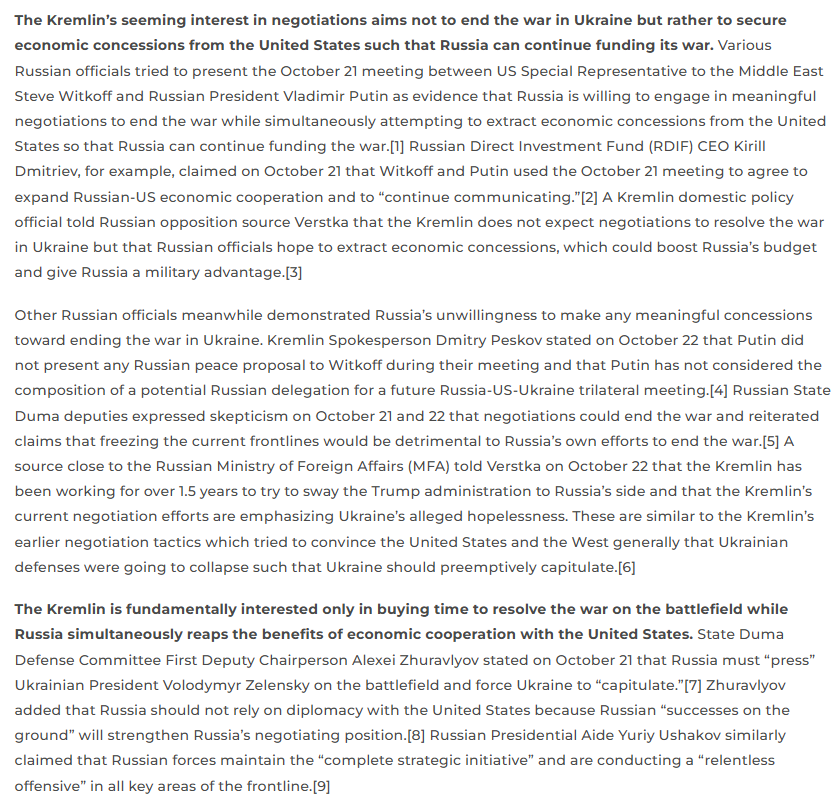
MORE: The Kremlin is fundamentally interested only in buying time to resolve the war on the battlefield while Russia simultaneously reaps the benefits of economic cooperation with the United States. ⬇️
Various Russian officials tried to present the October 21 meeting between US Special Representative to the Middle East Steve Witkoff and Russian President Vladimir Putin as evidence that Russia is willing to engage in meaningful negotiations to end the war while simultaneously attempting to extract economic concessions from the United States so that Russia can continue funding the war.
Other Russian officials meanwhile demonstrated Russia’s unwillingness to make any meaningful concessions toward ending the war in Ukraine.
La fable de l’Otan corrigée par Gorbatchev:
-Le traité ne stipulait pas que l'Otan ne s’étende pas à l'est. Le pacte de Varsovie existait encore. La question ne se posait pas.
-Avez-vous été trahis par l'Occident sur l'expansion de l'Otan?
-C’est un mythe
SPECIAL REPORT: Russian military victory over Ukraine is not inevitable. It is extraordinarily unlikely, in fact, unless Western support for Ukraine collapses.
There is simply no inevitable correlation between the relative size of combatants and the outcome of a war — particularly when the war is existential for the smaller state but not for the larger one, as is true today.
Russian President Vladimir Putin is nevertheless trying once again to breathe life into the myth of inevitable Russian military victory in order to persuade the United States and other supporters of Ukraine to compel Kyiv to surrender.
Ukraine, not Russia, has actually held the initiative in key sectors of the frontline for much of the year and has developed a number of ways of offsetting the overall Russian manpower advantage.
Russia’s population and relative (but diminishing) wealth will let Putin continue his war for a long time, to be sure. But Ukraine can also continue fighting for its existence as long as Western support continues.
Russian President Vladimir Putin cited genetics to declare that Russians and Ukrainians are “one people” and reiterated his claim to Ukrainian territory, saying: “I think that it is not their territory but the historical territory of Russia.” https://t.co/lGbmHtjEVN
OTD in 1956, Hungarians rose up against Soviet-backed communist rule. Students demanded free elections, a free press and the withdrawal of Soviet troops. On 4 November, the Soviet Union launched an invasion to brutally crush the uprising.
Seven decades later, Russia is seeking to rehabilitate the Soviet Union’s actions by portraying the uprising as the result of ‘Western provocations’, whitewashing the brutal intervention that killed and wounded thousands and forced 200,000 into exile.
NEW: The Kremlin's seeming interest in negotiations aims not to end the war in Ukraine but rather to secure economic concessions from the United States such that Russia can continue funding its war.
Other Key Takeaways:
The Kremlin is fundamentally interested only in buying time to resolve the war on the battlefield while Russia simultaneously reaps the benefits of economic cooperation with the United States.
Russian forces are not winning on the battlefield, however, particularly as Ukrainian forces have stymied the planned Russian offensive to seize Donetsk Oblast.
The Kremlin is likely actively seeking economic cooperation with the United States as Russia faces significant financial strain.
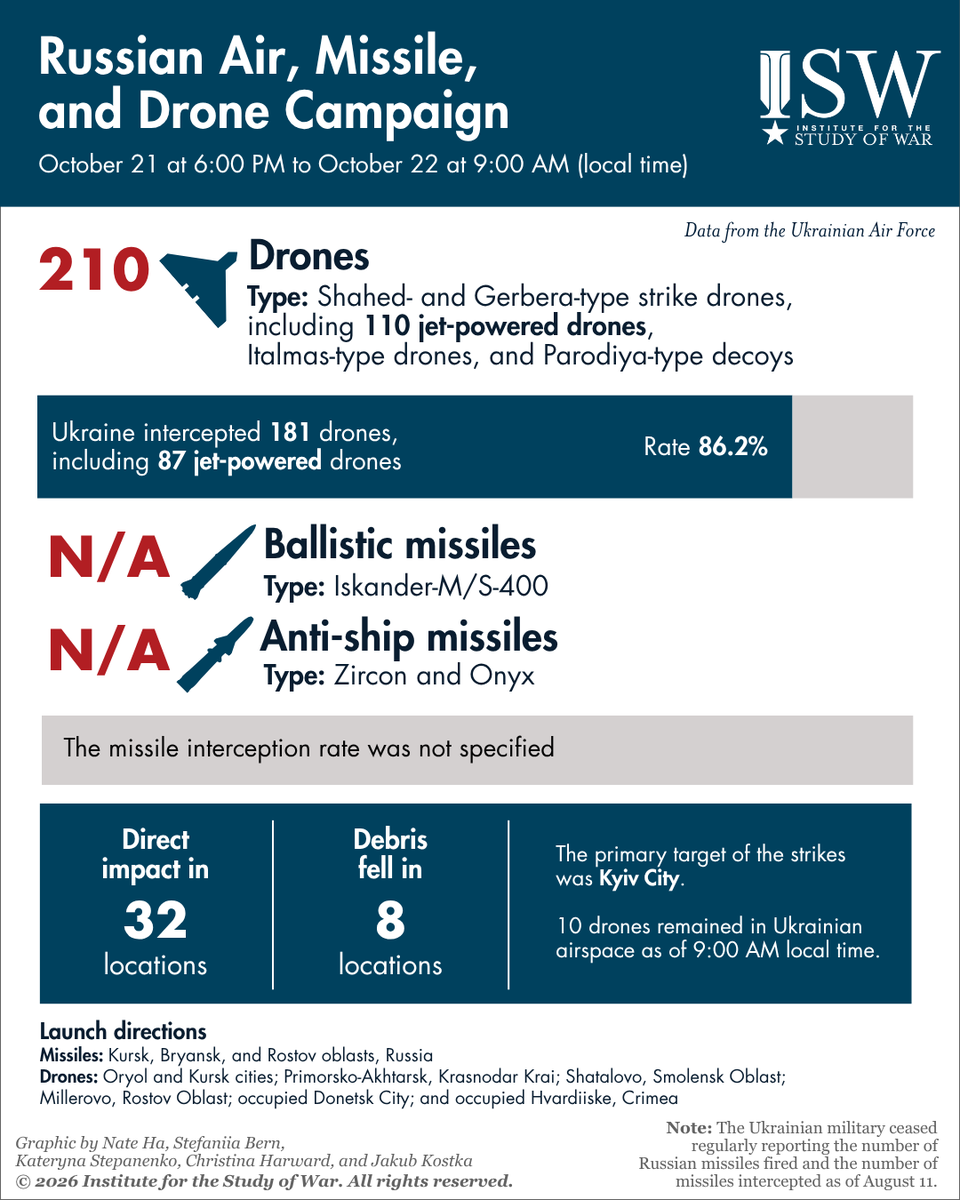
Russian forces conducted a massive missile and drone strike against Ukraine overnight on October 21 to 22 following the October 21 meeting between Witkoff and Putin- a continuation of Russia’s pattern of launching large strike packages in the days before and after major peace talks.
Russian forces struck Kyiv City with cluster munitions to purposely harm the civilian population, likely as part of wider Russian efforts to distract from Ukraine’s recent battlefield successes and ultimately force Ukraine into capitulation by making daily life untenable.
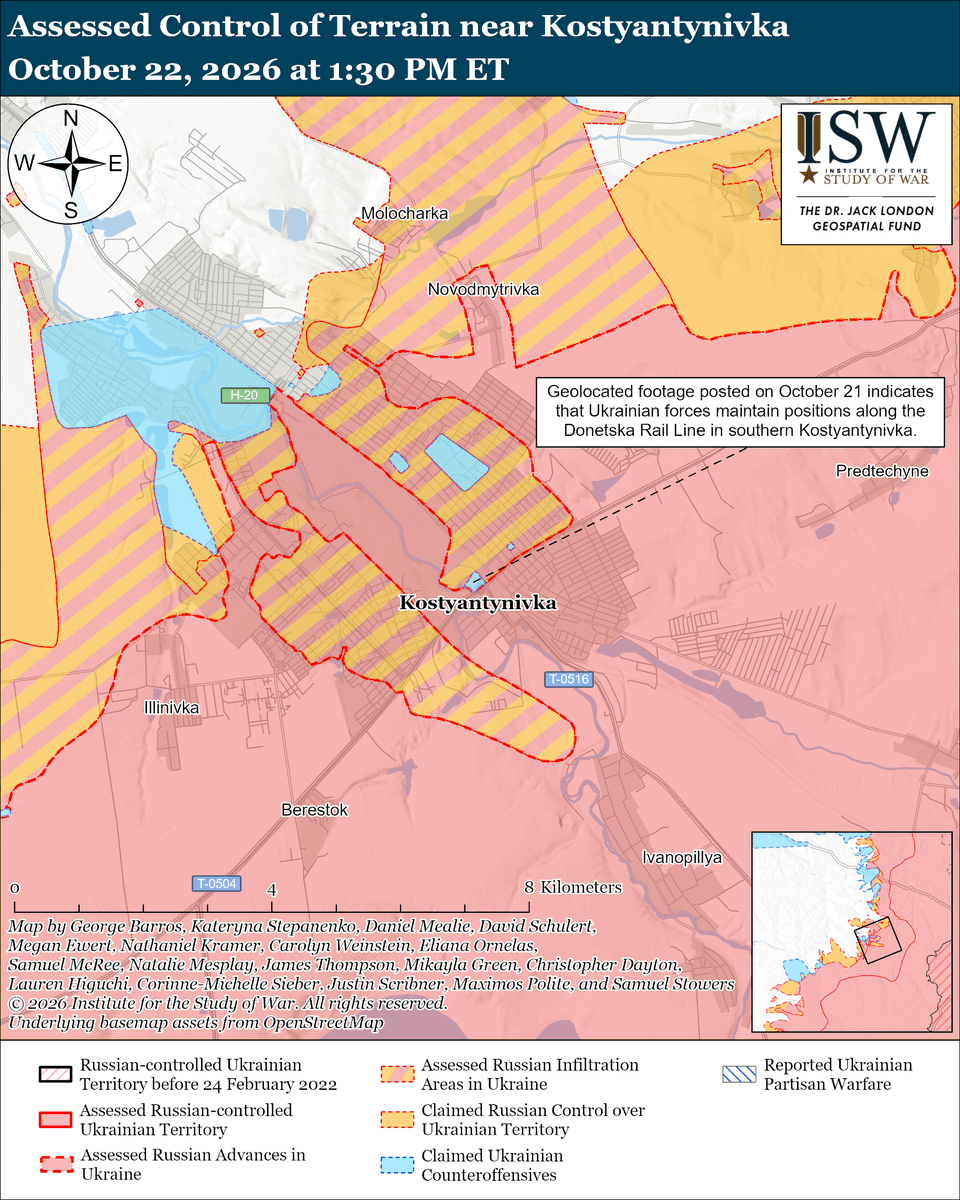
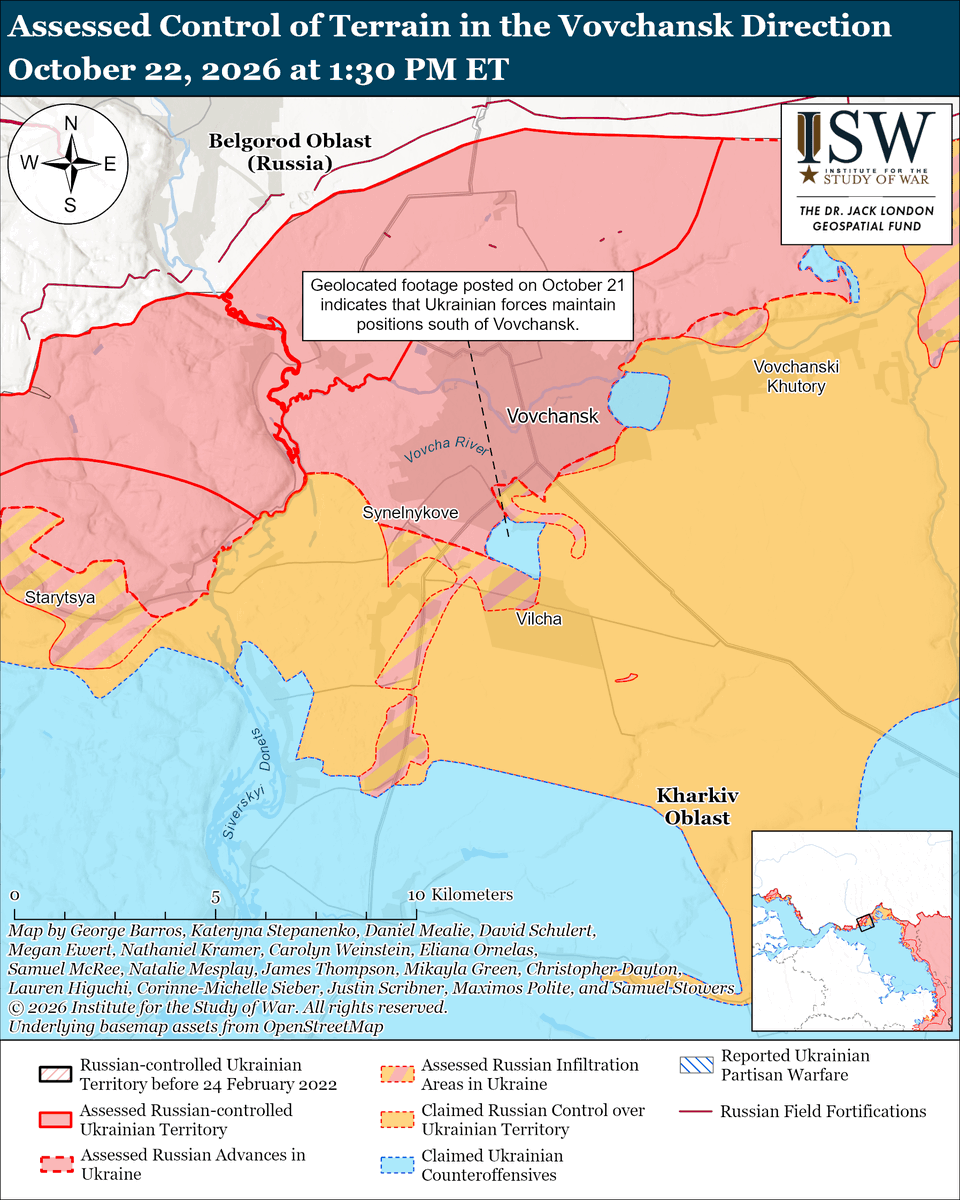
Ukrainian forces recently advanced south of Vovchansk and in southern Kostyantynivka.
Ukrainian forces continued their long-range strike campaign against Russian military assets on October 21 and overnight on October 21 to 22.
Russia struck Ukraine’s energy infrastructure 76 times during the US-declared truce. In the past week, it launched nearly 2,700 drones, 1,700 guided aerial bombs, and 66 missiles at Ukrainian cities.
The Kremlin’s understanding of a truce appears to be that Russia can continue striking Ukraine with impunity while Ukraine must refrain from defending itself or retaliating.
The world has a very short memory.
Bucha.
More than 450 civilians were brutally murdered there.
Bucha was a warning. The world ignored it.
Keep exposing russian war crimes. Never let these monsters escape justice.