This is Erwin Schrödinger.
Most remember him for his cat. That's the least interesting thing he did.
In 1944, he crossed from physics into biology — and ended with a view of consciousness modern science still ignores.
What he found changes what you think you are: 🧵
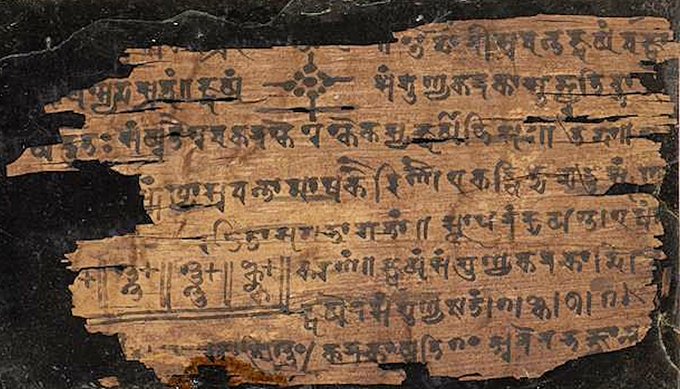
This fragile birch bark is the Bakhshali Manuscript, dated to the 3rd century CE.
Found by a farmer in 1881, it holds the absolute oldest recorded origin of the "zero" symbol we use today. Before it became a standalone number, ancient Indian mathematicians used this dot as a vital placeholder to separate values like 1, 10, and 100.
Without this leap, modern computing, calculus, and physics wouldn't even exist.
When you wander through woods with heavy shadows and dappled light and suddenly come upon an open space, a green meadow surrounded by stately trees, or a sparkling stream, you wonder why man has lost his relationship to nature and the beauty of the earth, the fallen leaf and the broken branch. If you have lost touch with nature, then you will inevitably lose relationship with another.
Nature is not just the flowers, the lovely green lawn or the flowing waters in your little garden, but the whole earth with all the things on it. We consider that nature exists for our use, for our convenience, and so lose communion with the earth.
Sensitivity to the fallen leaf and to the tall tree on a hill is far more important than all the passing of examinations and having a bright career. Those are not the whole of life. Life is like a vast river with a great volume of water without a beginning or an ending. We take out of that fast running current a bucket of water, and that confined water becomes our life. This is our conditioning and our everlasting sorrow.
— Krishnamurti
The Whole Movement of Life is Learning
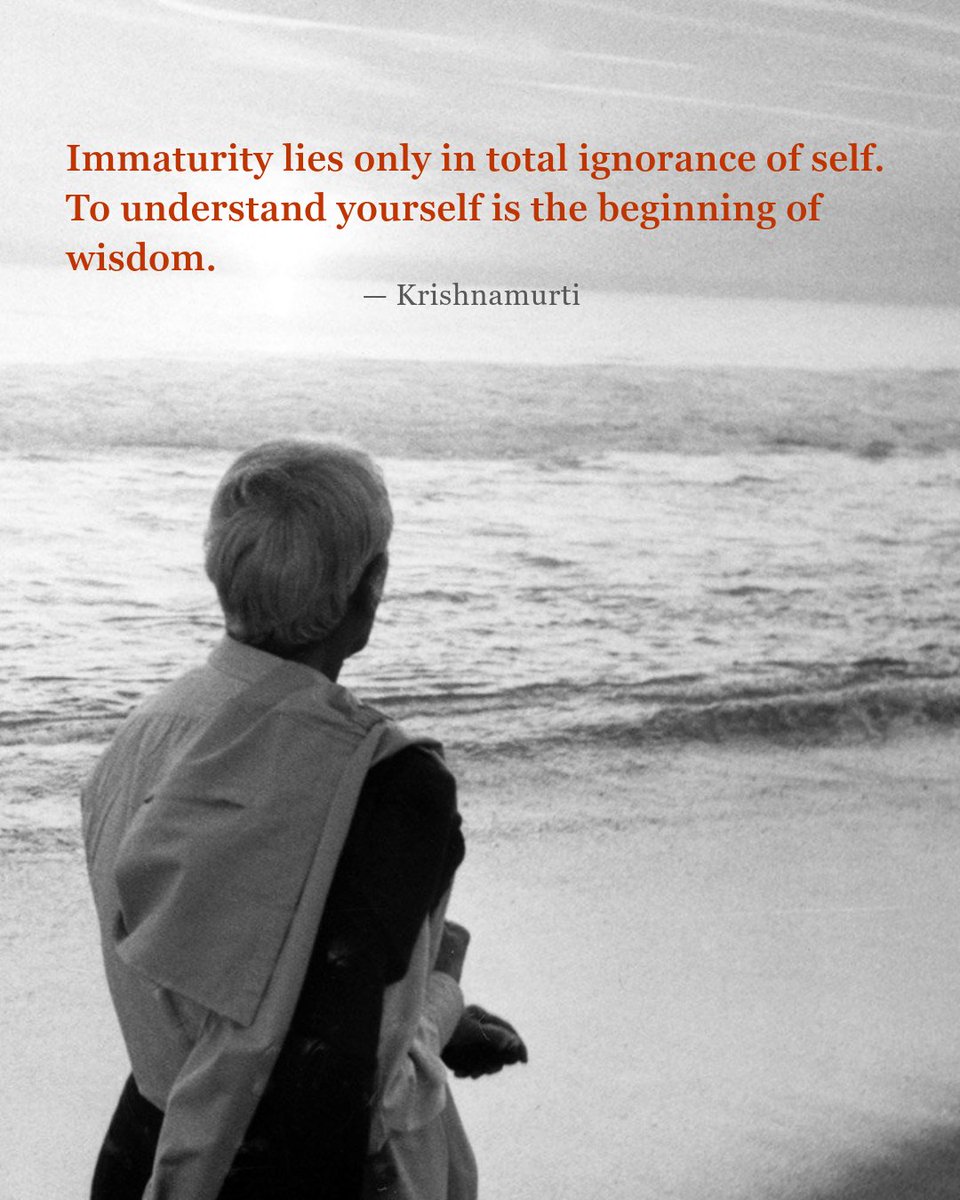
The question of whether or not there is a God or truth or reality, or whatever you like to call it, can never be answered by books, by priests, philosophers or saviours. Nobody and nothing can answer the question but you yourself, and that is why you must know yourself.
Immaturity lies only in total ignorance of self. To understand yourself is the beginning of wisdom.
— Krishnamurti
Freedom from the Known
I was watching The Last Samurai today and it made me realize how fascinating a country Japan is and how resilient and determined it is as a society.
Till 1868 they were a feudal, agrarian, peasant driven society largely isolated from the world.
In 1868, an event called Meiji Restoration happened, where the entire country came under the imperial throne under Emperor Meiji.
This led to the westernization of Japan.
40 years later, in 1905, they humiliated a legit western power Russia in battle and outmatched them strategically and technologically.
Battle of Tsushima was so one sided and it annihilated the Russians so badly, it makes the 2026 FIFA World Cup final look competitive.
In 1914, they sided with the Allies and defeated Germany in battle in the Far East.
By 1941, they had out navied England and almost Out Navied the USA and, a fact which was unthinkable in the 20s and 30s and entered the World War against them.
They over ran most of South East Asia and landed some really bloody blows to the USA, a country that was almost 50 times bigger.
By 1945, the entire country was literally burnt to the ground. Most of their cities were ash and cinders. Most of their youth, dead in far off islands.
That country was actually reduced to nothing.
Yet in the next 30 years, they became one of the largest economies in the world.
They don't have oil. They don't have any valuable natural resources. They are isolated and prone to natural disasters.
If the placement of countries was a deck of cards, Japan has been dealt with probably the worst hand of all.
Yet, thru sheer power of their will and determination, they find a way to progress and dominate.
Vedic Nirukta व् v-
Let us now meditate on the Varna Va-
Va is a labial ओष्ठव्य
It is a semivowel and closely related to the svara उ u-
Notice that the va- sound is coming out of your lips and being spread to the world
It is the sound of manifestation and its expansion as Sri Aurobindo has elegantly described
That is why we have words like Vayu which means that which is spread out in its flow
We have discussed the power of the sibilant sh- श् in a previous post which gives us intensity, force, speed, holding, compression
Now feel the intensity of sh- spreading out or held externally in the universe of manifestation and you have words like visha, vishaya, Vishva, etc
Vishva then is not just the external world but also the field of your consciousness. It can be narrow or it can be wide and as it grows wider the difference between the personal and the universal begins to disappear for the Rishi. The word Vishva then is a shlesha, a pun or paronomasia, just like so many Vedic terms that play in several universes at the same time and keep us on tenterhooks
@MakrandParanspe@Zoomerjeet
Katha & Character: Dhyana, Moksha, and Steadying the Mind in the Digital Age | Katha Series #8
In this final episode of the Deep Dive Katha Series, Smt. Vandana Mishra emphasizes the vital civilizational role of storytelling in steadying the mind for Dhyana and Moksha. Citing the Bhagavad Gita, Smt. Vandana illustrates how the mind can be one’s greatest friend or worst enemy.
To counter modern digital distractions and identity fragmentation, Infinity Foundation introduces “Katha at Night. Character for Life.” This initiative leverages ancient Dharmic Traditions to nurture Iccha, Vichara, and Karma Shakti in youth.
By reconnecting with Svadharma through the Puranas and Itihasa, we build psychological resilience, moral depth, and universal love for all living beings.
This series conclusion serves as a roadmap for Civilizational Literacy, transforming screen time into a vehicle for inner peace and ultimate truth (Satya).
Tune in to restore Sacred Continuity!
────────────────────────────────────
🎯 KATHA BEFORE YOU CRASH
👥Online Interactive Sessions (Ages 12–15)
🔗Register: https://t.co/wpMDbyMCFa
📧Inquiries: [email protected] ────────────────────────────────────
🔹Direction & Cinematography: Biswajit Malakar
🔹Editing, Sound Design & Animation: Rajkumar Thorat
🔹Editor & Audio: Ankit Singh
🔹Script: Vandana Mishra
Based on works by Rajiv Malhotra & infinity Foundation
@InfinityMessage@IFIMessage
#Katha #SanatanaDharma #SanskritNonTranslatables #BeingDifferent #Dharma
When the Sun is overhead, its light passes through a relatively short layer of air. Near sunset, that same light must travel through a much longer atmospheric path. Along the way, air molecules scatter short wavelengths (blue and violet) far more efficiently than long wavelengths (red and orange) as a consequence of Rayleigh scattering, which scales roughly as 1/λ⁴.
By the time the light reaches you, much of the blue has been scattered away from the direct beam, leaving sunlight enriched in warm oranges and reds. The beautiful colors of sunset are really a visible record of light interacting with Earth's atmosphere.
Under the trees it was very quiet; there were so many birds calling, singing, chattering, endlessly restless. The branches were huge, beautifully shaped, polished, smooth and it was quite startling to see them and they had a sweep and a grace that brought tears to the eyes and made you wonder at the things of the earth.
The earth had nothing more beautiful than the tree and when it died it would still be beautiful; every branch naked, open to the sky, bleached by the sun and there would be birds resting upon its nakedness.
There would be shelter for owls, there in that deep hollow, and the bright, screeching parrots would nest high up in the hole of that branch; woodpeckers would come, with their red-crested feathers sticking straight out of their heads, to drive in a few holes; of course there would be those striped squirrels, racing about the branches, ever complaining about something and always curious; right on the top-most branch, there would be a white and red eagle surveying the land with dignity and alone.
There would be many ants, red and black, scurrying up the tree and others racing down and their bite would be quite painful. But now the tree was alive, marvellous, and there was plenty of shade and the blazing sun never touched you; you could sit there by the hour and see and listen to everything that was alive and dead, outside and inside.
— From Krishnamurti's Notebook
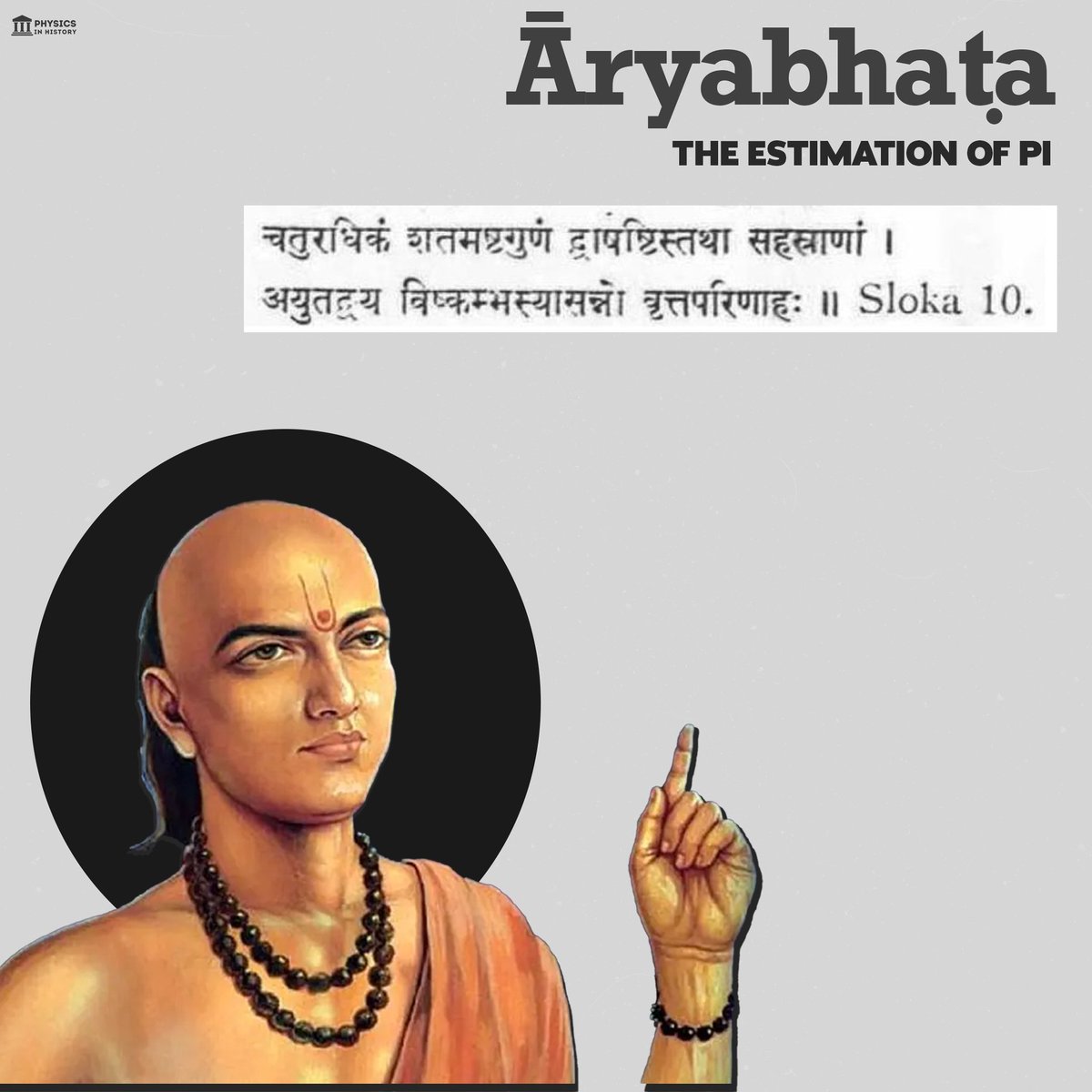
Aryabhatta's formula to calculate the value of π ✍️
caturadhikam śatamaṣṭaguṇam dvāṣaṣṭistathā sahasrāṇām
ayutadvayaviṣkambhasyāsanno vṛttapariṇāhaḥ.
Translation:
Add four to 100, multiply by eight, and then add 62,000. By this rule the circumference of a circle with a diameter of 20,000 can be approached.
Thus according to the rule ((4 + 100) × 8 + 62000)/20000 = 62832/20000 = 3.1416
The value of π calculated by this method is accurate unto 5 significant figures.
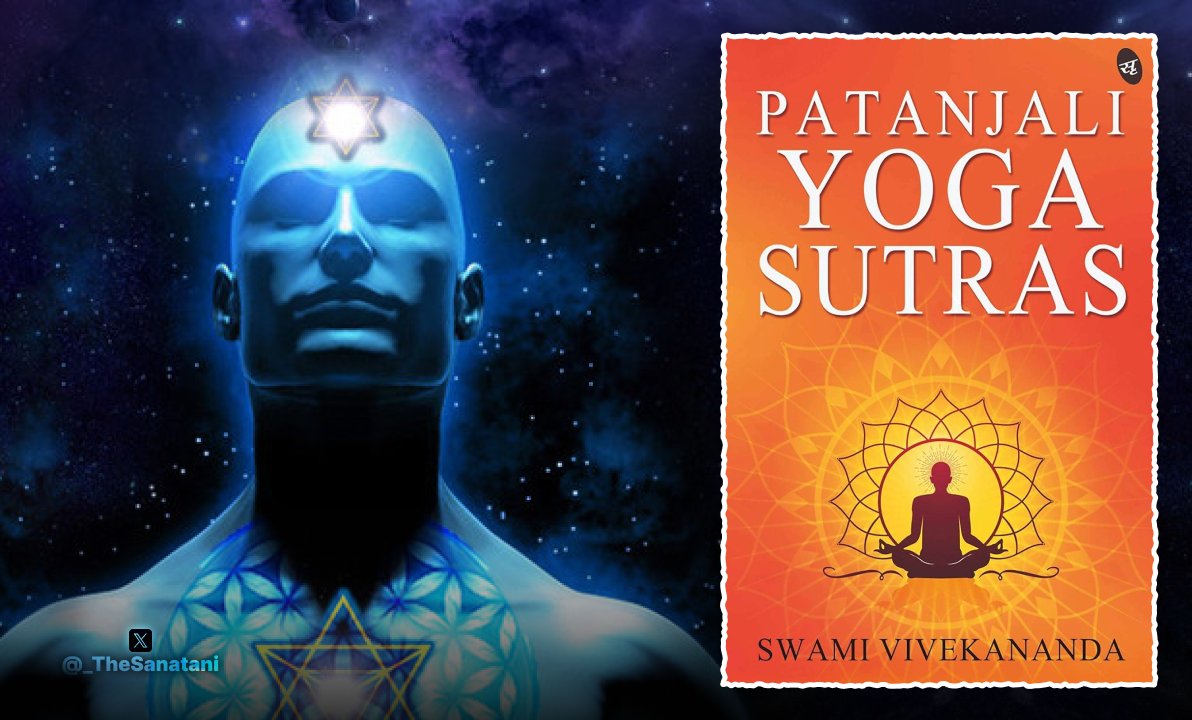
What the Yoga Sūtras Teach About the Human Mind… 🔥
The Yoga Sūtras of Maharshi Patañjali do not describe the mind as the Self. They describe it as an instrument... constantly changing, constantly reacting, and constantly shaping our experience of reality.
> According to Patañjali, the mind (Citta) is influenced by thoughts, memories, imagination, perceptions, and sleep. These changing modifications are called Vṛttis. When consciousness identifies with these Vṛttis, suffering begins.
> The mind is also shaped by Saṁskāras... the subtle impressions left by every thought and action. Repeated Saṁskāras become Vāsanās, deep tendencies that quietly influence behaviour, desire, and habit.
> At the root of this conditioning lie the Pañca Kleśas: ignorance, ego-identification, attachment, aversion, and fear of death. These afflictions distort perception and keep the mind trapped in the cycle of karma and rebirth.
> The purpose of Yoga is not to suppress the mind, but to understand and refine it. Through Abhyāsa (steady practice) and Vairāgya (detachment), the fluctuations gradually subside.
> When the mind becomes still, consciousness no longer mistakes itself for its thoughts. The Seer rests in its own true nature... this is the beginning of real freedom.
The mind is a powerful instrument... But it is a poor master. The Yoga Sūtras teach that peace begins... When you stop identifying with every thought that passes through it.
👉 Follow @_TheSanatani for more timeless wisdom of Sanatana Dharma.
👉 Join me on Telegram for all the Archives: https://t.co/NIElWWJflO
In case you found sandhi elusive while learning Sanskrit, you might want to check my latest substack article out.
Link : https://t.co/qEKoKl3bf0
I explain the phonology behind sandhi in general
This is a good book which has pretty good translations of Vedic mantras based on Paninian Grammar and Nirukta of Yaska. You can find a PDF online for free.
The profound knowledge of Bharat!
Where Sanskrit, Sanskriti and Science are not different but go hand in hand.
RT if you want more of this…
This will be our new series under “Sciencekritam”- where we’ll be sharing the knowledge of our rich science, history & culture .
<Its always a low quality video>
Padmabhushan Pt. Channulal Mishra, gracefully explaining the origins of music, breaks down exactly how the Vedas transitioned from spoken word to melody.
He credits his ancestor, Ṛṣi Bhāradvāja for engineering this shift by establishing a foundation of just three precise notes (Udatta, Anudatta, and Svarita). The quiet genius of his explanation is in the practical demonstration. By effortlessly pivoting from a casual village folk song straight into the strict, ancient verses of the Samaveda, he makes his point without needing heavy theory.
With sheer authority and zero theatrics, he shows that the most sacred classical chants and everyday folk traditions share the exact same root.
Truly an exalted bhūṣaṇa of this great nation, he is a sovereign of sound whose divine brilliance transcends mere mortal genius.