We built an operating system for our company. Then it started running our lives.
It started as a simple dashboard to watch revenue across our products. It became the single pane of glass for everything:
Run the business:
📊 Revenue, Finance, Cloud Spend - MRR, P&L, runway, and every cloud bill in one place
📈 Scorecard + Analytics - targets vs. actuals, GA4 vitals across every property
🤝 CRM, Outreach, Newsletter - full GTM engine with automated sequences
🎯 X Growth + Social CRM - an autonomous social agent with its own budget caps and approval queue 🎧 Support - cross-product ticket board, replies from each product's own domain
👥 Users - cross-project user admin
🔭 Observability, DevOps, Security - uptime, deploy drift, CI health, cert + DMARC monitoring
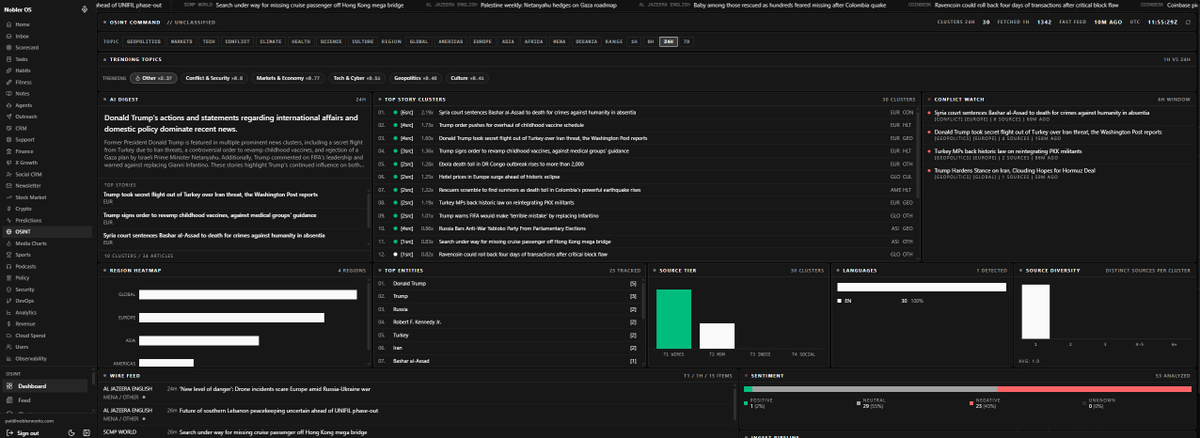
Run your edge:📰 OSINT Command (pictured) - global news ingested, clustered, and AI-digested every 5 minutes
💹 Stock Market, Crypto, Predictions - AI analyst agents for equities, on-chain, and prediction markets
🏛️ Policy - what Washington is doing that moves your portfolio
🏈 Sports, Podcasts, Media Charts - every league, every show, analyzed
Run your life:
✅ Tasks, Habits, Fitness - personal ops with real streak tracking
📝 Notes - a second brain with RAG search, multi-turn chat, and audio briefings
📥 Inbox - one notification stream for everything above
🤖 Agents - an always-on AI agent fleet doing the work while you sleep
And it's all wired for the agent era: MCP support means AI agents don't just display this data - they act on it. Draft the outreach. Enrich the lead. Audit the spend. Publish the brief.
The best part? It's modular. Take the modules you want, leave the rest. We deploy it into YOUR cloud account - your data never leaves your infrastructure.
Most companies run on 30 SaaS subscriptions that don't talk to each other.
We run on one OS. And now you can too.
DM me if you want to see it live.
Welsh and Irish are both Celtic, both put the verb first, both mutate the start of words - and knowing one won't give you a single word of the other. Different branches, same architecture. Semantix teaches you the shape, then fills it with real vocab.
7-day and 28-day active user windows end yesterday, not today - matching GA4's own reports instead of a partial day inflating the number. Nobler Works leads every dashboard row with that number, not sessions.
Fixed scope, fixed price, you own the code and the cloud when we're done. Nobler Works is a senior-only studio - no transformation decks, just deployed systems.
Apple's November 17 outage knocked out iCloud sign-in, the App Store, Apple Music, and AppleCare on Device inside the same few https://t.co/o17rDwHN14's only public explanation, given to reporters: an unspecified "internal update."Not a cyberattack, they said.
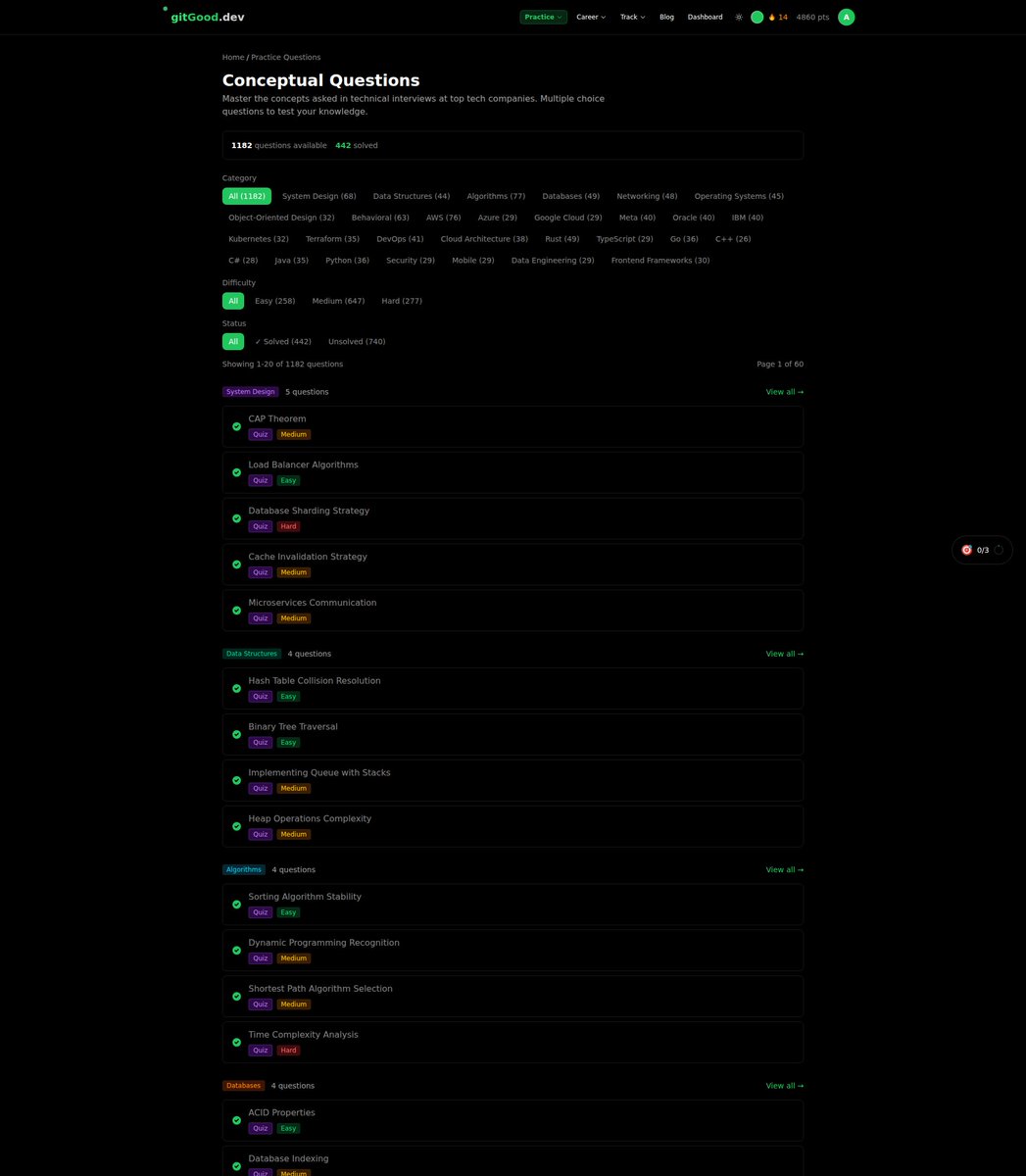
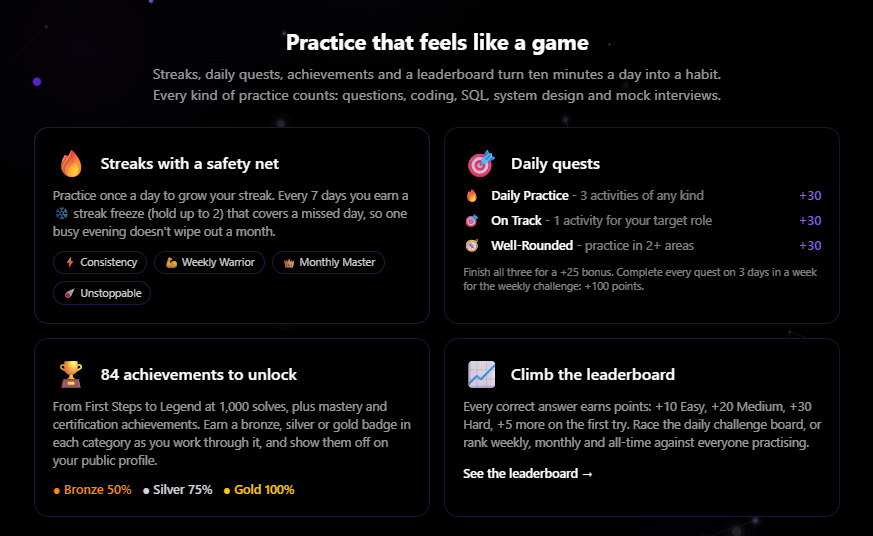
1,800+ interview questions, one bank: system design, DSA, databases, cloud, security, stats, ML and A/B testing all in the same place. gitGood stopped us juggling six tabs of random quizzes before a loop.
https://t.co/vvEmwdMDX1
Capacity estimation before architecture, not after - that's where most system design answers fall apart under follow-up. gitGood walks LLM inference, RAG, and flash-sale ticketing the same way: numbers first, then the design they force.
https://t.co/ku5ENI1ooN
A toothpaste company has quietly killed the entire market research industry and nobody is talking about it.
Colgate published a paper showing you can predict real purchase intent by simply asking LLMs to roleplay customers.
And this is beyond insane.
If you ask an AI, "Rate this product from 1 to 5," it gives safe, middle-of-the-road garbage.
So researchers invented a method called Semantic Similarity Rating (SSR).
Instead of asking the AI for a number, they asked it to roleplay.
They gave the LLM a demographic profile. They showed it a product concept. And they asked it to write down its raw, unfiltered thoughts.
Then, they used a semantic model to translate those written thoughts into a numerical score.
The results are staggering.
Tested against 57 real personal care product surveys and 9,300 human responses, the synthetic consumers hit 90% of human test-retest reliability.
They perfectly mirrored how different age brackets and income levels react to price changes.
And they provided detailed, qualitative feedback that was deeper and more critical than what actual humans wrote.
This destroys the economics of traditional market research.
You don't need to wait a month to see if a product will sell.
You can simulate 1,000 hyper-targeted customer interviews overnight.
You can A/B test pricing across every demographic instantly.