🤖 @PathOn_Robotics has been open source since day one. Today we're releasing something we never shipped.
From January to May, PathOn Robotics built an end-to-end "bring your own robot" pipeline — text → CAD → URDF/MJCF → gripper attach → ROS 2, every stage driven by coding agents. Describe an arm in a sentence, get a simulation-ready model and a working MoveIt stack.
Then we pivoted.
Rather than let five months of work sit in a private repo, we're releasing it to the DIY maker community. Out today: the architecture, the validated cases — what worked and what broke — and the design decisions we'd still defend. The load-bearing one: gripper attachment happens at the URDF/MJCF layer, not CAD, so you can bolt a custom hand onto an off-the-shelf arm without ever opening CAD.
One stage is already runnable today: end-effector attachment, as a Claude Code skill.
Coming soon: the rest of the agent skills, plus walkthroughs of each stage.
Generative robotics needs more shared plumbing. Hope this is useful to someone building.
https://t.co/xGxVUb6PHX
@PathOn_Robotics has been open source since day one. Newest drop: an isomorphic 3D-printed leader arm for teleoperating the @AgilexRobotics PiPER arm .
The usual way to teleoperate a PiPER is to buy a second PiPER and drive it in teach mode. $3,000 for something to hold.
Ours prints for about $100.
Isomorphic means the leader shares the follower's joint structure — angles map straight across. No IK, no retargeting. You move the leader, the PiPER goes exactly there.
- 6 DOF on Feetech SCS215 serial bus servos
- Squeeze trigger at the wrist for the gripper
- Largest part is 220 mm — fits a 256 mm bed. No printer upgrade
- Full STEP assembly + 7 printable STLs
This is what open source since day one buys: when we need a tool, the catalog is already ours. We print it Friday and run it Monday.
👉 https://t.co/QeLpBByX6J
#robotics #opensource #teleoperation #embodiedAI
When I started @PathOn_Robotics, I wondered if my years of research in AI and systems engineering would matter outside the lab.
Today my work crossed 1,000 citations — and the mission is clearer than ever: take embodied AI from papers to real workplaces, from factory floors to restaurants. We get there two ways — by building real automation, and by training the next generation of robotics engineers and technicians.
Building dexterous manipulation, one thing kept frustrating me: no good eval benchmark in sim.
Most papers report numbers on a floating hand — pose the fingers, close, check if the object stays. That tells you the model can wrap an object. It doesn't tell you whether the grasp survives a real arm reaching in, gravity turning on, or the object resting on a surface instead of welded to an anchor.
So at PathOn Robotics, we built one. A MuJoCo benchmark that sweeps:
🔹 hands — Allegro + Barrett today; ShadowHand, DH-3, Inspire next; plus our own in-house design (prototyping)
🔹 objects — YCB, ContactDB
🔹 physics — floating → arm-in-the-loop → object on a pedestal under real gravity
Swap any axis with a single config entry.
The video: Allegro + YCB orange and Barrett + ContactDB apple, same Agilex Piper arm, same stack.
More coming soon 👇
#Robotics #DexterousManipulation #Grasping #MuJoCo #PathOnRobotics
Looked back at my old posts today.
In 2012, bored with school, I threw myself into business development/consulting internships (BCG, EY-Parthenon), having no idea what was coming. By summer 2013, I realized a hard truth: I needed to build deep technical skills early in my career, and handle the business side later. I connected the dots and found Geospatial Analytics & Spatial Intelligence.
So, I made a hard pivot to teach myself AI/ML from absolute zero.
I didn't even have access to Google—I spent days just figuring out how to set up a VPN. No ChatGPT, no shortcuts. Somehow, I stumbled onto Kaggle and deep learning papers when I barely knew how to write a script. Just raw curiosity and grinding until 3 AM every single night trying to understand Python, ML, and algorithms.
Today, I'm a deeply technical builder—an AI Researcher (20+ papers at top conferences, 1k+ citations) and a Full-Stack Engineer spanning ML, Infra, and Robotics.
The pivot was brutal, but it's the best decision I ever made. It's not about where you start; it's what you're willing to learn in the dark.
Whenever I start something new, I remind myself: if I could figure it out back then with absolutely nothing, I can figure out anything now. 🛠️🤖
Generative robotics needs an integration layer — this is my robot-assets-skills. 🤖🛠️
AI makes 3D design much faster now. Industrial-grade arms run real algorithms. The combo is the unlock — but mounting the two is the slow, boring part everyone hates.
It's a Claude Code bundle for robot URDF/MJCF integration. The flagship skill — attach-end-effector — mounts any hand/gripper on any arm in MuJoCo with zero errors. Extensively tested on Piper, SO-101 6DoF (ours), Elephant Robotics arms — paired with Allegro, Barrett, and our Symmetric Gripper.
Bought a Unitree Go2. It doesn't ship with 3D LiDAR.
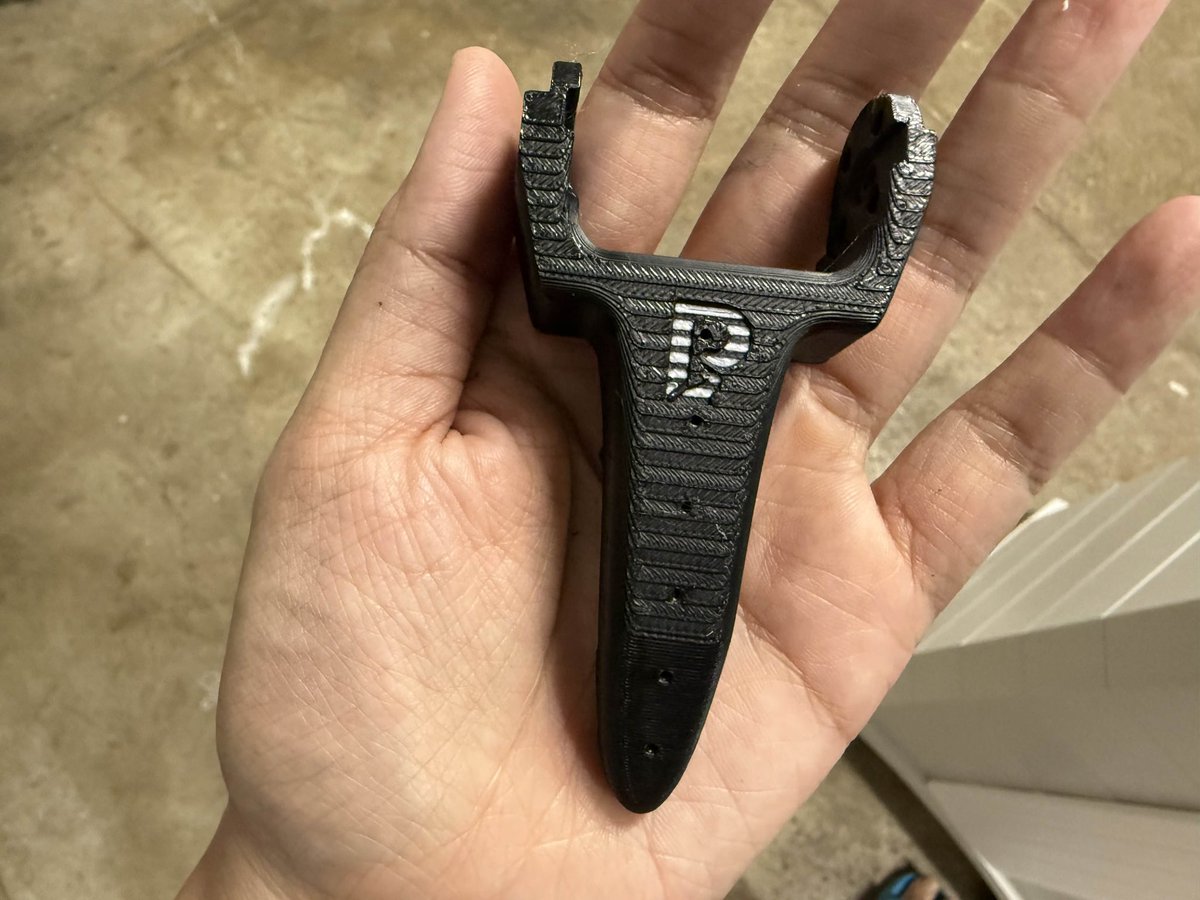
Designed a bracket. Printed it in the basement. Mounted a Livox MID-360 on top. Same bracket we use in our internal stack.
What sensor should I add next? 🤖🛠️
For anyone wanting to repro — open-sourced the mount: STL, hardware list, install notes 👇
Excited to share the first version of our in-house dexterous hand design at @pathon_robotics ! 🦾
We're building a unified dexterous manipulation pipeline that works across multiple hand platforms — both off-the-shelf hands and our own design, which
we're now prototyping.
Next week, we'll integrate eFlesh, a low-cost tactile sensor, to give the system rich contact feedback for fine manipulation. @Raunaqmb
The goal: a hardware-agnostic pipeline where you can plug in your preferred hand + sensor stack and get dexterous manipulation out of the box.
More updates coming soon 👇
Stock SO-101: 5 DoF + non-symmetric gripper.
SOTA grasp models: 6D poses + symmetric grippers.
So we upgraded the SO-101 to 6DoF and designed a symmetric parallel-jaw gripper — so any SOTA grasp model drops in. 🦾
Here's the full arc 🧵👇
Selling my $11k Chanel jumbo bag on @TheRealReal to buy robots instead! 🤖 Planning to get PiPER and others (~$2-3k total) because honestly, I'll use robots way more than a luxury handbag 😂
#priorities#robots#tech
🎉 LiteWebAgent just hit 100 stars on GitHub! ⭐
Thank you to everyone who has supported this project. Excited to keep building! 🚀
Check it out: https://t.co/4c1TJ0Yzx1
#OpenSource#WebAutomation
I started selling SO-101 and Lekiwi on https://t.co/oIdRE0H3ym. It is the cheapest and fastest place to get these open source robots if you order from the USA.
I just sold some Feetech servos to a research lab since they burned follower arm gripper servo as well. It's so important to add hardware and software guardrails to open source robots to prevent hardware damage.
🎉 Exciting News! We're thrilled to announce that our paper "Visual Tree Search of Web Agent" has been accepted to ECML-PKDD 2025, one of the premier European conferences in machine learning and data science!
This breakthrough work comes from our talented https://t.co/hX1PBlxf2l community members, with another web agent paper in the pipeline.
What is VisualTreeSearch?It's a fully-deployed system that makes web agent decision-making transparent and interpretable. For the first time, researchers and practitioners can observe how AI agents navigate and make decisions on the web in real-time.
Key innovations include:
⚡ Ultra-fast API-based state reset (50s → 2s)
☁️ Scalable cloud infrastructure with WebSocket + ECS
🌳 Interactive tree visualization with live browser execution
🧠 Support for advanced algorithms including LATS (Language Agent Tree Search)
This open-source system bridges the critical gap between research and real-world deployment, providing essential infrastructure for debugging web agents, analyzing search strategies, and prototyping new planning algorithms.
Explore the project:
🔗 Project details: https://t.co/NgUUeZUCvd
🎮 Live demo: https://t.co/44f57hps1T💻 GitHub: https://t.co/cI8nGBWirF
#MachineLearning #AI #WebAgents #OpenSource #Research #ECMLPKDD2025