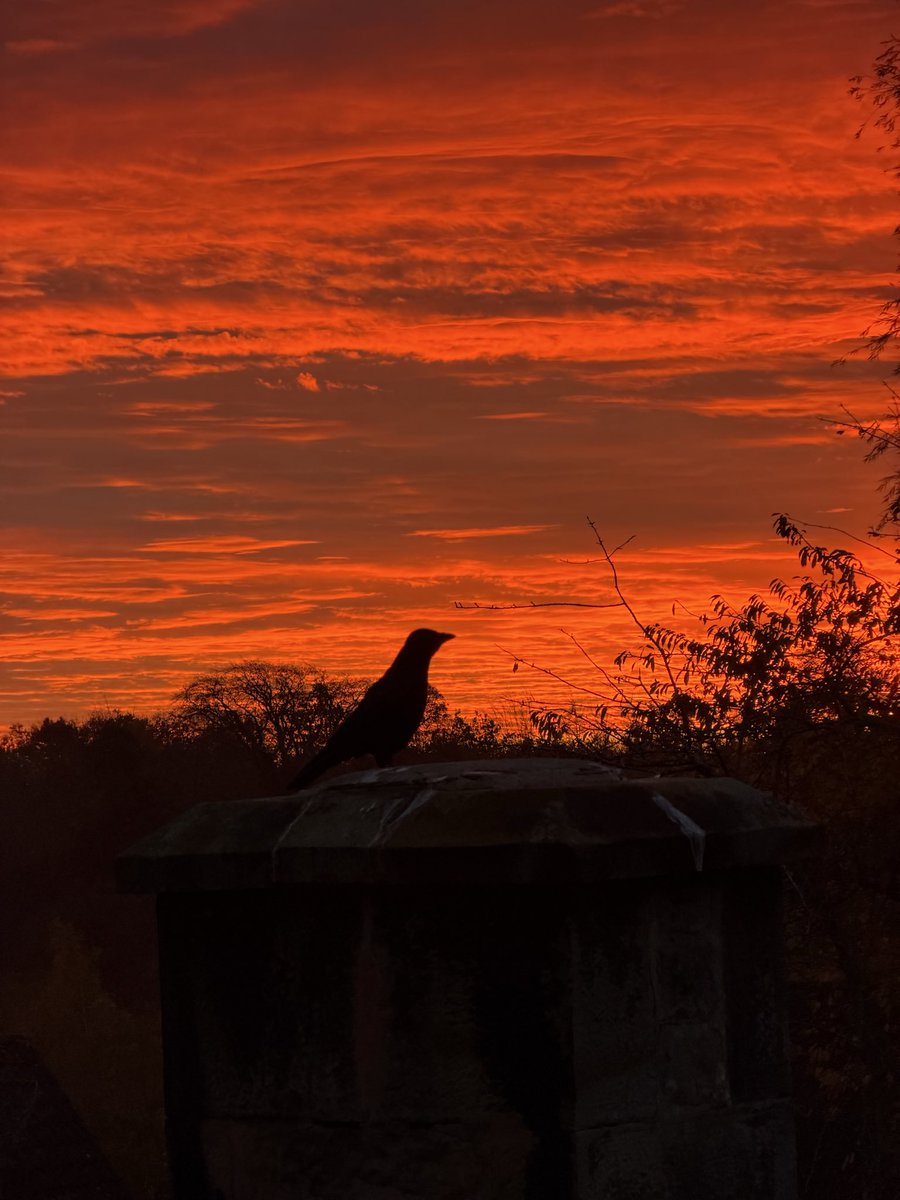
The hardest part of acknowledging that People don't want Ishwar.
A human said once people ask for me and love me when they are in need.
Ishwar replied same
A man never calls for ishwar as he calls his wife, a man never weeps for ishwar as he weeps for the loved ones, a man hardly thought about ishwar as he thought about wealth.
Just like butter present in milk, the supreme power is also within us but we have to churn it to see him.
By love, devotion, surrender and Rememberence.
Jai Maa.. Jai Narayan
ADI SHAKTI — EPISODE 06
Fertility and the Divine Feminine: What Did the Harappans Believe?
What did fertility mean to the people of the Indus Valley Civilisation?
For an agricultural society, fertility was inseparable from survival. The cycle of seasons, the growth of crops, the birth of animals and the continuation of human life shaped the everyday world of ancient communities.
Archaeological discoveries at Harappan sites reveal female terracotta figurines, representations of vegetation, animal motifs and objects that have sometimes been interpreted through the symbolism of reproduction and fertility.
Some scholars have suggested that these objects reflected beliefs in a Mother Goddess or a divine power associated with the regeneration of life. Jonathan Mark Kenoyer, for instance, discusses the possibility that certain male and female figurines represented fertility or particular deities.
Yet, Shereen Ratnagar cautions against treating female figurines as definitive evidence of a universal Mother Goddess cult. Their domestic contexts and varied forms suggest that their meanings may have been far more diverse.
The undeciphered Indus script leaves us without a definitive account of their beliefs.
Perhaps fertility was an important religious theme in Harappan life. But whether it centred on a supreme female deity remains unknown.
The distinction between the sacred feminine and an established Goddess tradition is essential to our historical journey.
धराधरेन्द्रनन्दिनीविलासबन्धुबन्धुर स्फुरद्दिगन्तसन्ततिप्रमोदमानमानसे।
कृपाकटाक्षधोरणीनिरुद्धदुर्धरापदि क्वचिद्दिगम्बरे मनो विनोदमेतु वस्तुनि॥🌺
Transliteration:🌼
Dharādharendra-nandinī-vilāsa-bandhu-bandhura
Sphurad-diganta-santati-pramoda-māna-mānase
Kṛpā-kaṭākṣa-dhoraṇī-niruddha-durdharāpadi
Kvacid-digambare mano vinodam-etu vastuni
Meaning:🌷
May my mind find joy in Lord Shiva, who delights in the playful grace of Parvati (daughter of the mountain king), whose mind rejoices in the radiance of all directions, whose compassionate sidelong glance wards off severe calamities, and who is all-pervading (Digambara).
Tandav : the dance of Shiva, the dance of silence and the dance of dissolution.
But when this tandav became the rhythm of creation?
There are two types of Tandav: Anand Tandav and Rudra Tandav
When Shiva merges with Shakti and their union signifies the Anand Tandav also known as Dance of Creation.
आधारभूते चाधेये धृतिरूपे धुरन्धरे ।
ध्रुवे ध्रुवपदे धीरे जगद्धात्रि नमोऽस्तु ते ॥१॥
Aadhaara-Bhuute Ca-Adheye Dhrti-Ruupe Dhurandhare |
Dhruve Dhruva-Pade Dhiire Jagaddhaatri Namostu Te ||1||
Meaning:
1.1 (I meditate on Devi Jagaddhatri) Who exists as the Substratum of the Universe, Incomprehensible by the Mind; Who is of the form of eternal Contentment, and Bears the whole Creation,
1.2: Who is Eternal, and takes one towards Her Eternal Feet; Who is Steady and Immovable; O Devi Jagaddhtri, Salutations to You.
To Maa Jagaddhatri, who dwells in all...
Yesterday marked the Completion of Jagadhatri Pujo in Bengal.
But durga puja is over then ?
Maa Jagadhatri is known as bearer of Universe, the mother of all, calmer form of Maa Durga.
It is worshipped a month after Durga pujo in kartik month.
Once upon a time Devtas had grown pride of their powers, The Indra declared himself to be God of all gods and Mightiest of all, the everpoweful. They said they are the reason why Durga came in to existence and they gave her power to kill Mahishaasur.
The pride takes away your intelligence. Isn't it?
A lady came and asked Indra to cut down the stand of grass she placed.
Devtas laughed and said it's a mare child play for us but decided to showcase their might.
Indra tried his best to tear it but failed, Agni tried to burnitc but it cannot, Varun tried to submerge it but failed, Vayu tried to lift it but it didn't flinched.
The Devtas realised the lady is none but Supreme Mother herself, they realised she is the source of creation, strength and dissolute.
The devtas realised their ego has made them deluded, they asked forgiveness from the Supreme Mother.
The Jagadhatri pujo reminds us how shallow we are like a fleeting butterfly on a planet made of dust?
How kind is Supreme Mother...
Joy Maa
The limit of “I am only this body and this history.”
Treating the form as the full measure is the habit the Gita’s Vishvarupa scene is meant to interrupt.
Once that scale drops, the Infinite is no longer something that has to “enter” ; it was never absent.
ADI SHAKTI — EPISODE 02
Mehrgarh: The Ancient Terracotta Traditions of the Divine Feminine
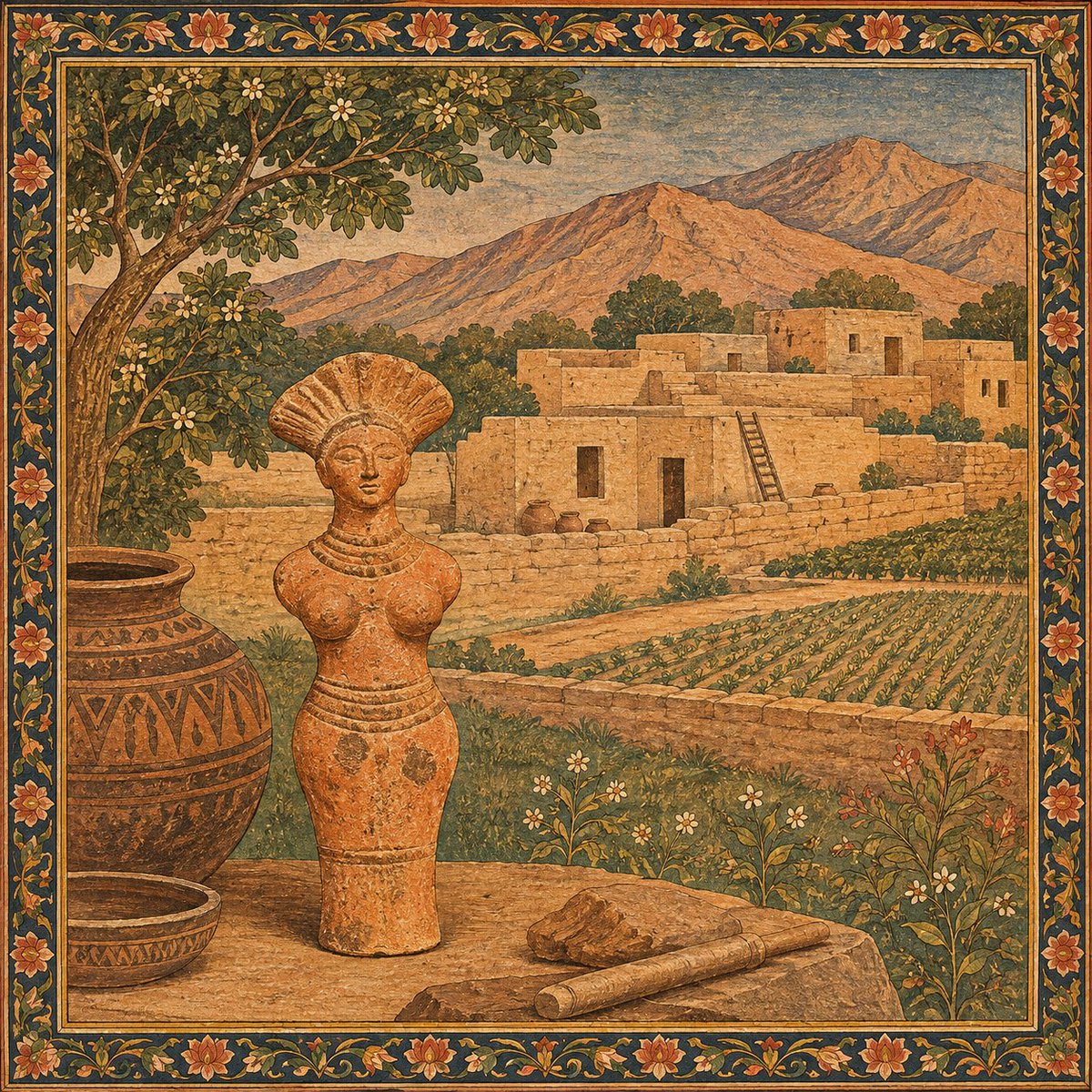
Long before the rise of the Indus Valley cities, the soil of Bharat witnessed the emergence of some of South Asia's earliest settled communities.
At Mehrgarh, in present-day Balochistan, archaeological excavations have uncovered terracotta human figurines dating back to the Neolithic and subsequent periods.
Among these discoveries are female representations, some adorned with elaborate hairstyles, ornaments and distinctive bodily features.
Who were these women? Were they symbols of fertility, motherhood, household prosperity, or perhaps representations of a divine feminine?
Some scholars have interpreted such figurines through the idea of a Mother Goddess. However, archaeology does not provide a definitive answer. Their precise religious and social significance remains debated.
What makes Mehrgarh remarkable is not that it proves the existence of Shakti worship, but that it reveals an ancient tradition of representing the human feminine in material culture.
Thousands of years before the great temples and philosophical traditions of Shaktism, these terracotta figures already occupied a place in the cultural world of early communities.
Our journey begins with these fragments of antiquity—not with certainty, but with questions worth exploring.
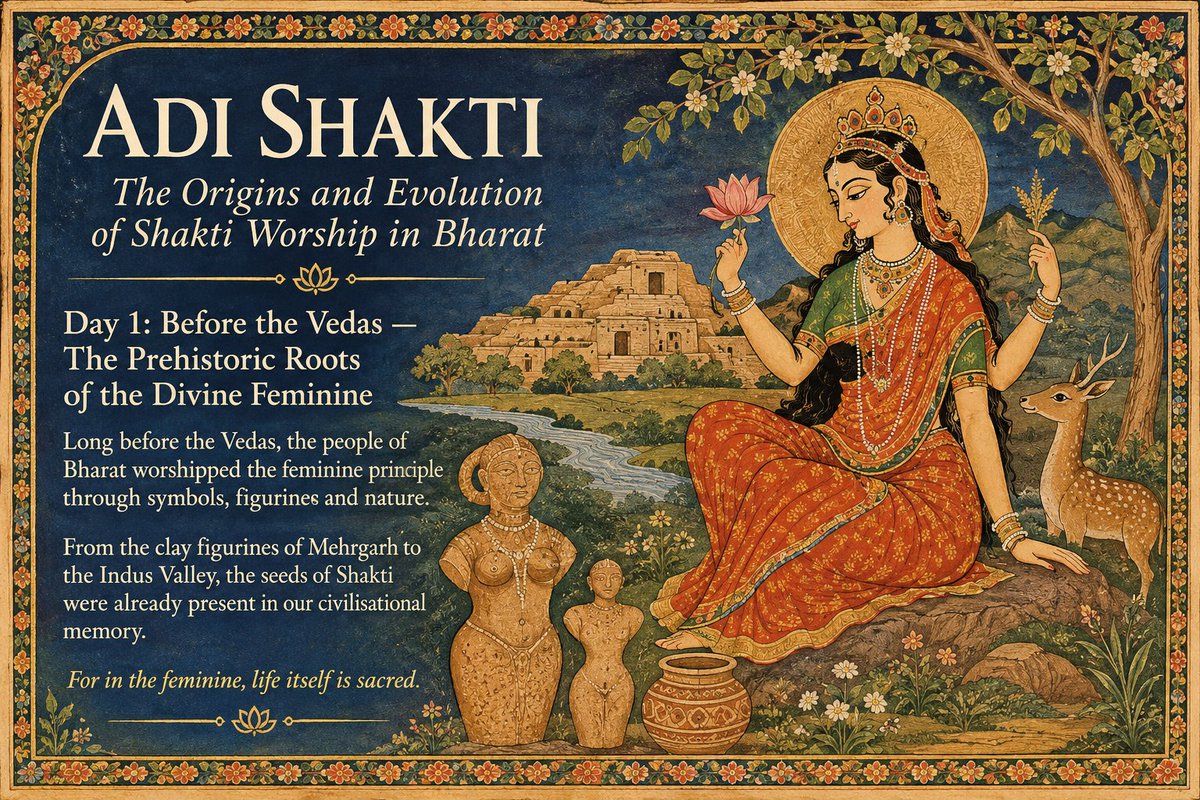
ADI SHAKTI : The Origins and Evolution of Shakti Worship in Bharat
Where did the worship of the Divine Feminine begin in Bharat?
Was it in the prehistoric settlements of the subcontinent, among communities that created terracotta female figurines? Was it in the hymns of the Rigveda, where goddesses such as Aditi, Ushas and Vac were celebrated? Or did the idea of Shakti take its fuller theological form in the later traditions of the Mahadevi?
The answer is not a single date, place or scripture.
The history of Shakti is a long and layered journey. Archaeological discoveries from prehistoric and Harappan sites offer glimpses of how ancient communities represented the feminine. The Vedas preserve hymns to powerful goddesses. Later texts, especially the Devi Mahatmya articulate the Goddess as an independent and supreme divine power.
These traditions must be studied in their own historical contexts; we cannot simply assume an unbroken line between them.
Yet, across centuries, one profound idea comes into focus: the feminine is not merely a consort or a symbol of fertility. In Shakta thought, She is Shakti—the power through which the universe exists, moves and transforms.
This is the story we begin to explore.
Share a story in just one image 🌳 🏡 Broken..but still standing with wall support
This was captured just few months after a heavy dust storm
#NaturePhotography