Govt BoM for a meal is ~INR 10. Add an egg and it increases by 50%. Plus extra cooking and handling cost because non veg foods are more prone to bacterial contamination than vegetarian foods + cost of segregation of meals if some students are vegetarian.
This is an idiotic debate
Most people whining about lack of eggs have never run an organization. Veg/Non Veg segregation is a logistical nightmare for a project of this scale.
Also Govt is under no obligation to help you meet your (expensive) protein goals.
If you want eggs/meat please eat them at home.
🚨 Repatha just proved it can save your life before you ever have a heart attack.
For years, PCSK9 inhibitors were reserved for patients who already survived an event. VESALIUS-CV (evolocumab) just buried that thinking.
But the data says otherwise. And no, this is not just a modest signal in a small study.
💓 Here is what the science actually says.
VESALIUS-CV (evolocumab) enrolled 12,257 patients with atherosclerosis or high-risk diabetes. None of them had a prior heart attack or stroke. That is primary prevention. The trial ran for a median of 4.6 years and landed in the New England Journal of Medicine in November 2025.
✅ VESALIUS-CV (evolocumab): cardiovascular death, heart attack, or ischemic stroke reduced 25%
That is not a rounding error. That is a 25% reduction in the hardest outcomes in cardiology, in patients who had not yet had their first event.
🔬 Why this matters mechanistically:
Evolocumab blocks PCSK9, the protein that degrades LDL receptors in the liver. Fewer receptors means more LDL circulating in the blood. More LDL means more plaque. More plaque means more events. Evolocumab breaks that chain before the first catastrophic rupture.
🫀 The old thinking was that you had to earn aggressive lipid therapy by surviving a heart attack first. VESALIUS-CV ends that logic. Atherosclerosis does not wait for your first event to cause damage. The plaque is building now. The inflammation is happening now. Waiting for a heart attack to act aggressively is waiting for the house to burn down before calling the fire department.
🩺 I am a cardiologist.
I have patients with subclinical atherosclerosis, elevated ApoB, and high-risk diabetes who never qualified under the old secondary prevention framework. VESALIUS-CV changes the conversation I have with every single one of them starting today.
⚠️ Who should be paying attention right now:
🔸 Patients with confirmed atherosclerosis on imaging but no prior heart attack or stroke
🔸 Patients with high-risk diabetes and additional cardiovascular risk factors
🔸 Patients already on maximally tolerated statins who still carry significant residual LDL risk
🔸 Clinicians still waiting for a second event before escalating lipid therapy
❌ The old framework said primary prevention patients were not sick enough for this class of drug.
❌ 12,257 patients and 4.6 years of follow-up say that framework was wrong.
That is the real story.
The question is no longer whether PCSK9 inhibitors work. The question is whether we are deploying them early enough.
❤️ Bottom line:
Evolocumab is not just a post-event drug anymore. VESALIUS-CV proved it cuts death, heart attack, and stroke by 25% in patients who have never had either. 12,257 patients over 4.6 years. Published in the New England Journal of Medicine. This is tier-one evidence. If you have atherosclerosis or high-risk diabetes and your LDL is not optimized, ask your doctor whether evolocumab belongs in your plan now. Not after a heart attack. Now. Are you waiting for an event that this drug could have prevented?
#Cardiology #HeartDisease #HeartHealth #CardiovascularHealth #PCSK9 #Evolocumab #Repatha #LDLCholesterol #PreventiveCardiology #MetabolicHealth
Very important, vitiligo is not a flaw and there should not be any stigma attached.
Vitiligo has significant mental health burden. Upto 55% patients experience moderate to severe depressive symptoms. This is majorly driven by social stigma. Let's work to break this stigma!
@Jagdish_Ahuja@devinamehra Herbivores have specialised digestive tracks that ferment the grass and fibres they eat. This results in proliferation of microorganisms like bacteria, fungi and protozoa which then be one their protein sources. Humans have a far simpler digestive systems. Vast difference.
The moment you shift to subjective evaluation criterias like clinical exposure, research experience, personal statements etc, it opens the door for manipulation. That said, a multi day computer based test like JEE Mains and old NEET PG is a good solution.
By all accounts, the NTA appears to have done a commendable job conducting the NEET retest after the earlier paper leak.
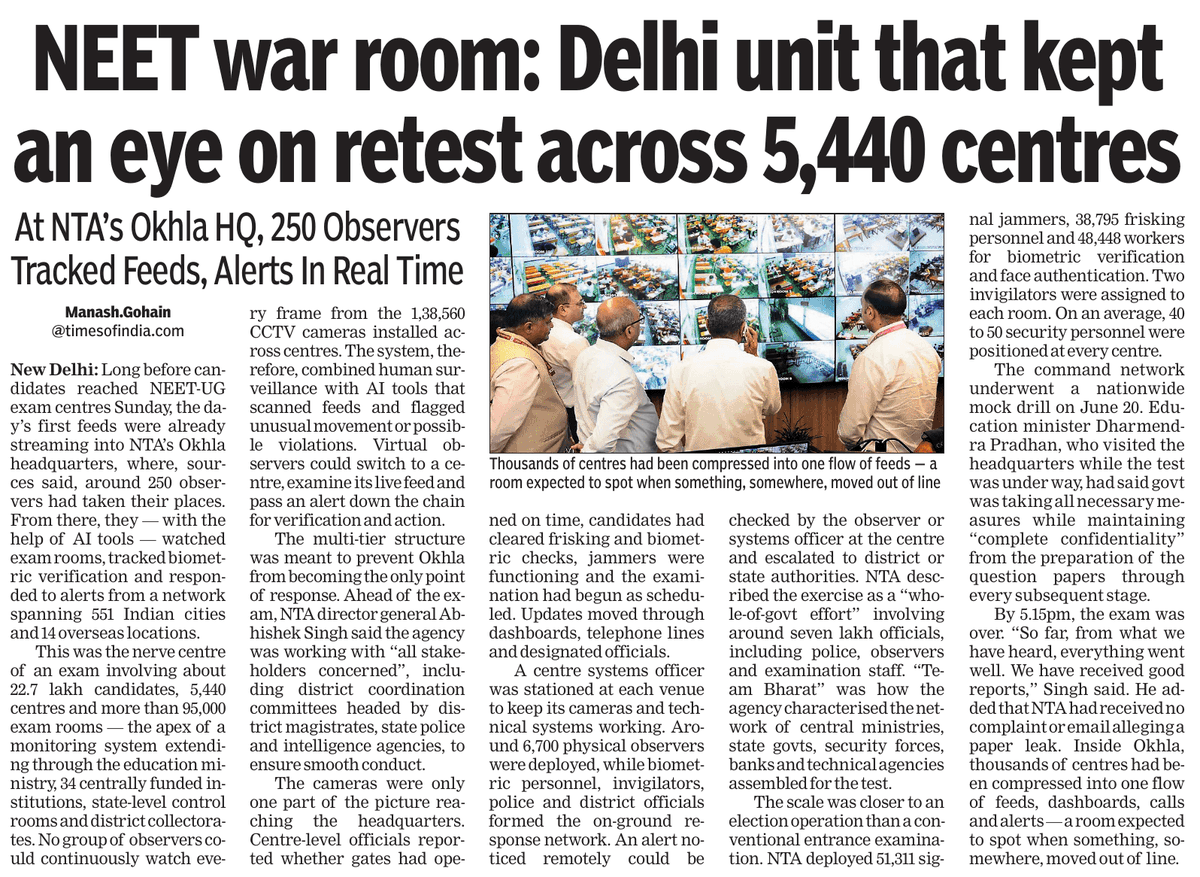
The scale of the security apparatus deployed appears to have been massive (ToI report). 51,311 jammers, 38,795 frisking personnel, 48,448 biometric verification staff, a nationwide mock drill, and real-time AI-based surveillance across 551 cities.
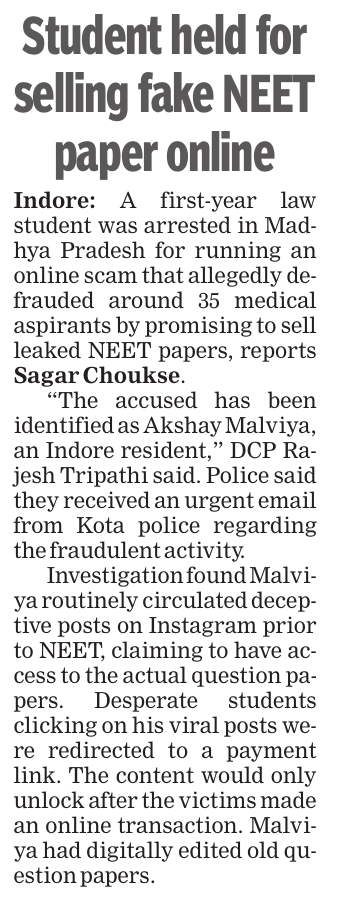
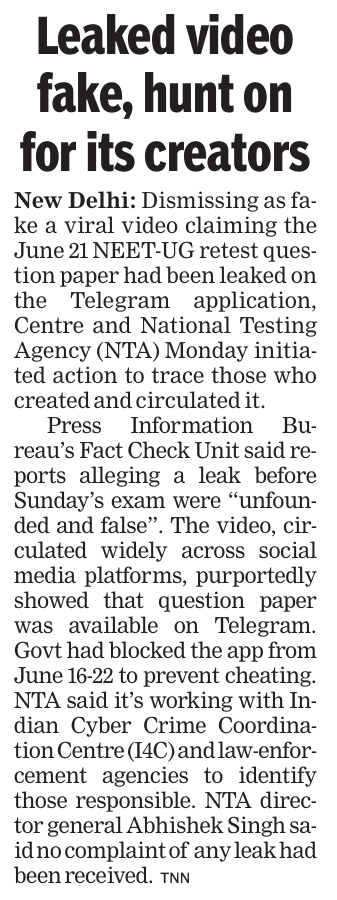
The agency also seems to have acted swiftly against the viral "fake leak" video and cracked down on impersonation rackets in Bihar and MP while the examination process was underway.
Yet, while all this may reassure students about the integrity of the examination, lot of folks continue to raise the question - why does a medical entrance exam require a command-centre-led, near military-style operation to ensure fairness?
The answer lies in the structure of NEET itself.
NEET is the only score that determines admission to medical colleges in India. One exam. One day. One number. Every vulnerability (paper leaks, impersonation, dummy candidates, biometric fraud) is concentrated into a single point of failure because the rewards for cheating are enormous and the attack surface is massive.
Which is precisely why an "on-demand, 24x7x365" NEET (something occasionally floated as a solution) is unlikely to work. We simply cannot sustain this level of security infrastructure every single day, indefinitely, across thousands of examination centres.
TBH, the smarter solution is the one the NTA is finally moving towards, although it is unfortunate that it was not implemented immediately after the 2024 leak episode. A JEE Main-style model.
A computer-based test conducted across multiple sessions over a few fixed days, combined with percentile normalisation and best-of-attempt scoring, reduces the risks substantially.
TA has already informed the Supreme Court that NEET-UG is expected to move to a CBT format from 2027, with multi-session and potentially multi-stage testing under consideration. Digital delivery effectively eliminates the traditional physical paper-leak vector. A limited number of staggered sessions also removes the incentive to target a single mega examination day, without requiring a parallel security state to operate every day of the year.
In countries such as the United States, the MCAT is only one component of the admissions process, alongside science GPA, clinical exposure, research experience, personal statements and institution-specific evaluations. In India, however, NEET remains the sole criterion for medical admissions. A genuinely multi-criteria admissions model is still years away from being practical at scale.
Until India eventually moves in that direction, the NTA will continue to rely on a massive security apparatus to protect the integrity of an examination that shapes the aspirations of nearly 1.4 million medical aspirants every year.
Issue could be less number of staff doctors.
For the amount of work they do (humongous) , the number of staff doctors should be 5 times as much. ... cardiologists, surgeons, nurses, techs all...
... And there is no lack of doctors willing to join AIIMS Delhi or any AIIMS ....
You might think most content creators are cringe.
But content creation is not an easy job.
Showing up every day, creating ideas, filming, editing, dealing with criticism, and staying relevant is harder than most people think.
When are busy mocking them, they’re building audiences, businesses, and creating wealth.
I'm a cardiologist. Something just happened today that I genuinely did not see coming — and it could change the future of preventive medicine more than anything I've written about on this platform.
Midjourney — the AI company that became famous for generating images from text prompts — just announced a medical hardware division and unveiled a working prototype of a full-body scanner unlike anything that's ever existed.
It's called the Midjourney Scanner. And it works like this.
You step into a shallow pool of water. You stand on a platform that slowly descends — about two inches per second — through a ring containing roughly half a million tiny ultrasonic transducers, each the size of a grain of sand. Every one of them acts as both a speaker and a microphone, sending ultrasonic waves through your body from every angle and recording what comes back.
60 seconds later, you step out. The scan is done.
No radiation. No magnets. No claustrophobia. No IV contrast. Just sound, water, and an almost incomprehensible amount of computing power — roughly 2 petaflops processing 17 gigabytes per second of raw acoustic data — reconstructing a 3D map of your entire internal anatomy down to half a millimeter resolution.
Organs. Tissues. Blood vessels. Bones. Muscle. Fat distribution. All segmented by AI in real time.
As a cardiologist who has spent months writing about how the standard screening playbook misses the majority of future heart attacks — this is the technology I've been waiting for without knowing it existed.
Here's why this matters for the future of your heart.
Right now, getting a detailed look inside your cardiovascular system requires either a CT scan (radiation), an MRI (magnets, claustrophobia, 45-60 minutes, $1,000+), or a coronary CT angiogram (radiation, IV contrast, limited availability). These are powerful tools. I order them regularly and they save lives.
But they're reactive. You get them when something is already suspected. They're expensive. They're uncomfortable. And for most people, they happen once — maybe twice — in a lifetime.
Imagine instead: a 60-second scan with no radiation that you could repeat monthly or quarterly. Tracking cardiac structure over time. Watching body composition shift. Detecting changes in organ size, fluid distribution, or vascular architecture before symptoms ever develop. Building a longitudinal dataset of YOUR body that AI can analyze for patterns no single snapshot would reveal.
That's what Midjourney is building toward.
The company plans 50,000 scanners worldwide over six years, with capacity for a billion scans per month. The first location — the "Midjourney Spa" in San Francisco — opens at the end of 2027 with 10 scanners alongside saunas, cold plunges, and a gym. The scan costs a few dollars. The experience is designed to feel like wellness, not medicine.
The technology is built on Butterfly Network's ultrasound-on-chip platform — 40 modules per scanner — combined with Midjourney's own AI segmentation and reconstruction stack. David Holz, the founder, claims the system aims for image quality comparable to MRI in many aspects but at nearly 100x the speed with zero radiation.
Now the caveats — because I'm a physician and the caveats matter enormously.
This is a Gen 1 prototype. About a dozen people have been scanned so far. Current scan time is actually closer to 20 minutes, not 60 seconds — the system is bottlenecked by bandwidth and reconstruction algorithms. The 60-second target is aspirational for future hardware generations.
It is not FDA-cleared for diagnostic use. Midjourney is starting with body composition maps — a category below diagnostic imaging in the regulatory hierarchy. The path from "beautiful 3D body scans" to "clinically validated diagnostic tool that your cardiologist can act on" runs through years of clinical trials, comparative studies against MRI and CT gold standards, and FDA review.
No independent clinical validation has been published. The imaging claims come from Midjourney's own demonstrations. Comparative data against established modalities does not yet exist.
And the privacy implications of full-body internal scans at planetary scale — a billion scans per month — is a conversation that hasn't even started yet.
So I want to be precise. This is not ready for clinical medicine today. It may not be ready for years. Many ambitious medical hardware projects have failed in the gap between prototype and product.
But.
The fact that a working prototype exists — producing real segmented 3D anatomy from sound waves and compute alone — means the physics works. The engineering works. The question is no longer "is this possible" but "how fast can it be validated and scaled."
And if it is validated — if the resolution holds up against MRI, if the AI segmentation proves reliable, if the regulatory path clears — then what we're looking at is the most significant new imaging modality in 50 years.
For my entire career, preventive cardiology has been limited by the fact that seeing inside the body is expensive, slow, uncomfortable, and infrequent. We catch disease late because we image rarely. We image rarely because imaging is hard.
A 60-second, no-radiation, spa-based full-body scan that costs a few dollars would demolish every one of those barriers.
I've written about AI detecting inflamed arteries. About gene editing curing cholesterol. About GLP-1 drugs rewriting metabolic medicine. About cellular reprogramming reversing aging.
This is the missing piece: the ability to see inside every human body, routinely, safely, and affordably — so all of those interventions can be deployed before the disease arrives instead of after.
The company that taught AI to generate images from imagination just built a machine that generates images from the human body.
The future of medicine showed up today from the last place anyone expected.
In 1971, Stanford University paid 24 normal college men to role-play as guards and prisoners in a mock basement jail. Within days, it had to be aborted. The "guards" became sadistic, and the "prisoners" suffered breakdowns.
Similar to 1st year and 2nd year residents here.
The moment I received this CCTV picture from GMC Bhavnagar (Gujarat), my mind froze for a moment thinking how mentally and physically devastated these Orthopaedic surgery resident doctors must have felt at this moment when they were made a murgha openly in the Operation Theatre.
Every NEET UG and PG aspirant and their parents must watch this to open their eyes regarding this over glorified profession in India .
This young man received a heart transplant with us >6 yrs ago.
In fact his DCM ( dilated cardiomyopathy with mitral regurgitation) was thought to be secondary to the MR and he underwent surgical repair first elsewhere. It didn't help.
He underwent a successful heart transplant and hasn't looked back since then .
Goes to college and also runs a cafe on the Pune-Ahilya nagar road .
Cafe of Joy.
Do go there if you are close by.
The cafe is also close to Ranjhangaon Ganapti mandir.
That's him in the video..the cook....
@theafterlight8@DNAwink Exactly. They think of medicine as a unidemnsional problem that can be solved by AI. Who will explain the complexities and human cost to them. Even if you do, they think we are AI Naive.
💯. Same logic applies for preventative genomic sequencing. What are you going to do when you find you have a mutation with likelihood of a disease? Diseases are multifactorial and no one can predict its course with absolute certainty. Is it really worth the mental stress?
Had a visibly distraught and shaken lady in her 40’s who had been told she possibly had pancreatic cancer by a posh AI driven cancer screening package costing her over 20k!
Of course, she was referred to me, the endocrinologist, apparently the expert in all things pancreas!
Reason? Her glossy, colorful, booklet album of results showed a mildly elevated ca19-9
(With normal scans-again very posh looking)
First! Ca19-9 is a terrible cancer screening tool! (The AI should have got that right)
Second! Don’t bother doing a test if you have no clue what to do with the result! At least get the referrals right! (The AI should have got that right)
Finally! Cancer screening is serious business, requires evidence-based pathways, careful test selection and expert oversight. Clearly meagre oncologists were not consulted or their advice overruled by the I behind the AI!
Fancy interiors, glossy reports and “luxury healthcare experiences” clearly trumped clinical judgement!
Of course my oncologist then reassured her plenty ….verbally and with further scans to prove her worth (ruling out becomes her responsibility!)
₹20,000 spent creating anxiety….
Another ₹10,000 spent proving the ₹20,000 was a mistake!….
Moral of the story:
screening should start with your doctor! Not in the lab / fancy machine however exotic the interiors!
#screening #healthcare #health #oncology #doctors
@DNAwink Yes I know this company. It's not fair to the patients tbh. We were approached by a company who takes conjunctival photos to predict anemia and jaundice. I was this close to losing it. Why donwe need it when it can be properly diagnosed using simple blood tests.
@DNAwink Absolutely. Also the scope of misuse is immense in our country. I know a place where the pathologist has resigned and the technician takes photos of the histopathology slides and puts them in LLM and gives a report. I shudder to think about the injustice to the patient.
Reminds me of two young founders who came to meet me with an idea of a microscope mounted camera that gives CBC report using AI from blood smears. I asked him what is the use case? Why would a pathologist manually scan slides when he can just see the slide and be done with it? +
Medical AI Startups: Image analysis, cancer diagnostics, funding & the search for customers
i made an appointment with a young founder in the medical diagnostics space. He was gracious enough to give me some time to talk. during our discussion, my first question was about...
Never thought an AI startup would produce an entirely new imaging modality.
They are taking ultrasound transducers, tech that's been around for decades, but scaling it up and combining it with massive compute to produce incredibly precise reads on the body.
Traditionally, when you get an ultrasound, a trained tech captures several still-images of each important organ. These are then read by a radiologist. The whole process is clumsy, cumbersome and hasn't really changed in 50 years. It takes years to train both the ultrasound tech and the radiologist, and very expensive to employ them as well.
Now there's a ton of 3D data in ultrasound scans that never gets interpreted or read, and that's likely where Midjourney saw an opportunity to leverage their expertise in image-generation into image-extrapolation and interpretation.
This is going to be very interesting to watch!