UN projections are utter nonsense. Just multiply last year’s births by life expectancy. Given downward trend in birth rate, that is best case unless reversed.
📑NEW #publication from CDE affiliate Christine Schwartz (@Schwartz_ChRe, @UWSoc) and CDE graduate students Rodrigo González-Velastín (@UWSoc) & Anita Li (@AnitaHLi, @UWSoc) in PNAS (@PNASNews) for your review -
https://t.co/jLXt96hfKP
Congrats to @OrsolaTorrisi_ for winning @SIStatistica's Valeria Solesin award for best thesis in #demography, and to our very own @chiccorampazzo for receiving an honourable mention 🥳 https://t.co/yeix8qtqX5
This reconstruction of the long-term trends illustrates how stunning, and worrisome the short-term increase in premature mortality in the US is. Great paper:
"Missing Americans: Early death in the United States—1933–2021" https://t.co/RQUY4hl7Wq
I was well aware of the mortality gap between the US and W Euro, but I still can't wrap my head around how large and how quickly increasing it is https://t.co/FTCdaIH6wt via @ConversationUS
@v_dilego@monjalexander@rmogimogi Love it, save me one! Only thing you guys could have done better with the acronym, my entry: Demographic Analysis Working Group😂
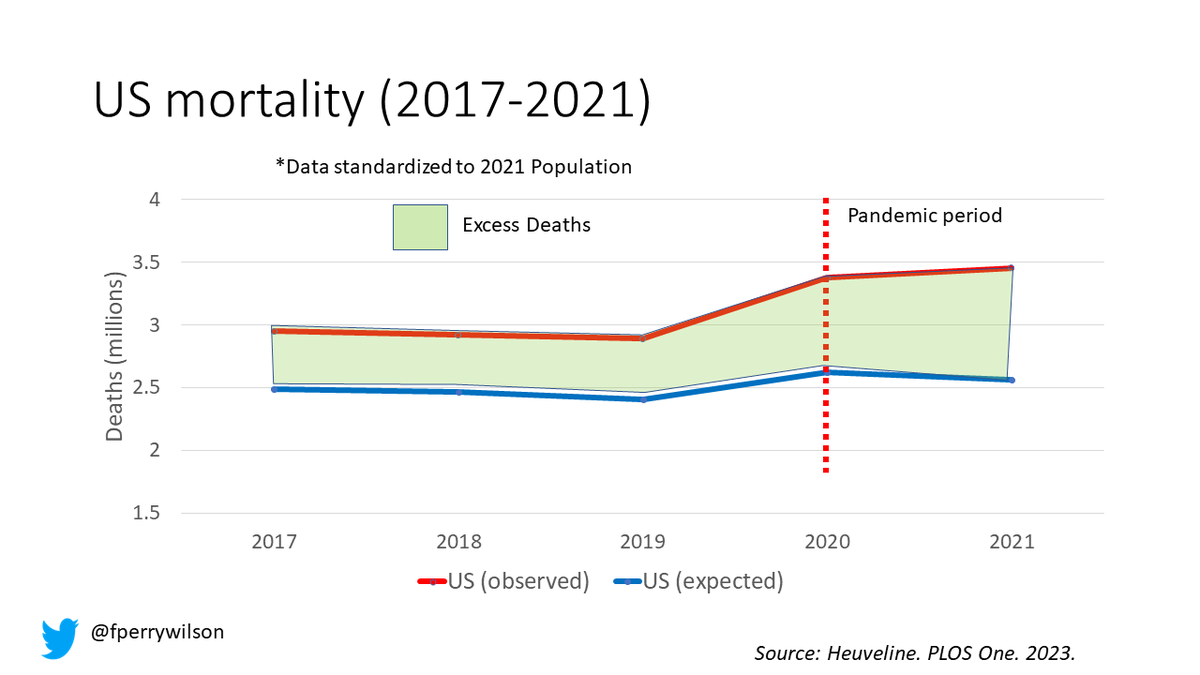
The number of excess deaths between the US and the five European countries increased between 2017 and 2021. Nearly half of the increase was due to causes other than Covid-19.
Important new paper by @PatrickHvl@UCLA in @PLOSONE
https://t.co/C732rDW6SX
Both the number and share of these “excess deaths” have increased during the pandemic, but nearly as much from the expansion of pre-pandemic differences in middle-age mortality as from differences in COVID-19 mortality itself
Out today in PLOS ONE: in 2021, one in 4 deaths in the US—nearly 900,000 deaths—would have been prevented with the average death rates of 5 largest W Euro countries: https://t.co/ksccU9Tff0
Nice study from @PatrickHvl in @PLOSONE shows that excess deaths in the US have increased dramatically during the pandemic, and it's not just due to COVID. I covered @medscape this week: https://t.co/bseky2SohV
States with high COVID death rates also saw high mortality from other causes.
Undercounting of COVID deaths was likely a major contributing factor.
New paper w Anneliese Luck @eugenio_paglino@irmatelo Sam Preston @khemp64@PennPSC@RWJF@PLOSONE
https://t.co/4SojoH0xKF
Congratulations to CCPR Faculty Fellow Dr. Martha Bailey for being the recipient of the 2022 Carolyn Shaw Bell Award from the American Economic Association! https://t.co/L8u1EemSa4
UCLA CCPR Seminar Dr. Benjamin R. Karney, "Public Policies and Private Lives: How Socioeconomic Status Affects Intimacy" on January 11, 2023 at 12:00PM. CCPR events are open to the public. Email CCPR staff for the link #poptwitter#demography
📢 We're hiring!
The Department is seeking to appoint 2 LSE Fellows to start September 2023.
More info on the #vacancy here: https://t.co/WPLNgTM6wY
📆Closing date 22 February
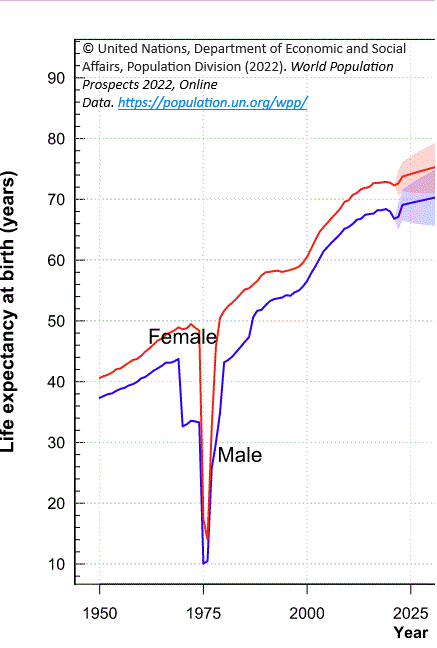
@AntonioLeonMex Right, should have added a legend, to illustrate mortality shocks, this is life expectancy at birth in Cambodia as estimated by the UN Population Division
Bottom line, I’m interpreting it as an age-standardized measure of premature mortality, but this is really an-ongoing reflection: would love to hear back from #poptwitter & #demogtwitter (or whatever’s left thereof now)
Demographers’ intuition for life expectancy values (LEV) derives from a constant mortality thought-experiment. How do we interpret changes in LEV during temporary mortality shocks then? See Patrick Heuveline’s reflections here 👉https://t.co/mR9vBkodsv
@MazzucoStefano Missed it at the time, but really interesting paper. In your useful framework, I took the relative approach with the normal <- earlier (pre-shock) survival curve. This normal is indeed harder to define when survival is gradually improving rather than suddenly declining