I just got back from Ukraine, where I was visiting some friends.
Everything we have heard about what’s happening in Ukraine is a lie.
The reality is darker, bleaker, and unequivocally hopeless. There is no such thing as Ukraine "winning" this war.
- By their estimates, they have lost over one million of their sons, fathers and husbands; an entire generation is gone.
- Even in the Southwest, where the anti-Russian sentiment is long-standing, citizens are reluctant or straight-up scared to publicly criticize Zelensky; they will go to jail.
- In every village and town, the streets, shops, and restaurants are mostly absent of men.
- The few men who remain are terrified of leaving their homes for fear of being kidnapped into conscription. Some have resorted to begging friends to break their legs to avoid service.
- Army search parties take place early in the morning, when men leave their homes to go to work. They ambush and kidnap them off the streets and within 3-4 hours they get listed in the army and taken away straight to the front lines with minimal or no training at all; it is "a death sentence."
- It's getting worse every day. Where I was staying, a dentist had just been taken by security forces on his way to work, leaving behind two small children. Every day, 3-5 dead bodies keep arriving from the front lines.
- Mothers and wives fight tooth and nail with the armed forces, beg and plead not to have their men taken away. They try bribing, which sometimes works, but most of the time they are met with physical violence and death threats.
- The territory celebrated as having been "won back" from Russia has been reduced to rubble and is uninhabitable. Regardless, there is no one left to live there and displaced families will likely never return.
- They see the way the war has been reported, at home and abroad. It's a "joke" and "propaganda." They say: “Look around: is this winning?”.
- Worse, some have been hoaxed into believing that once Ukrainians forces are exhausted, American soldiers will come in to replace them and “win the war”.
There is no ambiguity in these people. The war was for nothing - a travesty. The outcome always was, and is, clear. The people are hopeless, utterly destroyed, and living in an unending nightmare.
They are pleading for an end, any end - most likely the same "peace" that could have been achieved two years ago. In their minds, they have already lost, for their sons, fathers and husbands are gone, and their country has been destroyed. There is no "victory" that can change that.
Make no mistake, they are angry with Putin. But they are also angry with Zelensky and the West. They have lost everything, worst of all, hope and faith, and cannot comprehend why Zelenky wishes to continue the current trajectory, the one of human devastation.
I didn't witness the war; but what I saw was absolutely heart-breaking.
Shame on the people, regardless of their intentions, who have supported this war. And shame on the media for continuing to lie about it.
Does the #EuropeanUnion that cares so much about Human Rights have a problem with #Israeli Occupation Forces deliberately shooting 9 year old #Palestinian Children..? Or does the EU think that one has to be of a certain skin colour or religion to be entitled to Human Rights..?
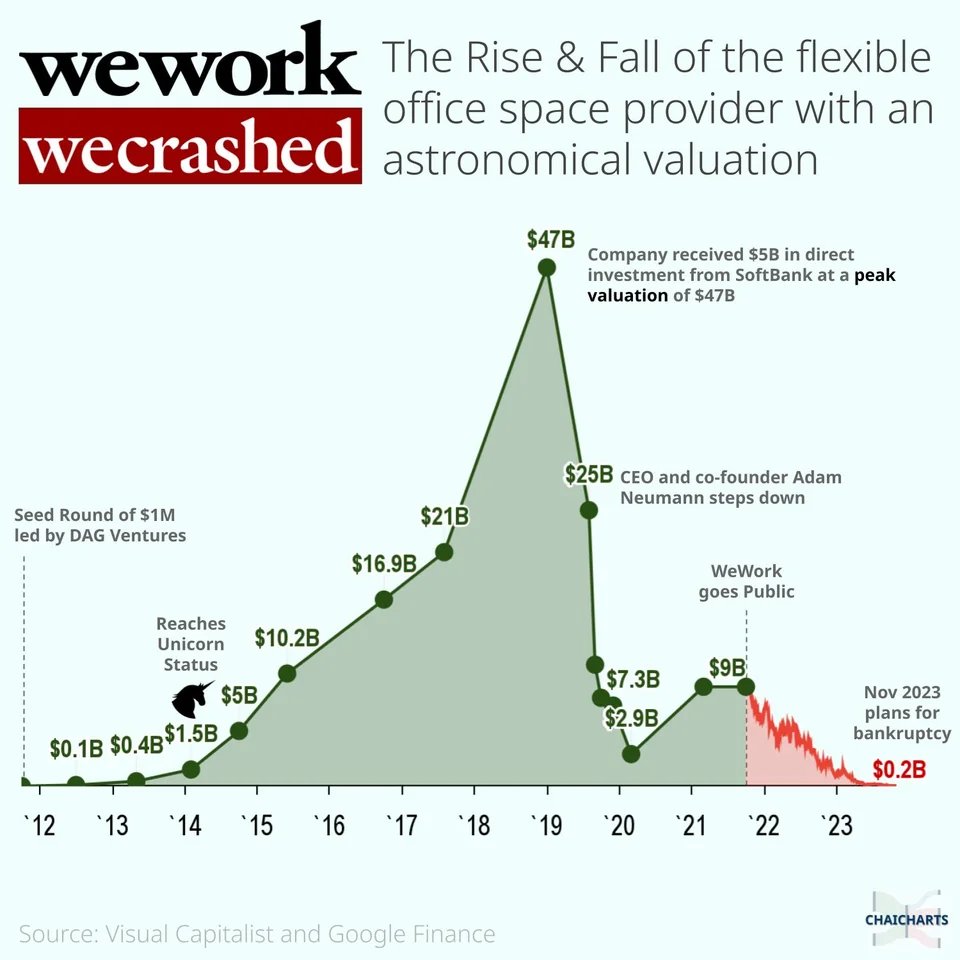
The news JUST broke that WeWork is filing for BANKRUPTCY next week
The same WeWork that was valued at $48 billion is now worth ~$48 million
I sold my company to them in 2019. And was briefly the head of Product Strategy of WeWork.
Here's what went wrong and what we can learn:
#1 People can turn on you on a dime
In the WeWork corporate halls, I witnessed folks singing praises of Adam Neumann, almost to the point of worship.
Adam could do no wrong, Adam knew all the answers, Adam could fix this.
But as soon as they realized their stock was tanking, they turned on him.
It happened overnight. Literally.
This taught me a lot about human nature.
Trust can be broken in seconds.
#2 Doing too much in business never works
WeWork was working on like 100 businesses at once, but never really figured out the economics of the core business.
Seems obvious, but get your house in order first, before you go and decide to venture out.
I’m a big believer in the multipreneur movement, owning a portfolio of businesses that cash-flow, not a bunch of businesses that drain cash aka WeWork.
#3 The valuation of your venture-backed business really doesn't mean a whole lot.
I met people at WeWork in summer 2019 that told me they were excited for the IPO so they could buy their house.
They were already house shopping.
"Yeah, I'll probably put $600k into renovations too. I know a good contractor if you need one."
I cringed.
Pretty delusional.
Never count on your stock options.
Consider it gravy.
(Thankfully I had very little stock.)
#4 The community piece was actually on-point.
This one is kinda a hot take.
Probably because the community-adjusted IPO was pretty made fun of.
But that's not what I'm talking about.
The idea of WeWork being a community is a valuable one.
Because when you build a community, you have trust and attention.
And when you have trust and attention, you can build products to support their rituals.
So, here's what would have made WeWork more successful:
I think if WeWork built vertical-specific co-working, that would have worked better.
WeWork for designers, WeWork for artists, etc.
With the ultimate goal of building a portfolio of vertical SaaS.
I think there is a tremendous opportunity to:
Step 1) Build community
Step 2) Build vertical SaaS on top of it
(I'll link an interesting graph on the state of verical SaaS in the next tweet)
If WeWork would have had a smaller portfolio of niche co-working spaces, say in NYC, London, and LA only... and built their enterprise value via vertical software...
Now that could have been not just a $47 billion startup, but a $470 billion business.
What do you think about this whole WeWork bankruptcy?
--
If you want more stories like this, reply to this tweet so I know you liked it.
Follow me at @gregisenberg if you enjoyed, and link in bio for deeper stuff like this. It'll take a few seconds
I don't share stuff that ChatGPT wrote, but real raw stories of my unedited thoughts.
Have a beautiful day!
In 2009, Stanford business professor Tina Seelig split her class into groups and issued a challenge:
Each group had $5 and 2 hours to make the highest return on the initial money.
At the end, they'd give a short presentation on their strategy.
The results were fascinating...
Most of the groups followed a basic approach:
• Use the $5 to buy a few items.
• Barter or resell those items.
• Repeat
• Sell final items for (hopefully) more than $5.
These groups made a modest return on their initial $5.
A few groups ignored the $5.
They thought up ways to make the most money in the 2 hours of allotted time:
• Made and sold reservations at hot restaurants.
• Refilled bike tires on campus for $1 each.
These groups made a better return on their initial $5.
The winning group took an entirely different approach.
They had three core realizations:
1. The $5 was nothing more than a distraction.
2. The 2 hours of time was not enough to make an attractive, outsized return with a mini-business (like selling restaurant reservations or filling bike tires).
3. The most valuable "asset" was actually the presentation time in front of a class of Stanford students.
Realizing the value of this hidden asset, they offered the presentation time to companies looking to recruit Stanford students.
They struck a deal to sell the time slot for $650, netting a monstrous return on the $5 of initial capital.
The losing groups thought in linear, logical terms and achieved a linear, logical outcome.
The winning group thought differently.
So, what can we learn from this story?
There are two types of problems:
1. Low-Stakes: Lower potential, linear rewards. Decisions are easily reversible.
2. High-Stakes: Higher potential, asymmetric rewards. Decisions are not easily reversible.
With low-stakes problems, given the reward potential is low and the decisions are easily reversible, we can use shortcuts and heuristics to choose our path. We can take a logical, linear approach.
With high-stakes problems, the high, asymmetric reward potential means we need to think differently. We want to take a creative, non-linear approach.
Three steps to start thinking differently:
Step 1: Avoid the Distraction
There will always be an "obvious" solution that is simple, clear, and entirely wrong.
In the challenge, the $5 was nothing more than a distraction. It was a trap.
To find the best path, you have to avoid the distraction.
Step 2: Ask Foundational Questions
Ask and answer questions that expose and vet underlying assumptions and logic.
• What's the real problem you are trying to solve?
• What's your hypothesis? Why?
• What are your core assumptions? Why?
• What evidence do you have?
• What are your core options?
• What alternatives exist?
This takes time, but it's an essential exercise when facing a problem with the potential for non-linear rewards.
Step 3: Select the High Leverage Approach
Slow down and evaluate the options on the table.
Select the path most likely to generate the asymmetric, attractive risk-adjusted returns.
If the story teaches us one thing, it's this:
Creative, non-linear, asymmetric thinking generates creative, non-linear, asymmetric outcomes.
If you enjoyed this or learned something, follow me @SahilBloom for more in future.