Your team spent months prepping for Black Friday.
Scammers take 10 minutes to clone your checkout page, text your shoppers a fake 70% off code, and steal their credit cards.
And when customers get scammed, they do not get mad at the phone company. They get mad at you.
See if scammers are targeting your brand this week: https://t.co/m9DP9qdeOj
Zero-knowledge privacy requires zero tolerance for impersonation.
ChainPatrol is proud to provide active brand protection for @ProvableHQ.
We are monitoring web domains and social channels to detect threats, block malicious URLs across Web3 wallets, and take down fraudulent accounts before they reach users.
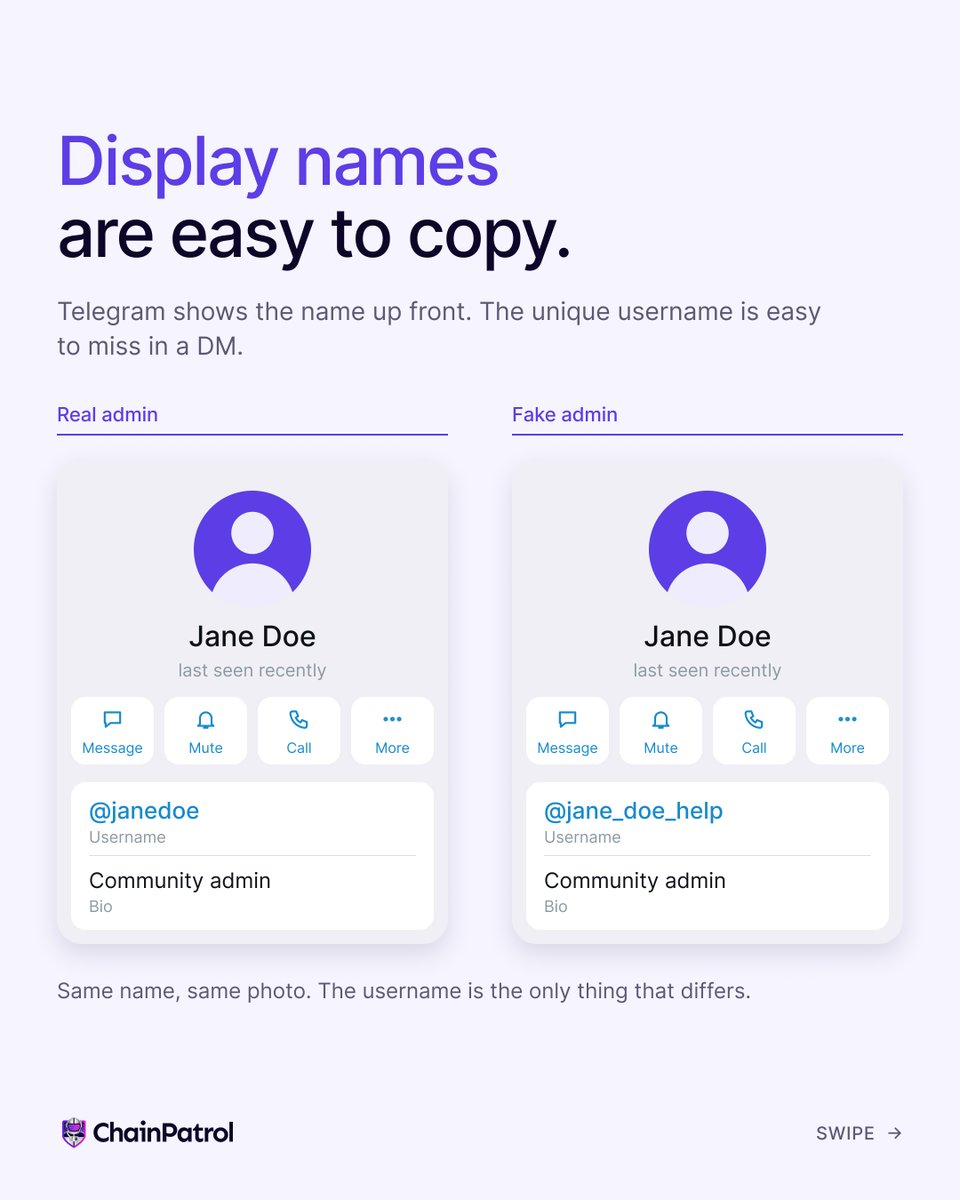
Fake Telegram admins don't need to fool anyone for long. They only need to arrive first.
They watch your public group for newcomers, copy a real admin's name and photo, and DM first.
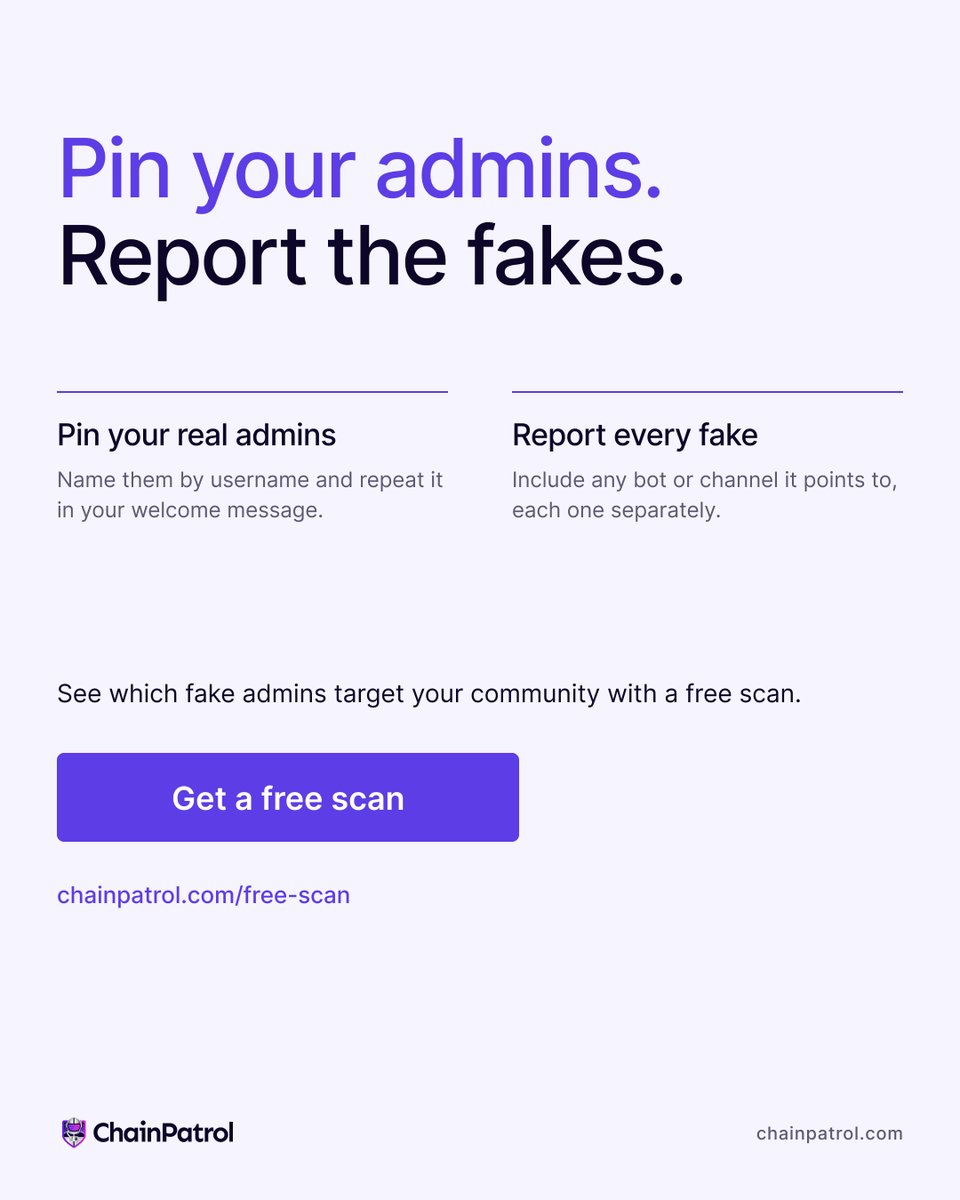
Pin your admins by username. Report every fake.
https://t.co/fyD76HUKLI
ChainPatrol now has an assistant in Slack.
Selected customers can tag it in their shared channel to ask about reports and takedowns, or drop in a screenshot. It never acts on its own. Nothing happens until someone clicks Confirm.
Docs:
https://t.co/HJpNt1aTn6
Impersonation scams work best when people don’t know the difference between what's real vs whats fake
Thank you to @moneywisecom for covering the work we do at ChainPatrol!
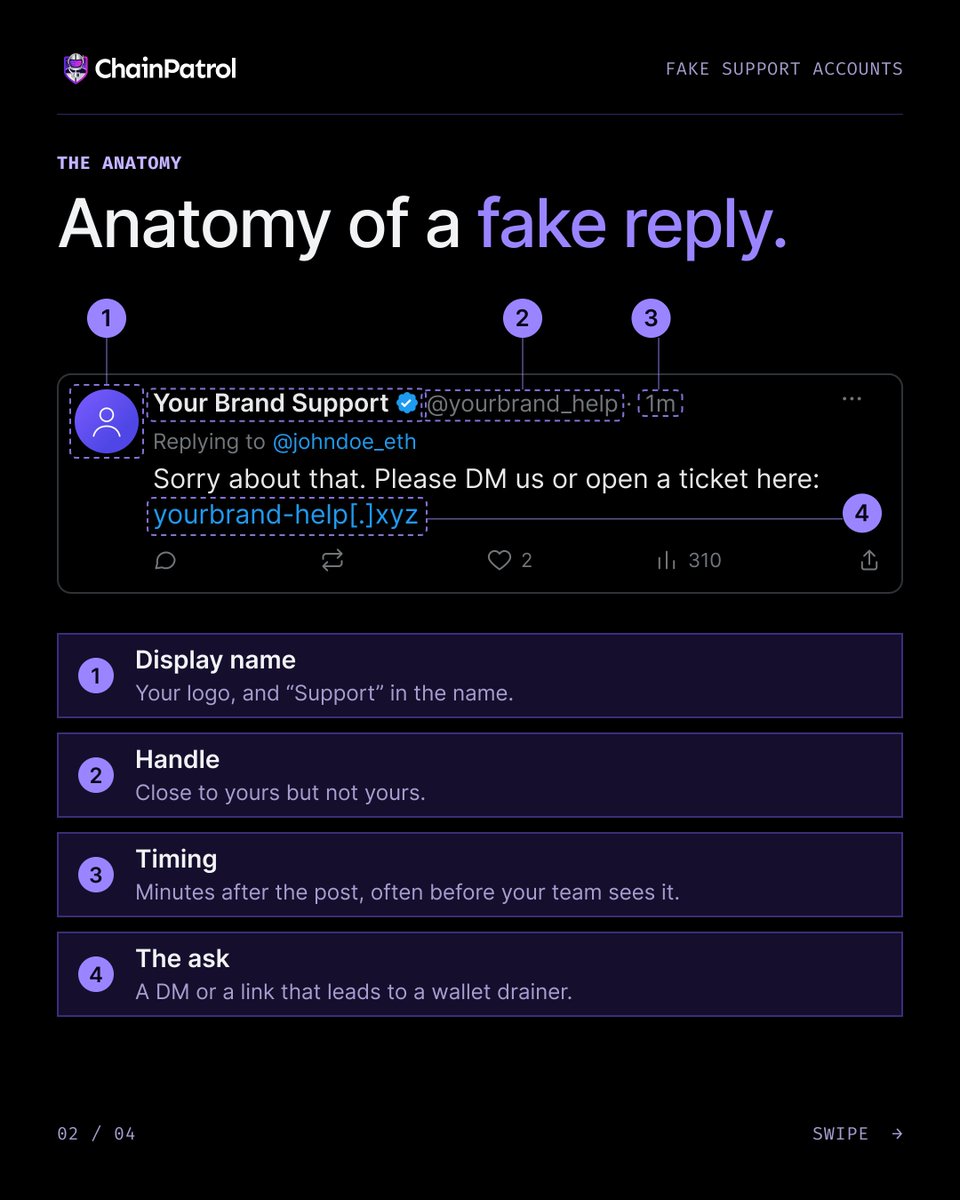
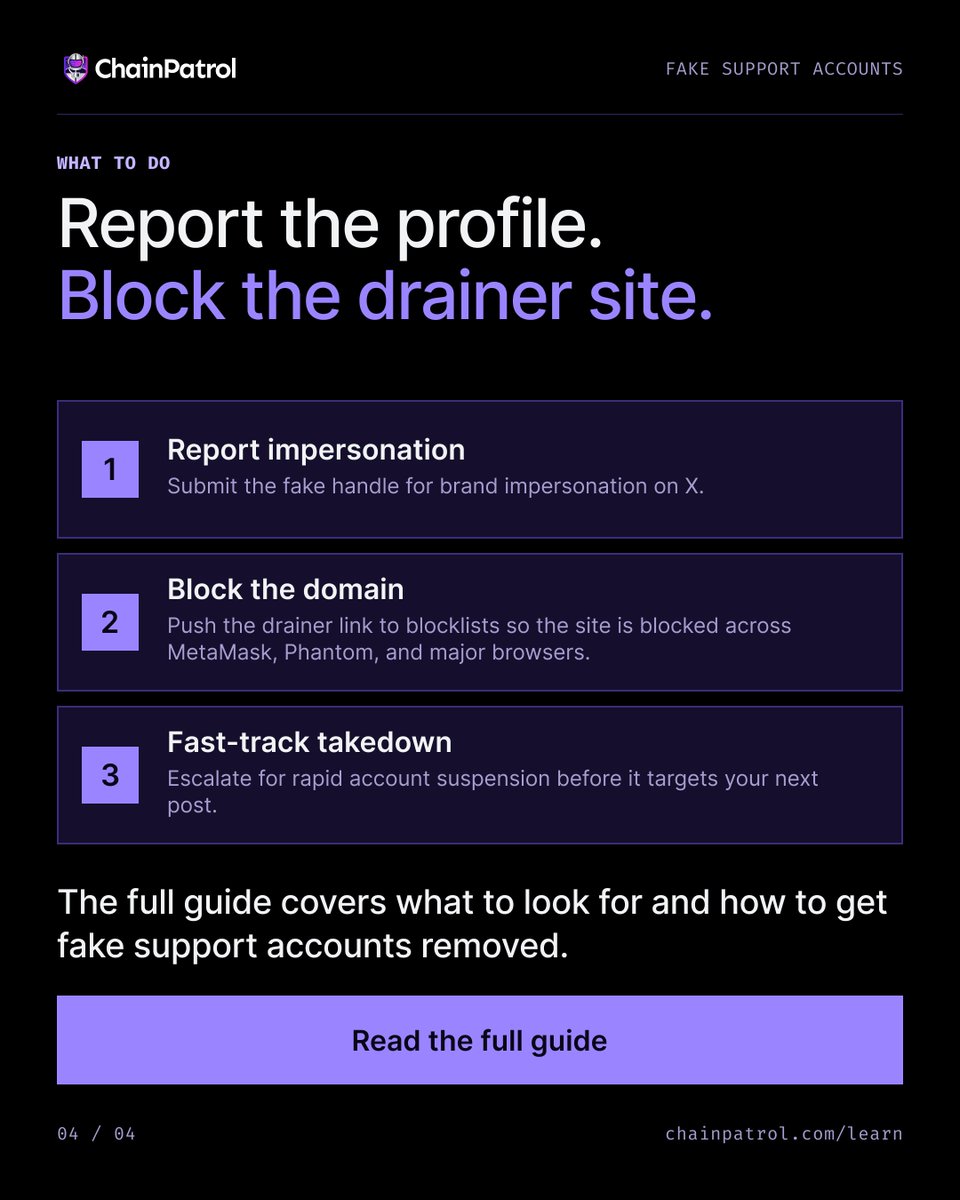
🚨 A customer asks for help. Minutes later, a fake support account replies first, with a link to a wallet drainer site.
Swipe to see how to spot it, the five signs it's fake, and how to get it reported and blocked 👇
Exposed logins can sit on the dark web for months before anyone notices.
We search leak data for records tied to the domains, staff, and wallet addresses you track. Every finding is graded by severity, alerting your security team directly in Slack the moment exposure increases for a monitored domain.
Is someone recruiting in your brand's name right now?
Fake recruiters borrow a real company's name and logo to get candidates to run malware. Our CEO @NikitaVarabei breaks down how it works and where brand protection can and can't help:
https://t.co/pbXssuGuTM
Scammers don't look like hackers. They dress up as your brand 🎭
Three rounds. When the fakes are this subtle, even careful users have to look twice.
Answers in the thread 👇
As @GenLayer for TGE, impersonators and scam sites tend to show up before the first token trades.
We're now protecting the project ahead of launch, watching for fake accounts, lookalike domains and impersonators aimed at its community.
Most brand protection providers stop building registrar relationships too soon.
They check the box and move on, then struggle with takedown times.
I see deep relationships across the industry as the real advantage.
You don't build them once.
For me, that means showing up to industry gatherings like ICANN conferences and listening when registrars are unhappy.
Then working through what's bothering them.
Brand protection teams need to collaborate with registrars on requests they're willing to accept.
I'm after a high acceptance rate.
When enforcement teams treat the hosting provider as an opponent, they make that cooperation harder.
The people handling your next request remember how you worked with them on the last one.
We are heading to @BlackHatEvents India 2026 to discuss brand protection at scale.
Fintech, banking, iGaming and crypto all face coordinated threats that require detection and takedown strategies built for speed and volume.
Our team will be there to share how organizations can protect users across multiple channels and platforms.
📅 October 27-30
📍 Bengaluru, India
Together with @PythNetwork we've blocked over 1,500 threats. More than half of them right here on X.
As Pyth builds access to a wide array of market data, we’re proud to help protect the next wave of finance.
As one of the most trusted wallet-cleanup utilities in the Solana ecosystem, @solincinerator has built a passionate, security-minded user base that relies on them daily, and we are proud to safeguard their community from evolving brand impersonations.
Together, we've blocked 287 threats. The largest share (54%) were counterfeit websites and fake dApp URLs, plus spoofed X profiles, fraudulent wallet addresses, scam Telegram groups, and unauthorized listings spanning Zora, Medium, etc.
In SF this week for TechCrunch Disrupt! 🌉
AI has made launching convincing brand impersonation practically instant, while manual takedowns still take days.
If you're at Disrupt and want to chat automated brand protection and real-time threat blocking, send me a DM!
Some scam sites never mention the brand name they're copying.
No imitation in the domain text or on the page. Just your icon in the browser tab, known as a favicon.
We now flag these fake domains by the favicon itself.
Back at Remix Jam in Toronto today! 🇨🇦
Best rooms are always the ones full of people who care about routing, web standards, and shipping fast.
If you're building on Remix, come find me. Happy to talk frameworks, real-time security, or anything in between.
When coordinated scam networks targeted @FlareNetworks with up to 126 impersonation threats a day, manual reporting could not keep up.
By pairing automated syndicate clustering with direct platform escalation and wallet-level blocking, Flare drove an 80%+ drop in daily threats.
Read the case study: https://t.co/0gWNAVXu3g
As a high-throughput Layer 1 blockchain built for global adoption, @SuiNetwork has a fast-growing ecosystem of builders, creators, and DeFi users, and we are proud to protect their community from impersonation and phishing threats across the web.
Together, we've blocked 3,023 threats. The largest share (50%) were web domains and URLs, plus 23% on Twitter / X, 7% on Medium, 6% on Telegram, 5% on YouTube, 3% malicious on-chain addresses, and 5% across other platforms.