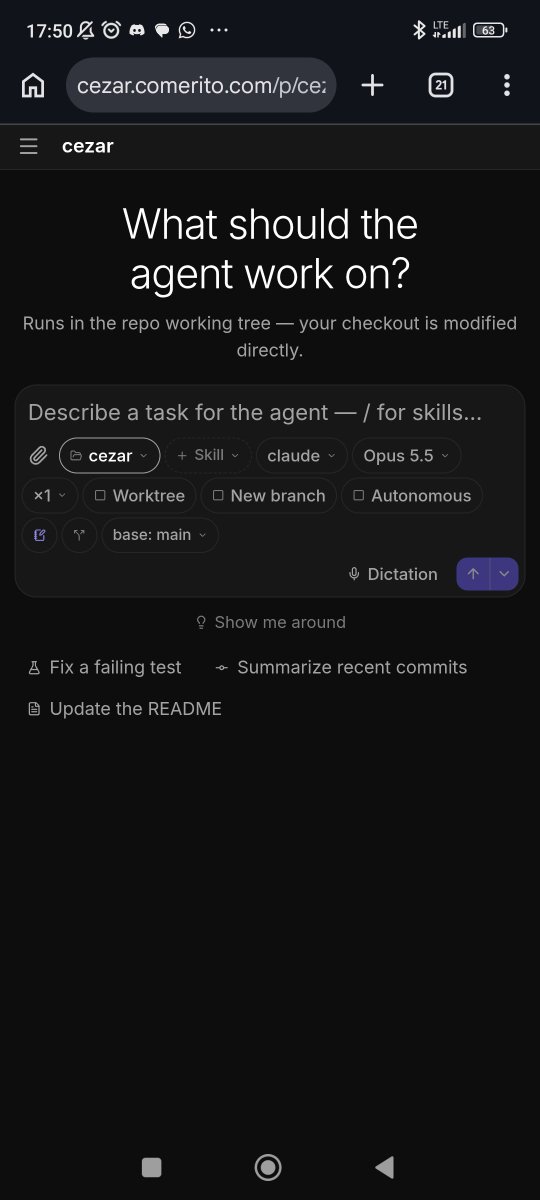
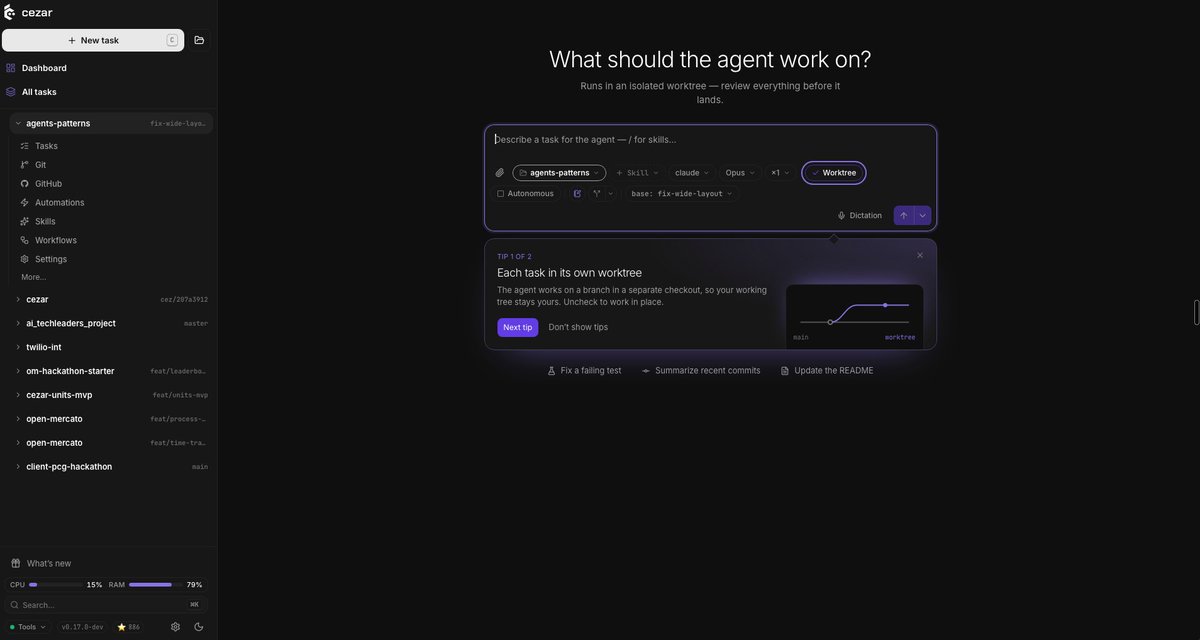
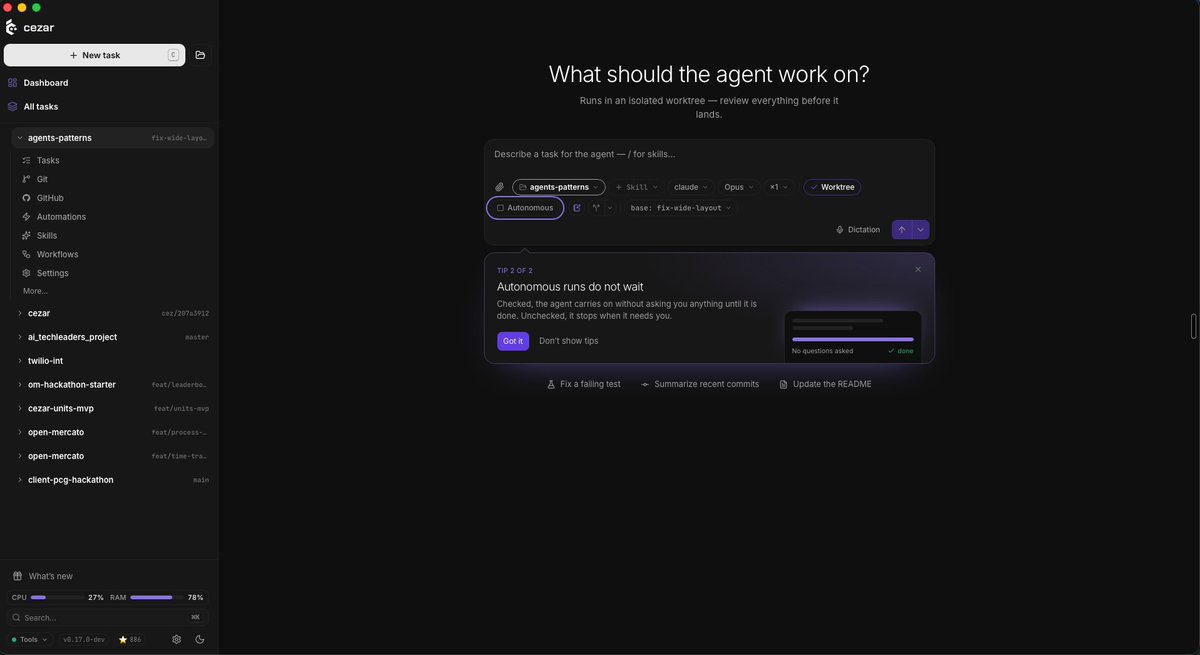
Your IDE was built for you typing. An ADE is built for agents shipping.
Cezar is an open-source ADE: drop in 10 tasks, Claude Code and Codex work in parallel, each on its own branch, tested and reviewed. You wake up to PRs.
No API keys. MIT.
npx cezar-run
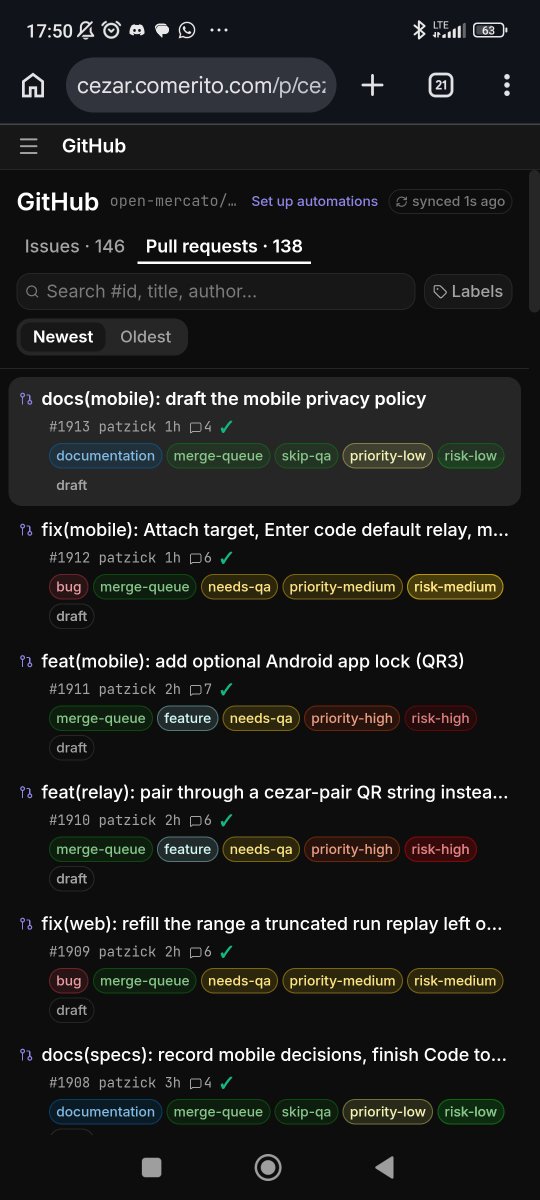
if I like a PR and see it in Cezar, I add the auto-merge label and the agent takes care of the rest: it fixes CI, resolves conflicts, and so on.
Cezar: https://t.co/KxMGedOLu6
DAY 9/30
I've started using auto-merge to merge various pull requests. The idea is the same as before: the automation flags the appropriate fixes for auto-merge, but it does so via a label on the PR, so I can also set that label manually...
Rest 👇
@kentcdodds This is so true but, you need to set-up full safety net to be able to do so.
Creating and deploying safety net that's a different job but definitely worth doing!
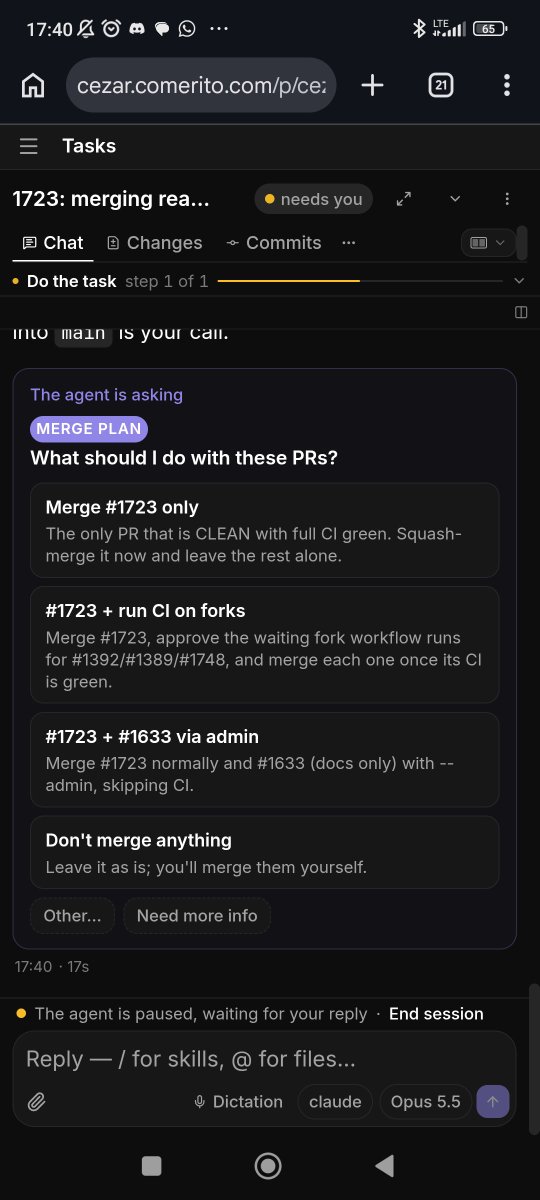
@ClaudeDevs We did an architecture with more separation that simple subagent. In Cezar an agent can create tasks (totally new sessions even in different agents harness) and we return only summary of result or questions like in agent to human cooperation.
This works surprisingly well
@thdxr My workflow for a while is Opus 5.5 on primary agent and GPT Luna 5.6 on subagents.
We have subtasks in Cezar but this is very similar to subagent capabilities
@QuantaCortex Very good question indeed. What we have inside situations is a task router inside the agent.md file.
In the case of a task subject we route to different instructions.
When the agent has a concrete task to do, it also gets a concrete set of instructions.
One test for every line in AGENTS.md:
Would the agent do this task differently without it?
If not, delete it, even if it's true and well written. You pay for that line in every session, on every turn.
AGENTS.md isn't documentation. It's a budget.
I took a lot of notes. Some already landed in the repo. We're polishing the features people need most, and we'll releases some of them tomorrow at v0.19.0.
Go to https://t.co/7403NnUDQQ
ADE building log, DAY 8/30
There's no better way to build a product than watching and listening to how people want to use it.
Posting late today. I spent the whole day with a client, then traveled home. Still, it was time very well spent in the FDE role. 🧵
Over the past two days of the workshop, I watched our client's developers use CEZAR. How they interact with it, which features they use, which ones they didn't know existed, and what they'd find useful.
DAY 7/30
I'm currently on a trip, organising a hackathon at one of our clients.
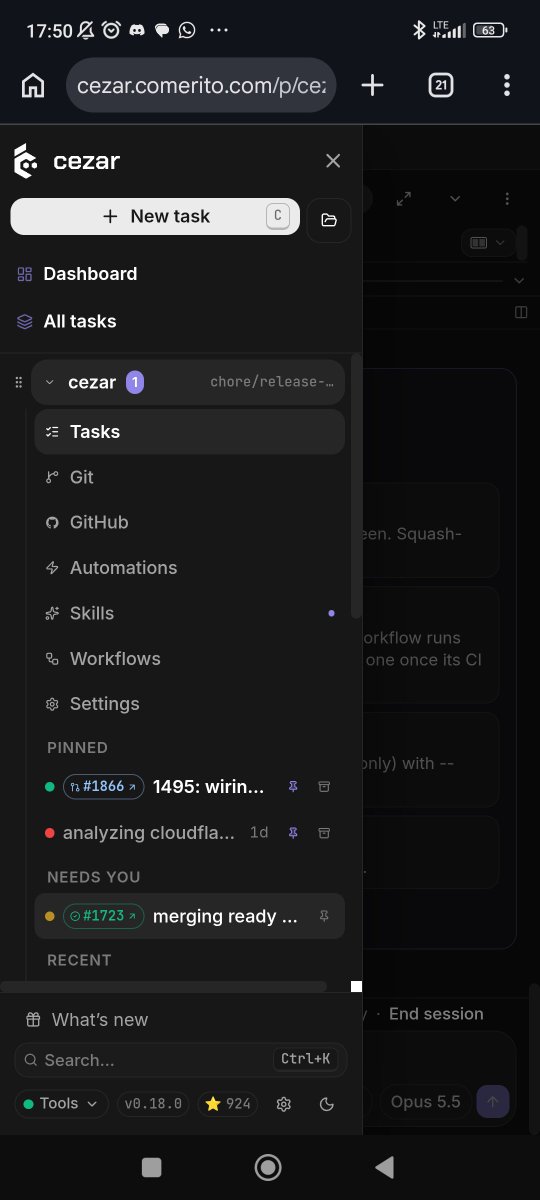
But work on Cezar doesn't stop. Mobile access is great for situations like this.
Mobile app is on the way!
Your IDE was built for you typing. An ADE is built for agents shipping.
Cezar is an open-source ADE: drop in 10 tasks, Claude Code and Codex work in parallel, each on its own branch, tested and reviewed. You wake up to PRs.
No API keys. MIT.
npx cezar-run
Day 6/30
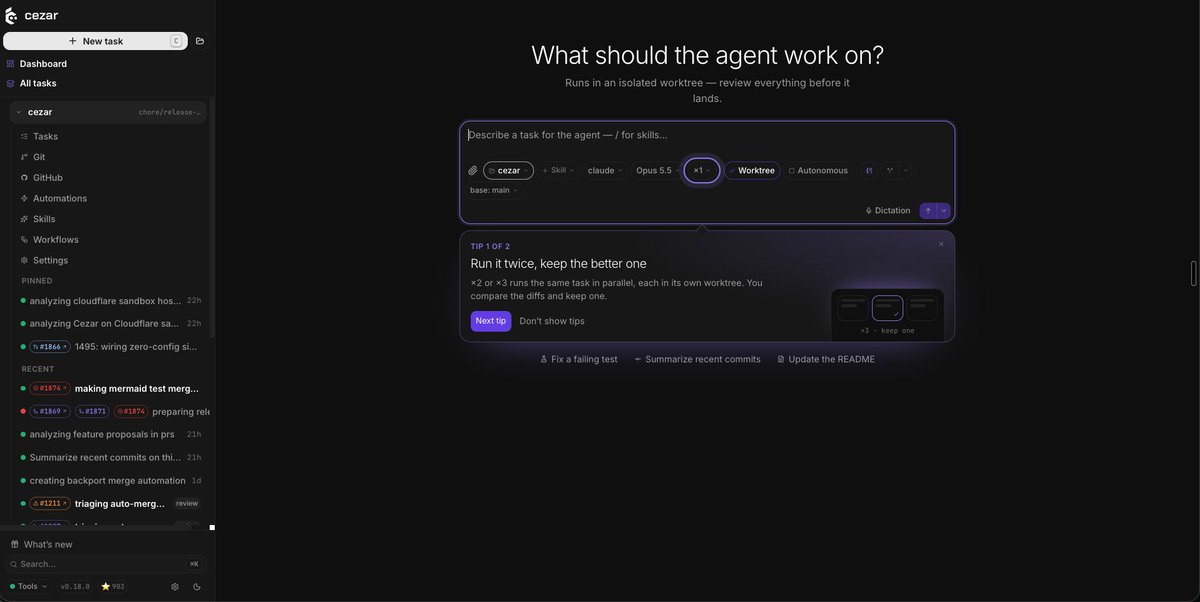
Just 2 days ago we had lust release now 0.18.0 is out to 🚀
New users now get a proper first run: sign in to your agent, pick or create a project, connect GitHub, done. No terminal needed.
Took us way too long to build this one 😅
@mattpocockuk@mattpocockuk I believe it is a best direction. We build open source tool Cezar on almost the same principles.
Work unit we have inside is a task which can be done with just picking a right skill.
I'm now working on sandboxing part and I will and Claudflare tonyour list
Why agents miss bugs in their own code:
1. Same context → new session
2. Bias toward their own style → different model
3. Same model family → different vendor
In one study, 14 open models missed their own errors 64.5% of the time, but fixed them when shown as external.