Ever See a Harpy Eagle? Now you have, and it not AI.
The largest and most powerful bird of prey , famous for its massive talons and striking, human-like facial disk.
Physical CharacteristicsSize and Weight: Females are larger than males, weighing 13 to 20 pounds (6–9 kg), while males weigh 8.5 to 12 pounds (3.8–5.4 kg). Their total body length reaches up to 41 inches.
Wingspan: They have a relatively short, broad wingspan of about 6.5 to 7.3 feet (up to 2 meters), an adaptation that helps them maneuver through dense rainforest trees.
Talons: Their rear killing talons grow up to 4 to 5 inches long—comparable to the claws of a grizzly bear—and can exert over 500 pounds of pressure per square inch to crush bones.
Hearing: They can adjust the facial feathers around their head like a satellite dish to funnel sound directly to their ears, much like an owl.
🚨 A groundbreaking MIT brain-scan study shows relying on ChatGPT weakens critical thinking and memory wiring.
A recent MIT study, titled ”The Cognitive Cost of Using LLMs,” monitored the brain activity of 54 students using electroencephalography (EEG) devices.
Researchers from the MIT Media Lab discovered that participants who consistently relied on ChatGPT for essay-writing tasks demonstrated significantly lower neural engagement in brain regions tied to memory and analytical reasoning.
Rather than actively synthesizing information, these users increasingly defaulted to a state of 'mental passivity,' struggling to recall their own work shortly after completion and producing increasingly generic, uninspired content.
However, the research also highlights a path forward: AI does not have to be a cognitive detriment. Students who initially worked unaided and later transitioned to using ChatGPT showed an increase in brain activity, suggesting that AI is highly beneficial when used to enhance and scaffold human thought rather than replace it entirely. To avoid a future of algorithmic echo chambers and cognitive decline, experts urge users to remain active, critical participants when collaborating with digital tools.
source: Chow, A. (2025). ChatGPT's Impact On Our Brains According to an MIT Study. TIME.
Modern life is keeping your body in survival mode... 👇
Not because something’s wrong with us.
Because our nervous systems are constantly stimulated.
A simple bird call can slow the breath, soften the stress response, and bring the body back into rhythm.
No supplements. No hacks. Just biology responding to sound the way it always has.
Modern life keeps us wired.
Nature reminds us how to regulate.
Pause. Listen. Let the system reset.
Posted to chill us out. There are beautiful things in this world, and we need to remember that through the gloom.
Sit back for a brief moment . Sound up
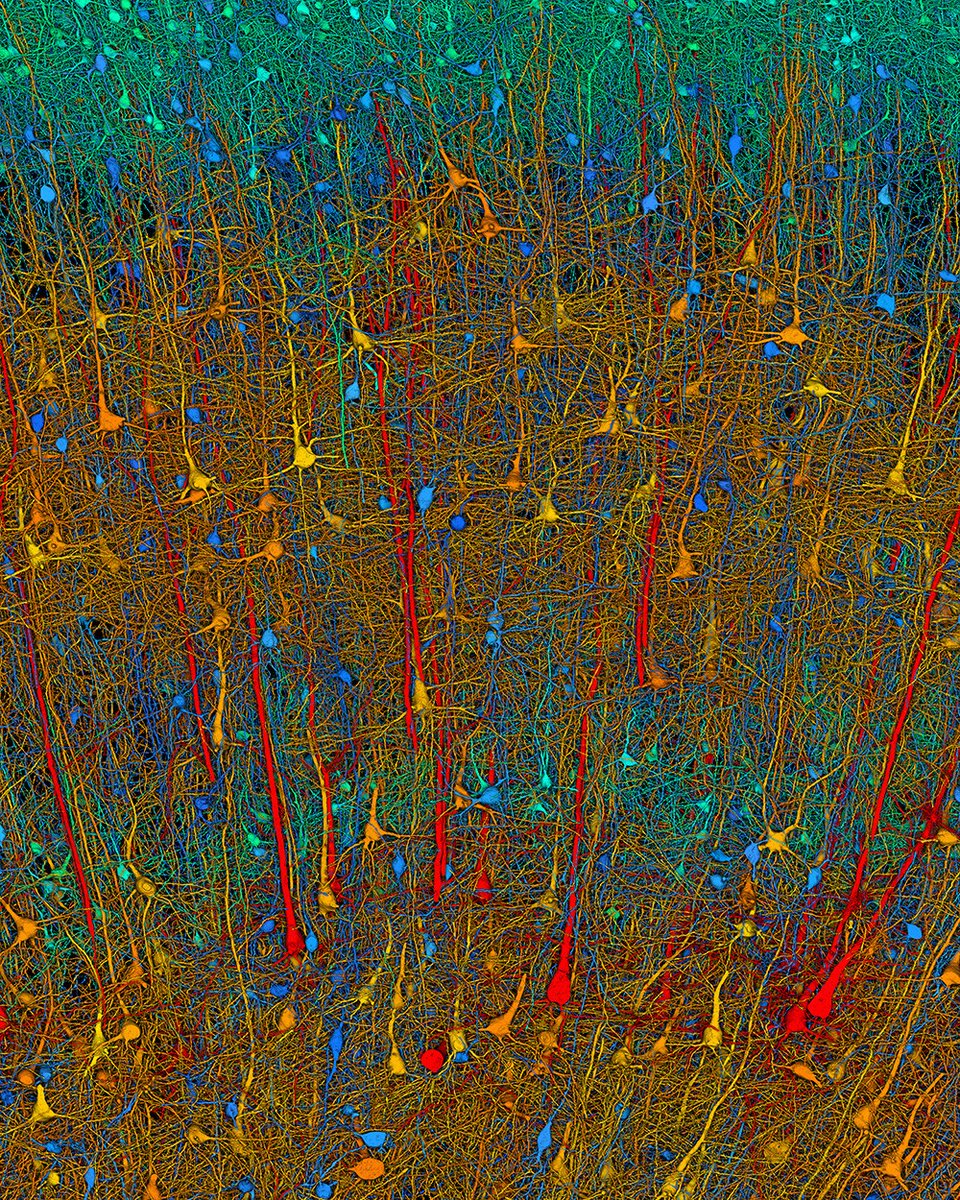
Using more than 1.4 petabytes of electron microscopy (EM) imaging data, researchers generated a nanoscale-resolution reconstruction of a millimeter-scale fragment of human cerebral cortex, providing an unprecedented view into the structural organization of brain tissue at the supracellular, cellular, and subcellular levels.
The human brain is a vastly complex organ and, to date, little is known about its cellular microstructure, including the synaptic and neural circuits it supports. Disruption of these circuits is known to play a role in myriad brain disorders. Yet studying human brain samples in such great detail comes with a host of challenges, ranging from technological limitations to the availability and preservation of tissue samples from healthy individuals.
In a 2024 Science study, researchers performed a high-resolution EM reconstruction of the ultrastructure of a cubic millimeter of human temporal cortex. According to the authors, the reconstruction contains roughly 57,000 cells, about 230 millimeters of blood vessels, and nearly 150 million synapses, comprising 1400 terabytes of data. The authors generated a three-dimensional reconstruction of nearly every cell and process in the cubic millimeter sample and developed a freely available tool for visualizing and analyzing the vast dataset.
Learn more on #WorldBrainDay: https://t.co/ye8JncNkrJ
Así se alimenta una cría de ballena azul🐳. Recibe hasta 600 litros de leche al día y engorda unos 90 kilogramos cada 24 horas. la leche de ballena azul contiene entre UN 35 y un 50% de grasa, comparado con el 4% de la leche humana. Su consistencia se acerca a la pasta de dientes. Si fuera leche líquida se disolvería en el océano antes de llegar a la boca.
La maravillosa naturaleza.
Kingxity TV