I felt like a personal recap and a forward look was in order for $NEURAL (real, unscripted, 1 take):
2024 showed what an organic, community-led token + a relentless team can do. 2025 looked rough (especially on price), because of the general market but also partially because we made a hard pivot for long‑term, defensible value.
In the video below I explain why we spent the last year building SPARQ - an AI‑native "Steam meets Roblox" engine + platform - as a basis for $NEURAL's world's first AI games launchpad and why 2026 is the rollout year (engine/platform beta/V1, staking, and the launchpad landing soon).
To the $NEURAL community, thank you with all my heart for the trust and support so far. We couldn't have done it without you.
To everyone else: You are still early, but not much longer.
2026 is strap the fuck in time.
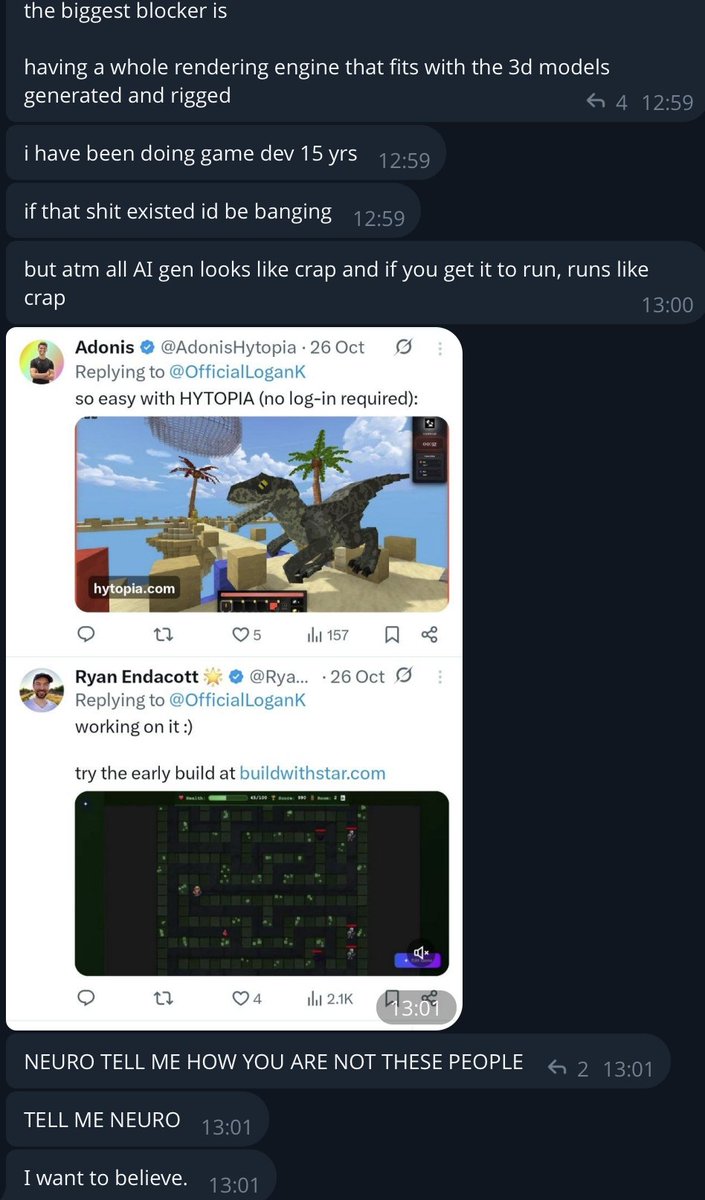
Had a conversation earlier with a highly experienced game dev about what $NEURAL is building.
It's very hard to understand for people without industry knowledge how big the gap is right now.
There are quite a few projects out there that look like they are building something in the direction of an AI game engine or AI roblox, but in reality are absolute garbage and will fade into irrelevance soon.
You can't just take threejs, slap an editor UI on top of it and call it an engine. Especially not an actually useful one.
You can't use any of the existing engines either (e.g godot like I saw some projects use) and think that will work out.
Before we started our work on the World Engine, we combined dozens of years of experience in the gaming industry and months of research on this particular topic to find an actual solution.
It would be insanely easy for us to spin up a threejs "engine" like some do and call it revolutionary and most people here would have believed us. I am talking less than a month of work.
But that's not a real product. That's shit in a fancy dress to make inexperienced people buy the token.
Instead, we are building an actual product that game devs, 3d artists and creators in general actually enjoy and use to build actual games.
1. Crossplatform (desktop, mobile, web) - most web3 projects out there already fail here.
2. Novel asset streaming - pretty sure all projects fail here.
3. Plugins to extend functionality (yes you can vibecode plugins too) - pretty sure all projects fail here as well.
4. Proper rendering - all projects fail here
5. Multiplayer editing - most projects fail here
6. AI workflows that make sense - most projects fail here as well
I could write an endless list of features and reasons why we do things the way we do, and why this is the only viable path to a production-ready AI engine experience.
But the bottom line is simple: Building an actual engine/better roblox takes year(s).
We are paying 6 digits monthly for top tier talent, and I can assure you this is not something you can vibecode in a few days/weeks.
Stay vigilant, stay focused. We have a clear vision and we know how to get there. Trust the process and together we will reach greatness eventually 🫡
The Start of Something Massive 🔥
It’s been going a long time, but now things are getting exciting.
We’ve been working out the next 2 to 3 years of what $NEURAL will be. The numbers are huge.
With the tech and team we have, there’s no reason this can’t be a multi billion dollar company.
That’s what gets me really excited.
Everyone’s firing on all cylinders now, and we’re about to do a lot in a short amount of time. ⚡️💚
Thoughts from the World Engine front 👇
Curious where World Engine (+ $NEURAL) is headed? Keep reading.
First things first;
The next AI wave isn’t going to be “more agents.”
It’s AI-born worlds - created & tokenized in minutes/hours, multiplayer by default, deploy-anywhere, with real economies embedded from day one.
This isn’t a small feat.
Rendering, networking, agent systems, creator tools, a multitude of AI models, token mechanics, and distribution all have to lock together.
You can’t fake that. Only teams shipping real tech will break into this niche. In fact, there's no team (web3 or web2) anywhere close to what we are doing right now.
That’s massive. It redirects attention from hype to genuine progress.
Now, the bigger point;
The market is dramatically underpricing $NEURAL's position.
We’re in a compounding lane no one in web3 is covering end-to-end - and basically no one in web2, either.
AI -> Playable: Natural language turns into living, shippable worlds
Engine -> Runtime: Multiplayer, TypeScript-native, built for web & Telegram
Economy -> Tokenization: AI Worlds Launchpad for world-native tokens
Incentives -> Access & Buybacks: Staking 2.0 for world token participation, $NEURAL buybacks from transaction fees
Agents -> Gameplay: Agent-guided loops for creation, testing and scaling
That’s the edge: compressing the path from idea -> world -> players -> economy.
There are too many unique innovations packed into this to list them all.
The kicker;
We’re not here to be “another game engine” or “another launchpad.”
We’re closing the gap holding AI gaming back: time-to-world, with liquidity and distribution wired in.
We’ve been building the foundation behind the scenes. Soon it will be ready to go public.
What it implies for $NEURAL;
As creators launch through the AI Worlds Launchpad, players (and agents) drive activity, and value routes back - via buybacks - to $NEURAL and to creator-owned worlds.
That’s a flywheel - and Staking 2.0 moves the most committed to the front of the queue.
Expect tight integrations with asset/effects providers, onchain infra and enterprise AI solutions - plus partnerships with top creator communities. $NEURAL utility keeps expanding in the most important way this cycle: Constant buybacks driving value plus early world token access for stakers.
Bottom line;
We are very close to the first chapter of the World Engine saga. There is $NEURAL before the World Engine, and there is $NEURAL after.
Our conviction has never been stronger. And our go-live is drawing closer every day.
If you remember one thing, remember this: we’re at an inflection point.
And in hindsight, it’ll look obvious.
The future is $NEURAL 🫡
✍️ NeuralAI Weekly Roundup: Key Highlights Week #78
Livestream #3 Highlight: Replicated State Container
The World Engine’s Replicated State Container enables real-time multiplayer editing with instant synchronization across collaborators. It removes the need for version control while powering replays, debugging, observer tools, and cinematic features—making collaboration faster and smoother than traditional engines.
Neural Starter Series: Build Your AI World
The World Engine makes creation simple and accessible for anyone discovering Neural. With natural language, you can turn ideas into 3D worlds, instantly publish across desktop, mobile, VR, and web, collaborate in real time with AI-powered tools, and even share the experience live with your community. For the first time, new creators and investors alike can see how worlds are built, shared, and streamed together.
Livestream #3 Highlight: Launchpad Models and Creative Fees
The World Engine Launchpad will support two types of launches: bonding curve based, where creative fees reward committed creators with a share of trading volume, and presale based, designed for serious teams with backing and longer-term projects. This dual model ensures flexibility while aligning incentives for sustainable growth.
Livestream #3 Highlights
$NEURAL is taking streaming to the next level. 🌍 The World Engine transforms tokens into living, playable worlds with built-in replays, real-time multiplayer editing, tokens directly tied to creation, and Twitch interactivity through observer mode. These features let anyone build not just a game but a strong player base and thriving community. 💚
Livestream #3 Highlight: How Neural Launchpad Powers Token Launches
Neural Launchpad will feature two systems: bonding curve–based, tying commitment directly to world creation, and presale-based, designed for longer-term projects. Creator fees will also be implemented, adding long-term value for both creators and the ecosystem.
Livestream #3 Highlight: Balancing Quality and Performance
The World Engine targets visuals on par with Unity today while aiming for Unreal-quality rendering in the near future. The focus is on achieving high fidelity without sacrificing performance, especially for smaller sessions with under 100 players.
The Totem 3D model is now available for FREE download!
Perfect for jungle or mystery-themed games and immersive scenes.
Livestream #3 Highlight: How the World Engine Makes Streaming Interactive
https://t.co/yah23mrtJX has streaming now, but the World Engine takes it further. Viewers can join the game if the session is open, or join as observers if it isn’t. Creators can even open the world-building session to their audience, letting people jump in and create directly from their browser. This transforms streaming into a powerful engagement tool that will be unique to the World Engine.
What can you create with just one Neural model? 💚
Our intern built an entire scene using just a single coconut model—proof that even one asset can set the vibe. 🌴
Check the comments for all the details.👇
@NadiaWhittomeMP Wow! Only when you have lost everything will you realise how completely ridiculous you sound. Wake up and start listening to the people of this country before it’s too late!