I spent 4 years writing a 900+ page guide to help you cut through crypto hype, avoid garbage projects, and evaluate risk properly.
Ensure you get the 𝐚𝐮𝐭𝐡𝐞𝐧𝐭𝐢𝐜, 𝐡𝐢𝐠𝐡-𝐪𝐮𝐚𝐥𝐢𝐭𝐲 𝐩𝐫𝐢𝐧𝐭𝐞𝐝 𝐞𝐝𝐢𝐭𝐢𝐨𝐧, direct from the publisher, at the 𝐛𝐞𝐬𝐭 𝐩𝐫𝐢𝐜𝐞 𝐠𝐮𝐚𝐫𝐚𝐧𝐭𝐞𝐞𝐝 𝐰𝐢𝐭𝐡 𝐟𝐫𝐞𝐞 𝐬𝐡𝐢𝐩𝐩𝐢𝐧𝐠: https://t.co/no1JqaagPX
In the book, I go through the 13 fundamental elements you need to check before you invest a single dollar:
1️⃣ Project Documentation
2️⃣ Core Offering
3️⃣ End-User Experience
4️⃣ Blockchain Architecture
5️⃣ Token Design & Use Case
6️⃣ Tokenomics
7️⃣ Financial Metrics
8️⃣ The Project Team
9️⃣ Project Roadmap
🔟 The Codebase
1️⃣1️⃣ Incentives & Rewards
1️⃣2️⃣ Community & Socials
1️⃣3️⃣ Funding & Partnerships
The whole point of this list is to teach you how to disqualify projects.
Most projects are garbage. You need to learn how to spot the bad ones so you don't lose your money.
#Crypto #Blockchain #Investing @Apress@SpringerNature
Everything is public but you're still pseudonymous. Here's how that works.
Blockchain's transparency paradox confuses most investors. Every transaction is visible on the public ledger, yet your identity remains hidden behind a wallet address.
This creates a unique dynamic. Anyone can see that address 0x742d... sent 10 ETH to address 0x8a1f... But they don't automatically know who owns those addresses. That's pseudonymity, not anonymity.
The catch? Chain analysis firms can connect the dots. If you link your address to a centralized exchange that requires KYC, or if you reuse addresses across platforms, your pseudonymity erodes fast. Transaction patterns reveal more than most people realize.
This matters for fundamental analysis. When evaluating projects, you can track team wallets, treasury movements, and whale behavior—all public data. But privacy-focused projects add layers that obscure this transparency, changing your analysis approach entirely.
I've watched investors ignore on-chain data for years, then get blindsided by obvious red flags that were visible the whole time. The data was public. They just didn't look.
Protect your pseudonymity. Use the transparency.
What would you add to this framework?
9/9 This thread barely scratches the surface
The full framework is in my book - get it direct from the publisher:
https://t.co/8sCamMCfwF
930 pages on how to not lose your money in crypto
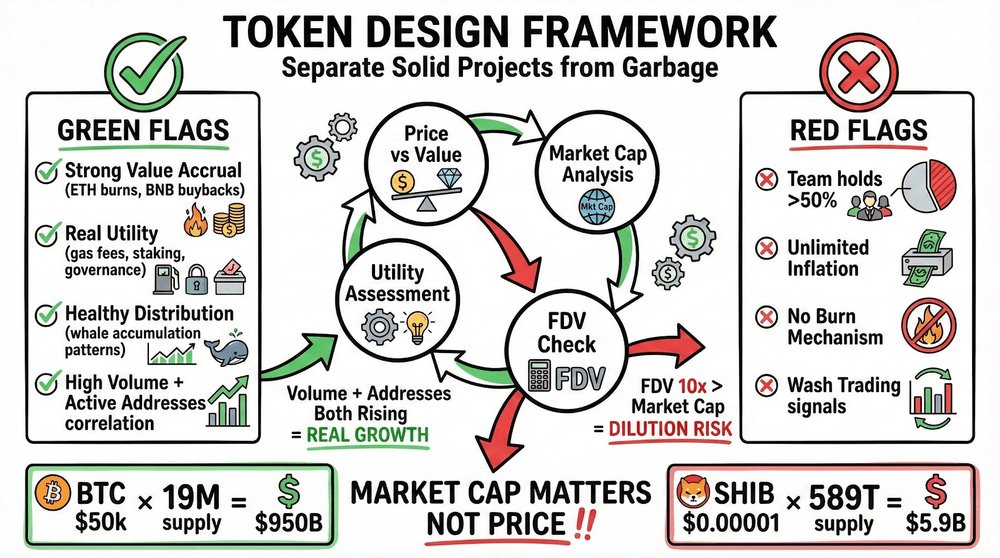
1/9 Token design can make or break a project
Most investors skip this step and get absolutely rekt
Here's the framework I use to separate solid tokens from garbage 🧵
8/9 Trading volume tells you if there's real demand
For short-term trades: need >$100M daily volume
For long-term holds: check if volume correlates with active addresses
High volume + flat addresses = wash trading bullshit
Both rising = real growth
A token launches at $2. Six months later it's at $5. Everyone's celebrating. Then the unlock hits.
Suddenly 40% of the total supply floods the market. Early investors and team members who got tokens at $0.10 start selling. Within days, price drops to $1.50. Regular investors who bought at $2-5 are left wondering what happened.
The unlock calendar was public information the entire time. Most people just didn't know where to look or what it meant for their position.
Vesting schedules determine when locked tokens become tradeable. They're designed to prevent team dumps, but they also create predictable selling pressure. Understanding when major unlocks hit can be the difference between timing an exit and holding through a crash.
This reel breaks down vesting mechanics, cliff periods, and how to track upcoming unlocks before they wreck your portfolio. The information is public - just need to know what to check.
📚 Get the full framework: https://t.co/no1JqaaOFv
#blockchain #bitcoin #blockchaineducation
Most people chase hype. Smart investors chase data.
After 10 years analyzing crypto projects, I don't look at Twitter threads or influencer takes first. I look at on-chain metrics that actually tell me what's happening with capital flow.
Here's what matters: tracking whale behavior through address balances.
When addresses holding 10,000+ BTC decrease as price rises, whales are distributing to retail. That's your signal the top might be near. When those same addresses increase as price drops, whales are accumulating from retail. That's your signal the bottom might be forming.
The 2018 crash showed this pattern clearly. So did the May 2021 drawdown. The data doesn't lie about who's buying and who's selling.
This is how you avoid being exit liquidity.
Combine this with metrics like Percent Supply in Profit and Active Addresses. When few holders are in profit (green zone), consider accumulating gradually. When most holders are in profit (red zone), consider taking profits in intervals.
Don't try to perfectly time tops and bottoms. Spread your risk. Follow the smart money.
I survived 2017, 2020, 2021, and 2022 by watching what whales do, not what influencers say.
I wrote 930 pages breaking down exactly how to analyze projects like this. Link in comments.
You can't stop your coins from dumping but you can limit the damage
What actually matters for 2026:
• Real revenue - not token emissions masking as growth
• Active addresses trending up - users matter more than hype
• Developer activity - dead repos = dead projects
• Treasury management - teams burning cash won't survive the bear
• Token utility beyond governance - actual demand drivers
Strong fundamentals won't guarantee gains but they'll keep you from getting completely rekt when sentiment shifts
Most altcoins still have fake metrics and no real business model
Be vigilant!
10/9 I cover this in Chapter 10 of my book, pages 536-539
How to evaluate teams, advisors, and institutional backing
Direct from Springer, free worldwide shipping:
https://t.co/8sCamMCNmd
1/9 Big name advisors look impressive on a project's website
But are they actually involved, or just collecting tokens for lending their name?
Here's how to tell if advisors are valuable or just window dressing 🧵
9/9 Action step: Pick 3 projects you're watching
Google each advisor's name + the project name
If you can't find evidence of involvement beyond the announcement, assume they're just window dressing
Don't invest based on names alone