The biggest business opportunity in Kenya might be hiding in plain sight:Things we currently import that we could manufacture locally.Look at the import bill. Then look for opportunity.
@SokoAnalyst Kenya needs a strict Prompt Payment Law for SMEs! 🇰🇪 Big vendors must be legally required to clear micro-enterprise bills within a fixed timeline. If they delay, they should pay interest at commercial bank lending rates. ProtectSmall businesses! #SMEs#KenyaBusiness#PendingBills
Taxpayer's life in India:
Pay income tax on salary.
Pay GST when you spend.
Pay tax on investments.
Pay tolls on highways.
Pay for private healthcare.
Pay for private education.
Pay for private security.
Then the government says:
"Pay more taxes for better services."
Which services?
Visa lays off employees.
Bengaluru founder Sanket Sheth raised a question that deserves attention:
Why is severance pay taxed like a bonus?
Employees pay income tax throughout their careers.
Then they lose their jobs.
The one payment meant to help them survive, cover EMIs, rent, school fees, groceries, and medical bills is taxed too.
Severance isn't a reward.
It's survival money.
India has millions of private-sector employees but almost no real unemployment safety net.
Should severance pay receive separate tax treatment?
What's your take on this ?
Former CEO of Africa’s leading airline hired to rescue India’s🇮🇳 second-largest carrier after record losses of more than $2 billion
Air India has appointed former Ethiopian Airlines chief Tewolde Gebremariam as its new chief executive and managing director, handing one of Africa’s most accomplished aviation leaders the task of steering India’s loss-making flag carrier through a difficult turnaround.
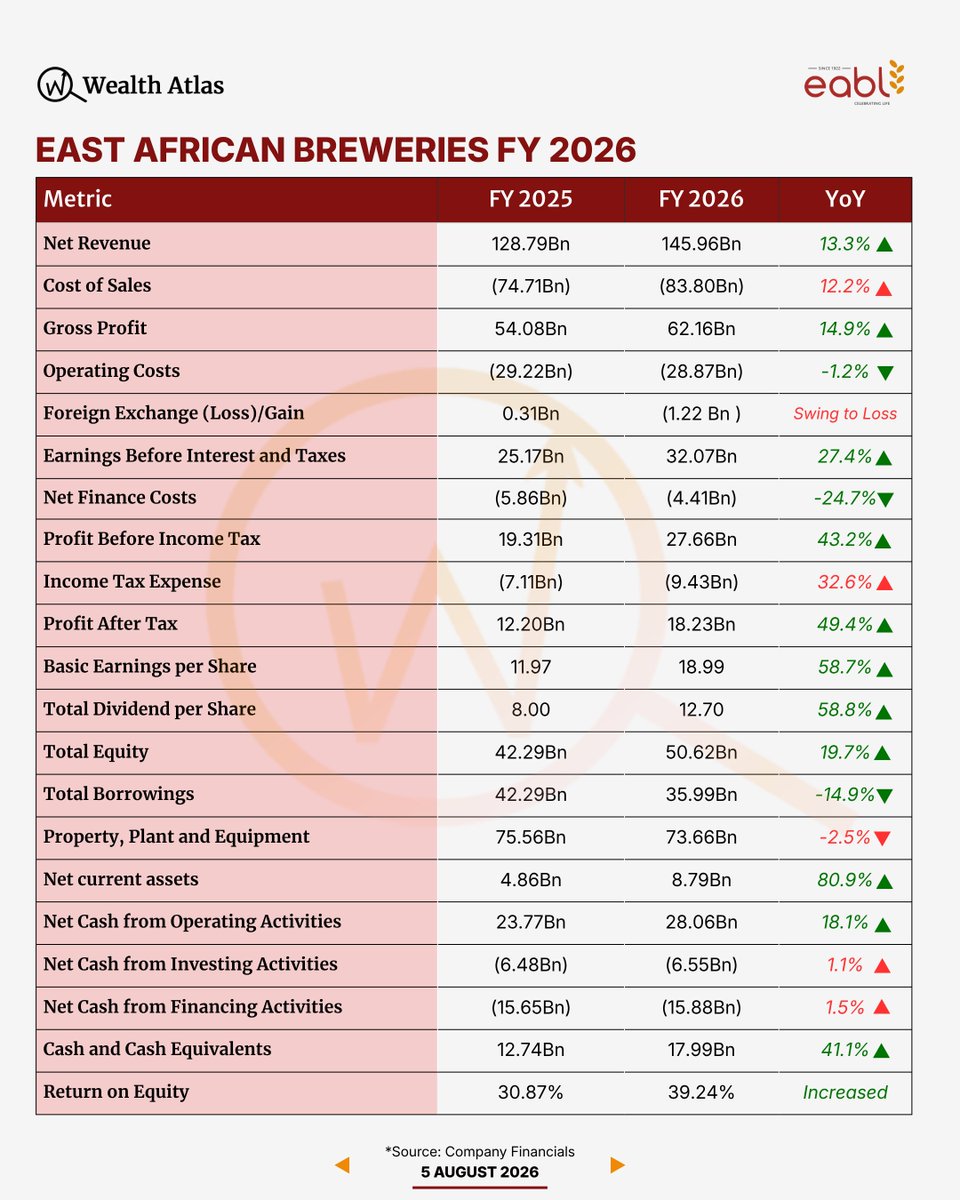
EABL delivered a strong financial performance for FY 2026, highlighted by a 49.4% surge in profit after tax to 18.23 Bn.
Net revenue expanded by 13.3% to 145.96 Bn, supported by a 14.9% growth in gross profit and lower net finance costs (-24.7%), which helped offset a swing to a foreign exchange loss of 1.22 Bn.
Basic earnings per share rose 58.7% to 18.99, while the balance sheet strengthened with total equity up 19.7% to 50.62 Bn and total borrowings reduced by 14.9%. Cash generation remained robust, with net cash from operating activities increasing by 18.1% to 28.06 Bn.
The Board of Directors recommended a final dividend of KShs 8.70 per share, bringing the total proposed dividend for the year to KShs 12.70 per share (a 58.8% increase), which offers a dividend yield of 4.4% based on today's closing share price of 286.00.
Book Closure: close of business on October 19, 2026.
Payment Date: on or about October 31, 2026.
EABL H1 2026 Results Snapshot
East African Breweries PLC posted a strong half-year performance, with Profit After Tax rising 38% to KSh 11.2Bn and net revenue increasing 11% to KSh 75.5Bn.
The performance was supported by volume growth across beer and spirits, stronger regional momentum, and disciplined cost management. EABL also declared an interim dividend of KSh 4.00 per share, up from KSh 2.50 per share in the previous comparable period.
For investors, this points to improved earnings momentum and stronger shareholder returns despite a tough consumer environment.
Trade listed shares online with ABC Capital:
https://t.co/wA1rVpcBPj
For information purposes only. Not investment advice.
#ABCCapital #EABL #NSE #MarketUpdate #Investing
A really hard life lesson to learn is that you will never truly value something until it is no longer within your possession
The human brain chases after shiny objects it cannot have, but forgets to be grateful for everything it already has
This is your reminder to be a little bit more grateful for the life you have today
How to invest KES 1M in Kenya?
1M in an Infrastructure bond yielding 13% will give you 130K per annum.
1M in a dividend king like BAT at the NSE will give you 118K per annum after taxes. (Current div yield of 12.5%)
1M in a MMF with an annual yield of 10% will give you a return of 87K after taxes.
1M in a special fund with a net return of 17% will net you a return of 170K after taxes
1M in SACCO savings with a rebate of 10% will give you 95K after taxes.
1M in the average rental property in Kenya (8% return from rental income, with 90% plus occupancy) will give you 75K after taxes.
1M in your bank savings account will earn you a very big ZERO after a whole year
Where are you investing your money?
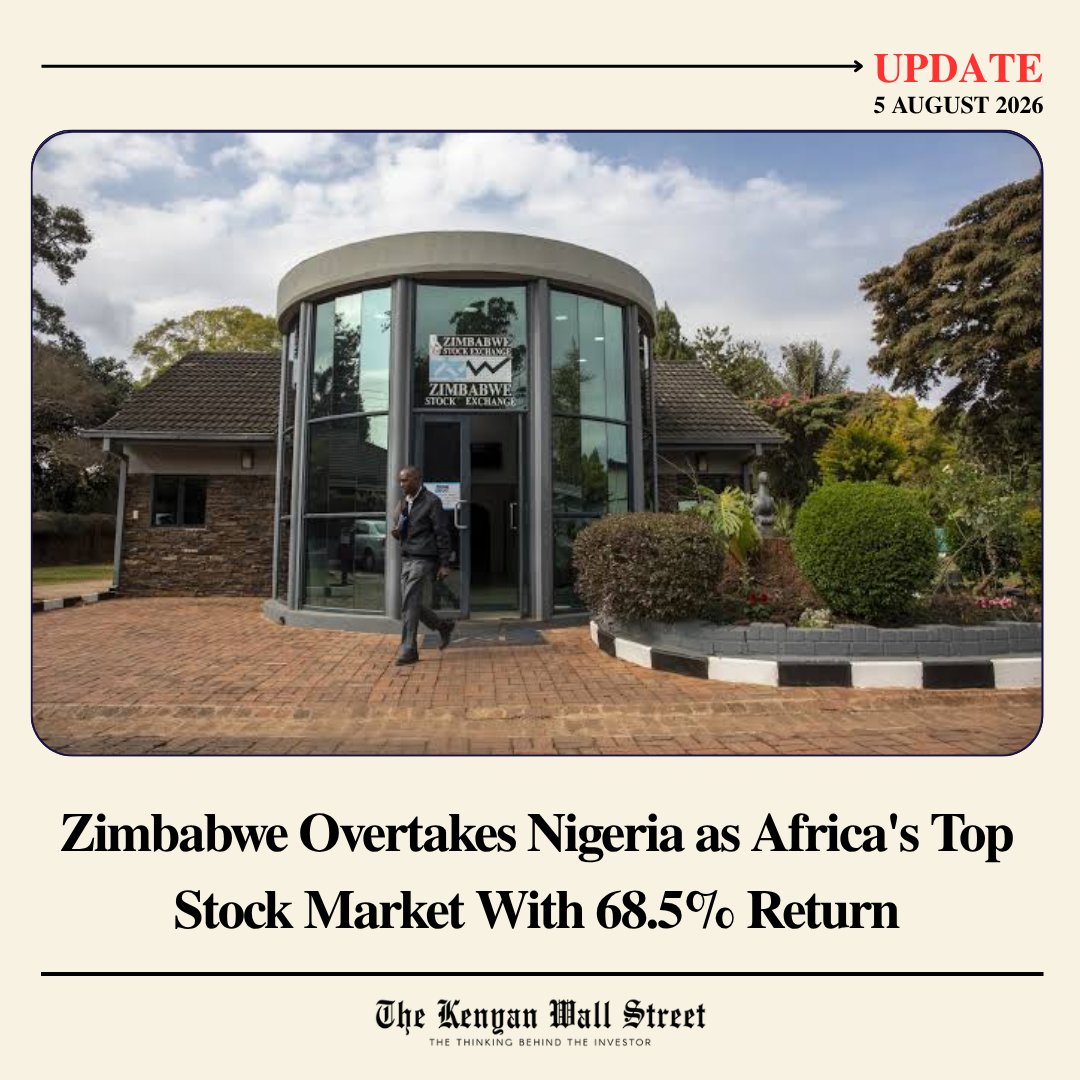
The Zimbabwe Stock Exchange returned 68.5% in dollar terms year-to-date through July 31, 2026, overtaking Nigeria's 66.9% to become Africa's best-performing market, per African Markets data.
Annual inflation slowed to 3.2% in July from 95.8% a year earlier, aided by the 2024 gold-backed ZiG currency. Foreign participation on the ZSE rose to 26.5% in Q2 from 15.4%, with foreign trade value surging 153.9% to ZiG743.6 million ($27.7 million).
East Africa isn’t just a market: it’s an economic bloc of 350M+ people.
From opening trade corridors to championing PAPSS for cross-border payments, to backing the roads and rail networks that connect us, KCB is shaping what regional integration really looks like.
In this inaugural episode of the Architects of Deals series on the Lion’s Share podcast, brought to you by KCB, Maurice Opiyo, MD at KCB Investment Bank, sits down with Maina Chege to discuss the role of KCB in driving and architecting our economy, and the region at large.
There are some SME owners who like employing their wives as shopkeepers and the wife later insists on bringing her brother, sister or random cousin as an assistant.
PwC has a new tax alert out on KenGen v KRA, where the Tax Appeals Tribunal has clarified that capital allowance-driven tax losses do not automatically protect a company from compensating tax:
— During the review period, KenGen generated profits from selling electricity, but significant capital allowance claims pushed the company into a tax loss position for income tax purposes.
— Even while in that tax loss position, KenGen paid dividends, which became the central issue because KRA argued that the distributions were made from profits that had not borne tax.
— The Tribunal held that where dividends are paid from economic gains or profits that have not been taxed, compensating tax can still apply under Section 7A of the Income Tax Act.
— The ruling also placed the burden on companies to prove that dividends came from profits that had already been taxed, rather than relying only on retained earnings balances.
— Key takeaway: capital-heavy companies need proper dividend tracing records before making distributions, especially where capital allowances have reduced taxable income, but accounting profits remain available for dividends.
Link: https://t.co/B45i7Thflh