The leading source for crypto payment card analytics. Featured in @BinanceResearch, @TheBlockCo, @Polymarket, and more. By @datadashboards and @tstereth
We're excited to see VISA's Onchain Data Lead @0xSector draw insights from our data.
If you're interested in the stablecoin card stack, onchain settlement, and the joys and limitations of onchain data, this is the place to start.
Neobanking Weekly Recap (May 2026)
Stablecoin card growth is showing no signs of slowing down, with a new all-time high of over $750M in verifiable onchain volume in May.
Top gainers:
🥇 @Plasma One $3.41M (+346%)
🥈 @Hyperbeat $390K (+83%)
🥉 @itstuyo $1.99M (+72%)
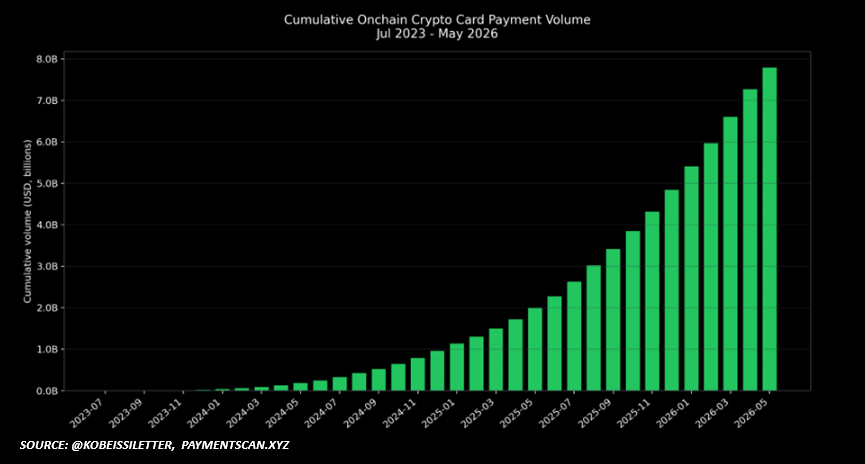
BREAKING: Cumulative crypto card payment volumes have reached a record $7.8 billion, with monthly volumes now up +230% since May 2025.
Crypto card adoption has rapidly accelerated in 2026 due to growing access to stablecoins as a payment rail through crypto cards.
In other words, more people can now spend stablecoins like fiat by using crypto cards, further driving adoption.
The growth comes amid the launch of Jupiter Global, which has seen a +648% surge in spending volume over the last 2 months.
Visa is capturing ~90% of onchain card transactions via crypto-native infrastructure partnerships like Jupiter Global.
Crypto cards are the ultimate use case for stablecoins.
Crypto card flows are becoming a multichain game. TRON still leads, but transaction sizes reveal who's actually winning consumer spending.
TRON holds 35% of card volume as of March 2026. By April that number moved to ~32.7% on ~$649M total volume, and the share's fragmenting faster than people realize.
Solana went from 2.6% to 35.5% of adjusted stablecoin volume in two years (Allium), with crypto card programs driving that growth. Base is hitting $2,700 average transactions, and Jupiter's Solana card posted 660% month-over-month growth in April.
Transaction sizes tell the real story:
- TRON: $6,400
- Solana: $4,200
- Base: $2,700
- BSC: $1,200
Your typical Visa purchase sits under $100. The chain with the biggest liquidity pool isn't the chain capturing your daily coffee purchase, and that gap is where the multichain story actually lives.
Chains winning consumer volume look nothing like chains winning settlement. Most people tracking this market are confusing the two.
Solana's velocity hit 15.5x in January (Allium), highest of any chain, meaning supply churns faster than chains with way more raw liquidity backing them. The numbers prove it:
- Two years ago: 2.6% of adjusted volume
- February 2026: 35.5%
@JupiterExchange's Solana card grew 660% last month, and Shinhan Card, 28 million cardholders and South Korea's biggest issuer, signed with @SolanaFndn in April for stablecoin payments.
Then April 29 changed the game. Visa expanded stablecoin settlement to 9 blockchains, adding Base, Polygon, Arc (Circle's payment L1), and others. Settlement pilot hit $7B annualized run rate growing 50% quarter-over-quarter, with 130+ card programs across 50+ countries on this infrastructure.
Being in that network shapes which chains become the defaults.
Card programs are standardizing on USDC because of regulatory clarity and Circle's direct integration with Visa and Mastercard. USDC grew 73% in 2025 while USDT managed 36%.
Base launched Shopify integration across 34 countries with USDC through Stripe, and Solana hosts Visa's USDC settlement for U.S. banks.
The regulated payment layer's being built around USDC, and chains supporting it natively catch the flow.
TRON built the foundation that still matters:
- Sub-$0.001 fees
- ~$85B+ in USDT liquidity
- Southeast Asia distribution
Nobody's taking that away. For high-frequency payments in emerging markets, TRON's cost advantage is still unbeatable. But consumer card flows are splitting by what each chain does best:
- Solana: speed + institutional USDC alignment
- Base: regulated onramps (Coinbase ecosystem, Shopify merchants)
- BSC: micro-transactions at scale
The @PaymentScan chart tells the whole story:
- Pre-December 2023: Ethereum dominated card flows
- Post-December 2023: TRON surged to 60-80% through 2024
- Early 2026: Share fragments with TRON at 35%, BSC at 15%, rest split across Solana, Base, Optimism, others
Infrastructure's diversifying based on what each chain handles best, and the signals point in one direction.
Key signals to watch:
- Transaction sizes matter more than volume headlines, and chains hitting $2k-4k averages capture genuine consumer behavior
- Partnership announcements with card issuers signal where institutional infrastructure's being built
- Which chains get added to Visa's settlement network is the institutional validation shaping long-term defaults
- Developer activity on payment tooling, because chains building native consumer payment apps create the UX layer driving adoption
Chains optimizing for sub-$5k transactions with strong USDC support and institutional partnerships are capturing the fastest growth. TRON's liquidity foundation remains massive, but new payment products are getting built on chains with different architecture priorities.
Volume share tells you where money sits. Transaction size tells you where people spend.
Those are two different maps of the same market.
Which chain captures most consumer card volume by 2027? Solana, Base, TRON, or something nobody's tracking yet?
cc:@trondao@solana@AlliumLabs@0xheun@base@circle
Crypto Cards Weekly Digest: May 18-24
Volume:
RedotPay: $100 million
KAST: $22.99 million
EtherFi: $18.71 million
Karta: $8.05 million
Tria: $5.41 million
Kolo: $2.35 million
Plasma One: 889.7K
Other: $12.88 million
Total: $171.3 million
Transactions:
EtherFi: 221,920
RedotPay: 136,678
Gnosis: 49,631
Safepal: 40,115
BFinance: 32,983
Tria: 24,938
Plasma One: 4,115
Other: 81,342
Total: 591,722
Users:
RedotPay: 75,249
EtherFi: 21,862
BFinance: 10,047
KAST: 7,926
Tria: 6,901
Safepal: 6,776
Plasma One: 1,297
Other: 19,987
Total: 150,045
Interesting facts:
@KASTxyz hit a new volume ATH of $22.99 million.
@ether_fi hit a new volume ATH of $18.71 million.
Volume on @Optimism increased by ~6x in the last two weeks.
Neobanking Weekly Recap (18-24th May)
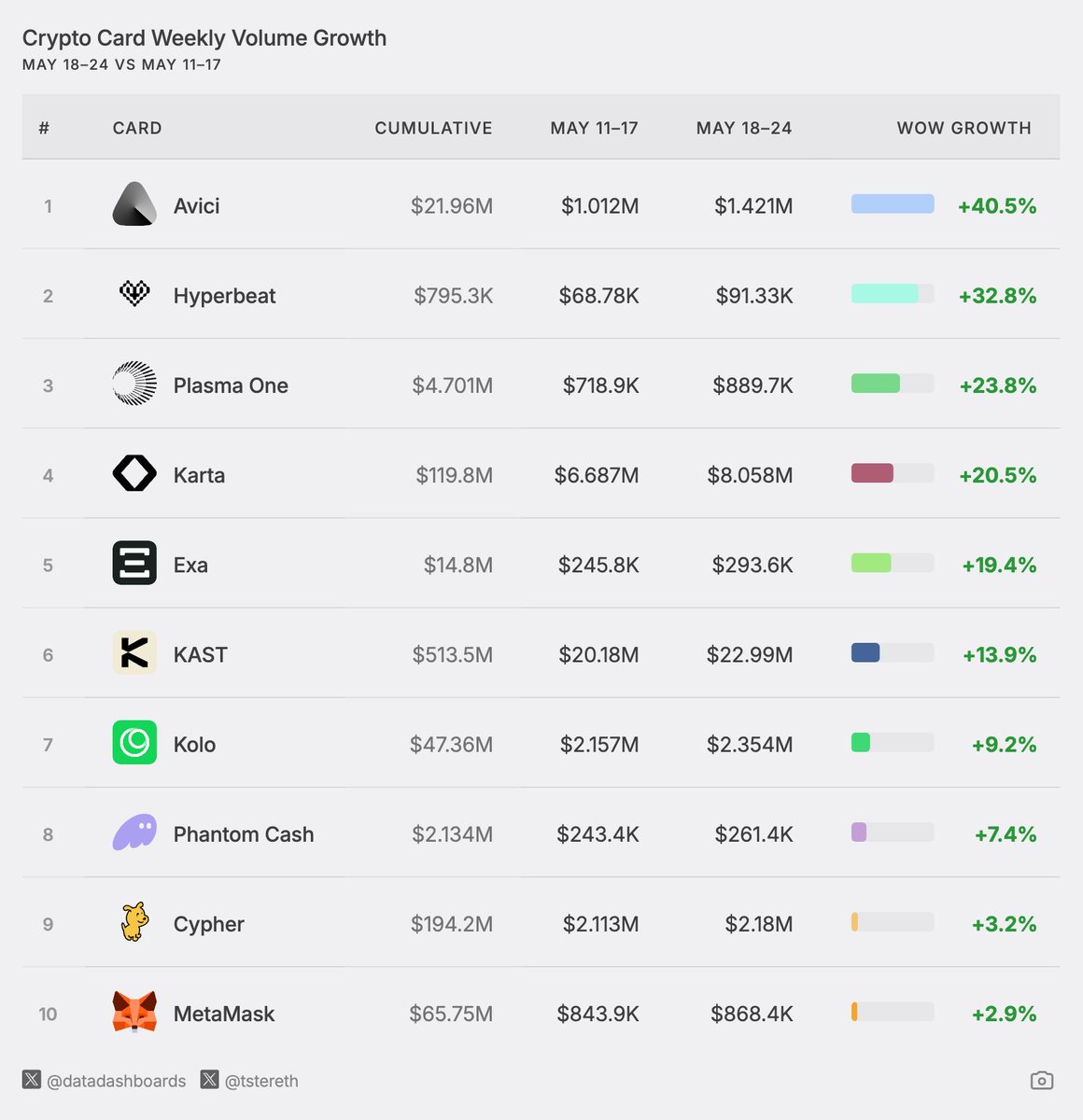
Stablecoin cards saw an impressive $166.6M in volume this past week, just shy of the all-time high set a week prior.
Top gainers:
🥇 @AviciMoney $1.421M (+40.5%)
🥈 @Hyperbeat $91.33K (+32.8%)
🥉 @Plasma One $889.7K (+23.8%)
Thank you to the teams at @datadashboards and @PaymentScan for the detailed overview of Kolo’s metrics.
Transparency and real on‑chain data are key to building trust in crypto payments.