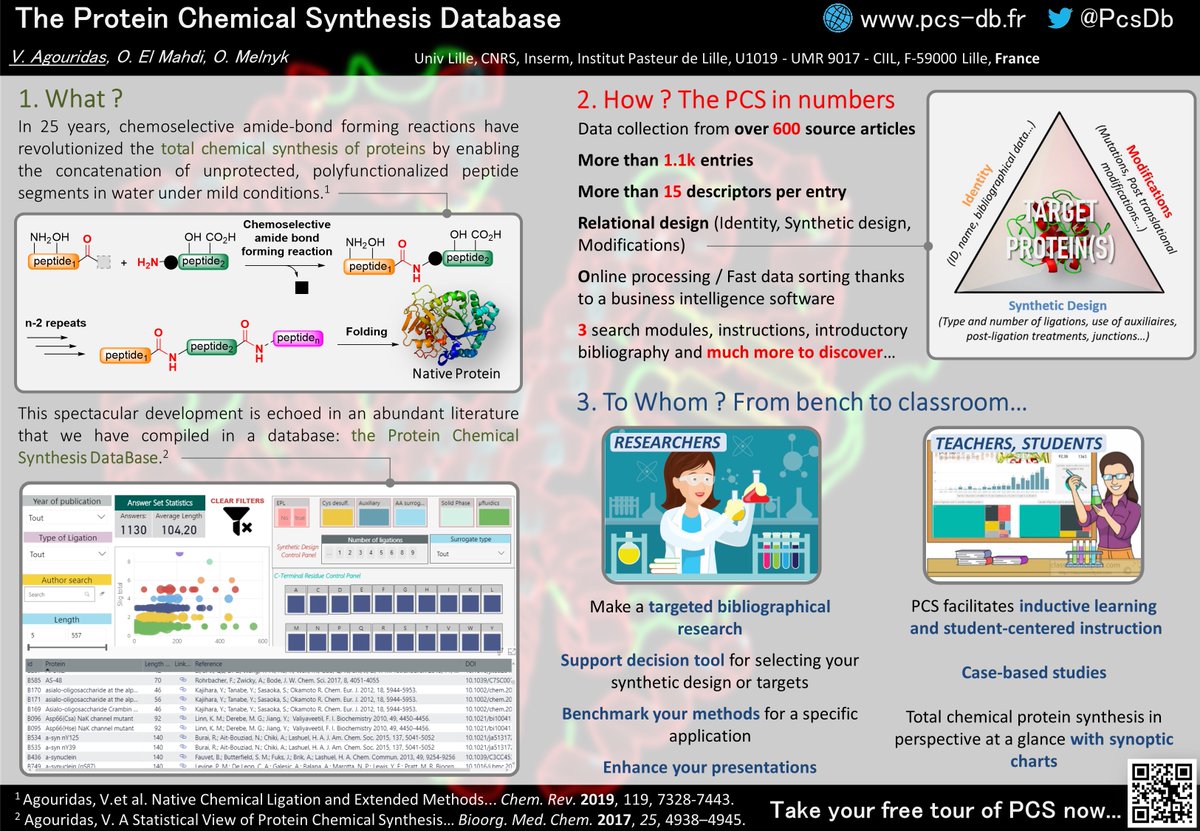
The database of synthetic proteins prepared by means of chemoselective amide bond-forming ligation reactions (managed by Vangelis Agouridas @Melnyk_Group)
Happy to introduce our work at the #RSCPoster twitter conference (#RSCChemBio#RSCOrg#RSCEdu) ! The PCS - https://t.co/1G81yxtX6S - is a free database on #proteinchemicalsynthesis, and a useful tool for students and researchers. Your comments and questions are welcome. Enjoy!⚗️
@Teachforaliving@alisonbflynn. In such a case, the middle segments are bifunctional and one their reactive extremity has to be activatable on demand. Entries B691 & C050 in the PCS precisely illustrate such latency concepts. But other works (such as B542) are equally illustrative of this issue.
@Teachforaliving Hello @Teachforaliving@alisonbflynn. Lot of case studies can be imagined. It just depends on your pedagogical objectives. One I really like is connected to the chemistry we develop in the lab and which concerns the assembly of large proteins from 3 or more peptide segments.
@PEPPERSchool is an international thematic school about engineering #peptides and #proteins (15-18 March 2021).
This year, the event goes virtual making it accessible from anywhere in the world. Don’t miss such an opportunity to gain some insights into peptides and proteins !
Looking for PTM-decorated synthetic models ? Have a look at the new PCS-PTM module : https://t.co/z6qk19Vka8
Some of its potential is described in the paper below:
Chemical Protein Synthesis in Medicinal Chemistry https://t.co/jr6a85BWOX
Find a protocol article on the PCS-db in Peptide and Protein Engineering - From Concepts to Biotechnological Applications https://t.co/EttBojropS #springer
A major content update is on its way (with probably the release of a new module 😉). Stay tuned !
Congrats to Vincent for his @NatureComms paper on a novel #selenium derivative of #cysteine for #protein chemical synthesis.
A cysteine selenosulfide redox switch for protein chemical synthesis https://t.co/xrAwjzTBo8
Can you see the "hidden" photoedited dish of spaghettis in this graphical abstract ? Yum yum... whets my appetite for future challenges in solid supported #proteintotalsynthesis and #nativechemicalligation. What about you ?
behind the scene @Melnyk_Group@PcsDb
@GTsodikova https://t.co/lzx8s9ANTj
https://t.co/VigyQbBqZI
In general we use these approaches to introduce the #nativechemicalligation reaction. It is a good way to sensitize students to contemporary research issues on #proteintotalsynthesis.
Btw, thanks for your comments!
@SRouhanifard Case based studies are also greatly facilitated as you can ask students to elaborate a synthetic design on a target protein by comparison with examples from the database.
Happy to introduce our work at the #RSCPoster twitter conference (#RSCChemBio#RSCOrg#RSCEdu) ! Our poster presents the Protein Chemical Synthesis Database, a comprehensive database on #proteinchemicalsynthesis. We are waiting for your comments and questions. Just enjoy !😀
@GTsodikova PCS is accessible with a smartphone or computer and can easily be used in the classroom provided that these devices are connected to internet. Let me just retweet you some examples of application.
@SRouhanifard Case based studies are also greatly facilitated as you can ask students to elaborate a synthetic design on a target protein by comparison with examples from the database.
@SRouhanifard One example that comes to my mind is the following activity. Ask the students to generate different datasets by applying filters corresponding to each synthetic method. By comparing the size of these subsets, they can start discussing the rise in power of a specific method.
@dino_spagnoli We use the PCS as a teaching material in the context of summer schools or at the undergrad level to introduce chemoselective Ligation reactions.
What is worse than waiting for acceptance of your manuscript @ACSChemRev ? Enduring the slow (way to slow) disclosure of the #CRFavoriteRev contest's results... Great event, congrats to the winners and a big big thank to whoever supported our work !
#3 from issue #12: "Native Chemical Ligation and Extended Methods: Mechanisms, Catalysis, Scope, and Limitations" @Melnyk_Group @JMonbaliu https://t.co/qsT4dovibE