tech desperately needs a new design aesthetic
we literally have agi now and flying cars
but every ui looks the same with this apple/linear minimalist rounded corner tailwind shadcn slop look
we’re not thinking big enough on how things should look and feel
chatting with an agent should look and make me feel like i’m living in the future
it should make me feel hope and awe and optimism that humanity actually got to agi and it will lead to unimaginable prosperity
it should make me tap into my 9 year old self, who wondered if we’d *ever* have talking humanoid robots, and make me feel totally amazed by the realization that this future is not even a possibility now, it is a CERTAINTY!
the time is so ripe now
the coding agents have gotten so good that we can be experimenting and playing with new ideas 100x faster than before
now is the time for excessive experimentation
# Black October
For anyone who knows me even somewhat well, it's clear that I am a 99th percentile tech optimist. However, the vibes have shifted for me quite a bit in the last 18 hours, and I feel a moral imperative to share what I'm thinking and feeling with my circles so that everyone can understand, and hopefully take seriously, what's happening right now. I think October 2026 will have many chapters written about it in the history books.
You know those scenes in financial movies like Margin Call where someone realizes that they're all fucked, and no one else sees it yet? And that person feels like they're crazy, and then suddenly everyone is pulling an all-nighter in a boardroom and freaking out? Yeah, that's kind of how this is feeling right now in the SF/Bay Area/AI circles.
We're 48 hours into what is being called Black October. In the last 2 days there have been several dozen cyber attacks which, in isolation, would each have been the worst to happen in an entire calendar year. Every sector from government to education to big tech and banks is being massively affected, and people are starting to freak out.
In a nutshell, what's happened is that frontier AI models have gotten to a point where they are as advanced as the most sophisticated programmers, with one critical difference: they can work 24/7, and you can spin up 10,000 of them with a single command and they'll work together tirelessly until they accomplish their task. The most advanced models today are from companies like Anthropic and OpenAI, whose current best technology is so good that they haven't been able to roll it out to everyone yet because of the national security risks it poses.
Meanwhile, the best open source models (where anyone can just download the model weights and do whatever they want with them, uncensored) are slightly behind the frontier but still 90-95% as capable. These models, developed primarily in China, are being used by black hat hackers to wreak havoc on the Western capitalist structure. Presumably, this has been part of China's plan the entire time, and we're seeing its implications fall out in real time.
In red-pilled AI circles, we've been sharing and reading papers called things like "Situational Awareness" and "AI 2027" for the last year or so, which at the time felt a bit like near-term speculative fiction. They laid out the case for why Artificial General Intelligence (AI smarter than any human at any knowledge task) and Recursive Self-Improvement (models that are able to use themselves to get better) weren't half-baked future ideas anymore, but instead an inevitable outcome of the linear progress that's happening.
These papers would then talk about things like "takeoff scenarios," trying to envision how that moment would come to be and what it would be like when it happened. It would either be a "slow takeoff" that would play out over the course of months and quarters, happening subtly and only obvious to a few. Or, it would be a "fast takeoff" where it would pretty much happen instantly, like a bit flipping from 0 to 1.
From everything that I can see and am feeling, we are currently experiencing the fast takeoff scenario. Beyond the crazy security vulnerabilities that have come out recently, there have also been massive breakthroughs in life sciences, fundamental computer science, materials science, and pure mathematics that have all landed in the same time frame. While I still firmly believe that AI will be a net positive for humanity, it's more clear to me than ever that the societal and individual risk is very real, and is playing out NOW.
For as much conviction as I have that this is happening, the thing that's caused me to lose sleep is that I don't really know what to do about it, or more importantly, what to tell you, reader, to do about it. So, the best I can do is make a few suggestions that have always been a good idea but are more timely now than ever:
Set up 2-factor authentication for everything. I use Duo.
Use a password manager across your devices. I use 1Password.
Get an identity protection app set up. I use Alta.
Move your IoT devices to their own network. Claude helped me do this.
And last, but certainly not least, if you've been avoiding leaning into AI, see this as a catalyst to wake up and start using it. Don't just use the chat mode version of ChatGPT/Claude; click that Code/Work button and see how easily you can have AI write code to help you with your job. One of the biggest vulnerabilities was in a massively popular programming language called PHP, and the prompt that set it off was literally, "Find vulnerabilities in php."
This is an unprecedented time for humanity, but as we've done with many things before, we will prevail so long as we are kind, loving, and open-minded to the world.
Much love.
Dario has written that we need to “pace the frontier,” and Sam has agreed. People may be surprised by my response: go ahead.
You guys are the frontier. By any reasonable metric — market share, revenue growth, model capability — the two of you have a duopoly on frontier intelligence. You’ve also claimed the lead is widening because of recursive self-improvement.
I don’t see what you see in the lab. If the unreleased models are scary enough that you think you should slow down, I support your decision to be responsible.
But stop pretending you need anyone else’s permission. Stop pretending antitrust law has to be suspended so you can form a cartel. Stop pretending you need a regulatory approval process that supersedes product liability. Stop pretending METR is independent when it is intertwined with Anthropic’s investors and staff. Stop pretending you need those same evaluators to police competitors who aren’t even at the frontier.
Most of all, stop pretending the motivation to slow down is purely altruistic. You face massive product-liability exposure if your products enable a truly damaging cyberattack. The market already punishes models that behave in unpredictable or unauthorized ways. After the Hugging Face episode, it is simply good business for OpenAI and Anthropic to trade some raw power for reliability and predictability. Call it alignment if you want. It is also just giving customers what they want.
Pacing the frontier would also create breathing room for a more intelligent conversation about regulation than Bernie Sanders’ “shut it all down.” China is very unlikely to join a global agreement, as you know, and that has to be taken into account as well.
So go ahead and pace the frontier. You are the ones setting it. The easiest way not to build superintelligence is for you to agree not to build it. Demanding your preferred regulatory framework as the price of that will look like blackmail of the public and the political system. So just do it.
If you do, you’ll buy goodwill for the next conversation. If you don’t, we’ll know this was just another bid for regulatory capture — or an election-season psyop.
👉 https://t.co/NOMx8Cc3sv
This website is very simple yet powerful.
Basically, it will give you roadmaps of different programming languages so that you don't get lost and you know exactly what to learn in the best order.
🚨 Perplexity just dropped something wild.
It’s called “Perplexity at Work” their official guide to actually getting more done with AI.
Not another “productivity tips” doc this is the real framework their own teams use to:
→ Block distractions & reclaim focus
→ Scale yourself like a 5-person team
→ Turn AI from noise into results
It’s clean, practical, and honestly the most useful thing I’ve read on using AI for work not just chat prompts.
Comment “Guide” and I’ll send you the full PDF (it’s 100% free from Perplexity)
RIP prompt engineering ☠️
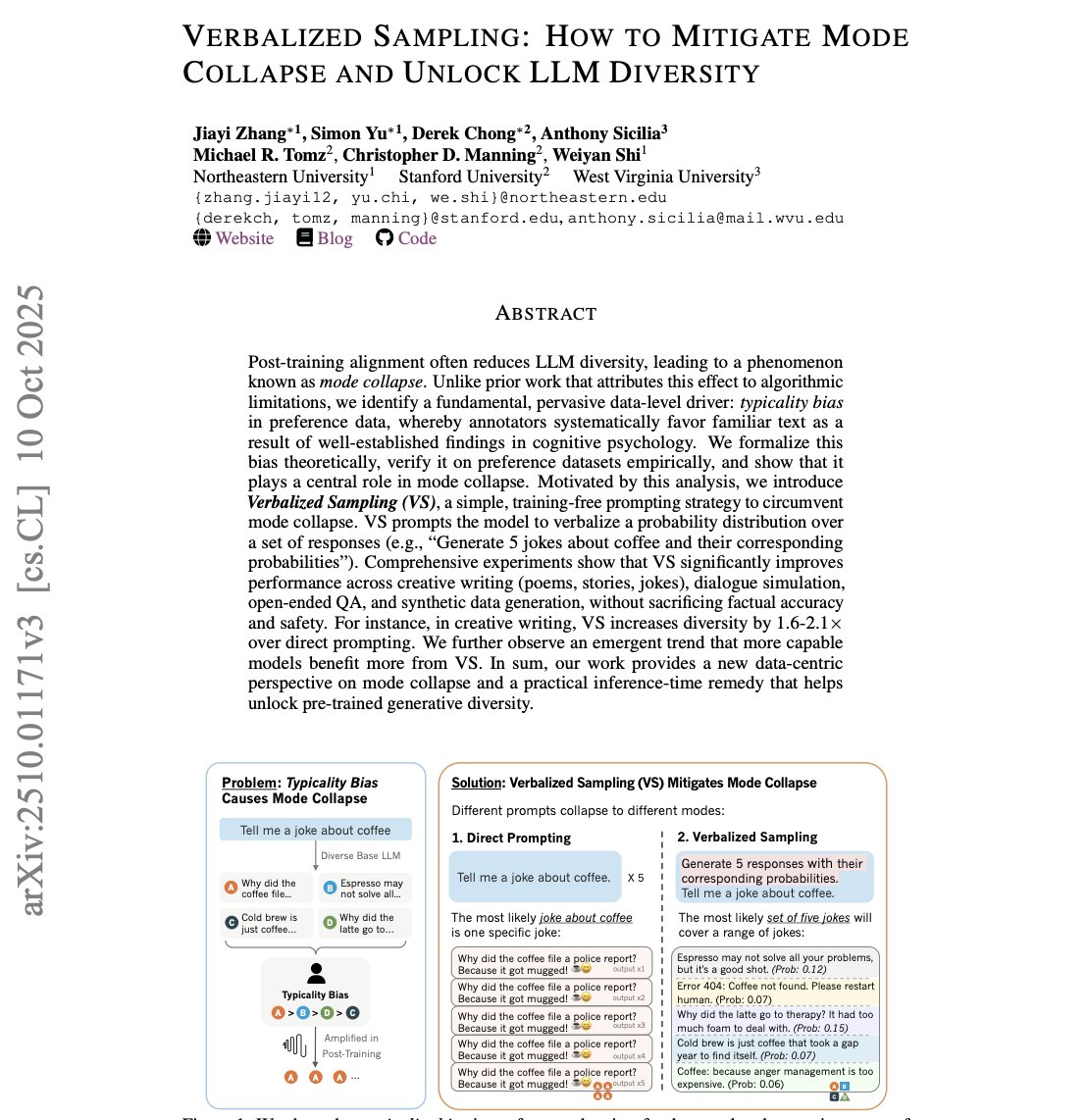
This new Stanford paper just made it irrelevant with a single technique.
It's called Verbalized Sampling and it proves aligned AI models aren't broken we've just been prompting them wrong this whole time.
Here's the problem: Post-training alignment causes mode collapse. Ask ChatGPT "tell me a joke about coffee" 5 times and you'll get the SAME joke. Every. Single. Time.
Everyone blamed the algorithms. Turns out, it's deeper than that.
The real culprit? 'Typicality bias' in human preference data. Annotators systematically favor familiar, conventional responses. This bias gets baked into reward models, and aligned models collapse to the most "typical" output.
The math is brutal: when you have multiple valid answers (like creative writing), typicality becomes the tie-breaker. The model picks the safest, most stereotypical response every time.
But here's the kicker: the diversity is still there. It's just trapped.
Introducing "Verbalized Sampling."
Instead of asking "Tell me a joke," you ask: "Generate 5 jokes with their probabilities."
That's it. No retraining. No fine-tuning. Just a different prompt.
The results are insane:
- 1.6-2.1× diversity increase on creative writing
- 66.8% recovery of base model diversity
- Zero loss in factual accuracy or safety
Why does this work? Different prompts collapse to different modes.
When you ask for ONE response, you get the mode joke. When you ask for a DISTRIBUTION, you get the actual diverse distribution the model learned during pretraining.
They tested it everywhere:
✓ Creative writing (poems, stories, jokes)
✓ Dialogue simulation
✓ Open-ended QA
✓ Synthetic data generation
And here's the emergent trend: "larger models benefit MORE from this."
GPT-4 gains 2× the diversity improvement compared to GPT-4-mini.
The bigger the model, the more trapped diversity it has.
This flips everything we thought about alignment. Mode collapse isn't permanent damage it's a prompting problem.
The diversity was never lost. We just forgot how to access it.
100% training-free. Works on ANY aligned model. Available now.
Read the paper: arxiv. org/abs/2510.01171
The AI diversity bottleneck just got solved with 8 words.
"All in all we went from $0 to $100m to $0 because I followed the advice of the VCs."
When you raise from a VC you need to build a unicorn (aka 1B+ company) and nothing else
Doing 10M ARR? You are a failure, 50M ARR? Nope.. You failed
A lot of amazing startups implode because of this model and this is also exactly the reason why I am never that worried to compete with well-funded companies because I know the chances of them imploding are very high
@levelsio said it very well: You are just another 1/100 bet to a VC
Is all funding bad? no, I think there are interesting opportunities and now that the model is changing (I hope) we will see more "boring" investments made in companies that focus more on sustainable business models
The giant sequoia tree pictured was a magnificent specimen that had an estimated age of 2600 years at the time of its unfortunate felling in the 1890s. Giant sequoias (scientifically known as Sequoiadendron giganteum) are among the largest and longest-living trees on Earth, and their existence spans several millennia. They are native to the western slopes of the Sierra Nevada mountain range in California, USA.
During the late 19th century, the logging industry experienced a significant boom in the United States, driven by the high demand for timber to support expanding cities and infrastructure projects. This period coincided with the industrial revolution, which led to an increased need for lumber. The immense size and durability of giant sequoias made them particularly sought after, and sadly, many of these ancient trees were felled during this time.
The cutting down of the 2600-year-old giant sequoia tree in the 1890s represents a tragic loss of natural heritage and a poignant reminder of the environmental impact caused by human activities. Today, there are efforts to protect and preserve the remaining giant sequoias, as they hold immense ecological value and are regarded as national treasures in the United States.
Index funds take all of the stress out of investing.
They make it so it’s not a matter of if you’ll become wealthy, it’s a matter of when.
Here’s how they work:
@koeppelmann It's possible for it to go back to peg and still have every single UST holder lose a ton of money.
This is the clearest explanation I've seen
https://t.co/V9KM48JU7V
@KaranSanwal48 In most cases, the bias is represented by a 1-period scenario. One anchor is presented that influences the decision making. The end.
This was how Kahneman et al constructed the experiment for the original study, and how the CFA test whether you know if the bias is present or not
Being self-aware is a common characteristic of successful investment professionals.
Our rationality is bounded and often leads us to take acceptable, but not optimal decisions.
Here's a 🧵 with the most common cognitive errors and emotional biases and how to mitigate them.
@KaranSanwal48 Short answer, yes. New information will create "stickiness" to those who have anchoring bias.
(Particularly if you also have a case of Representativeness Bias and completely discard the previous anchor 😂)