These men created tools of freedom and financial independence. They wrote code and ran businesses. They are good people.
They were rewarded with federal prison sentences.
Keonne Rodriguez
William Hill
Ian Freeman
Roman Sterlingov
Roman Storm
Free the crypto prisoners.
The prosecution of the Tornado Cash developers is directly relevant to the conclusion of this post, even if the connection isn't immediately obvious.
Closed systems have concentrated incentives. They can protect their intellectual property and trade secrets until they are ready to release a product that can rapidly grow and capture dominant network effects.
Open networks have a different set of advantages: anyone can contribute, anyone can innovate, and everything is permissionless. That only works if you can deploy a permissionless protocol without being held liable if someone misuses it.
In essence (setting aside the rhetoric the government used) the Tornado Cash indictment prosecuted standard protocol team activity. It was no different from what the developers of Uniswap or Aave do: write open-source code, deploy smart contracts, and at most provide ancillary services. In fact, Tornado Cash had even less developer involvement. The protocol itself charged no fees. The relayers were optional ancillary services run by third parties. Also, prosecutors didn't even allege that Roman Storm operated a relayer himself. And unlike Uniswap or Aave, where the team serves the front-end UX, the Tornado Cash developers put the front end on IPFS and merely linked to it from an informational site.
Framing that as running a "financial institution" is a massive expansion of financial regulation into the act of publishing software and speech. If publishing immutable smart contracts and maintaining ancillary services around them makes you a regulated service provider, then any DeFi developer with post-deployment involvement is suddenly treated as a financial institution.
Open networks already have their work cut out for them to produce breakthroughs that rival closed companies. By making developers liable for how strangers use permissionless code, the Tornado Cash prosecution is a direct assault on the ability of open networks to compete in the future.
My guess is that some of the headwinds ETH is facing right now come down to the problem I wrote about a few months ago about how closed AI has hurt the narrative for open networks.
AI/SI will accelerate development in every software industry by some ridiculous factor, e.g. 100 times. Any software project that doesn't fully embrace AI will be left in the dust.
Yanis Varoufakis spent years warning that private cryptocurrency and blockchain systems are dangerous and that money should stay under political or state control.
Now a regular bank has frozen their accounts with no warning and no appeal. They're stuck asking for emergency donations just to keep operating.
This is what happens when you reject alternatives to state-controlled money.
DeFi upgrade keys exist because software has bugs, but the key that can rescue funds shouldn't be able to rewrite the contract. Users could route funds to immutable protocols through a safety contract whose backup key can only send them to a preset address https://t.co/b0IJ99e2oT
Stan Druckenmiller and ICE backing 24/7 futures on Hyperliquid is a major milestone for onchain markets, and the competitor best positioned to benefit from this shift is Lighter. Instead of relying on 27 validators to run its network and control the bridge holding user funds like Hyperliquid does, Lighter matches trades on a fast single server and uses zero-knowledge proofs so Ethereum serves as its consensus computer for security and settlement, with capacity rising further as zk-proving speeds scale and smart contracts roll out.
Cryptocurrency is the blockchain's only native app. It's the app on which the blockchain's security rests. An entirely self-contained economic system that is formally defined by machine-readable code is the only way distributed consensus can emerge within an adversarial environment.
Gabriel shows how smart contracts let people build more tools around an SoV, keeping users' wealth in its economy and making the SoV more valuable.
https://t.co/zquCulziGm
@dhh Too late. I'm being prosecuted for not stopping a tool no one can stop. Read my case story for more. I face up to 45 years in prison.
If it happened to me, it will soon happen to other AI and software developers.
This is actually huge
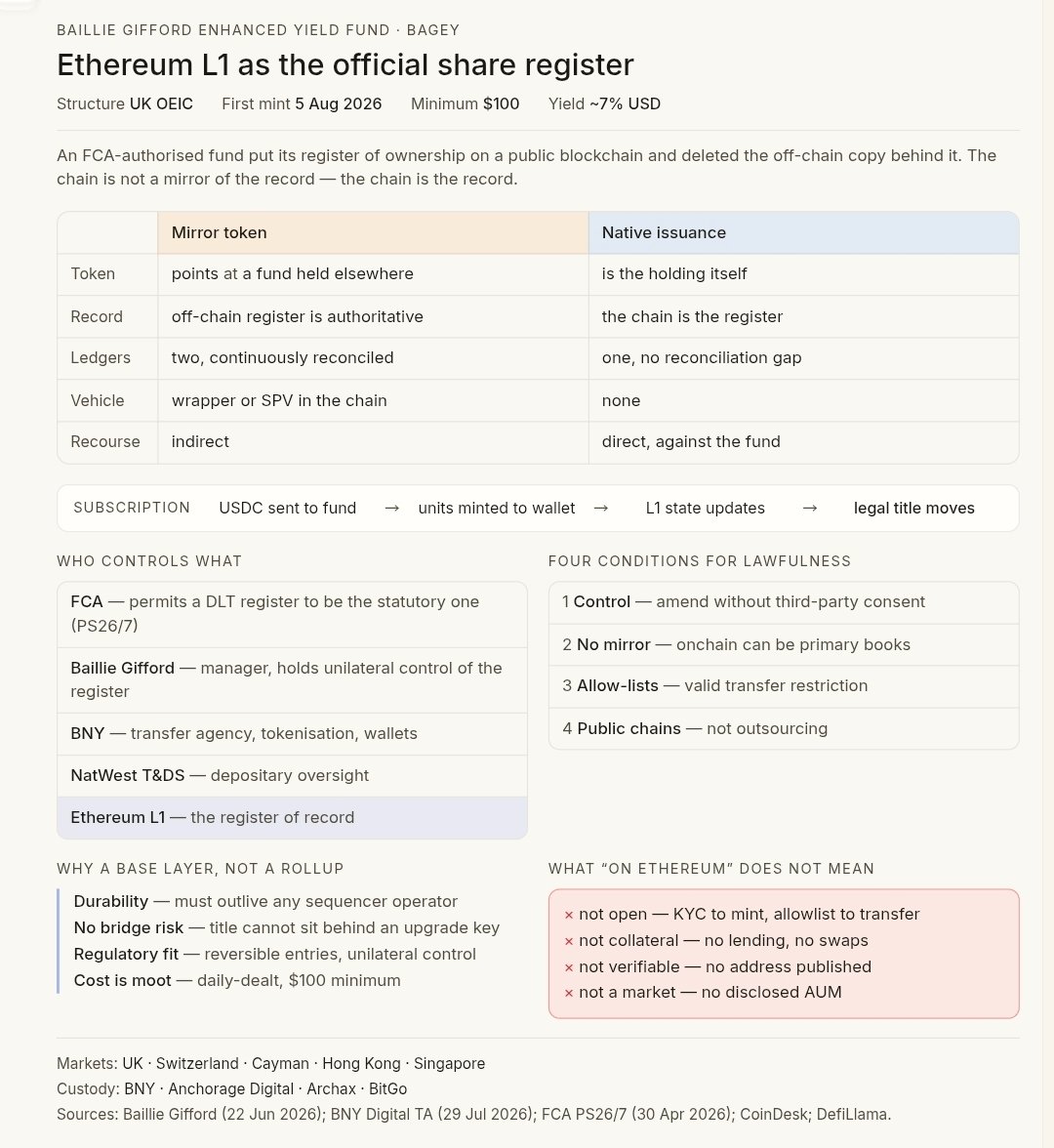
Ethereum L1 is being used as a fully decentralized registry of ownership for an investment fund
This is proving that Ethereum L1 is premium blockspace:
1) L1 is reliable and never goes down
2) L1 is decentralized and credibly neutral
3) L1 ensures data availability
My wife has never understood why I've held Ethereum since 2014. I tell her the same thing every time: it's brilliant, it has more potential than anything else out there, and I honestly believe next year is its year. Last night she finally
Ethereum is the Schelling point for programmable finance. Its position will grow more dominant because its researchers are simultaneously pursuing these five "north stars":
• Fast L1: Inclusion and finality in seconds
• Gigagas L1: 10,000 TPS on the base layer, enabled by zkEVMs (enabled by zk-proving) and new type of UTXO state that can be hyper-pruned
• Teragas L2: 10 million TPS cross rollups, via PeerDAS (enabled by erasure codes) and prior EIP-4844 upgrade (enabled by polynomial commitments)
• Post-quantum L1 (enabled by hash-based algorithms)
• Private L1 (enabled by adding a native append-only Merkle tree for note commitment and a native set for spent nullifiers)
ETH is the Schelling point for storing value on Ethereum, as the highest liquidity asset without counter-party risk, so as the Ethereum consensus computer comes to subsume all economic coordination, ETH will emerge as the world's base money.
All of this is largely due to the incredible researchers who are building the Ethereum protocol, foremost amongst them, Vitalik Buterin.
The man has outputted a multitude of extremely high value works that advance the state of the art in consensus system design, scalability, privacy, rollup architecture, p2p networking, etc. The innovation he and his peers spearheaded will catapult humanity into a Kardashev Type II civilization.
Ethereum gets stronger when its people ask hard questions.
Glamsterdam, the next upgrade, can increase Ethereum’s capacity by over 3x, but developers have raised important concerns about some of the proposed changes.
We’ve spent the past week working with the EF, auditors, core developers and community members to investigate them.
Here’s where we believe things stand, and how we can move forward together.
https://t.co/z4Q7MQi14g
The era of expensive Ethereum is officially over!
@VitalikButerin just revealed exactly what happens to the network over the next 18 to 24 months, and his answer is what users have been waiting to hear: basically everything gets cheaper.
Right now, executing a private transaction is notoriously heavy, burning a minimum of 300,000 gas and frequently pushing up to a million. However, the upcoming EIP-8288 upgrade is set to slash those costs entirely while simultaneously making those operations completely quantum-safe.
The improvements go far beyond just lowering fees. Historically, proving that a smart contract was actually safe required massive, expensive auditing. Now, by pairing AI with formal verification, even solo developers can ship applications with highly reliable security guarantees. As Buterin pointed out, people are still heavily underrating just how much this will change the daily builder experience.
We at Everstake see this continuous evolution as a major tipping point. Every single day, our team works hard to help make the blockchain industry better, more efficient, and highly accessible for everyone. Watching Ethereum actively solve its biggest friction points aligns perfectly with that vision. When privacy becomes affordable and elite security becomes accessible to anyone, the entire community wins!
The market got confused because ETH started of as a SoV like BTC
Then we told the market that ETH was digital oil and that fees were the key metric via the ultrasound site (Justin Drake built that)
But actually, ETH is a SoV like BTC but much better in every way
It has more TPS, more security, is more reliable, is programmable, is independent of Chinese ASICs, scales peer to peer via L2s and saves $7 BILLION per year in electricity
The electricity costs alone should be reason to swap to Ethereum
Do we really need to be burning $7bn in electricity to run a secure blockchain nowadays? The world is adding ~2.5ppm of CO2 per year to the atmosphere
@PNCBank, the 8th-largest US bank, is now taking stablecoin payments on @ethereum , where 53.8% of all stablecoins already sit.
Banks go where the dollars are.