Do you want to include figures and tables in your literature review?
Here is how to do it automatically in seconds
1. Go to https://t.co/eW6aDnJ41s
2. Enter a prompt for your literature review
3. For example, generate a review on cancer causes.
4. @scispace will create the draft of the review
5. This review contains figures, tables, and graphs.
6. You can save the draft to notebook.
7. This will open the draft in an editor.
8. You can work on the draft in this editor.
9. You can add citations here automatically.
Once you complete the review, you can download it.
You can download it in PDF, Word, or Latex format.
You can also connect your Zotero library to SciSpace.
Once you bring papers from your library, talk to them
SciSpace library enables you to interact with the papers
Try SciSpace today for FREE:
https://t.co/eW6aDnJ41s
An excellent and free guide on how to write a literature review by the San José State University Writing Center.
Download the guide for free by clicking the link below.
Covers:
• Purpose of a literature review
• What isn't a literature review
• Parts of a research paper
• Literature review organization
• Summary, synthesis, and evaluation
Follow Silvi on LinkedIn for more tips and free resources on systematic reviews and academic writing.
https://t.co/l9f6XP7bYg
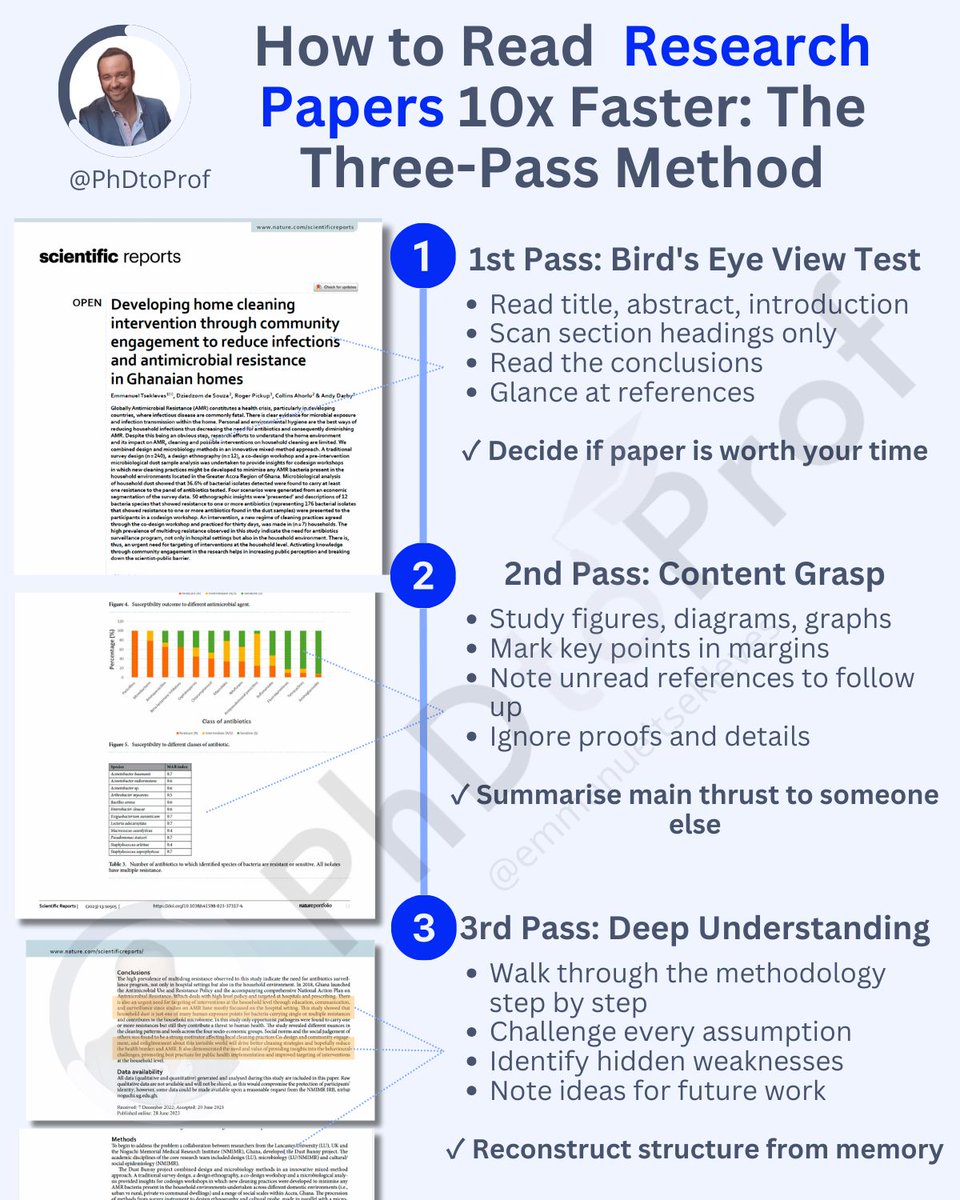
How to Read a Research Paper and Make Meaning of It.
Reading a research paper is a vital skill for students and professionals, yet it is rarely taught. Many students make the mistake of reading a paper from start to finish like a novel. This approach often leads to total exhaustion and confusion.
To truly understand a paper without getting overwhelmed by technical jargon, you should adopt the "Three-Pass Approach." This method allows you to build your knowledge in layers, ensuring you don't waste hours on a study that isn't relevant to your needs.
1. The First Pass: The Bird’s-Eye View
The first pass is a quick scan that should take only five to ten minutes. The goal is to get a general idea of the paper’s scope.
Read the title, abstract, and introduction carefully. This tells you the "what" and "why" of the research.
Scan the headings. Look at the section and sub-section titles to see how the work is organized.
Check the conclusions. This helps you understand the final results before you even look at the data.
Glance at the references. This shows you which other studies the authors are building upon.
By the end of this pass, you should be able to answer the Five Cs:
- What is the Category of the paper? - What is the Context (what else is it related to)?
- Does the Correctness of the assumptions seem valid?
- What are the main Contributions?
- And finally, is the Clarity sufficient for you to keep reading?
2. The Second Pass: Grasping the Content: If you decide the paper is worth your time, move to the second pass. Here, you read with more care but still ignore deep technical details like complex mathematical proofs or heavy statistics. Look closely at figures, diagrams, and illustrations, as these often contain the most important data in a visual format.
During this stage, it will be helpful to jot key points or terms you don't understand. This pass helps you grasp the main "story" of the paper. For many readers, such as those doing a general literature survey, this level of understanding is often enough to move on to the next paper.
3. The Third Pass: Deep Understanding.
To fully master a paper, the third pass requires you to "virtually re-implement" the work. You should try to imagine how you would recreate the experiment or theory yourself. This is the stage where you identify the paper’s greatest strengths and its hidden weaknesses. By thinking about how you would have solved the same problem, you gain a deep, intuitive sense of the research.
Why This Matters:
Making meaning of a research paper isn't about reading every word; it’s about strategic layers. By using these three passes, you can save time, stay focused, and decide which papers are truly worth your energy. Instead of drowning in details, you gain a clear, high-level understanding that allows you to apply the research to your own work effectively. Mastering this skill transforms research from a daunting chore into a powerful tool for your personal and professional growth.
I built a functional 8-bit ALU from 3,488 transistors in my dorm. 🎉
19 ops • 7 status flags • 5-bit control • 8-bit word size
- 3D site: https://t.co/xZmo0zrFbd
- Repo: https://t.co/pVI5zITx4D
Verified with 1.245M test vectors (Verilog twin). This is the arithmetic engine on the path to a CPU — built from first principles.
Next up: optimization, error checks, PCB order, assembly, and hardware testing.
#ComputerArchitecture #ALU #Hardware #TyroneMarhguy
In Seattle, I build train systems but in Ghana, we build homes. Life has taught me not to limit myself or block the opportunities this world offers.
In 2026, I’m staying liquid—ready to adapt wherever I find myself. Happy new year!