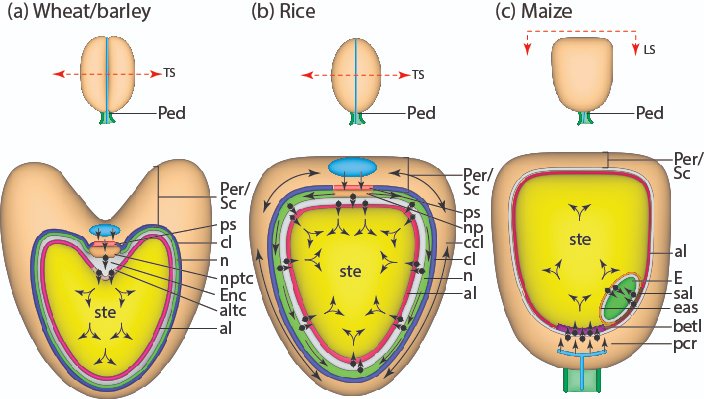
I am very excited to see this @NewPhyt Tansley review published.
With Professors John Patrick and Christopher Grof, we have explored the events and transporters underpinning sugar loading of developing seeds in grain crops and Arabidopsis.
https://t.co/rAQ4SRI56j
🌱 New year, new membership?
Join ASPS for: ✓ Professional networking ✓ Conference discounts ✓ Award eligibility ✓ Phytogen updates
Student rates available!
Become a member: https://t.co/eIYteImw8O
I feel incredibly honoured to be awarded the Thomas Davies Research Grant. This study will investigate plant constituents which sequester PFAS in contaminated water samples. @Uni_Newcastle @UON_research
📣Awardees for the 2025 Thomas Davies Research Grant for Marine, Soil and Plant Biology have been announced. Congratulations to
• Dr Amanda Dawson and Dr Qi Yang from @CSIRO,
• Dr Julian Greenwood, @ourANU,
• Dr Satomi Hayashi, @QUT,
• Dr Zeinab Khalil, Dr Eve Maunders and Dr Anne Sawyer from the @UQ_news,
• Dr Joseph Pegler, @Uni_Newcastle, and
• Dr Shima Ziajahromi, @Griffith_Uni.
Learn more https://t.co/WIdNlsNHLo
Out now in @PNASNews Subchronic elevation in ambient temperature drives alterations to the sperm epigenome and accelerates early embryonic development in mice
https://t.co/yaMG1nrsBh
Led by @NATrigg & @BrettNixon13 with contribution from many others @HMRIAustralia @UON_research
Interested in studying the impact of environmental stressors on sperm epigenetics? A PhD position is open to domestic candidates to work in @BrettNixon lab. See link for more details or get in contact! @UON_research @HMRIAustralia https://t.co/0lhlK7lM1I via @uni_newcastle
It is exciting to see the results obtained during my Fulbright Future Scholarship (@FulbrightAUS) working with Prof. John Ward at the @UMNews are now published in @PlantDirectJ.
We functionally characterise sugar transport protein 13 (STP13) from bean.
https://t.co/QHVxuC4Lts
I was honoured to attend the Minnesota Governor’s Trade Mission to Australia. It was a pleasure to hear from members of the Delegation and @GovTimWalz on how Australia and Minnesota can work together for a better future. Thank you to the @FulbrightAUS for this opportunity!
GO PLACES IN PLANT SCIENCE @AustPlantPhenom PostGrad Internship Award applications are open now. Add our world class technology and team to your #plantscience research, with up to $10k infrastructure access. Apply by 30 November. https://t.co/Yzc4O42Nj5 #NCRISimpact
Can’t wait to run this again and to see everyone in our very supportive community. Pls follow the link and repost! Let’s get as many there as possible in support our mission to improve the outcomes of kids with brain cancer #DIPG#DMG#HGG
#TansleyReview: Sugar loading of crop seeds – a partnership of phloem, plasmodesmal and membrane transport
@PeglerJoseph et al.
📖 https://t.co/sAqgIKKH0Y
@wileyfoodsci @wileyplantsci
Applications for Student, Indigenous and Carer's Travel Awards are due 28th July - only 2 weeks left!
Make sure you have encouraged your colleagues, students and/or yourself to apply for travel to ASPS2023!
Find all details here: https://t.co/TBgX6Wsyt1
A 2-year part-time Research Assistant position is currently available in my group at Monash University. If you love photosynthesis and/or plant molecular biology, join us in our mission to create energy-efficient crops for a sustainable future 🌱
https://t.co/W5UmUfor1o
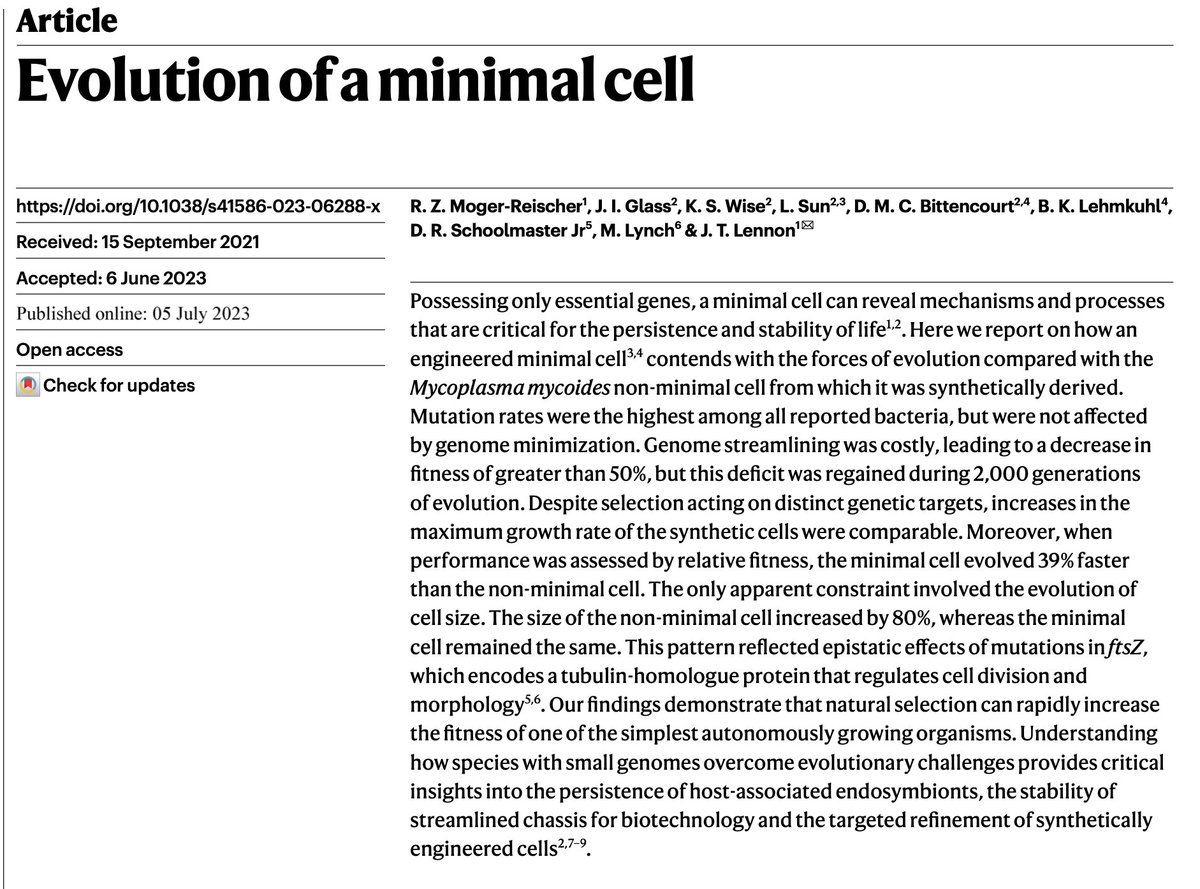
A mind-blowing paper has come out today in @Nature
In 2016, JC Venter Institute scientists trimmed a bacterial genome to its barest minimum required for life to synthesize what they called a "minimal genome" (https://t.co/Rk8oZJ0bUj).
Today, a group of scientists from Indiana University reports how that minimal genome evolved over 2000 generations in comparison to the non-minimal genome.
The authors found that even when you reduce a bacterial genome to its absolute minimum where every nucleotide matters, the genome undergoes mutational events generation after generation as much as the non-minimal genome. One simply cannot stop the evolution.
Just over 300 days of evolution (equivalent to 40,000 years in humans) the minimal cell has gained everything it lacked in fitness on day one in comparison to the non-minimal cell.
When comparing the evolved traits between the minimal and non-minimal cells, the scientists found something striking. The evolutionary process increased the cell size of non-minimal cells but not that of the minimal cell. But that is not the striking part.
The scientists were able to identify the key mutation that resulted in cell size evolution. And it turned out that the mutation that helped the non-minimal cells to grow bigger is the same that helped the minimal cells to stay smaller. Growing bigger had a survival advantage for non-minimal cells and not growing bigger had a survival advantage for minimal cells. So, the mutation had a context-dependent effect. This just demonstrates that the evolutionary effects on traits have no absolute direction. All that matter is what is beneficial for the organism's survival.
The conclusion of the paper is metaphorically a quote from the Jurassic Park movie:
“Listen, if there’s one thing the history of evolution has taught us is that life will not be contained. Life breaks free. It expands to new territories, and it crashes through barriers painfully, maybe even dangerously, but . . . life finds a way". (https://t.co/UlxRlb86CT)
https://t.co/zA9OAqSoAu
I am very excited to see this @NewPhyt Tansley review published.
With Professors John Patrick and Christopher Grof, we have explored the events and transporters underpinning sugar loading of developing seeds in grain crops and Arabidopsis.
https://t.co/rAQ4SRI56j