“One-person company” is a fun headline.
But it’s an incomplete model of what’s actually happening.
Teams aren’t disappearing. They are being completely redefined.
A founder armed with agents doesn’t necessarily need fewer humans. They need different humans.
Agents handle routine execution.
Humans hold judgment, taste, context, and customer relationships.
There’s a reason "Forward-Deployed Engineer" was barely a thing 3 years ago and is now the most fought-over hire in Silicon Valley.
Every major tech shift kills task lists, not people.
The daily reality of a "marketer" or "analyst" in 2027 will look nothing like 2023. Same title, totally rewritten job description.
The founders who win this era won’t be the ones who cut the most headcount.
They’ll be the ones who redraw roles the fastest.
One person moves fast.
A team goes far.
@coryalthoff Too many race in this question:
model race, the mindshare race, the enterprise budget race, and the "default first-time-user experience" race..
BCG, Columbia MBA, and years moving between China and US — I've watched two very different AI races up close. First as a strategist, now as a founder building in the Bay Area.
One question followed me the whole way: as AI gets stronger, how do people stay needed, seen, trusted?
That question became @Brix_AI
We are building an AI-native recruiting and organization platform, incubated by HF0 and part of the NVIDIA Inception Program.
Our mission is to build a future where AI lets people meet beyond every border and work together through passion alone.
How we are building the new global work infrastructure:
AI Agents handle sourcing, initial screening, coordination, and the repetitive work.
Humans handle judgment, trust, taste, context, and the last mile.
Our platform includes:
Agent-led sourcing & ranking (not just keyword search)
Real-time calibration — you approve/reject, it learns
Auto-drafted outreach, ready to send
DM me, would love for you to try Brix: https://t.co/6RVYR8GPs4
And always looking to meet more AI founders and builders:)
@levie Yes. Agents don't remove the work, they move it up a level. You stop writing the thing and start specifying, reviewing, and vouching for ten things. The bottleneck becomes human attention and judgment, which is exactly the input that doesn't scale with a bigger model.
@DrJimFan The compounding skills library is fascinating. Does the accumulated skill graph become the true moat over the base policy? Feels like the durable asset is the memory, not the model.
@zarazhangrui A year ago, swapping models was a research experiment. Today it’s a config change. Model choice and price per token have officially shifted from infra to product strategy.
OpenAI just filed to go public around an $850B valuation while losing $1.22 for every dollar it earns. Public markets aren't being asked to price a business here. They're being asked to price a belief — that the unit economics flip before the money runs out. That's an extremely expensive bet, denominated entirely in the future tense.
@DanielSmidstrup Building AI recruiting for the A2A era, helping founders and hiring managers find the right people through agent-led calibration, expert referrals, and high-signal AI / Tech talent networks. https://t.co/ibr990qVPo
True, with one twist that changes the whole sale: SaaS sold you a tool and you owned the outcome.
An agent implies the outcome itself, so the real product becomes accountability when it's wrong, not features when it's right. Whoever nails the "who's responsible" layer wins this category.
The diagrams are great, and the load-bearing question is "where" you choose to keep a human. Agents can run the process end to end; trust still collapses the moment no one's accountable for the output. The companies that win won't be the most automated, they'll be the ones who put a person on exactly the right step.
@AravSrinivas The orchestrator framing is the interesting move..swap the underlying model in weeks, keep the product. Which makes me wonder how much of the moat can live in the model at all anymore, versus the routing and context layer around it?
Electricity sat inside factories for nearly 40 years doing almost nothing useful.
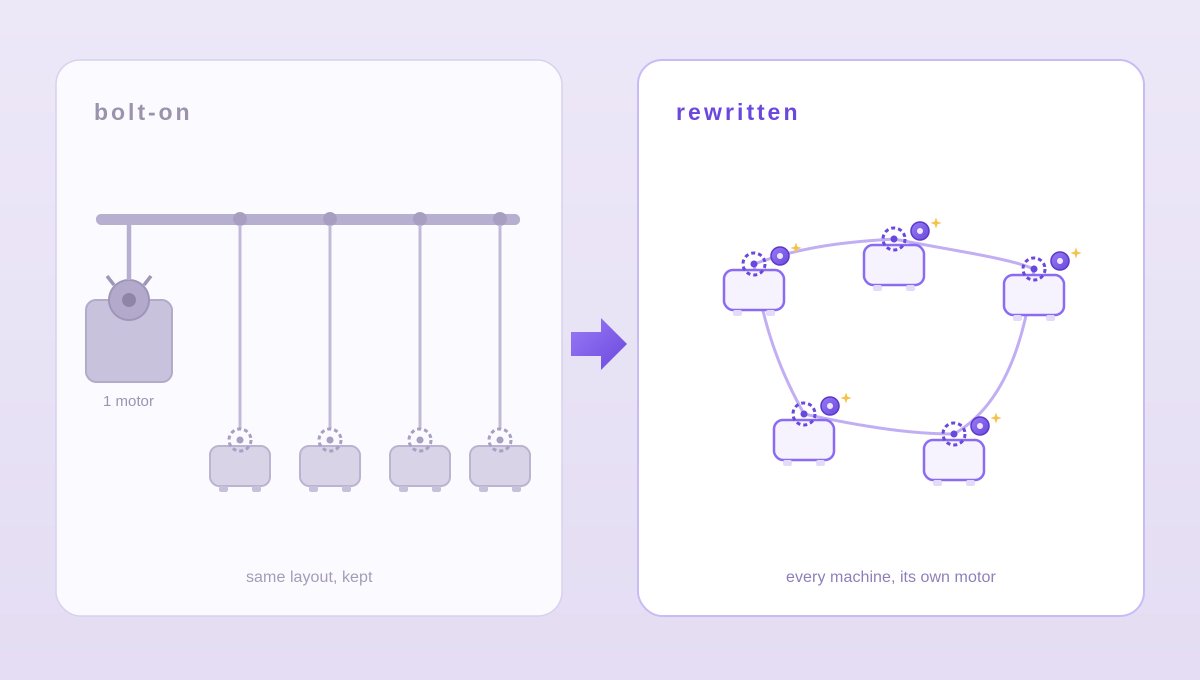
Plant owners just bolted a big electric motor exactly where the old steam engine used to be. They kept the same layout and wondered why the productivity miracle never showed up.
The tech was ready. The imagination wasn't.
The unlock came when they gave every machine its own small motor and rebuilt the floor around the work itself, instead of a single central shaft.
The winner of the electricity era wasn't the company that made the best generator. It was Ford, who redesigned the entire factory around what the new tech actually made possible.
Most companies today are in their "bolt the motor onto the old engine" phase with AI.
They're dropping a model into yesterday's workflow and quietly disappointed that it didn't change everything.
The payoff of a general technology is never the new tool.
It's the rewritten work. And that takes nerve, not just budget.
#FutureOfWork
The jump from code-writing agents to physical-world AutoResearch is wildly underrated. But it also surfaces a massive failure mode no one is pricing in: an autonomous lab can run 100mph in the wrong direction for days.
When execution becomes effectively free and unsupervised, judgment about what is actually worth doing becomes the entire game.
Today, we enable AutoResearch in the physical world for the first time! Introducing ENPIRE: we give 8 Codex agents a fleet of robots, an allocation of GPUs, and generous token budget. We set them free with a simple goal: solve the task as quickly as possible, keep the robots busy but stay safe, don't waste precious compute. Make no mistake.
Then humans step aside and our watch begins. The robot fleet starts to come alive: they learn to look for visual clues, reset the scene, practice novel skills, tinker with control stack, read papers online, debate, reflect, get stuck, and try again directly on the hardware. All we did is to give Codex an API to the world of atoms, and the rest is emergence.
ENPIRE is able to solve high-precision tasks like tying zip-ties, organizing fine pins, and installing GPUs all by itself. We also discovered a new type of "physical scaling": 8 robots exploring in parallel improves significantly faster than fewer ones.
A part of our NVIDIA GEAR lab now self-improves tirelessly over night. We just read the reports in the morning.
/goal: we all take a holiday and Jensen wouldn't even notice ;)
We will be open-sourcing everything, so you can host your self-running robot lab at home too! Deep dive in the thread:
Chinese labs now hold 4 of the top 5 open-weight models, and Kimi can run swarms of up to ~100 sub-agents. 'Open vs Closed' was last year's debate. The divide forming now: teams who can orchestrate many cheap agents vs teams still prompting one expensive one.