This does cut to the heart of what we found: Nvidia chips used at a Chinese military-linked lab that works on stuff like simulating how to invade Taiwan, when those chips are made by a company founded by a Taiwanese American, who remains beloved here in Taiwan.
I think Amtrak's north star should be to provide service that is either cheaper or faster than driving to the same destination — ideally both, and never neither.
Love to see open bigotry be the reason someone was *ejected* from a country club, rather than the reason they were *admitted.*
There has been progress in the past 50 years!
NYT: While pitching investors for Megaspeed in 2023,
Alice Huang & her husbanded boasted of her relationship w Jensen Huang, and hinted of a deep-pocketed customer who wanted access to Nvidia AI chips -- Alibaba, which has close ties to China's military
https://t.co/i4LiEKbah5
After drawing level in September, India has now solidly surpassed the US in EV sales share in October.
India: 6.5% battery electric
United States: 6.0% battery electric
The US will continue to fall behind India and others in this key technology if nothing changes.
In his toast at APEC, Xi said about Shenzhen: "When I first set foot here in 1978, it was little more than a fishing village." What he didn't say was that his father was then the leader of Guangdong province. Here are some pics of father and son during that 1978 visit to GD.
"Megaspeed’s customer and financial backer turned out to be Alibaba, the Chinese internet giant, according to three people familiar with the relationship. Alibaba is a colossus, with a wide range of businesses. It also co-founded an A.I. lab with strong ties to China’s military, where researchers have worked on tasks such as automating cyberattacks and simulating war games."
Our latest story looks at how a Chinese military-linked lab ties together Alibaba, Alice Huang’s corporate network and Nvidia. A sign of the very real security questions behind Nvidia’s chip sales to Chinese firms. https://t.co/USRMM0unuT
New from @paulmozur and @satariano: How Nvidia chips ended up within reach of the Chinese military
Alibaba, the Chinese internet giant behind Megaspeed, the company at the center of the Nvidia saga, has used its A.I. computing technology to aid a lab with links to China’s military.
https://t.co/kycYlMnIc6
Ukraine hit the Kerch bridge with weapons systems that did not exist in 2022. The Ukrainian army and the Ukrainian military industry are now the most important source of security in Europe.
1/ Russian warbloggers say that Ukraine's attack on the Crimean Bridge, destroying the roadway arch over the shipping channel, was carried out by saturating the defences with drones and hitting the bridge with around 10 missiles nearly simultaneously. ⬇️
https://t.co/islZLswjBy
Jensen Huang reportedly instructed his team at Nvidia "never to think about" planning for a Taiwan contingency.
Despite the fact that their business is reliant on TSMC.
The Jensen-Megaspeed mess really puts these incredible — and barely-noticed — details from Stephen Witt's The Thinking Machine in a new light:
Huang refuses to consider the impact on his global business if China were to blockade or invade Taiwan, despite the regular threats emanating from Beijing to do just that. “To my great surprise, Nvidia had done no contingency planning for this eventuality,” Witt writes.
He quotes Deb Shoquist, Nvidia’s executive vice-president of operations: “If something happens to Taiwan and TSMC, the ramifications are so large it’s almost like asking me what I’d do if California fell into the ocean.” Huang had instructed her “never to think about this question.”
—from my @nybooks essay earlier this year on Nvidia and American policy toward China: https://t.co/xfn5RqtKy3
—more thoughts from me today: https://t.co/lQG6IFcdwh
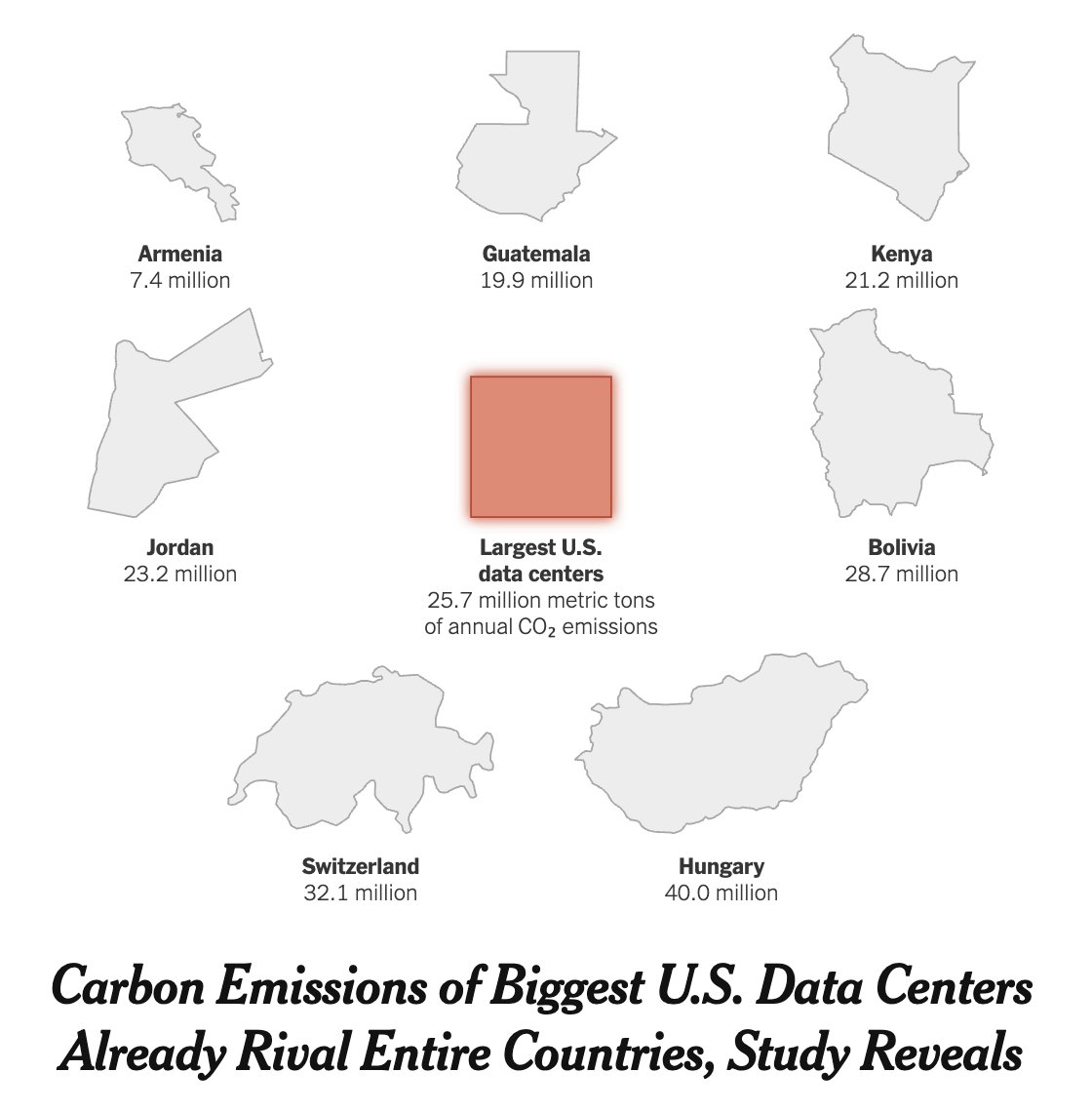
“The largest data centers in the United States are responsible for an estimated 25.7 million metric tons of carbon dioxide emissions annually — almost as much as entire countries like Bolivia or Denmark — according to new research.” https://t.co/dlRSU8v8li
I am just catching up to the news that longtime China correspondent for The Economist, Ted Plafker, has passed away. Our paths crossed a few times when I was posted in Beijing, and I found him to always be the nicest person. Rest in peace. https://t.co/cgsZbsWXVe
The arch fell into the Kerch-Yenikale Canal, which forms the main deep-water shipping passage between the Sea of Azov and Black Sea, according to maritime security company Ambrey. Merchant ships were unable to use the channel, Ambrey said, further disrupting grain, fuel and fertiliser shipments from Russia, which have already been significantly curtailed owing to strikes. via @alicemhancock https://t.co/mWpJqHr3bp
The largest U.S. data centers now consume nearly 2% of all U.S. electricity — more than NYC and LA combined.
They are responsible for 25.7 million metric tons of CO₂ each year.
https://t.co/4EpHa4hgAg
The Economist: “Ted Plafker, a stalwart of our China coverage, has died—He was a giant among Western journalists in the country…It is a difficult country for any Western journalist truly to call home. Yet Ted Plafker, a native of New Jersey, did so.”
https://t.co/2X31w3vllj
Ted Plafker arrived in China in 1989, and planned to remain a few weeks and return to America to find work as a journalist. He ended up staying, and became a mainstay of The Economist’s China coverage. We remember our colleague https://t.co/oamrgKN6TC