As the OAU–US Envoy, I join my voice in the spirit of OAU brotherhood to extend our deepest and most sincere apologies to the people of Uganda. We convey this message with humility and respect on behalf of all the Okello's worldwide.
THE HEAVENS LIFT KERUNEN
Every artist talks about blurring the lines; some of us blurred them so hard we disappeared from the canvas altogether. I was that guy once -murals at Nommo Gallery in ’95 (long story involving pride, paint, and poverty) and an expensive easel I imported from Texas in 2010 that has since become very good at holding… dust. The renowned artist Nuwa Nyanzi once told me, “Just start drawing again.�� Even @NadaAndersen said (paraphrased), “Walk the talk, we’ll exhibit.” I nodded, rolled the dream like a mat, and pushed it under the bed.
Then a message from Nebbi’s own, @AcayeKerunen :
“Will you be able to attend my exhibition 1246 Days Around the Sun at @nyuniversity?”
Like we say at home, she was 'playing in the answer'. Of course I would go. Delayed train from Jersey? No problem. I was ready to dress like an Eskimo and wade through Manhattan wind, nephew @Peokello in tow. Second Sunday in a row in the city - last week it was the @YaleClubNYC with fintech gurus thanks to an invite from a son of Nebbi; this week it was the Great Hall with a girl from Nebbi bending the global art market with raffia and banana fibre. Who is worthy now?
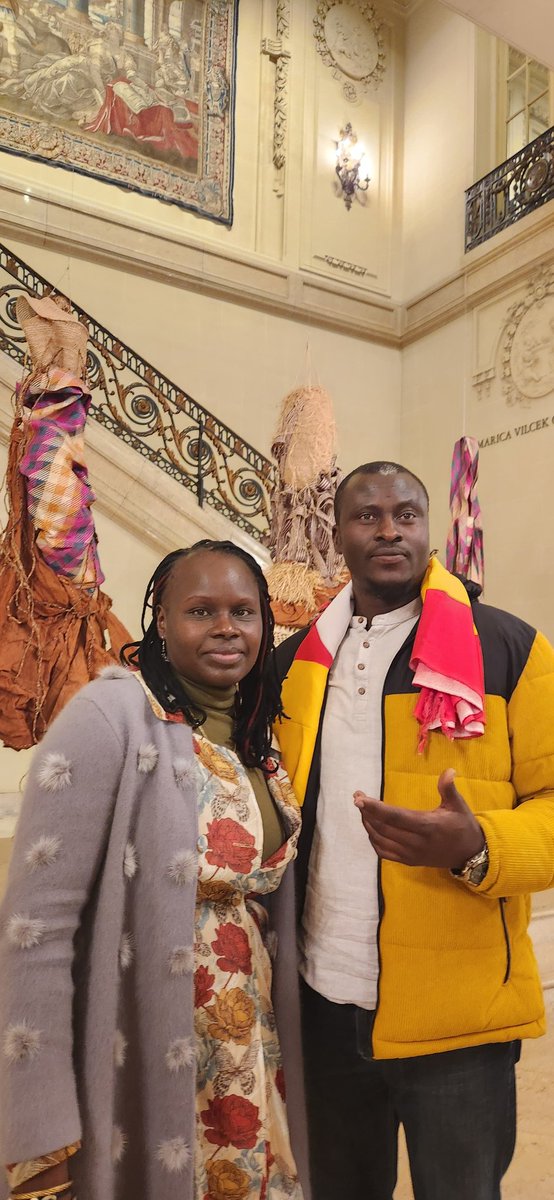
We slipped into the Marica Vilcek Great Hall - Beaux-Arts ceiling, serious faces, serious glasses, serious note-taking.
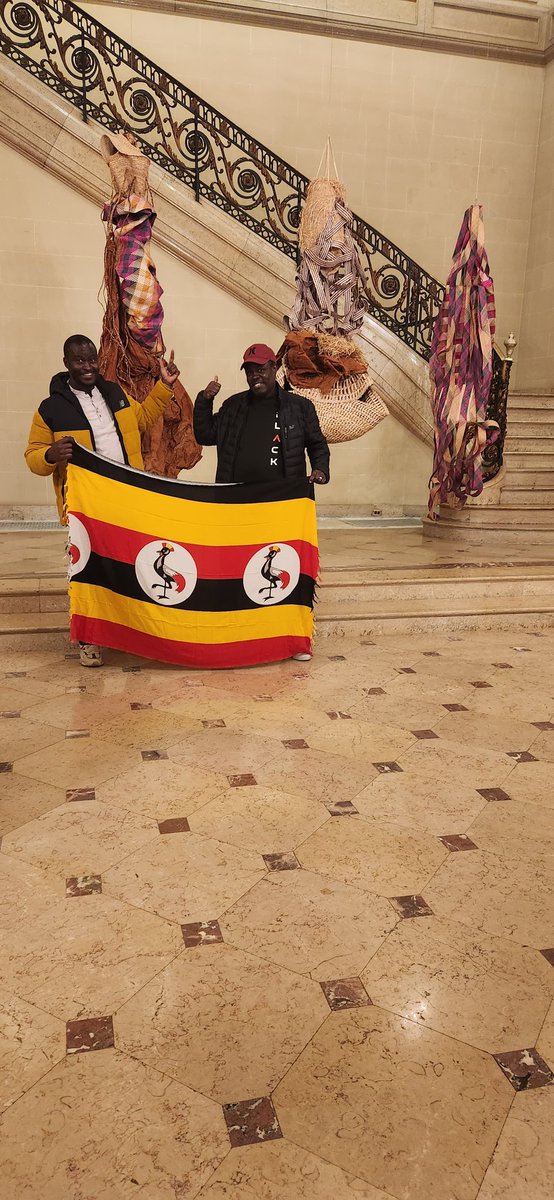
Kerunen glanced our way and simply said, mid-sentence, “My cousins are here.” The room smiled. That’s when I regretted not carrying a 'Bilu' traditional horn and fly whisk to properly scandalize #NYU. We made do: we draped her in the Ugandan flag, turned it into a backdrop, a portable pavilion. The cocktail food wasn’t Ugandan - no tooke, no binyebwa, no luwombo - but at least the flag and the fibre were. Next time, @utcaorg catering squad, you’re on notice.
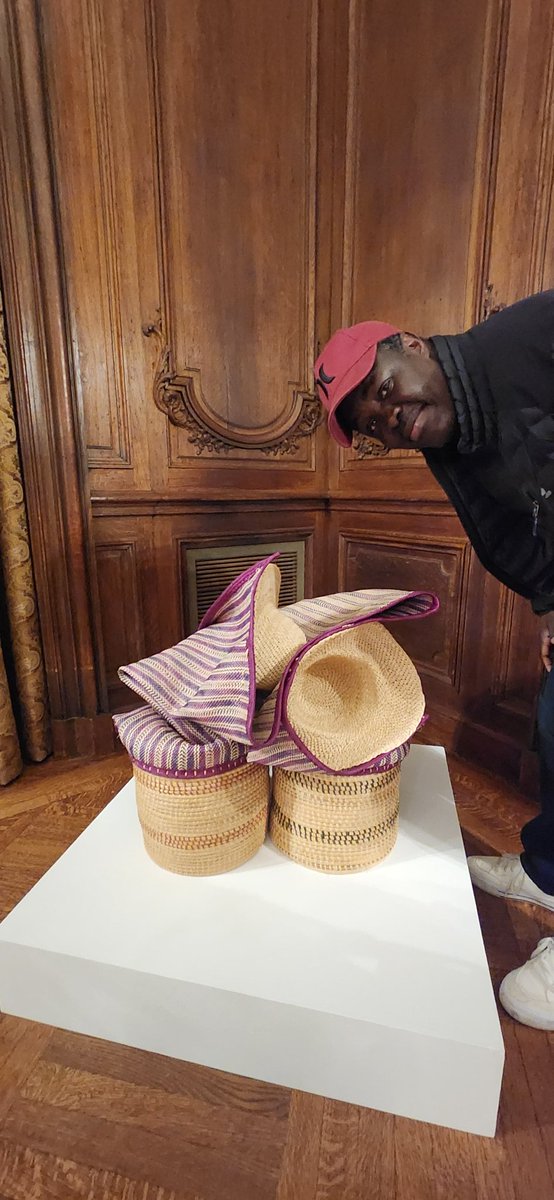
Kerunen’s works floated above us while she calmly rearranged the room’s mental furniture - poverty versus wealth, cycles of growth and harvest, art and ecology kissing in mid-air.
'Poluutingu' (The heavens have lifted her in Alur), spun from obuso (raffia), byayi (banana fibre), mutuba (barkcloth), and ensansa (palm leaves). Wetlands of Nalubaale translated into sculptural constellations. She spoke of Kyotera barkcloth makers, three generations of mat weavers, of what the West calls “waste” and what we call “home.”
Kerunen’s works have now threaded through Venice, Kampala, Oslo, Los Angeles, Vienna, Brussels, London, and now New York. A mat woven long at home, finally unrolled in the world’s living room.
'Poluutingu' is not just the title of her work; it’s the state of things. The heavens have lifted her -yes - but in that lift, every dormant easel-owner in the diaspora feels a small tug. A reminder that mats are woven one fibre at a time, one practice sketch at a time, one brave “yes, I will exhibit” at a time.
Somewhere in #NewJersey tonight, an old easel is shifting nervously.
@Njabala2 @afriartgallery
#UgandaRising @Princeton
#UgandanArts #ArtsAndCrafts
KOLOLO TO THE BRONX - THE UG FLAG SHALL BE RAISED!
At the stroke of midnight on October 9, 1962, Kololo Ceremonial Grounds fell silent. The floodlights dimmed, the Union Jack began its slow descent, and in that moment of darkness, hearts pounded across Uganda. Then -whoosh! - Major Kanuti Akorimo hoisted the new black, yellow, and red flag skyward. The lights came back on, and the crowd erupted. People shouted, cried, danced, and hugged strangers. Uganda had been born. It wasn’t just a flag going up; it was 70 years of colonial rule finally being folded away.
Fast-forward 63 years, and the rhythm of that night still echoes - in every drumbeat, every anthem, every 'Rolex' eaten. On October 9, 2025, Uganda celebrates its 63rd Independence Day at the very same Kololo Ceremonial Grounds where the nation first drew breath. There’ll be speeches, songs, military drills, and that familiar blend of pride that only #Ugandans can pull off.
But the spirit doesn’t stop in Uganda alone - it traverses the world. Thousands of miles away, in the 'Boogie Down Bronx' - the birthplace of breakdancing - Ugandans in the Tristate will be turning up their own moves. Back in the ’80s, Ugandans caught the breakdance fever that started right there in the Bronx. Now, decades later, they’re returning to the same borough - not with cardboard mats, but with flags, drums, and joy in full gear.
Whether they’re spinning to a kadoodi beat, singing the anthem off-key, or testing if their knees still remember the Backslide, one thing’s for sure - it��ll be a great night. The Beat shall Go On! In the Bronx.
@UgandaMissionNY @utcaorg @UgandaUN @newvisionwire @DailyMonitor @ChimpReports
Beyond the Music: A Masterclass in Experiential Marketing at #JonasCon2025
This afternoon, I stumbled upon a phenomenon at the @americandream Mall. What started as a casual visit quickly turned into a marketing epiphany. The @jonasbrothers -yes, those Jonas Brothers -were in town, celebrating 20 years of music and memories. But this wasn’t just a show. It was an EXPERIENCE. And not the kind we throw around casually in event decks back home. This was a full-scale, immersive takeover of one of America’s most iconic malls.
From Jonas-themed laser tag, milkshake bars, and trivia corners, to karaoke lounges and escape rooms -every inch of the mall whispered (or screamed) #JonasCon. There were giveaways, immersive art installations, and even a Jonas-themed observation wheel. This wasn’t an event. It was a world.
My marketing antennae stood at full attention. Now, as someone who’s danced in Lugogo, partied at @kampalaserena, and even helped organize the madness back then -this hit different. We know how to do a show in UG, Kenya etc. The music bangs, the lights flash, the crowd screams. But here’s the truth: the game has changed.
What I witnessed today wasn’t about a better sound system or bigger screen. It was about crafting an ecosystem of engagement. A layered experience where the music was just the anchor, not the full ship.
Now imagine Ugandan artist “Sheebah Experience” at Arena Mall or Kingdom Kampala. Not just a Sheebah concert - but SheebahCon. Sheebah-themed pop-ups, beauty stations, mini fashion runs, interactive TikTok challenges, “Queen Karma” escape rooms, "Weekend" dance-offs in food courts, perfume collabs, karaoke lounges belting out “Nakyuka”… A total mall-wide immersion.
#SheebahCon. Not just a Sheebaholic show. A Sheebah experience. A “Nakyuka” escape room; Makeup pop-ups with Sheebah’s glam team; A “Wankona” dance-off arena; Perfume collabs; Branded cocktails. A “Karma Throne” selfie booth.
@FenonRecords , @david_galukande@Swangz_Avenue , @talentafrica@MadfunXperience , @juliuskyazze@benonswangz , @MutuaAbel@AggreyKagonyera do you dig?
@Ksheebah1 playlist pumping through the mall speakers as you shop.
Kingdom Mall. Arena Mall. Village Market Mall (Nairobi), Acacia Mall, West Gate Shopping Mall (Nairobi). Pick your battleground.
It takes more than talent. It takes planning, creative strategy, partnerships, and -yes -money. 'Mob Ma-kaloos'! But what you get? Unrivaled engagement, brand love, and moments fans will post about for years.
To my fellow ad minds, event managers, music sponsors, and creatives in Uganda, and East Africa overall: Let’s stop doing events. Let’s start building experiences. The kind that transport fans, brands, and even the occasional mall wanderer into a new universe.
Because as I learned at #JonasCon2025, people may forget a good show -but they never forget how an experience made them feel.
And that, my friends, could make a Ugandan, East African or African Dream.
You Can Do It.
#MUSICFAIR #MemorableShows #experientialmarketing #Uganda #NewJersey #Kenya #GardenState @JenkinsMukasa
VALENTINES IS ON BUNKENKE!
Once upon a time, the #COVID pandemic threatened to kiss this beloved holiday goodbye - literally. Kissing was deemed hazardous, candlelit dinners became Zoom calls with bad Wi-Fi, and love was socially distanced to the brink of extinction. Cupid wore a face mask, and sanitizer -not the promised one from a Luzira factory, became the fragrance of passion.
Fast forward to 2025, and we’re back to hugging and kissing -thank heavens! But just when Ugandan lovers thought it was safe to splash cash on red roses, romantic dinners, and over-the-top Instagram proposals, enter the USAID freeze, the stage left.
Suddenly, the economy in light of a much needed adjustment, is gasping for breath like it just sprinted up Mutungo Hill.
It’s a grim reality for the Ugandan man, already sweating under the pressure of love’s unrelenting demands. Chocolate prices? Skyrocketing. Bouquet budgets? Slashed. Dinner dates? Replaced with a romantic stroll through "Toninyila-Mu-Kange" in search of bargains. A once-flourishing economy of love has been reduced to meme culture -where roses are now replaced with hibiscus flowers and even onions, because at least onions have layers.
Meanwhile, the recipients of this love holiday are forced to recalibrate their expectations. No more iPhones wrapped in heart-shaped boxes. Instead, they get heartfelt promises of “better days when the economy stabilizes.” Ezo Sente zimalaa (the one I gave you last week), my friend, and lovebirds must now rely on deep, meaningful connections -or at least well-crafted WhatsApp messages with GIFs of flying hearts.
Today, #ValentinesDay is no longer for the faint-hearted. It is not what Hon. Peter Ssematimba envisaged then when he promoted it and brought it to the mainstream in Uganda. Nga 'things' are tight.
It’s now for the financially savvy, the creatively resourceful, and those who can stretch a single 50K note into a weekend’s worth of romance. So pity the Ugandan man, who must now become a magician of love, turning air into affection and limited budgets into everlasting memories.
#SatireIsNotACrime #Uganda
@patrickoyulu My first job, moreover in advertising, took my abode to Ku Kaffene. With evenings were at the sprawling but seedy Ntinda 'CBD'. Yakobos or The Deep and the myriad dinghy bars, helped a young man understand Kampala's urban culture. And Ku Kaffene was the starting point
Maaso Awo Ku Kaffene: Ntinda’s Unofficial Landmark.
In the fast-evolving suburb of Ntinda, where every plot of land is fair game for a café, boutique, petrol station, or shiny billboard, one hero stands resilient -the Kaffene Tree.
Trimmed but never defeated, this humble jackfruit tree is more than foliage. It’s a living legend, a street sign, and, dare we say, a spiritual compass for Ntinda's commuters.
While Google Maps might have fancy algorithms, true Kampala navigators know there’s only one real reference point: Ku Kaffene awo! Say that phrase in any matatu, and the driver instinctively knows you’re not talking about some obscure street corner; you’re invoking the power of history. Ku Kaffene is a vibe, a ritual, a sacred call that ensures your journey ends exactly where it should.
Forget traffic lights and shiny road signs -our dear Kaffene Tree is the OG urban guide. It has seen generations come and go, watched #Ntinda evolve from a sleepy neighborhood into a bustling commercial hub. New businesses sprout faster than jackfruit, and modernity tries to elbow its way in, but the Kaffene Tree? It still stands, weathering storms, bulldozers, and over-ambitious trimmers.
Even after a recent haircut (okay, severe pruning), it remains Ntinda’s most reliable stop. Sure, the poor tree’s crown may be smaller, and it might not throw as much shade (literally), but in taxi parlance, Ku Kaffene awo is immortal. It’s not just a location; it’s a way of life.
This tree has seen things. Morning rushes, late-night trips, passionate roadside arguments, the hustle of a cobler who sat under it, Newspaper vendors, and secret rendezvous. It’s the silent witness to Kampala’s hustle, and it listens to everyone but says nothing -because trees don’t snitch.
In a city where landmarks rise and fall like the tide, the #Kaffene Tree stands firm, quietly reminding us that not all icons are made of steel and glass. Some are rooted in history, culture, and a little patch of dirt in Ntinda.
Long may it stand. Trimmed, but triumphant. Always there, waiting for the next 'maaso awo ku Kaffene' to echo through the air #Uganda #SatireIsNotACrime
Although this got me in a pensive moment, "...Let’s admit it: the drunk version of us often has the audacity to ask why not? when sober us is stuck on why?" ... the why not is so nostalgic!
Taking the last sip of 2024 and swirling with some wit in 2025!
The ancient Persian custom of debating crucial matters both sober and drunk is a gem of historical wisdom, showcasing their flair for ensuring that decisions were doubly proofed, much like their wine.
This practice might seem eccentric at first glance, but it’s an ancient predecessor to modern methods of critical thinking – only with more toasts and likely fewer spreadsheets.
In the Persian dual-debate system, the sober mind offered clarity, structure, and restraint – the perfect foil to the tipsy, unbridled, and creative musings of the intoxicated state.
Let’s admit it: the drunk version of us often has the audacity to ask why not? when sober us is stuck on why?
Persians understood this dynamic well. If an idea survived both the sharp-edged logic of sobriety and the whimsical chaos of drunkenness, it passed their version of a litmus test. After all, 'omwenge' tends to drown out the timid and amplify both brilliance and absurdity.
From a historical angle, Persians were also master strategists and organizers. This system wasn’t just about validating decisions; it was about stress-testing ideas across human moods.
It’s safe to say that some Ugandans have refined the art of mixing conviviality with problem-solving. After all, where else can you find a village elder settling disputes over malwa under a mango tree?
Visit places during the Holiday season or after Sunday mass, you will find folks dishing out 'wisdom' while at a seating.
In Uganda, drinking isn't just about imbibing; it’s a social institution, a hub for brainstorming, storytelling, and, of course, decision-making.
Much like ancient Persia’s sober-and-drunk debate practice, Ugandans are masters of merging the inspired creativity of a tipsy mind with the grounded wisdom of a morning hangover. Tonight as they view the #FireWorks from places like @SkyLoungeKLA they shall debate anything while rounds of the bitter are flowing.
Fast-forward to tomorrow January 1, 2025, with Heads ache, and fuzzy memories, their 'big ideas' shall remain.
Sober minds will convene again -albeit clutching mugs of steaming katogo or goat soup – to refine and reassess at places like @GardensNajjera . Others could even have parallel 'meetings' at @Kasuku256 's 'Luseke Nyam Nyam,' With Four Cousins wine, Lemon and Ginja, TML, and Rum as the main Agenda.
These 'meetings' supposedly generate ideas and thoughts.
The result? Only the ideas strong enough to survive both malwa, rum, and katogo make it into action.
Sounds familiar? The ancient Persians would’ve been proud.
Let’s not get started on politicians making promises after a heavy night out at the Stone Haven on Malcolm X. The hangover press conference or meeting is always more sobering than a manifesto launch.
Just like the Persians, Ugandans intuitively probably understand that ideas born of alcohol-fueled creativity need the sharp-edged realism of the morning after.
Even if half the plans fade with the hangover, the remaining ones? PURE GOLD!
Probably the genius in us often needs a bit of fermentation.
In a world often divided between rigid planners and reckless dreamers, historical Persians managed to embrace both extremes. Ugandans could put their theory to the test.
The Persian method was a reminder that the best ideas can withstand both scrutiny and spontaneity.
And, let’s face it, the practice sounds like it led to far fewer awkward office parties and far more memorable policy wins.
So here’s to the Persians, -drunk on wisdom and sober about its implementation. Truly, they proved that great civilizations don’t just think outside the box; they occasionally drink outside it too. Who knows, it could deliver results for Ugandans as we celebrate the new year.
Cheers to History, and while at it, take a moderate sip of the 'sparkly' things as we enter 2025.
Don’t forget the Molokony.
#HappyNewYear #ForLaughs #SatireIsNotACrime #Uganda
Taking the last sip of 2024 and swirling with some wit in 2025!
The ancient Persian custom of debating crucial matters both sober and drunk is a gem of historical wisdom, showcasing their flair for ensuring that decisions were doubly proofed, much like their wine.
This practice might seem eccentric at first glance, but it’s an ancient predecessor to modern methods of critical thinking – only with more toasts and likely fewer spreadsheets.
In the Persian dual-debate system, the sober mind offered clarity, structure, and restraint – the perfect foil to the tipsy, unbridled, and creative musings of the intoxicated state.
Let’s admit it: the drunk version of us often has the audacity to ask why not? when sober us is stuck on why?
Persians understood this dynamic well. If an idea survived both the sharp-edged logic of sobriety and the whimsical chaos of drunkenness, it passed their version of a litmus test. After all, 'omwenge' tends to drown out the timid and amplify both brilliance and absurdity.
From a historical angle, Persians were also master strategists and organizers. This system wasn’t just about validating decisions; it was about stress-testing ideas across human moods.
It’s safe to say that some Ugandans have refined the art of mixing conviviality with problem-solving. After all, where else can you find a village elder settling disputes over malwa under a mango tree?
Visit places during the Holiday season or after Sunday mass, you will find folks dishing out 'wisdom' while at a seating.
In Uganda, drinking isn't just about imbibing; it’s a social institution, a hub for brainstorming, storytelling, and, of course, decision-making.
Much like ancient Persia’s sober-and-drunk debate practice, Ugandans are masters of merging the inspired creativity of a tipsy mind with the grounded wisdom of a morning hangover. Tonight as they view the #FireWorks from places like @SkyLoungeKLA they shall debate anything while rounds of the bitter are flowing.
Fast-forward to tomorrow January 1, 2025, with Heads ache, and fuzzy memories, their 'big ideas' shall remain.
Sober minds will convene again -albeit clutching mugs of steaming katogo or goat soup – to refine and reassess at places like @GardensNajjera . Others could even have parallel 'meetings' at @Kasuku256 's 'Luseke Nyam Nyam,' With Four Cousins wine, Lemon and Ginja, TML, and Rum as the main Agenda.
These 'meetings' supposedly generate ideas and thoughts.
The result? Only the ideas strong enough to survive both malwa, rum, and katogo make it into action.
Sounds familiar? The ancient Persians would’ve been proud.
Let’s not get started on politicians making promises after a heavy night out at the Stone Haven on Malcolm X. The hangover press conference or meeting is always more sobering than a manifesto launch.
Just like the Persians, Ugandans intuitively probably understand that ideas born of alcohol-fueled creativity need the sharp-edged realism of the morning after.
Even if half the plans fade with the hangover, the remaining ones? PURE GOLD!
Probably the genius in us often needs a bit of fermentation.
In a world often divided between rigid planners and reckless dreamers, historical Persians managed to embrace both extremes. Ugandans could put their theory to the test.
The Persian method was a reminder that the best ideas can withstand both scrutiny and spontaneity.
And, let’s face it, the practice sounds like it led to far fewer awkward office parties and far more memorable policy wins.
So here’s to the Persians, -drunk on wisdom and sober about its implementation. Truly, they proved that great civilizations don’t just think outside the box; they occasionally drink outside it too. Who knows, it could deliver results for Ugandans as we celebrate the new year.
Cheers to History, and while at it, take a moderate sip of the 'sparkly' things as we enter 2025.
Don’t forget the Molokony.
#HappyNewYear #ForLaughs #SatireIsNotACrime #Uganda