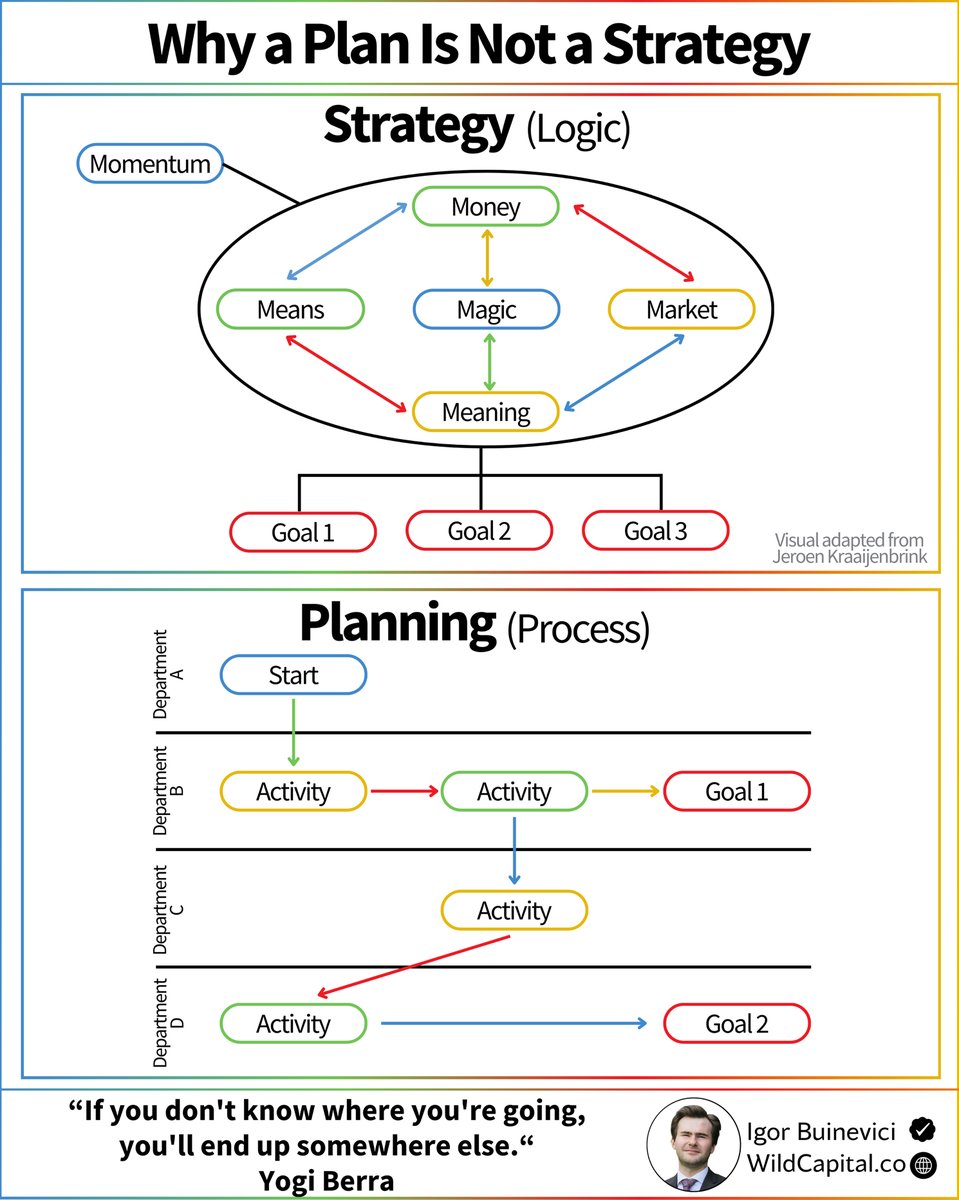
Plan and strategy are two distinct terms:
Planning is a process, while strategy is logic.
Many people confuse these terms:
But let me explain the difference.
The confusion arises from the use of the term "strategy".
Sometimes, we use "strategy" to refer to special topics like "strategic finance" or "strategic marketing."
Other times, we mention our plans to achieve goals, "My strategy to improve my grades is to study 10% more every day."
However, in the context of business or organizations, strategy has a specific meaning.
If every plan or process were labeled as a strategy, things would become very confusing.
Here's the key difference:
➟ Strategy is the underlying logic behind how an organization creates and captures value.
➟ Planning is the method used to execute strategy.
Put simply:
➟ Strategy sets the goals, while planning helps to achieve them.
A strategy outlines the reasons behind an organization's actions.
In Jeroen's book, "The One-Hour Strategy," strategy is broken down into several components:
a) Identifying customers and competitors (Market)
b) Deciding on products or services (Magic)
c) Utilizing assets and skills (Means)
d) Making money (Money)
e) Leveraging the environment (Momentum)
f) Defining the purpose behind these actions (Meaning).
This describes an organization's strategy, whether it's currently implemented or planned for the future.
None of this is about a specific plan.
A plan outlines the steps, resources, and time required to achieve specific goals.
Although a plan may align with a strategy, it's not the same thing.
Goals are derived from the strategic logic and guide the planning process.
This distinction matters because many organizations claim to have a strategy without truly understanding the overarching idea behind creating value.
They might have plans and goals but lack a proper strategy.
So, the important question is:
Does your organization have a strategy, or is it simply operating based on plans?
Adapted from Jeroen Kraaijenbrink
📌 To get a high-res PDF:
1) Follow me @Igor_Buinevici
2) Subscribe to my newsletter at https://t.co/jTnaNRbsRL
You will get this PDF (+15 others) directly in your welcome email.
The global economic landscape is shifting—and these countries are leading the charge. According to IMF projections, here are the GDP growth frontrunners for 2025.
https://t.co/uIRpYjqOVu
The global economic landscape is shifting—and these countries are leading the charge. According to IMF projections, here are the GDP growth frontrunners for 2025:
https://t.co/uIRpYjqOVu
On AI agents, I have an unpopular opinion:
While crypto is the currency for AI, not every agent needs its own token.
Agents can take fees in an existing crypto for providing a service.
Launch a coin only if you have scale. Focus on utility, not tokens.🙏
🇺🇸 BIG WINNERS OF U.S. CRYPTO POLICY: $XRP, $ADA, and $SOL are thriving, with $AVAX awaiting recognition and $SUI, $FIL, $APT, $NEAR, and $MOVE gaining momentum after White House invitations.
Meanwhile, $LINK, $LTC, $DOT, and $HBAR are stronger candidates for the strategic reserve than memecoins.
Dips are a part of free markets. 🤷♂️
Not financial advice.
If you are stressed about it, you probably should reduce your investment size. (That is, if you view crypto as an investment.)
For me, it's a worldview shift. I exited the old world 11 years ago.