6 FREE Cloud Projects that can literally change your DevOps game
Stop scrolling. Save this.
Everyone talks about “learning DevOps”
Very few actually build something real.
If you’re serious about AWS, Azure, or GCP…
these projects are your shortcut from theory → real skills → job-ready.
🟥 Amazon Web Services (AWS) Projects
- Deploy a containerized web app on ECS with CI/CD (Beginner)
- Go from code → Docker → pipeline → production
- Watch tutorial: https://t.co/hNjr24Y6xp
- Build an EKS cluster with Terraform (Intermediate)
- Kubernetes + Infrastructure as Code = 🔥
📘 Lab guide: https://t.co/wngpKpSkdJ
🟥 Azure Projects
- End-to-end infra with Terraform & Azure DevOps (Intermediate)
- This is what real enterprise setups look like
📘 Lab guide: https://t.co/mpafjsHU8r
- Real-time DevOps with Azure DevOps & GitOps (Beginner → Advanced)
- Understand GitOps the way companies actually use it
📘 Lab guide: https://t.co/JVRoslUqOV
💾 Repo: https://t.co/lZRlhMR6ry
🟥 Google Cloud Projects
- CI/CD with Cloud Build & Cloud Deploy for GKE (Beginner)
- Build → Test → Release like a pro
📘 Lab guide: https://t.co/uQe7n2EF0x
- GitHub Actions + Terraform CI/CD on GCP (Intermediate)
- Full automation. Zero excuses.
📘 Lab guide: https://t.co/PQSNrjkRc8
💡 Real Talk:
If your resume only has courses… you’re already behind.
Projects like these are what get you shortlisted.
👉 Build
👉 Document on GitHub
👉 Post your learnings
Consistency > Talent
Feel free to share this post with your network or tag someone who might be interested!
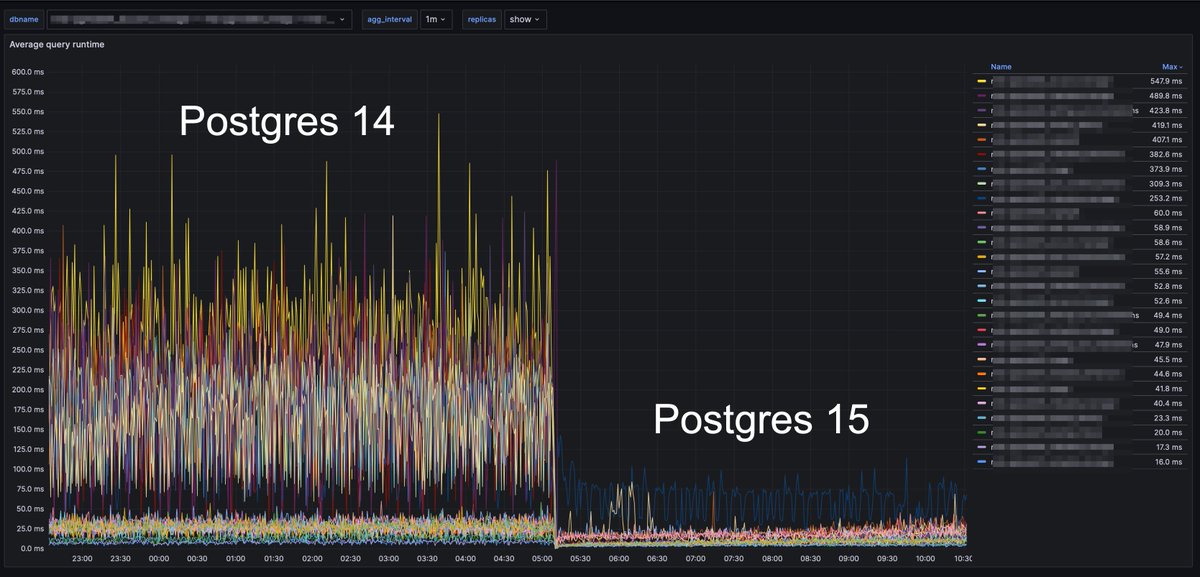
Don't neglect to upgrade your Postgres!
Regular updates can significantly improve the performance and security of your database.
Plus, with postgresql_cluster, this process is fully automated
https://t.co/sZAloK63oo
UI/UX Designer, If you want a guide on how to create better gradients in UI design. In this post, I'll show you how to create one for your next design project.
Credit: @adriankuleszo
Retweet & Save For Later ❤️
Cloudflare serves around 20% of the web with 46 million requests a second.
Surely they must have a lot of data.
Where do they store it?
Plain old PostgreSQL. 🐘
Around 15-20 clusters of them.
Each cluster consists of 3 servers split into two regions.
The primary region is where the writes go, and the secondary is the region which replicates this data asynchronously and serves reads.
Within those servers exist many databases owned by different people - they essentially offer multi tenancy.
And as you know, multi-tenancy comes with a lot of challenges:
• How do you decide which physical cluster a new tenant goes into?
As they say in CloudFlare - it’s more of an art than a science! 🎨👨🎨
Think twice. Deploy once. 👌
But it depends on a lot of questions that get asked, like:
• Is your data the source of truth, or can it be repopulated from elsewhere?
• How sensitive is the data? (PII, etc)
• What’s the expected traffic pattern - read heavy or write heavy?
• How long do you need to store the data for?
• How are your apps opening connections? (connection hungry apps can take a lot out of postgresql)
• What is the growth projected to be?
🐙 Well-Connected DB
Each connection in PostgreSQL is a new OS process.
This makes connections expensive!
As such, Cloudflare has to gatekeep the number of connections - and it does so, via PgBouncer. 🛡
🐬 PgBouncer pools a maximum server-side connections which it then allocates across tenants.
From there, it forwards queries to HAProxy, which load balances across Postgres’ primary and read replicas.
🦏 Thundering Herd
When apps get redeployed, they re-initialize all their state and connect to the database at once. This can be costly, as they compete with other tenants for the same shared underlying physical resources.
CloudFlare implemented a way to handle this in their own fork of PgBouncer - it supports granular load shedding by either throttling or outright killing existing user connections.
🆙 High Availability
The latency of an offline database is infinite.
To keep high availability, CloudFlare uses the Stolon cluster manager to replicate data across Postgres instances and elect leaders/failover under high load scenarios.
🌞 No Clouds
CloudFlare does NOT run on the cloud. They deploy on bare metal instances in their own data centres without any virtualisation whatsoever.
As such, they hit some unique challenges here too:
🔥 natural disasters / cooling issues
e.g if your data centre in Portland overheats due to hot weather, your performance slows down.
You can say your “db is running hot”, but bad puns aside - your data infrastructure should be resilient to that.
⚡️ network partitions
It’s a lot of work to get to the bottom of diagnosing a network partition. You have to test connectivity between a lot of components.
Instead of being reactive, CloudFlare is proactive and runs chaos tests to test their distributed system’s behaviour in the presence of such partitions.
El otro día me preguntaron que roadmap recomendaría alguien que esta empezando o a alguien que quiere saber más allá de frameworks.
Comparto por aquí lo que recomendé por si le sirve a alguien más
[ H I L O ] ⇩
@CelsiusUcc there's really no question here about whether if we legally own our coins when held at Celsius, Alex Mashinsky makes it perfectly clear that we do otherwise it's 100% false advertising.
#Celsius#celsiusnetwork
How to scale a website to support millions of users? We will explain this step-by-step.
The diagram below illustrates the evolution of a simplified eCommerce website. It goes from a monolithic design on one single server, to a service-oriented/microservice architecture.
Laravel Tip:
❌ Don't create an Object using new keyword
✅ Use Service Container to define how an instance of class can be created.
Below is an example. If you prefer fancy phrase, this is Dependency Injection.