When the ANC assumed power in 1994, they inherited the most sophisticated economic engine on the African continent.
They were handed a deep-water port network, a highly complex rail system that efficiently moved freight from the interior to the coast, an integrated national power grid that generated some of the cheapest electricity in the world, and a professional, rule-bound civil service.
That system possessed underlying engineering and administrative principles that were globally competitive.
The historical task of the new government was simple: maintain the existing engineering standards, scale the capacity to include the black majority, and expand the productive tax base.
Instead, the ANC executed a 30 year masterclass in structural vandalism.
They introduced cadre deployment, incompetence, corruption, and political impunity, systematically replacing competent engineers, financial auditors, and institutional administrators with politically loyal party hacks.
The results are not ideological; they are physical.
It takes centuries of capital accumulation, spatial planning, and disciplined maintenance to build an interconnected civilization, but it takes only a few decades of deliberate neglect to destroy it.
You can see the rot in real-time.
The ultimate tragedy is that the liberation movement successfully decoupled its survival from the material reality of the country.
The ANC did not "decolonize" South Africa; they simply consumed its foundational capital.
They proved that an elite equipped with nothing but liberation slogans and an insatiable appetite for state contracts can liquidate 300 years of built infrastructure in just three decades, leaving the next generation to inherit a broken, unmanageable corpse.
If AI isn’t a bubble, you’ll lose your job. If AI is a bubble, you’ll lose your savings. Most likely, AI is currently in a financial bubble but technologically still on an exponential improvement curve, so you’ll first lose your savings and then lose your job. Good luck.
El régimen de Marruecos es un régimen muy profesionalizado. Hay varios parecidos en el mundo: Egipto y Turquía. Son los llamados «estados profundos», gente muy profesionalizada en la política y dictaduras no muy duras. (1/5)
🚨Elon Musk: “Puede que todavía no sepas qué te apasiona… porque nunca exploraste el mapa completo”
Cuando le preguntan por el sentido de la vida, Elon no habla de meditación ni de “encontrar tu propósito”. Va directo:
“Lee. Lee muchísimo. Construye un terreno accidentado del paisaje del conocimiento. Aprende un poco de muchas cosas.”
La razón más subestimada:
Solo puedes desear lo que has visto.
Si tu menú de opciones se limita a lo que te dieron tus padres, la escuela o el primer trabajo… estás eligiendo a ciegas.
Los libros rompen ese límite.
Son el motor de búsqueda de tu propia vida.
Habla con gente de mundos distintos.
Explora campos que nunca imaginaste.
Luego busca la intersección perfecta:
ser intrínsecamente bueno en algo
que te guste hacerlo de verdad.
Porque el talento solo es una trampa:
puedes ser excelente, ganar dinero… y odiarlo en silencio durante años.
Lee. Amplía el mapa.
El mayor riesgo no es equivocarte de camino…
es nunca haber visto los otros.
1/10 ¿Y si las entidades autónomas del DMT fuesen realmente conscientes?
Esta es una de las propuestas más locas con las que me he topado en mucho tiempo. Tan absurdo como serio, y tan improbable como interesante.
(preprint) DOI 10.31234/osf.io/8qvgy_v2
Millennials, it's time to choose your midife crisis
1. Date a 23 year old
2. Quit drinking and become insufferable about it
3. Double down on drinking
4. Train for a marathon nobody asked about
5. Have a panic baby (with wife you hate)
6. "We're opening the relationship" (she bangs)
7. Get divorced
8. Get diagnosed with adult ADHD/autism
9. Niche side quests like rock climbing, hyrox, gardening, handstands
La crisis no es solo de los MBA.
Es de un sistema educativo entero diseñado para un mundo donde el valor estaba en acceder a la información, memorizarla y reproducirla de forma ordenada.
Ese mundo ya no existe.
Hoy cualquiera puede acceder a conocimiento técnico de altísimo nivel desde su casa y apoyarse en IA para aprender muchísimo más rápido que antes.
Pero ahí aparece una confusión importante:
informarse no es lo mismo que formarse.
Porque formar a alguien no es solo transmitir contenido.
También es desarrollar:
criterio,
tolerancia a la incertidumbre,
capacidad de integrar contradicciones,
trabajo con otros,
agencia,
profundidad,
y una identidad profesional propia.
Y eso no se resuelve simplemente viendo vídeos, leyendo hilos o preguntándole cosas a Claude.
La paradoja es que cuanto más barata y accesible se vuelve la información, más valiosas serán precisamente las capacidades que menos se pueden automatizar.
Game theory explains why most ambitious people stay stuck at the level they currently operate at. Although their effort feels intense and their output is very real and impressive, their position never changes.
Most go on to blame "bad circumstances" for this. The truth is far worse: they are competing in an already saturated game. And effort in saturated games produces marginal returns, regardless of genuine intensity and razor-sharp focus.
The correct response is not to work harder. It's to identify a game with fewer players and a more exponential payoff curve. Yet, most people refuse to do this because this "new game" has no proof of viability yet, so they remain stuck working with their marginal gains.
They end up spending years exhausted, sometimes in a worse position than before.
Just because saturation is invisible doesn't make it any less lethal.
The fear of the unknown silently collapses your positioning and facilitates inertia.
Arabic has 14 words for love. Each one describes a different stage. And here's what got me. Each one comes from a root that has nothing to do with love. Until you see the connection. And then you can't unsee it.
All 14. Let me walk you through them.
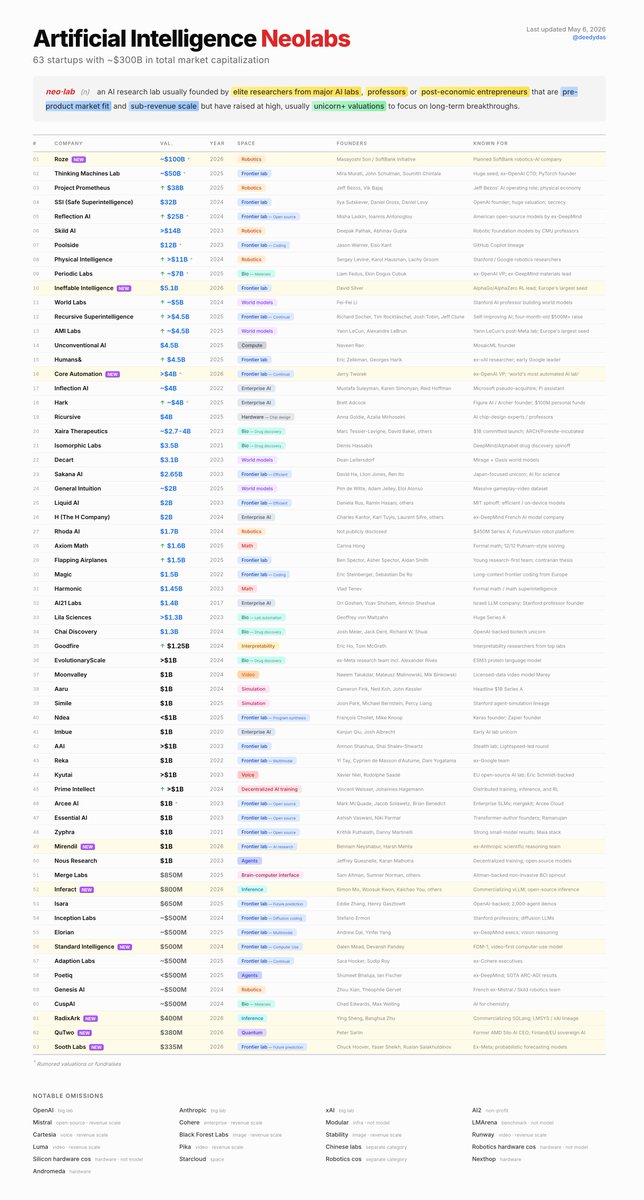
The Ultimate List of Artificial Intelligence "Neolabs": May 2026.
A Neolab is a pre-revenue scale startup working on long-term AI breakthroughs, usually with a $1B+ valuation.
There are now 63 of them!
The older I get the more I realize luck is mostly exposure. The men who seem to get lucky are not blessed. They are just out in the world more. Different rooms. Different people. Different conversations. If your routine has been the same for five years, your luck will be the same for five years. Move around. Talk to strangers. Show up where you do not normally go. The rest of your life is sitting in a room you have not walked into yet.
Game theory explains why working harder inside a broken system is the worst response to that system. Because a system is never truly broken. It's just producing exactly the outcomes its own incentive structures were designed to produce, whether intentional or not. Working harder inside this system increases your output in the payoff matrix, but it simply won't change the actual structure of the system's matrix. Thus, the correct response is not more effort. Instead, you must aim to identify whose interests the current structure serves and position yourself in favor of those interests rather than against them. Change the game, or play the game that is actually being played. Either way, you must stop optimizing for the game you wish it to be and start acting realistically.
MIT proved every major AI model is secretly converging on the same "brain."
It’s called the “platonic representation hypothesis,” and it’s one of the most mind-blowing papers you’ll ever read.
You train a vision model purely on images. You train a language model purely on text.
They use completely different architectures. They process completely different data. They should have completely different "brains."
But as these models scale up, something impossible is happening.
When researchers measure how they organize information, the mathematical geometry is identical.
A model that only "sees" images and a model that only "reads" text are measuring the distance between concepts in the exact same way.
The models are converging.
The researchers named this after Plato’s Allegory of the Cave.
Plato believed that everything we experience is just a shadow of a deeper, hidden, perfect reality.
The paper argues that AI models are doing the exact same thing.
They are looking at the different "shadows" of human data, text, images, audio. And they are independently discovering the exact same underlying structure of the universe to make sense of it.
It doesn't matter what company built the AI.
It doesn't matter what data it was trained on.
As models get larger, they stop memorizing their specific tasks. They are forced to build a statistical model of reality itself.
And there is only one reality to map.
2024, Arxiv