Between 1948-1950, Keith Vaughan made a series of images depicting steelworkers in a foundry. In this work from 1949, three furnacemen are taking a tea break. The image is related to a sketchbook he made entitled 'Steel,' which is now housed in the Tate Britain archive.
'The Landing in Summer.' Mary Dawson Elwell emerged on the British art scene as a painter of interiors, or more accurately, 'portrait interiors,' of her Yorkshire home in the 1930s. Her watchwords are stillness, silence, containment, privacy, meditation, illumination.
'Sleeping Girl.' (1927) Just like Laura Knight, Dod Procter became well known in Britain in the mid-1920s after painting a series of portraits of young women using the fall of light across the figures to give a sense of volume; a style which shows her admiration for Giotto.
'Farm on a Hillside,' (1914) shows the characteristic hallmarks of John Nash's pattern-making. Before WW1 John and Paul were spoken of as ‘the Nash brothers’ because their work was so close in spirit; John’s paintings frequently received better reviews than those of Paul.
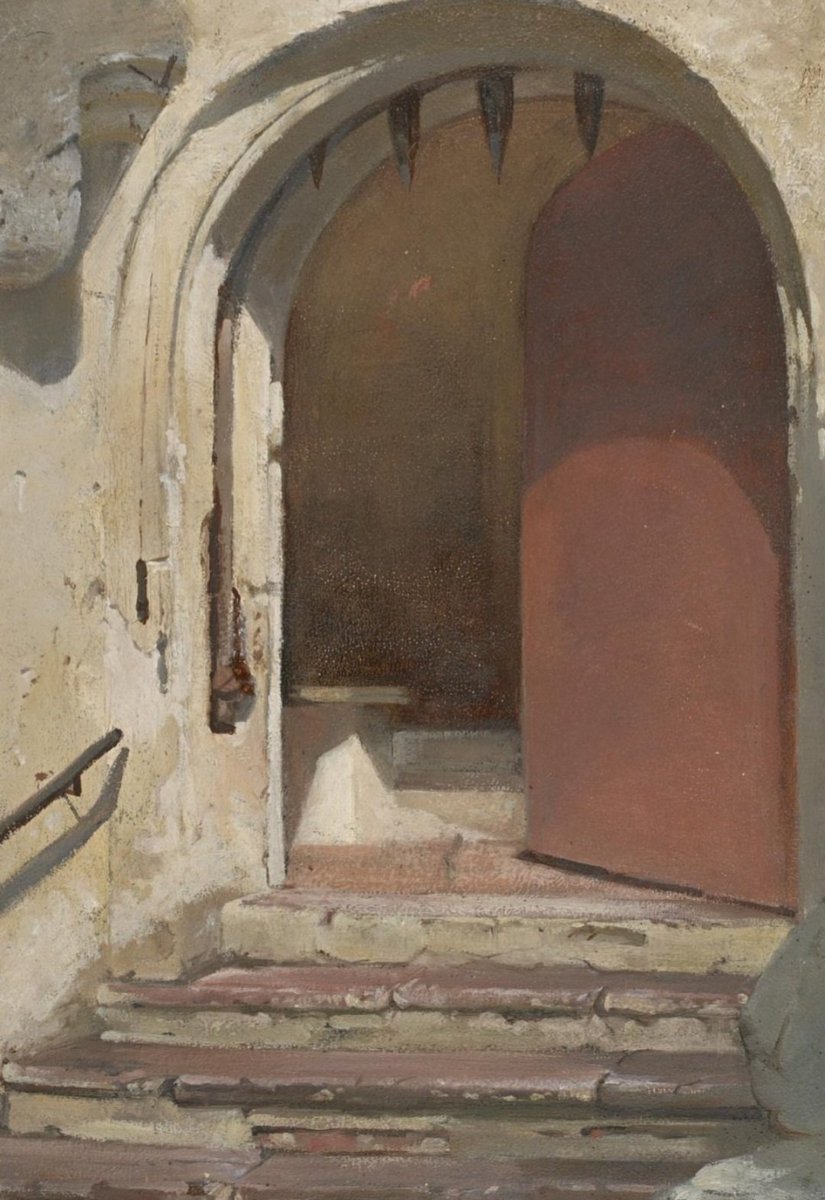
It might not be a great piece of art but it has something about it. This particular door was painted by George Folingsbury at Schloss Hohenaschau a 12thC medieval ring castle in Aschau in Bavaria, Germany, in the 1870s.
I thought I'd run a seascape theme this week so here's the first one in the series. This is "Hayle" by Walter Steggles from 1949. I have previously shown it as "Near Carbis Bay" but the discovery of the tracing for the piece has allowed me to place the correct title to it.
Wall Maps, Eric Ravilious, 1941. Made during his time as a War Artist in the early years of #WW2 it depicts the Home Security Control Room located deep below Whitehall in #London. The original artwork is in the collection of @I_W_M.
One summer morning in 1909, Spencer Gore painted this work from an upstairs window at 31 Mornington Crescent in London. The art critic Frank Rutter said of Gore's work: 'the hallmark of the true artist is he finds beauty ever waiting for him at his own door.'