We are proud to announce @periodiclabs. Our mission is to accelerate science.
Our founding team co-created ChatGPT, DeepMind’s GNoME, OpenAI’s Operator (now Agent), the neural attention mechanism, MatterGen; have scaled autonomous physics labs; and have contributed to important materials discoveries of the last decade.
We’re fortunate to be backed by investors who share our vision, including @a16z who led our $300M round, as well as @felicis, DSTGlobal, NVentures (NVIDIA’s venture capital arm), @Accel and individuals including @eladgil, @ericschmidt, @JeffDean, and @JeffBezos.
We’ve come together to scale up and reimagine how science is done. If you want to help build the first generation of AI scientists, we’re hiring.
Today, @ekindogus and I are excited to introduce @periodiclabs.
Our goal is to create an AI scientist.
Science works by conjecturing how the world might be, running experiments, and learning from the results.
Intelligence is necessary, but not sufficient. New knowledge is created when ideas are found to be consistent with reality. And so, at Periodic, we are building AI scientists and the autonomous laboratories for them to operate.
Until now, scientific AI advances have come from models trained on the internet. But despite its vastness — it’s still finite (estimates are ~10T text tokens where one English word may be 1-2 tokens). And in recent years the best frontier AI models have fully exhausted it.
Researchers seek better use of this data, but as any scientist knows: though re-reading a textbook may give new insights, they eventually need to try their idea to see if it holds.
Autonomous labs are central to our strategy. They provide huge amounts of high-quality data (each experiment can produce GBs of data!) that exists nowhere else. They generate valuable negative results which are seldom published. But most importantly, they give our AI scientists the tools to act.
We’re starting in the physical sciences.
Technological progress is limited by our ability to design the physical world.
We’re starting here because experiments have high signal-to-noise and are (relatively) fast, physical simulations effectively model many systems, but more broadly, physics is a verifiable environment. AI has progressed fastest in domains with data and verifiable results - for example, in math and code. Here, nature is the RL environment.
One of our goals is to discover superconductors that work at higher temperatures than today's materials. Significant advances could help us create next-generation transportation and build power grids with minimal losses. But this is just one example — if we can automate materials design, we have the potential to accelerate Moore’s Law, space travel, and nuclear fusion.
We’re also working to deploy our solutions with industry. As an example, we're helping a semiconductor manufacturer that is facing issues with heat dissipation on their chips. We’re training custom agents for their engineers and researchers to make sense of their experimental data in order to iterate faster.
Our founding team co-created ChatGPT, DeepMind’s GNoME, OpenAI’s Operator (now Agent), the neural attention mechanism, MatterGen; have scaled autonomous physics labs; and have contributed to some of the most important materials discoveries of the last decade. We’ve come together to scale up and reimagine how science is done.
We’re fortunate to be backed by investors who share our vision, including @a16z who led our $300M round, as well as @Felicis, DST Global, NVentures (NVIDIA’s venture capital arm), @Accel and individuals including @JeffBezos , @eladgil , @ericschmidt, and @JeffDean. Their support will help us grow our team, scale our labs, and develop the first generation of AI scientists.
Our co-founders @LiamFedus and @ekindogus sat down with @mariogabriele to discuss @periodiclabs, the limits of pure digital AI, and creating autonomous labs where nature is the RL environment.
"A system that can literally engineer matter is going to be of key importance to everybody."
@LiamFedus and @ekindogus are the co-founders of @periodiclabs, a San Francisco-based startup building AI systems and autonomous laboratories to discover new materials, starting with a higher-temperature superconductor. Fedus previously helped build ChatGPT and ran post-training at OpenAI; Cubuk led materials and chemistry research at Google DeepMind.
(3:14) What it takes to build a synthetic superintelligence
(16:44) Dogus and Liam's path to AI
(23:28) Lessons from launching ChatGPT
(35:10) What AI learns across experiments
(49:23) The difference in LLM performance on math vs. science
(54:09) The competitive landscape
(55:39) Final meditations
Visited the lab - was struck both by how wide the search space is for materials synthesis experiments, and also how amenable it is to depth first search, where the design and informativeness of your next experiment improves as you pile up more data from previous runs.
We’ve spent the past year building high-throughput labs and infrastructure for large-scale physics experiments in our search for better superconductors and magnets.
We ran our first experiments by hand. Now, experiments run continuously in the labs. We’re building AI to make sense of what they produce and to determine which experiments to run next.
We built high-throughput materials labs in Menlo Park to create a loop between experiments and models. The labs generate fresh data, the models learn from it, and then help us decide what to try next.
Using only 1,300 H200s, plus months of our experimental data, we mid-trained and RL’d an open-source model to surpass GPT-6 Astra on our analysis benchmark. We call it Neon.
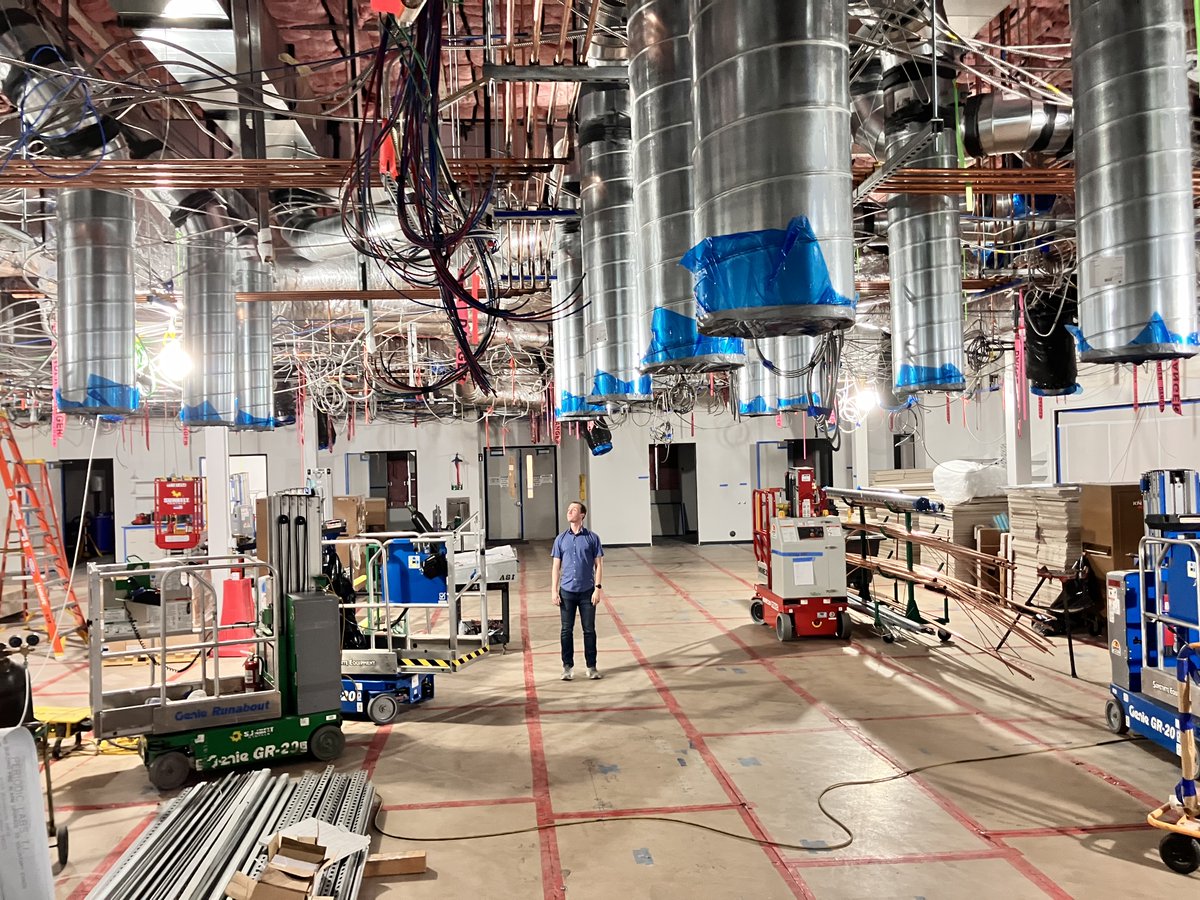
This is real footage from our lab. We’re focusing first on hard problems in materials science, including superconductors, magnets, and semiconductor materials.
Read our blog posts below.
Our co-CEO @ekindogus will be speaking at @RaiseSummit tomorrow. Join us at the Master Stage at 3:00 PM to hear more about the work we’re doing at Periodic.
application of deep learning to machine translation led us to attention and transformers
can't wait to see what application of deep learning to science at @periodiclabs will lead us to!
I gave a talk at ICLR 2026 about how we are scaling RL on frontier LLMs with 1T+ parameters, on experimental data from our physical lab at Periodic!
Here's a rough recording of the talk:
The internet has been exhausted as a data source for AI.
Our co-founder @LiamFedus joined @eladgil on @NoPriorsPod to discuss what comes next, and how we are building AI scientists and the autonomous laboratories for them to operate.
We're in Washington at the Genesis Mission event today. 🇺🇸
At Periodic Labs, we see a new era of science emerging where AI systems learn and direct physical scientific experiments. We're excited to partner with @ENERGY on this important endeavor.
By uniting the DOE’s deep scientific resources with private industry’s frontier AI, we will accelerate breakthroughs in materials and energy. Close public-private collaboration is essential to secure America’s strategic leadership.
if you’re interested in autonomous science at frontier scale, come find the @periodiclabs team at neurips!
look for:
@vwxyzjn to discuss training big MoEs
@xiangfu_ml for atomic GNNs
@mzhangio for AI scientists
@VincentMoens for RL systems
me for midtraining sample efficiency
We are looking for a condensed matter theorist to join our team at @periodiclabs. Consider applying if you are an expert on applying formal condensed matter theory to real quantum materials.
condensed matter physics provides theoretical tools to understand how quantum mechanical effects manifest in real materials you can hold
we're hiring theorists eager to work with an autonomous lab and petaflops of compute at @periodiclabs